
How One Person Can Start a TikTok Shop and Make $100K/Month

TikTok Shop generated over $20 billion in global GMV in 2025. Unlike Amazon or Shopify, the platform rewards content over ad spend. Viral videos drive sales. Algorithms favor engagement over budget. This creates an unusual opportunity: solo entrepreneurs can compete with established brands.
Running a one-person TikTok Shop is not just possible—it is increasingly common. The platform's infrastructure handles fulfillment logistics, creator partnerships, and payment processing. What remains is product selection, content creation, and customer management. All manageable by a single operator with the right systems.
This guide covers the complete playbook for launching and scaling a TikTok Shop as a solo seller.
Why TikTok Shop Works for Solo Sellers
Low Barrier to Entry
TikTok Shop has different requirements depending on how you want to sell:
| Selling Method | Follower Requirement |
|---|---|
| Seller (sell your own products) | No followers required |
| Affiliate/Creator (promote others' products) | 5,000 followers minimum |
Unlike Instagram Shopping or YouTube Shopping, you do not need an established audience to sell your own products. The platform actively promotes new sellers through discovery algorithms and promotional campaigns.
What You Need
- Valid US ID (18+)
- Business registration (LLC recommended, not required for individuals)
- US bank account or payment processor (Payoneer, Hyperwallet)
- Phone and computer
Platform Traffic Support
TikTok pushes content to users based on engagement, not follower count. A video from a new account can reach millions if it resonates. This organic reach is worth thousands in ad spend on other platforms.
Platform Incentives for New Sellers
- Reduced commission rates during onboarding period
- Free shipping subsidies for promotional events
- Priority placement in "For You" recommendations
- Access to affiliate creator network
Fulfillment Options
TikTok Shop offers multiple fulfillment models:
| Model | Best For | Solo Seller Fit |
|---|---|---|
| Fulfilled by TikTok (FBT) | High volume, hands-off | ⭐⭐⭐ Excellent |
| Self-Fulfillment | Custom products, control | ⭐⭐ Good |
| Dropshipping | Testing, low capital | ⭐⭐⭐ Excellent |
For solo operators, FBT or dropshipping eliminates warehouse management entirely.
What You Need to Get Started
Legal Requirements (US)
| Requirement | Individual Seller | Business Seller |
|---|---|---|
| ID Verification | Driver's license or passport | Same |
| Tax ID | SSN | EIN |
| Business License | Not required | State registration |
| Bank Account | Personal checking | Business checking |
Recommendation: Register an LLC ($50-500 depending on state). This separates personal and business liability, looks more professional to suppliers, and simplifies taxes.
Tools and Software
Essential (Free/Low-Cost)
- CapCut (video editing, free)
- Canva (graphics, free tier)
- Google Sheets (inventory tracking)
- TikTok Seller Center (built-in analytics)
Growth Stage
- Inventory management: Sellbrite, Linnworks
- Analytics: FastMoss, Kalodata
- Automation: Zapier, Make
Initial Capital
| Expense | Budget Range | Notes |
|---|---|---|
| Product samples | $100-500 | Test before committing |
| Initial inventory | $500-2,000 | Start small, scale winners |
| Content equipment | $0-300 | Phone camera is fine initially |
| Software | $0-100/month | Start with free tools |
| LLC registration | $50-500 | One-time cost |
Total minimum: $500-1,000 to start testing products.
Step-by-Step: Setting Up Your Store
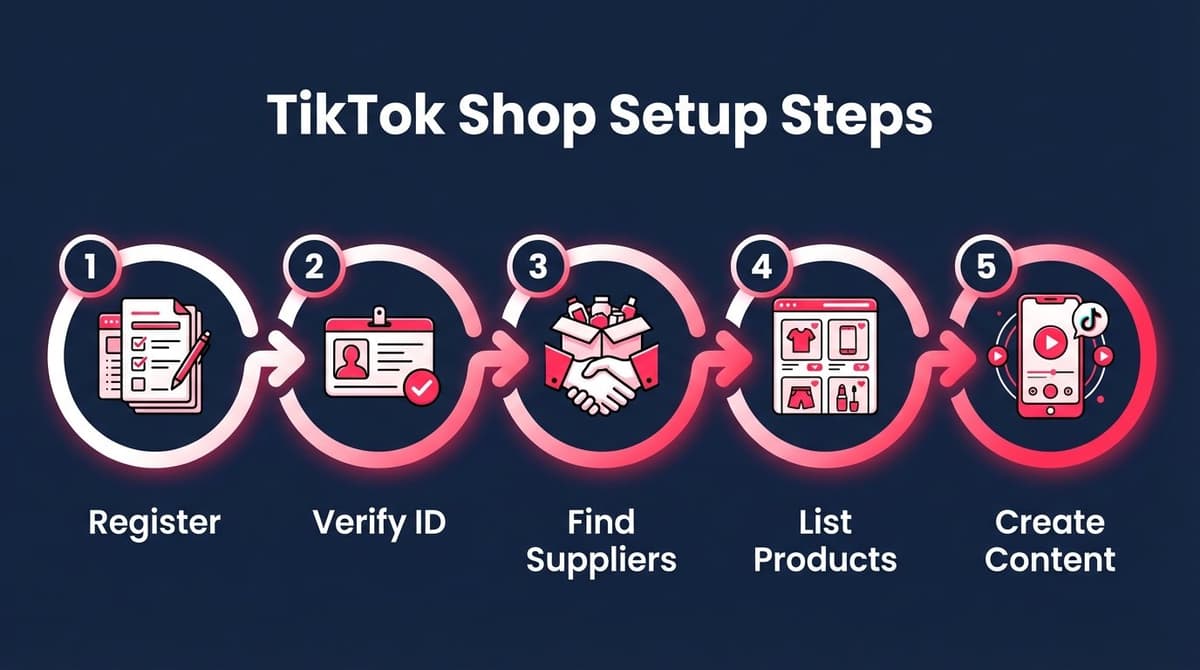
Step 1: Register on TikTok Seller Center
- Go to seller-us.tiktok.com
- Sign up with email or existing TikTok account
- Select seller type (Individual or Business)
- Complete identity verification (1-3 business days)
- Set up payment information
- Configure shipping settings
Pro Tips
- Use a business email, not personal
- Have documents ready before starting (speeds up verification)
- Set realistic shipping times (under-promise, over-deliver)
Step 2: Find Reliable Suppliers
Solo sellers cannot manufacture products. You need suppliers who: - Ship reliably (2-5 day delivery for US customers) - Provide quality products (low return rates) - Offer competitive pricing (maintain margins)
Supplier Platforms
| Platform | Pros | Cons | Best For |
|---|---|---|---|
| Spocket | US/EU suppliers, fast shipping | Higher prices | Quality focus |
| CJDropshipping | Low prices, US warehouse option | Variable quality | Testing products |
| AliExpress | Huge selection, low MOQ | Long shipping from China | Validation only |
| TopDawg | US-only, verified suppliers | Limited selection | Domestic fulfillment |
| Faire | Wholesale, unique products | Higher minimums | Scaling winners |
Supplier Vetting Checklist
- [ ] Order samples before committing
- [ ] Check reviews and ratings
- [ ] Verify shipping times to your target market
- [ ] Confirm return/refund policies
- [ ] Test communication responsiveness
Step 3: List Your Products
TikTok Shop product listings need:
Required
- Product title (clear, keyword-rich)
- Main image (white background, high quality)
- Price and inventory
- Shipping information
- Product description
Optimization Tips
- Use all available image slots (9 images)
- Include lifestyle images, not just product shots
- Write descriptions for scanning (bullets, short paragraphs)
- Price competitively (check competitor listings)
Listing Example
❌ Bad: "Nice Headphones for Sale"
✅ Good: "Wireless Bluetooth Headphones - 40H Battery, Active Noise Cancelling, Foldable Design for Travel"
Step 4: Create Content
TikTok Shop sales come from content. No content = no sales.
Content Types That Convert
| Type | Effort | Conversion | Best For |
|---|---|---|---|
| Product demos | Medium | High | Problem-solving products |
| Unboxing | Low | Medium | New arrivals, gifting |
| Before/after | Medium | Very High | Transformation products |
| Tutorials | High | High | Complex products |
| Trends + product | Low | Variable | Viral potential |
Solo Creator Workflow
- Batch film content (one session = multiple videos)
- Edit in CapCut (templates speed up process)
- Schedule posts (consistent posting > sporadic)
- Repurpose: one product shoot = 5+ video angles
Posting Frequency: Minimum 1 video/day. Optimal 3-5 videos/day during growth phase.
Step 5: Leverage the Affiliate Program
You do not need to create all content yourself. TikTok Shop's affiliate program connects sellers with creators.
How It Works
- Set commission rate (typically 10-20%)
- Add products to affiliate marketplace
- Creators apply to promote your products
- They create content, you fulfill orders
- Commission paid automatically on sales
Affiliate Strategy for Solo Sellers
- Start with higher commission (20%+) to attract creators
- Provide product samples to top performers
- Create an affiliate resource kit (images, talking points)
- Build relationships with consistent performers
This is leverage. One creator with 100K followers can generate more sales than your own account.
Product Selection Strategy
Product selection determines success more than any other factor.
What Sells on TikTok Shop
High Performers
- Problem-solving products (visible transformation)
- Impulse purchases ($15-50 price range)
- Demonstrable products (works well in video)
- Trend-adjacent items (current cultural moments)
Categories Performing Well
- Beauty and skincare
- Home organization
- Phone accessories
- Fitness gadgets
- Pet products
Finding Winning Products
Method 1: TikTok Research
- Search product keywords in TikTok
- Filter by "Shop" to see what's selling
- Note: views, engagement, shop ratings
Method 2: Competitor Analysis
- Find stores with 500-3,000 monthly sales
- Analyze their best sellers
- Look for products you can improve or differentiate
Method 3: Data Tools
- FastMoss: TikTok Shop analytics
- Kalodata: Trending product research
- Nexscope ecommerce data: connect capabilities to your Agent through API, MCP, or Skills.
Testing Strategy
Do not commit large inventory to unproven products.
Test Phase
- List 20-50 products (low inventory or dropship)
- Create 3-5 videos per product
- Run for 2-4 weeks
- Track: views, click-through, conversion
Scale Phase
- Identify winners (top 10-20%)
- Increase inventory for winners
- Double down on content for winners
- Cut losers without hesitation
Numbers to Watch
- Video views > 10K = product has potential
- Click-through rate > 3% = listing is working
- Conversion rate > 2% = winner worth scaling
Solo Seller Time Management
Running a one-person operation requires ruthless prioritization.
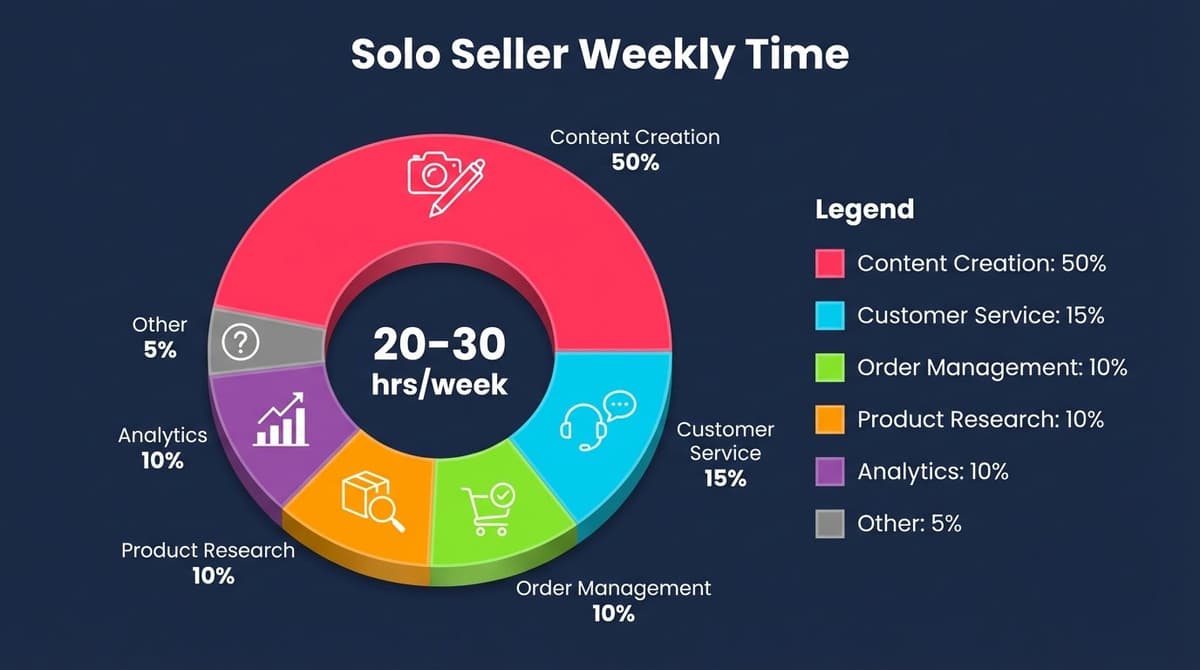
Weekly Time Blocks
| Task | Hours/Week | Priority |
|---|---|---|
| Content creation | 10-15 | Critical |
| Customer service | 3-5 | High |
| Order management | 2-3 | High |
| Product research | 2-3 | Medium |
| Analytics review | 1-2 | Medium |
| Supplier communication | 1-2 | Medium |
Total: 20-30 hours/week for a functional solo operation.
Automation Priorities
Automate low-value tasks first:
- Order processing → Use FBT or integrated dropship tools
- Customer FAQs → Create response templates
- Inventory alerts → Set reorder notifications
- Content scheduling → Batch create and schedule
What to Outsource First
When revenue justifies it (typically $5K+/month):
- Video editing → Freelancers on Fiverr/Upwork ($5-20/video)
- Customer service → VA for routine queries ($5-15/hour)
- Content creation → Affiliate creators (commission-based)
The 3-Phase Growth Model
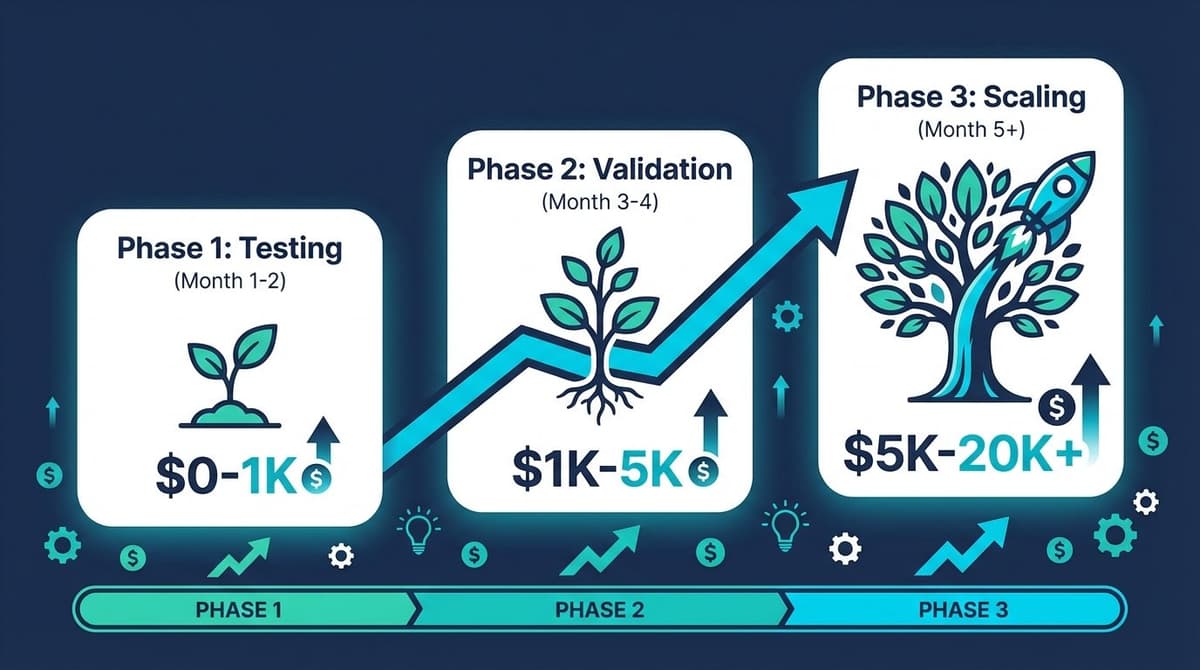
Phase 1: Testing (Month 1-2)
Goal
Find winning products
Actions
- List 30-50 products
- Create 3-5 videos per product
- Track performance religiously
- Cut losers after 2 weeks of data
Metrics
- Revenue: $0-1,000/month (normal)
- Focus: Learning, not profit
Phase 2: Validation (Month 3-4)
Goal
Scale winners, build systems
Actions
- Focus on top 5-10 products
- Increase content volume for winners
- Start affiliate program
- Optimize listings based on data
Metrics
- Revenue: $1,000-5,000/month
- Focus: Profitable unit economics
Phase 3: Scaling (Month 5+)
Goal
Systematic growth
Actions
- Expand to 2-3 product categories
- Build creator relationships
- Consider paid ads on proven products
- Explore international markets
Metrics
- Revenue: $5,000-20,000+/month
- Focus: Leverage and efficiency
Common Mistakes to Avoid
1. Starting with Too Many Products
Listing 200 products with one video each beats nothing. But managing 200 SKUs as a solo seller creates chaos.
Fix: Start with 20-30 products. Master the process before scaling catalog.
2. Ignoring Content Quality
TikTok is a content platform. Low-effort videos get low-effort results.
Fix: Invest time in learning video creation. Watch successful TikTok Shop creators. Iterate on what works.
3. Underpricing Products
Competing on price alone is a race to the bottom. Solo sellers cannot out-price volume operations.
Fix: Compete on content, presentation, and customer experience. Price for healthy margins (30%+ after all costs).
4. Neglecting Customer Service
Bad reviews tank your shop score. Low scores reduce visibility. Reduced visibility kills sales.
Fix: Respond to all messages within 24 hours. Resolve issues generously. A $10 refund is cheaper than a 1-star review.
Conclusion
TikTok Shop rewards creativity and hustle over capital and scale. Solo entrepreneurs who master content creation and product selection can build profitable businesses without teams, warehouses, or massive ad budgets.
The formula is straightforward: find products that demonstrate well on video, create content consistently, leverage the affiliate network for scale, and iterate based on data.
Start small. Test relentlessly. Double down on winners. The platform's algorithm will do the rest.
Nexscope provides structured ecommerce data that teams can use in focused web tools or connect to their existing Agent through API, MCP, or Skills. Ready workflows include Keyword to Ads, Video Clone, and Buy Box Repricer.
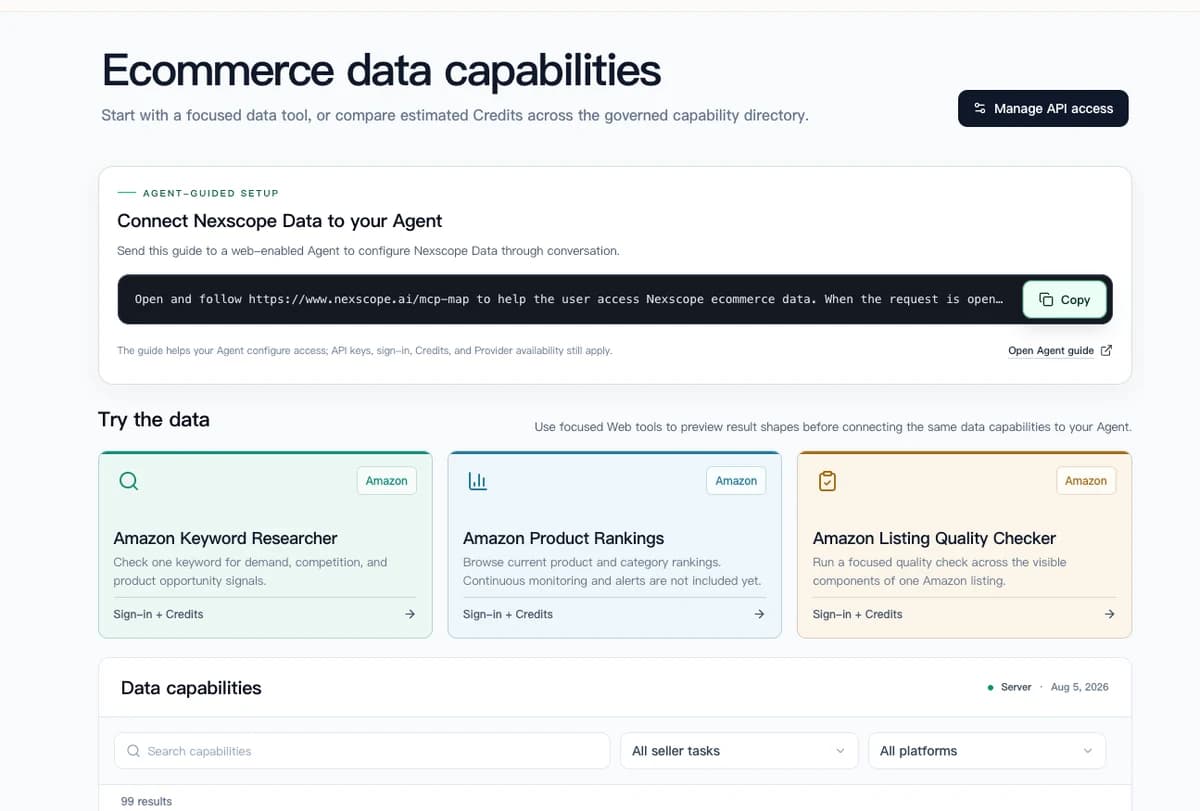
Connect Ecommerce Data to Your Agent
Use Nexscope through API, MCP, or Skills, or open a ready seller workflow.
Explore Ecommerce Data →FAQs
Can I really run a TikTok Shop alone?
Yes. The platform handles payment processing, provides fulfillment options (FBT), and connects you with affiliate creators. Many successful TikTok shops are one-person operations, especially in the $5K-20K/month range.
How much money do I need to start?
Minimum $500-1,000 for product samples, initial inventory, and basic tools. You can start even lower with pure dropshipping, though margins will be tighter.
Do I need to show my face in videos?
No. Many successful TikTok Shop videos are product-focused with voiceover or text overlays. However, face-to-camera content typically builds more trust and performs better long-term.
How long until I make money?
Expect 1-2 months of testing before consistent sales. Profitability typically comes in months 3-4 for sellers who iterate based on data. Some hit winners earlier; others take longer.
What's the biggest challenge for solo sellers?
Content creation volume. TikTok rewards consistent posting. Creating 1-5 videos daily while managing other operations is the primary bottleneck. Solution: batch creation and affiliate partnerships.
Should I use TikTok Ads?
Not initially. Prove organic sales first. Once you have winning products with proven conversion, ads can scale what already works. Ads cannot fix bad products or weak content.