

Amazon FBA vs FBM: Which Fulfillment Method Is Right for You?

Choosing between FBA and FBM is one of the most important decisions you'll make as an Amazon seller. Get it wrong, and you'll either bleed money on unnecessary fees or drown in logistics headaches.
FBA (Fulfillment by Amazon) means Amazon stores, packs, and ships your products. FBM (Fulfillment by Merchant) means you handle everything yourself. Both have their place, and many successful sellers use both. This guide breaks down the real costs, trade-offs, and decision factors so you can choose what actually makes sense for your business.
What Is Amazon FBA?
FBA stands for Fulfillment by Amazon. You send your inventory to Amazon's warehouses, and they handle everything from there: storage, picking, packing, shipping, customer service, and returns.
Here's how it works:
- You source or manufacture products
- You ship inventory to Amazon fulfillment centers
- Customers order on Amazon
- Amazon picks, packs, and ships the order
- Amazon handles customer inquiries and returns
- You receive payment (minus fees)
FBA products automatically qualify for Prime shipping, which can significantly boost your conversion rates. Amazon customers trust Prime—they know they'll get fast, reliable delivery.
The trade-off is cost. You pay storage fees, fulfillment fees, and various other charges. For some products, these fees eat into margins so much that FBA doesn't make sense.
What Is Amazon FBM?
FBM stands for Fulfillment by Merchant. You list products on Amazon, but you store inventory and ship orders yourself (or through a third-party logistics provider).
The FBM process:
- You source or manufacture products
- You store inventory at your location or with a 3PL
- Customers order on Amazon
- You receive the order notification
- You pick, pack, and ship directly to the customer
- You handle customer service and returns
- You receive payment (minus referral fees only)
FBM gives you more control over your fulfillment process and typically lower per-unit costs for certain product types. However, you don't automatically get Prime eligibility (unless you qualify for Seller Fulfilled Prime, which has strict requirements). FBM is often used by sellers doing Amazon dropshipping or those who already have warehouse infrastructure.
FBA vs FBM: Key Differences
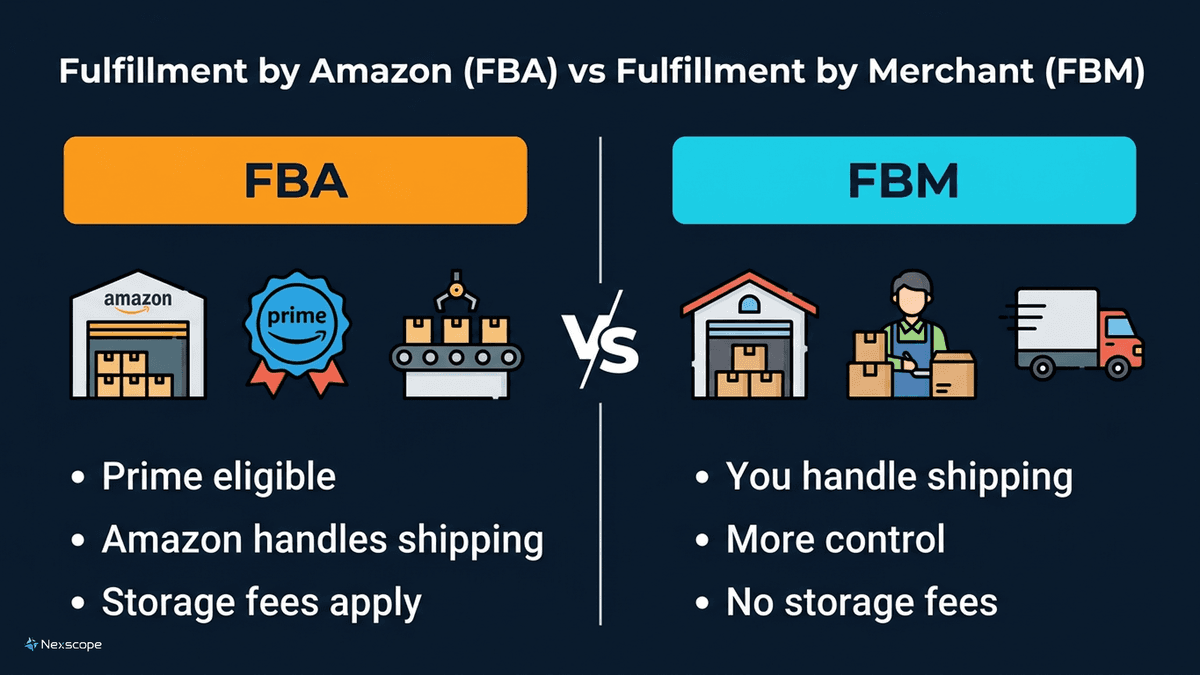
| Factor | FBA | FBM |
|---|---|---|
| Who fulfills orders | Amazon | You or your 3PL |
| Prime eligibility | Automatic | Only with Seller Fulfilled Prime |
| Storage location | Amazon warehouses | Your warehouse or 3PL |
| Customer service | Amazon handles | You handle |
| Returns processing | Amazon handles | You handle |
| Shipping speed | 1-2 day Prime | Varies (typically 3-7 days) |
| Fee structure | Storage + fulfillment fees | Shipping costs only |
| Inventory control | Limited | Full control |
| Buy Box advantage | Higher priority | Lower priority (generally) |
| Multi-channel fulfillment | Available (extra fees) | Easy to implement |
The Buy Box factor matters more than most sellers realize. Amazon's algorithm favors FBA sellers when determining who wins the Buy Box, especially when prices are similar. If you're competing against FBA sellers with FBM listings, you'll likely need lower prices to win.
FBA Costs Breakdown
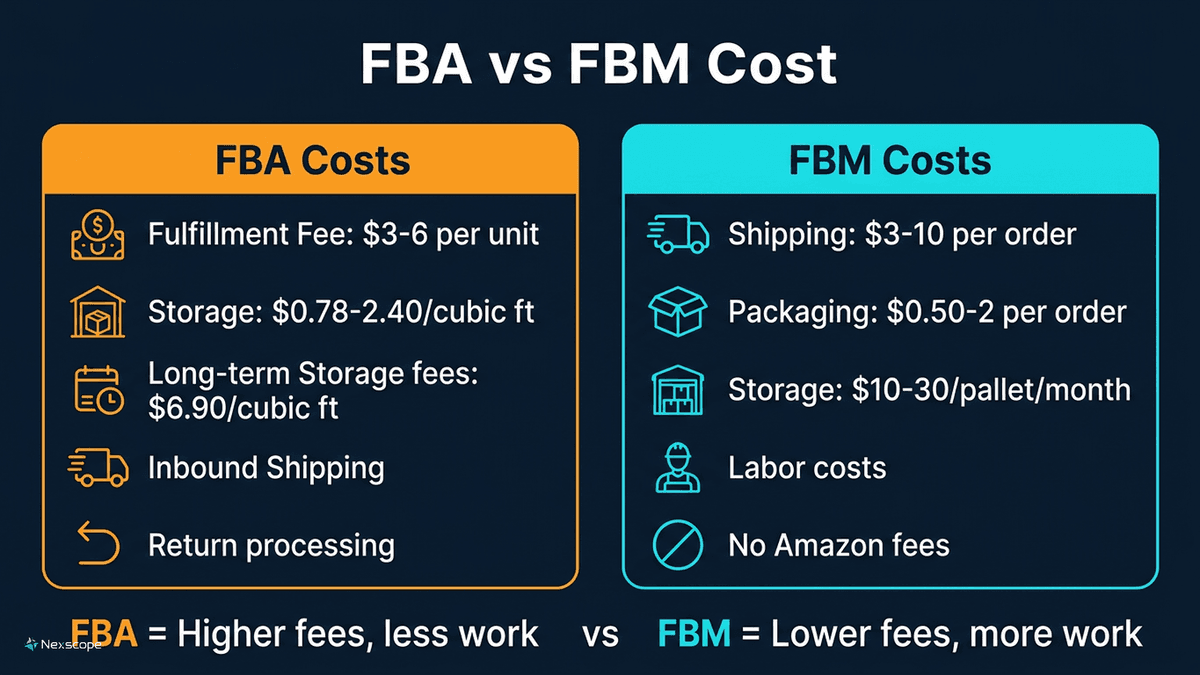
Understanding FBA fees is critical. Many sellers underestimate these costs and end up with razor-thin margins or losses.
Fulfillment Fees
Amazon charges per-unit fulfillment fees based on product size and weight. As of 2026:
Standard-Size Items: - Small (up to 15" x 12" x 0.75"): $3.22 - $3.86 - Large (up to 18" x 14" x 8"): $4.75 - $6.10 - Extra-large: $8.00+
Oversize Items: - Small oversize: $9.73+ - Medium oversize: $19.05+ - Large oversize: $89.98+
Storage Fees
Monthly storage fees vary by time of year:
- January - September: $0.78 per cubic foot (standard) / $0.56 per cubic foot (oversize)
- October - December: $2.40 per cubic foot (standard) / $1.40 per cubic foot (oversize)
Q4 storage fees triple because Amazon needs warehouse space for holiday inventory.
Long-Term Storage Fees
Inventory sitting longer than 181 days incurs additional fees: - 181-365 days: $0.50 per cubic foot (or $0.10 per unit, whichever is greater) - 365+ days: $6.90 per cubic foot (or $0.15 per unit, whichever is greater)
Other FBA Fees
- Inbound placement fees: Charged when Amazon distributes inventory across multiple warehouses
- Removal fees: $0.97+ per unit to have inventory returned or disposed
- Return processing fees: Charged for certain categories (apparel, watches, etc.)
- Labeling fees: $0.55 per unit if Amazon labels products for you
An FBA calculator helps estimate your actual costs before committing. Getting these numbers right is essential for a solid pricing strategy.
FBM Costs Breakdown
FBM costs are more variable because they depend on your specific setup.
Shipping Costs
Your biggest FBM expense. Options include:
- USPS: Cheapest for lightweight items under 1 lb
- UPS/FedEx: Better rates for heavier items, especially with negotiated rates
- Regional carriers: Can be 20-40% cheaper for specific zones
- Amazon Buy Shipping: Often competitive rates, plus protects against negative feedback for late deliveries
Typical shipping costs: - Lightweight items (under 1 lb): $3.50 - $5.00 - Medium items (1-3 lbs): $6.00 - $9.00 - Heavy items (3+ lbs): $10.00+
Storage Costs
If you store at home: essentially free (but factor in space opportunity cost).
If you use a 3PL: - Storage: $10-30 per pallet per month - Pick and pack: $2-5 per order - Monthly minimums: Often $250-500
Packaging Costs
- Boxes: $0.30 - $2.00 depending on size
- Poly mailers: $0.10 - $0.30
- Packing materials: $0.10 - $0.50 per order
- Labels and tape: $0.05 - $0.10 per order
Labor Costs
Often overlooked. If you're packing orders yourself, calculate your hourly rate. If you're paying employees or using a 3PL, factor in those costs per unit.
Pros and Cons of FBA
Advantages of FBA
- Prime badge: Automatic eligibility increases conversion rates 20-30%
- Buy Box advantage: Algorithm favors FBA sellers
- Hands-off fulfillment: Focus on sourcing and marketing instead of logistics
- Customer trust: Amazon handles customer service and returns professionally
- Multi-channel fulfillment: Can fulfill orders from other channels (Shopify, eBay) through FBA
- Scalability: Easy to scale without building logistics infrastructure
Disadvantages of FBA
- Higher fees: Per-unit costs often exceed FBM for low-margin products
- Storage fees: Can eat into profits, especially for slow-moving inventory
- Less control: Can't customize packaging or include inserts easily
- Commingling risk: If you don't use labels, your inventory mixes with other sellers'
- Inventory limits: Amazon restricts how much you can send, especially for new sellers
- Stranded inventory: Products can get lost or damaged in Amazon warehouses
Pros and Cons of FBM
Advantages of FBM
- Lower per-unit costs: Often cheaper for large, heavy, or low-margin items
- Full inventory control: No storage limits or commingling concerns
- Custom packaging: Can include brand inserts, custom boxes, personalized notes
- Faster cash flow: No waiting for inventory to check in at Amazon
- No long-term storage fees: Keep inventory as long as you want
- Better for fragile items: More control over packing quality
Disadvantages of FBM
- No automatic Prime: Must qualify for Seller Fulfilled Prime (difficult requirements)
- Lower Buy Box priority: Harder to compete against FBA sellers
- More work: You handle customer service, returns, and shipping issues
- Shipping deadlines: Must ship within Amazon's expected timeframes or risk account health
- Returns management: You process and inspect all returns yourself
When to Choose FBA
FBA makes sense when:
- High-margin products — If your margins are 30%+ after FBA fees, the convenience and Prime boost are worth it.
- Small, lightweight items — FBA fees are most competitive for items under 1 lb that fit in standard packaging.
- Fast-moving inventory — If products sell within 60-90 days, storage fees stay manageable.
- Competitive categories — Where the Prime badge and Buy Box advantage significantly impact sales.
- Scaling quickly — When you don't have infrastructure to handle increased order volume, especially solo sellers without a team.
- Seasonal products — For Q4 rushes when you can't staff up quickly enough.
FBA Sweet Spot
The ideal FBA product: - Sells for $15-50 - Weighs under 2 lbs - Has 40%+ margin after all fees - Turns over every 60-90 days - Competes in a Prime-dominated category
When to Choose FBM
FBM makes sense when:
- Low-margin products — When FBA fees would eliminate your profit.
- Large or heavy items — Oversize FBA fees can be brutal—often cheaper to ship yourself.
- Slow-moving inventory — Long-term storage fees kill profitability for items that sit.
- Custom or fragile products — When you need control over packaging and handling.
- Multi-channel selling — When most sales come from non-Amazon channels and you need flexible fulfillment.
- Local selling — For products where local pickup or same-day delivery is a selling point.
FBM Sweet Spot
The ideal FBM product: - Large or heavy (oversize in FBA terms) - Low competition from FBA sellers - Niche category where Prime isn't expected - High enough margins to absorb shipping costs - Consistent, predictable order volume
Can You Use Both? (Hybrid Strategy)
Yes, and many successful sellers do. A hybrid FBA/FBM strategy lets you optimize for different scenarios.
How Hybrid Works
You can list the same product with both FBA and FBM offers simultaneously. Amazon will typically show the FBA offer first (because of Prime), but your FBM offer acts as a backup when:
- FBA inventory runs out
- You want to test new products without committing FBA inventory
- Seasonal demand exceeds your FBA stock limits
Hybrid Strategy Examples
Inventory buffer: Keep 80% of inventory in FBA, 20% at your warehouse. When FBA sells out, FBM keeps sales going while you restock.
New product testing: Launch new products via FBM first. If they sell well, transition to FBA. If they flop, you haven't lost money on inbound shipping and storage.
Oversized + standard: Use FBA for standard-size products, FBM for oversized items in the same product line.
Geographic arbitrage: FBA for customers near Amazon warehouses, FBM for remote areas where your 3PL might be closer.
Managing Hybrid Inventory
The main challenge is inventory management. You need systems to track stock levels across both channels and avoid overselling. Most sellers use inventory management software that syncs FBA and FBM quantities.
Conclusion
There's no universal answer to FBA vs FBM. The right choice depends on your products, margins, volume, and business goals.
- Choose FBA if — You sell small, fast-moving products with healthy margins and want the Prime advantage without building logistics infrastructure.
- Choose FBM if — You sell large, heavy, or low-margin products where FBA fees would eliminate profits, or you need more control over fulfillment.
- Use both if — You have diverse product lines or want the flexibility to optimize fulfillment based on changing conditions.
Run the numbers for your specific products. A product that's profitable with FBA might lose money with FBM (due to lost Prime sales), or vice versa. Test both when possible, and let the data guide your decision.
Make Smarter FBA vs FBM Decisions with Nexscope
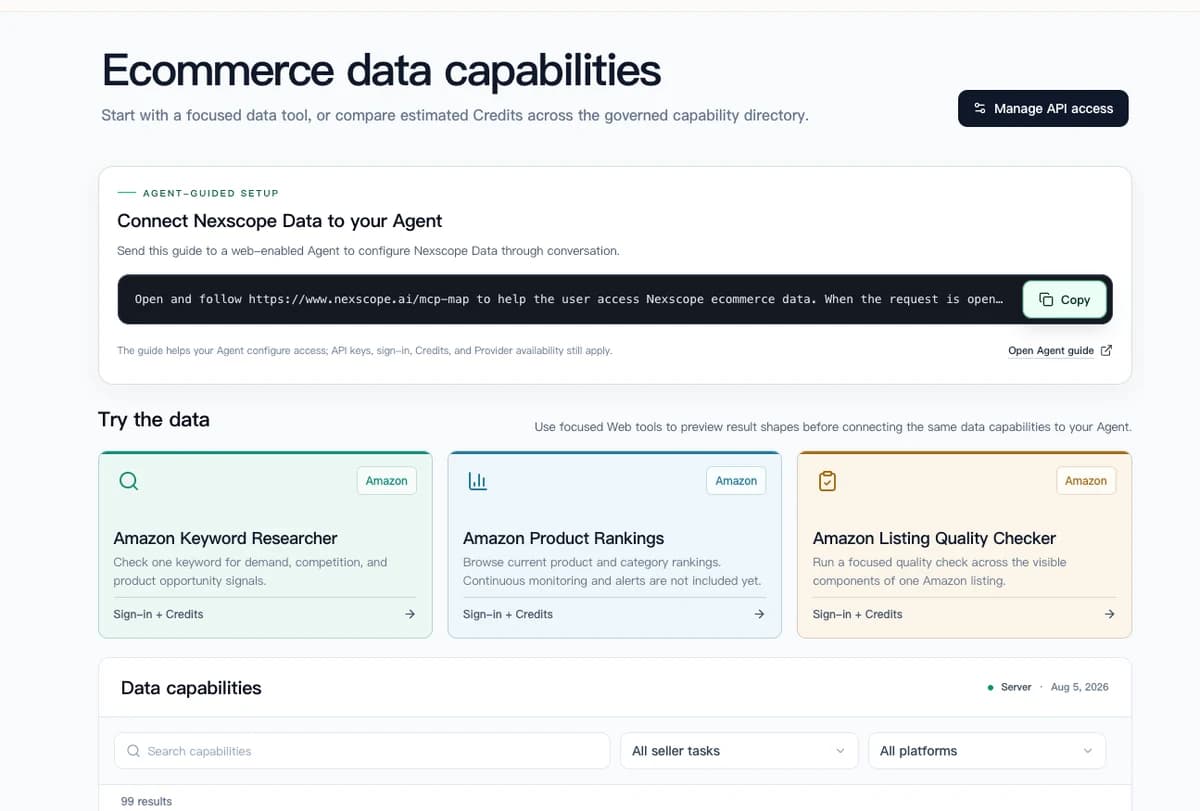
Nexscope provides structured ecommerce data and focused seller workflows. Teams can use Nexscope's web tools directly or connect governed capabilities to their existing Agent through API, MCP, or Skills. Ready workflows include Keyword to Ads, Video Clone, and Buy Box Repricer.
Key Features
- Agent-ready access — Connect ecommerce capabilities through API, MCP, or Skills
- Live data — real-time pulls from Amazon, TikTok Shop, Jungle Scout, eBay, Walmart, Google Trends
- FBA Calculator — estimate fees and margins before committing to inventory
- Competitor analysis — see what fulfillment methods top sellers use
- Context memory — remembers your products and margin targets
Whether you're evaluating FBA vs FBM or optimizing your current fulfillment strategy, Nexscope helps you make data-driven decisions faster.
Connect Ecommerce Data to Your Agent
Use Nexscope through API, MCP, or Skills, or open a ready seller workflow.
Explore Ecommerce Data →1,000 free credits • API, MCP & Skills
FAQ
What is the main difference between FBA and FBM?
FBA (Fulfillment by Amazon) means Amazon stores, packs, ships, and handles customer service for your products. FBM (Fulfillment by Merchant) means you handle all fulfillment yourself, either from your own warehouse or through a third-party logistics provider. The main trade-off is convenience and Prime eligibility (FBA) versus lower fees and more control (FBM).
Is FBA or FBM more profitable?
It depends on your product characteristics. FBA is typically more profitable for small, lightweight, fast-moving items with margins above 30%. FBM is often more profitable for large, heavy, slow-moving, or low-margin products where FBA fees would eliminate profits. Calculate the actual costs for your specific products rather than assuming one is always better.
Can I use both FBA and FBM for the same product?
Yes. You can create both FBA and FBM listings for the same ASIN. Amazon will typically show the FBA offer first due to Prime eligibility, but your FBM offer can serve as backup inventory or capture sales when FBA stock runs out. Many sellers use this hybrid strategy to optimize fulfillment costs and availability.
Do FBM sellers get the Prime badge?
Not automatically. FBM sellers can apply for Seller Fulfilled Prime (SFP), which allows Prime badging on self-fulfilled orders. However, SFP has strict requirements: 99% on-time shipping, less than 0.5% cancellation rate, and the ability to offer one-day and two-day delivery to most US addresses. Most small sellers don't qualify.
What are the biggest hidden costs of FBA?
Long-term storage fees catch many sellers off guard—inventory sitting over 181 days incurs extra charges, and items over 365 days face steep fees of $6.90 per cubic foot. Other hidden costs include inbound placement fees, removal fees for unsold inventory, and the opportunity cost of having capital tied up in Amazon's warehouses for weeks during check-in.
How do I decide between FBA and FBM for a new product?
Start by calculating your landed cost and expected selling price. Use Amazon's FBA calculator to estimate FBA fees, then compare to your estimated FBM costs (shipping, packaging, labor). Factor in the Prime conversion advantage—FBA typically converts 20-30% better. If margins are tight, test with FBM first; if margins are healthy and the category is competitive, FBA is usually the better launch strategy.
Does FBA help win the Buy Box?
Yes. Amazon's Buy Box algorithm favors FBA sellers, especially when competing against FBM sellers at similar prices. FBA provides consistent shipping performance and customer service, which Amazon values. FBM sellers typically need lower prices or exceptional performance metrics to compete for the Buy Box against FBA sellers.
Can I switch from FBM to FBA later?
Yes. You can convert existing FBM listings to FBA by sending inventory to Amazon fulfillment centers. The process takes 1-2 weeks for inventory to check in and become available. Many sellers start with FBM to validate demand, then switch to FBA once products prove successful. Just update your listing's fulfillment channel and create a shipment to Amazon.
Sources
- Amazon Seller Central. (2026). FBA Features and Fees. Retrieved from sellercentral.amazon.com
- Amazon. (2026). Fulfillment by Amazon Revenue Calculator. Retrieved from sellercentral.amazon.com/hz/fba/profitabilitycalculator
- Jungle Scout. (2025). State of the Amazon Seller Report. Retrieved from junglescout.com
- Red Stag Fulfillment. (2025). Amazon FBM vs FBA: A Complete Comparison. Retrieved from redstagfulfillment.com
- Helium 10. (2024). FBA vs FBM: Which Is Better?. Retrieved from helium10.com