

How to Find Amazon Product Opportunities from a Keyword

Finding Amazon product opportunities from a keyword starts with a simple question: does this search term point to a real buyer need with enough demand and enough room for a new offer? A keyword is not a product idea by itself. It is a doorway into buyer intent, competing listings, review complaints, price expectations, and launch risk.
The strongest opportunities usually appear when demand is visible, competition is still workable, and existing products leave a clear gap. Nexscope helps ecommerce sellers connect those signals into a practical research workflow, especially when a seller starts with a keyword and needs to decide what product direction to test.
Start with the Right Keyword
A good product opportunity keyword describes a buyer need, product category, use case, or problem. It should be specific enough to reveal intent but broad enough to show a market.
Examples:
- "electric blanket"
- "garden hose reel"
- "dog grooming kit"
- "car trunk organizer"
- "baby bottle warmer"
- "espresso accessories"
These keywords are useful because they point to product categories that can be analyzed. A keyword such as "gift" is too broad. A keyword such as "blue insulated 1 gallon water bottle with time marker and straw" may be too narrow for first-pass opportunity research.
Use seed keywords, not final product names
At the start, the seller should not try to guess the exact product. A seed keyword helps reveal subcategories. For example, "garden hose reel" may lead to wall-mounted reels, retractable reels, decorative hose pots, heavy-duty commercial reels, and compact apartment-friendly reels.
Each subcategory can have different demand, competition, price, reviews, and sourcing requirements.
Strong Amazon keyword research starts with broad seed terms; keyword-led product research narrows those terms into one testable market angle.
Avoid keywords that only describe a brand
Brand-heavy keywords can be useful for competitor research, but they are often weak starting points for product opportunity discovery. A seller looking for a new product should focus on category terms, buyer problems, and use cases.
Check Whether the Keyword Shows Real Demand
Demand is the first filter. A product opportunity needs buyers who are already searching, comparing, and purchasing.
Important demand signals include:
- Search volume around the main keyword
- Related keywords and long-tail variations
- Sales estimates for top listings
- Best Seller Rank movement
- Google Trends or external trend movement
- TikTok Shop or social trend signals for visual products
- Repeat purchase or accessory potential
No single metric proves demand. A keyword with high search volume may still be difficult if every buyer expects a low price. A smaller keyword can be attractive if the buyers are specific, the price band is healthy, and the current products have weak reviews.
An Amazon sales estimator can help sanity-check whether top listings are moving enough units before the seller spends time on suppliers or packaging.
Look for demand clusters
The best opportunities often show a cluster of related searches. For example:
- "electric blanket"
- "electric throw blanket"
- "heated blanket queen size"
- "battery heated blanket"
- "washable heated blanket"
A cluster shows that the market has multiple buyer intents. That gives the seller more room to choose a specific angle.
Separate seasonal spikes from steady demand
Some products rise sharply during a season and then fall. Seasonal products can work, but they require tighter inventory planning and earlier launch timing. A seller should check whether the demand curve is steady, seasonal, or trend-driven.
Read the Search Results Like a Market Map
After checking demand, inspect the Amazon search results. The goal is to understand who currently wins and why.
Review the top listings
For the first page of results, check:
- Number of reviews
- Average rating
- Price range
- Main image quality
- Product format and bundle structure
- Brand presence
- Coupon or discount usage
- Delivery promise
- Sponsored listing density
If the top listings have tens of thousands of reviews, mature brands, strong images, aggressive pricing, and heavy ads, the keyword may be too competitive for a beginner.
Look for weak but visible competitors
The best sign is not weak products with no demand. It is products that already sell but leave visible gaps. Examples include:
- Good sales with repeated complaints
- High demand but poor images
- Strong search volume but generic product positioning
- Many listings with similar features and no clear angle
- A price band that leaves room for a better bundle
This is where product research becomes more useful than simple keyword research.
Use Reviews to Find Product Gaps
Reviews show what buyers expected and what the current products failed to deliver. A seller should read both positive and negative reviews because each group reveals something different.
Negative reviews reveal product risk
Common complaint patterns include:
- Breaks after limited use
- Wrong size or misleading dimensions
- Difficult setup
- Cheap material
- Weak packaging
- Poor instructions
- Leaking, peeling, rusting, shedding, or overheating
- Missing parts
- Bad smell or uncomfortable texture
These complaints can become product improvement ideas. They can also warn the seller to avoid the category if the issue is hard to fix.
Positive reviews reveal the buying reason
Positive reviews often explain the real reason people buy:
- "Fits small apartments"
- "Easy for elderly parents"
- "Safe around kids"
- "Looks better than expected"
- "Saves time every morning"
- "Works for travel"
These phrases can shape listing copy, images, and product positioning. Strong Amazon listing optimization usually starts before the product is ordered, not after the inventory arrives.
Check Price Band and Margin Room
A product opportunity needs enough price room to cover sourcing, packaging, shipping, FBA fees, storage, returns, ads, and profit.
Map the current price range
Group the top listings into price bands:
- Budget products
- Mid-market products
- Premium products
- Bundles or multi-packs
- Branded versions
If the market is dominated by low-price products, a new seller needs a clear reason to charge more. Better material, design, bundle value, warranty, packaging, or a specific use case can help, but only if buyers care.
Watch for hidden cost pressure
Some products look attractive until the seller checks shipping size, weight, breakage risk, returns, or compliance. Large, fragile, regulated, or low-margin products can create problems after launch.
For Amazon FBA products, the seller should check likely fulfillment costs and profit before choosing a product. An Amazon FBA calculator is useful before the seller contacts suppliers.
Estimate PPC Pressure Before Launch
Many sellers validate a product with organic demand and forget paid competition. That is risky because a new listing often needs PPC to gain visibility.
Check sponsored density
Search the main keyword and look at how many sponsored listings appear. Heavy ad density can mean:
- The keyword converts well
- Sellers are fighting for placement
- Launch costs may be high
- Organic ranking may take longer
This does not automatically make the product bad. It means the seller needs a clear ad plan and enough margin.
Group keywords by intent
A seller should not only target the highest-volume keyword. Keyword groups may include:
- Main category terms
- Problem-based terms
- Size or material terms
- Use-case terms
- Gift terms
- Competitor-adjacent terms
This helps the seller avoid spending the entire PPC budget on the most expensive head term. A good Amazon PPC strategy often starts with keyword segmentation.
Turn the Keyword into Product Opportunity Ideas
Once demand, competition, reviews, price, and PPC pressure are checked, the seller can turn the keyword into concrete product ideas.
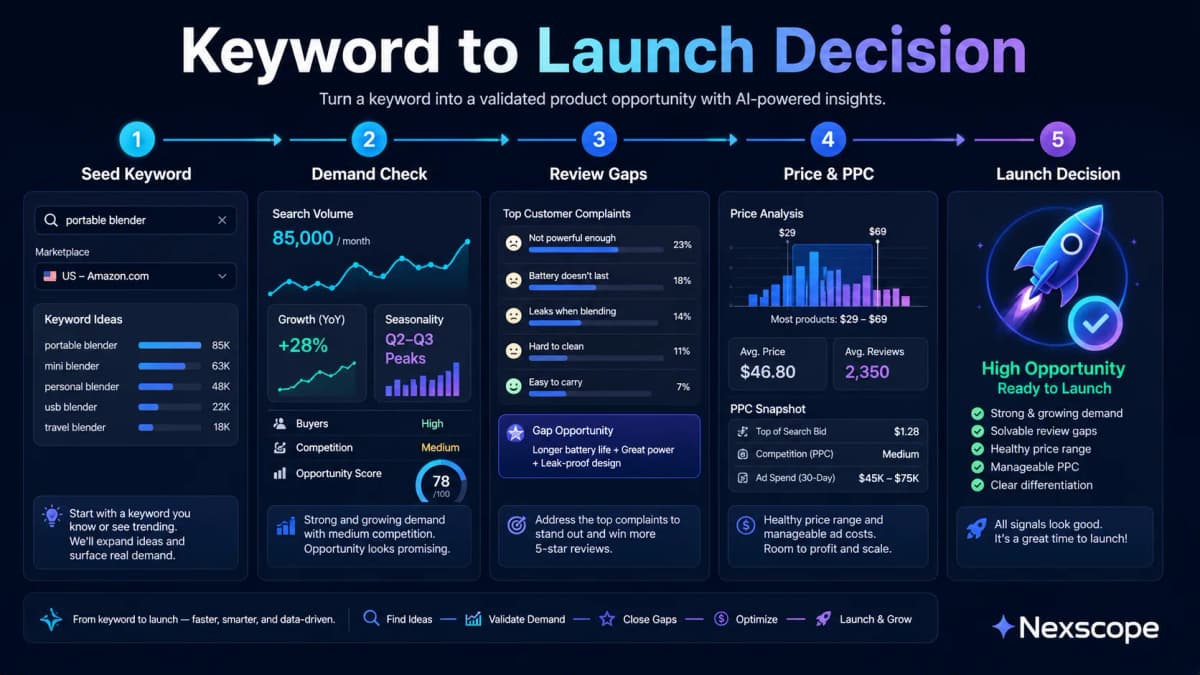
Build a simple opportunity scorecard
Use a scorecard with six questions:
- Is demand visible and stable enough?
- Are the top competitors beatable?
- Do reviews reveal fixable complaints?
- Is the price band high enough for margin?
- Is PPC pressure manageable?
- Is there a clear listing or product angle?
The goal is not to force a perfect score. The goal is to compare ideas consistently.
Define the product angle
A product angle should be specific. For example:
- "A compact garden hose reel for renters with small patios"
- "A baby bottle warmer built for travel and night feeds"
- "A dog grooming kit for nervous dogs and first-time owners"
- "A car trunk organizer that stays rigid under grocery weight"
The angle should connect the keyword, buyer problem, review complaints, and product format.
Decide whether to enter, avoid, or keep watching
Each keyword should lead to one of three decisions:
- Enter: demand is real, competition is manageable, and the angle is clear.
- Avoid: competition, cost, compliance, or quality risk is too high.
- Keep watching: demand is emerging, but the seller needs more trend or competitor evidence.
This makes product research actionable.
Use Amazon Opportunity Finder to Speed Up the Workflow
The manual workflow above is useful, but it can take hours when the seller wants to test many keywords. The Nexscope Amazon Opportunity Finder is designed for the first pass of keyword-led product research.
Sellers can enter a keyword, choose a marketplace, and review product opportunity starting points based on demand, competition, and launch room. It is especially useful when the seller has a seed keyword but does not yet know which product format, price band, or category angle deserves deeper research.
If the seller is still expanding seed terms, the free Amazon keyword research tool can help turn one starting keyword into more search angles before deeper opportunity validation.
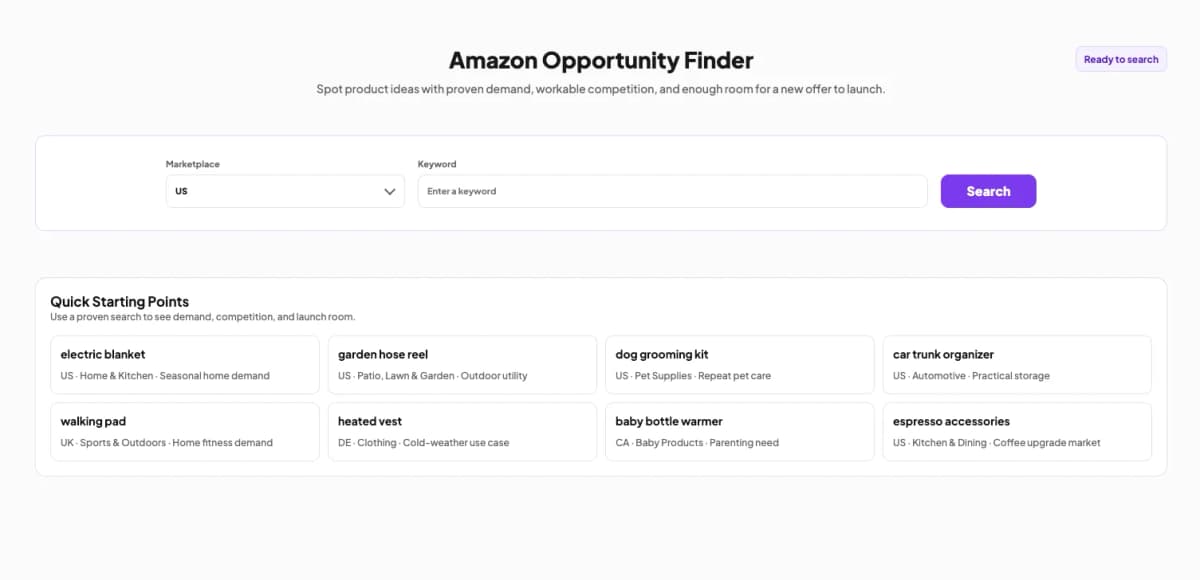
Key features for keyword-led research
- Keyword input for product opportunity discovery
- Marketplace selection for localized research
- Quick starting points for common ecommerce categories
- Product opportunity framing around demand, competition, and launch room
- Natural handoff into deeper Nexscope ecommerce data and seller workflows
After the first opportunity list is generated, the seller can continue with competitor analysis, review analysis, listing direction, creative planning, and monitoring.
Conclusion
Finding Amazon product opportunities from a keyword is a decision process. A seller starts with search intent, then checks demand, reviews, competition, pricing, PPC pressure, and differentiation. The best opportunities are not always the biggest categories. They are the categories where buyers are active and the current products leave room for a better offer.
Amazon Product Opportunity Explorer, Helium 10, Jungle Scout, SellerSprite, and other Amazon product research tools can all support this work. Nexscope is useful when the seller wants to move from keyword research to a practical product opportunity workflow, then continue into listing strategy, images, and launch planning.
Connect Ecommerce Data to Your Agent
Use Nexscope through API, MCP, or Skills, or open a ready seller workflow.
Explore Ecommerce Data →Frequently Asked Questions
How do sellers find Amazon product opportunities from a keyword?
Start with a category or use-case keyword, then check demand, related keywords, top listings, review count, rating quality, price band, PPC pressure, and customer complaints. A good opportunity should show demand and a clear way for a new product to compete.
What is a good Amazon product opportunity?
A good Amazon product opportunity has visible demand, manageable competition, workable margin, fixable customer complaints, and a clear product or listing angle. It should also be feasible to source, ship, and advertise without destroying profit.
Is high search volume enough to choose a product?
No. High search volume can attract heavy competition and expensive ads. Sellers should also check reviews, price range, listing quality, brand strength, PPC pressure, and product differentiation.
How many reviews are too many for a new seller?
There is no universal review cutoff. A product with many reviews can still be beatable if the reviews reveal major complaints and the seller can offer a better version. For beginners, categories where every top listing has very high review depth and strong brands are harder to enter.
Should sellers use Amazon Product Opportunity Explorer?
Amazon Product Opportunity Explorer is useful for eligible sellers because it uses Amazon marketplace signals. Sellers should still validate opportunities with competitor analysis, review research, pricing, PPC planning, and external trend checks.
Can AI choose a product for Amazon sellers?
AI can help organize research, summarize reviews, compare competitors, and suggest product angles. The seller should still verify data, calculate profit, check compliance, and review supplier feasibility before sourcing.
Sources
- Amazon. (2026). Product Opportunity Explorer. Retrieved from sell.amazon.com.
- Helium 10. (2026). Product Research Tools. Retrieved from helium10.com.
- Jungle Scout. (2026). Amazon Product Research Framework for Launching Products. Retrieved from junglescout.com.
- SellerSprite. (2026). Evaluating Competition and Demand for Product Ideas. Retrieved from sellersprite.com.
- Seller Labs. (2026). AI Product Research Tools for Amazon Sellers. Retrieved from sellerlabs.com.