

How to Run a One-Person Amazon Business with AI

Starting an Amazon FBA business used to require a team—product researchers, graphic designers, copywriters, and operations staff. Not anymore.
AI tools have changed everything. In 2026, solo sellers are building profitable Amazon businesses without hiring anyone. The "solopreneur" model is thriving, and the barrier to entry has never been lower.
This guide walks you through exactly how to start and run an Amazon FBA business by yourself, using AI tools to handle the work that used to require a team.
Why 2026 Is the Best Time to Start Solo
Lower Operating Costs
Traditional Amazon businesses needed multiple hires: - Product researcher — $50K+/year - Graphic designer — $45K+/year - Copywriter — $40K+/year - Operations manager — $55K+/year
Total: $190K+ in annual salary costs alone.
With AI tools, a solo seller can handle all of these functions for a few hundred dollars per month in software subscriptions.
Faster Execution
Tasks that took days now take minutes:
| Task | Traditional Time | With AI |
|---|---|---|
| Product research | 2-3 days | 30 minutes |
| Competitor analysis | 1-2 days | 15 minutes |
| Listing copywriting | 4-6 hours | 10 minutes |
| Keyword research | 3-4 hours | 5 minutes |
AI as Your Virtual Team
Modern AI tools can: - Generate product ideas based on market trends - Analyze competitor listings and pricing strategies - Write SEO-optimized titles, bullet points, and descriptions - Create product image concepts and backgrounds - Calculate profitability and FBA fees
You're not working alone—you have an AI co-pilot handling the heavy lifting.
Step 1: Find a Profitable Product (AI-Assisted Research)
The first step is product selection. Most failed Amazon businesses fail here—they pick products with too much competition or too little demand.
Brainstorm Product Ideas
Open Nexscope and start with broad questions:
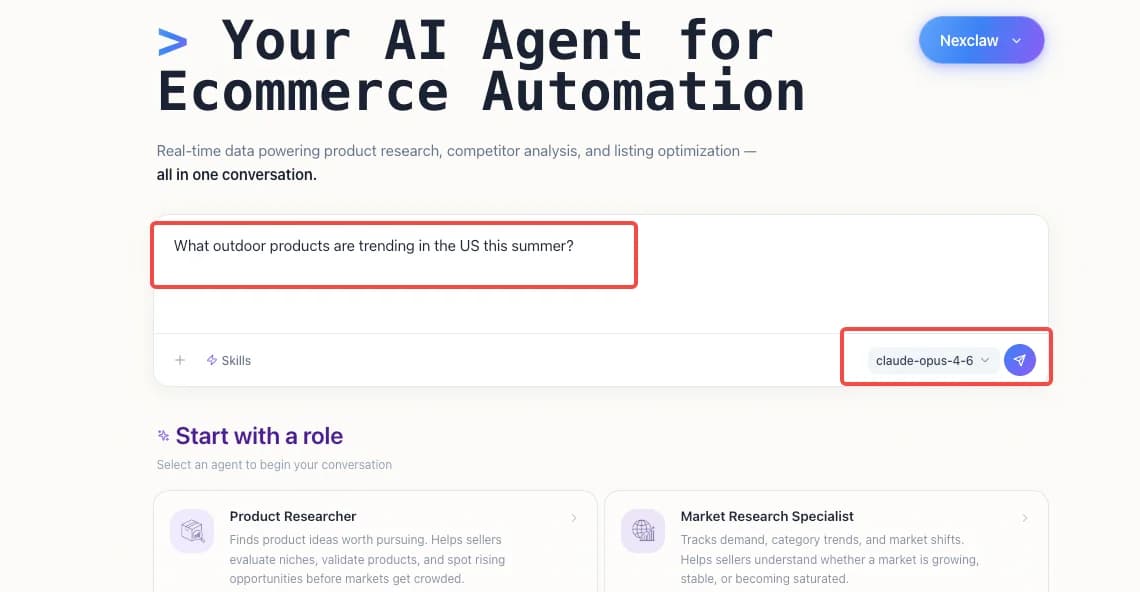
Try these prompts:
"What outdoor products are trending in the US this summer?"
"What are common pain points for new parents that products could solve?"
"What kitchen gadgets are popular on TikTok but underserved on Amazon?"
Nexscope will analyze real market data and return a full opportunity report:
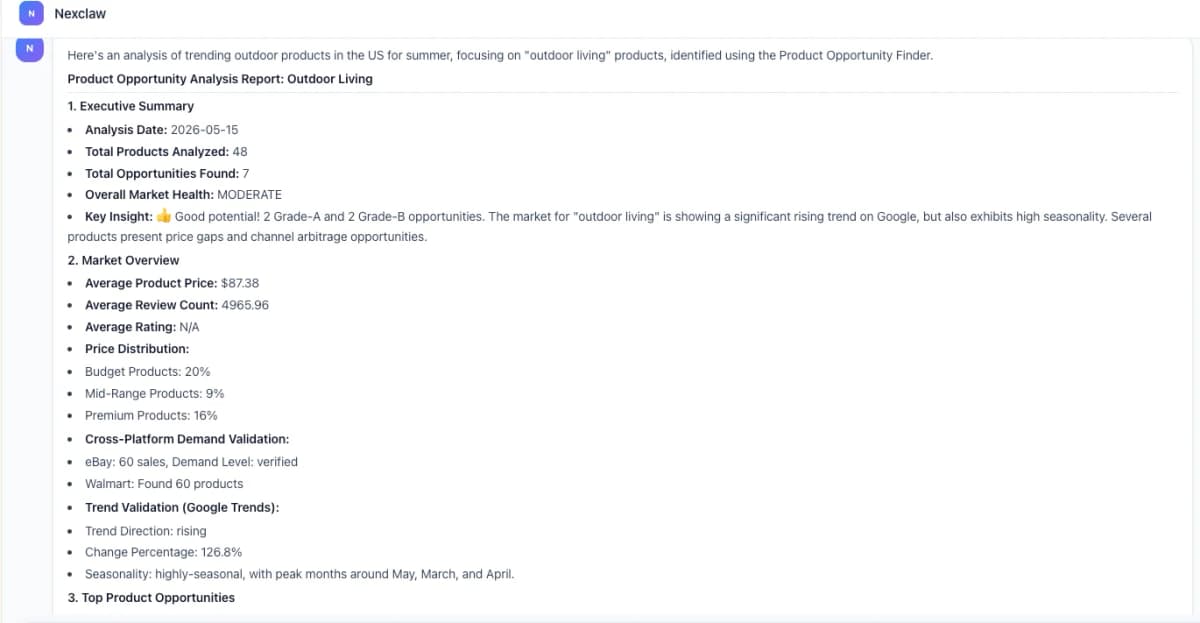
The report includes: - Market health score (is demand growing or declining?) - Top product opportunities ranked by potential - Price distribution (budget vs. mid-range vs. premium) - Seasonality patterns (peak months, trend direction) - Cross-platform validation (demand on eBay, Walmart, Google Trends)
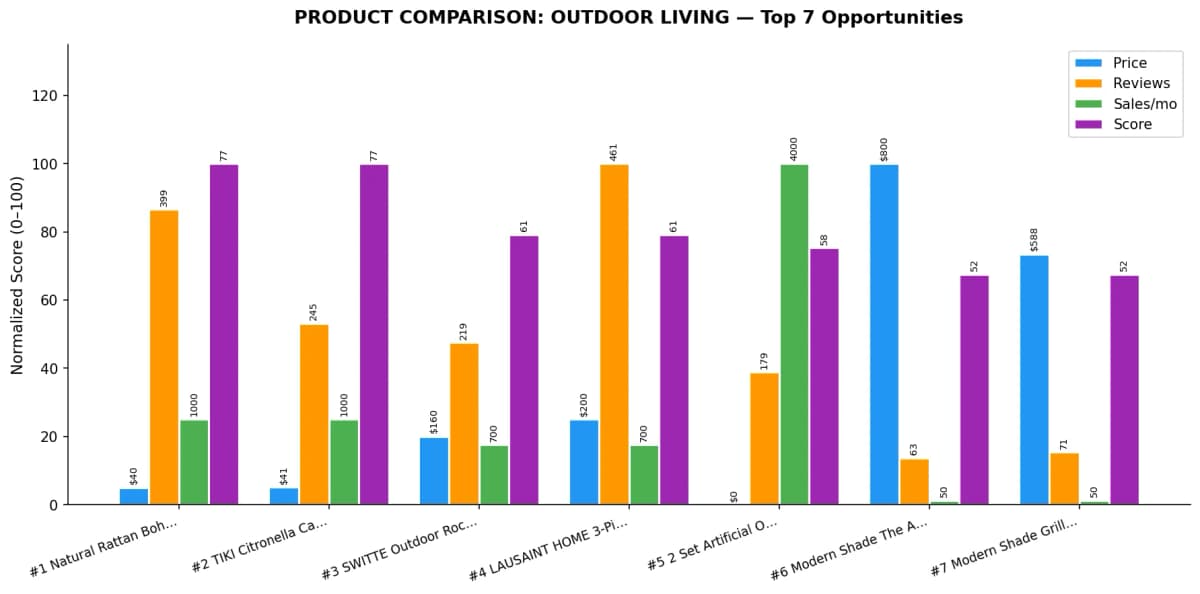
You'll also get a visual comparison of top opportunities:
Validate a Specific Product Idea
Once you have a category in mind, dig deeper:
"Analyze the market opportunity for portable blenders on Amazon US"
"Is the outdoor furniture market saturated? Show me competition levels."
"Find product opportunities in the pet grooming category under $30"
Nexscope returns detailed metrics for each opportunity: - Estimated monthly sales - Average review count (lower = easier to compete) - Price gaps in the market - Opportunity grade (A/B/C ranking)
What to look for: - Monthly search volume: 3,000+ searches - Top 10 competitors: Average reviews under 500 - Price range: $20-$50 (sweet spot for FBA margins) - Not dominated by Amazon's own brands - Opportunity grade A or B
Check Keyword Demand
Validate that buyers are actively searching:
"Find long-tail keywords for silicone ice cube trays"
"What keywords are buyers searching for in the yoga accessories category?"
"Show me keyword opportunities for reusable food storage bags"
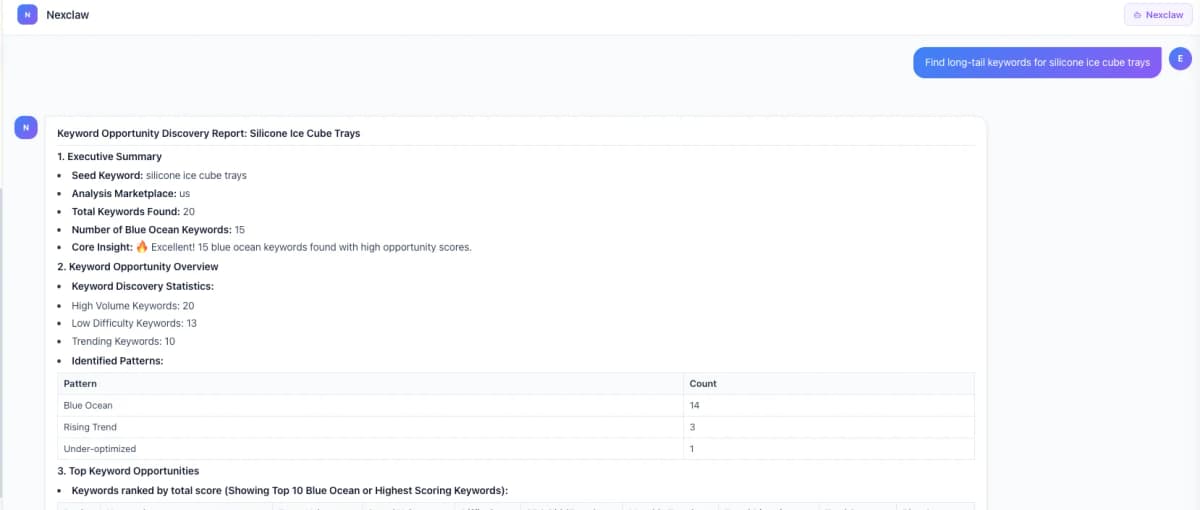
Look for keywords with decent volume (1,000+) but low competition. These become your ranking targets for launch.
Step 2: Analyze the Competition
Before committing, understand who you're competing against.
Competitor Deep Dive
Ask Nexscope to analyze your competition:
"Analyze the top 10 sellers for portable blender on Amazon US"
"What are customers complaining about in reviews for B0XXXXXXXXX?" (paste any competitor ASIN)
"Compare pricing strategies for top sellers in the insulated water bottle category"
"Show me the weakest competitors in the yoga mat niche — low reviews, poor listings"
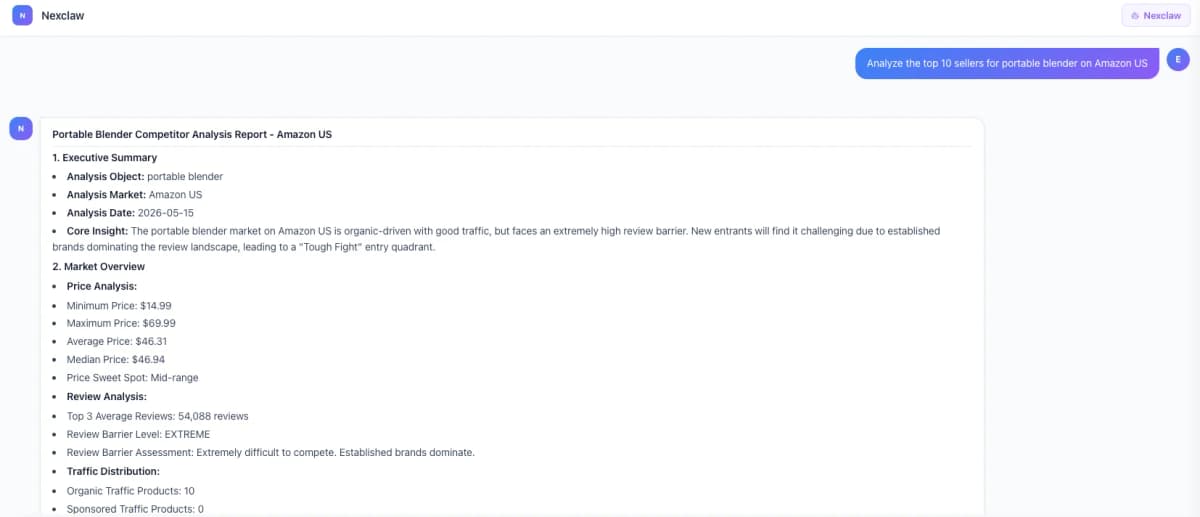
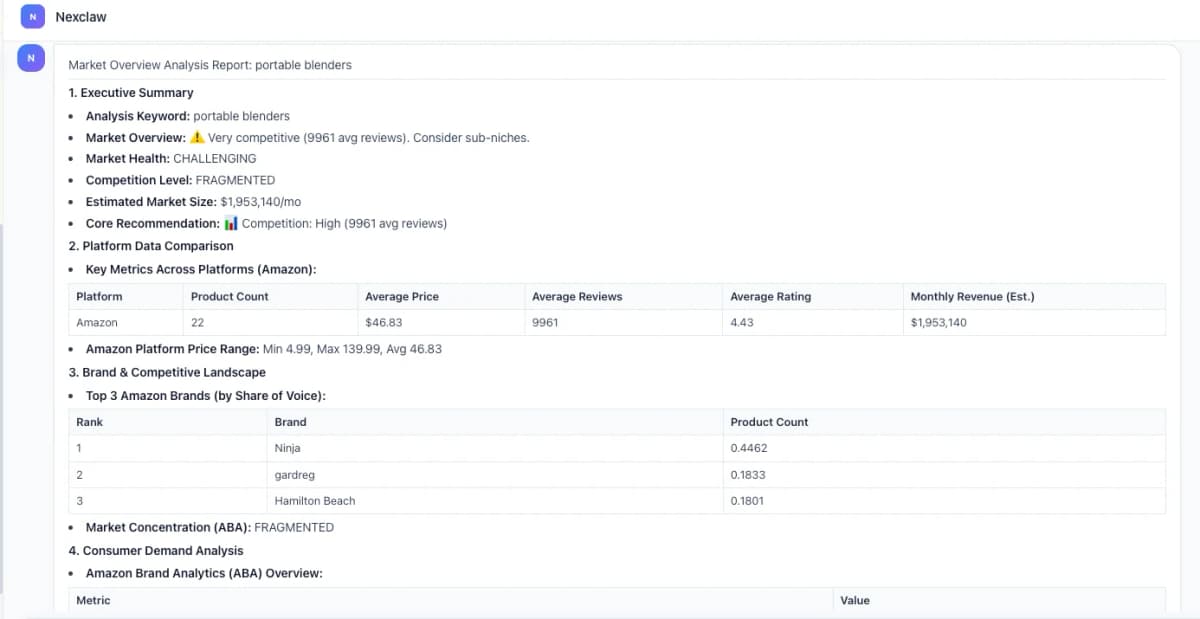
Nexscope will identify: - Review gaps — What are customers unhappy about? This is your differentiation opportunity. - Listing weaknesses — Poor images, weak copy, missing keywords - Price positioning — Where you can fit in the market - Seller type — Brands vs. resellers vs. Amazon itself
Calculate Your Break-Even
Before sourcing, know your numbers:
"Calculate FBA fees for a product weighing 12 oz, dimensions 8x6x4 inches, selling at $29.99"
"What's my profit margin if product cost is $8, selling price $34.99, shipping to FBA is $3?"
"Break down all Amazon fees for a standard-size product at $24.99"
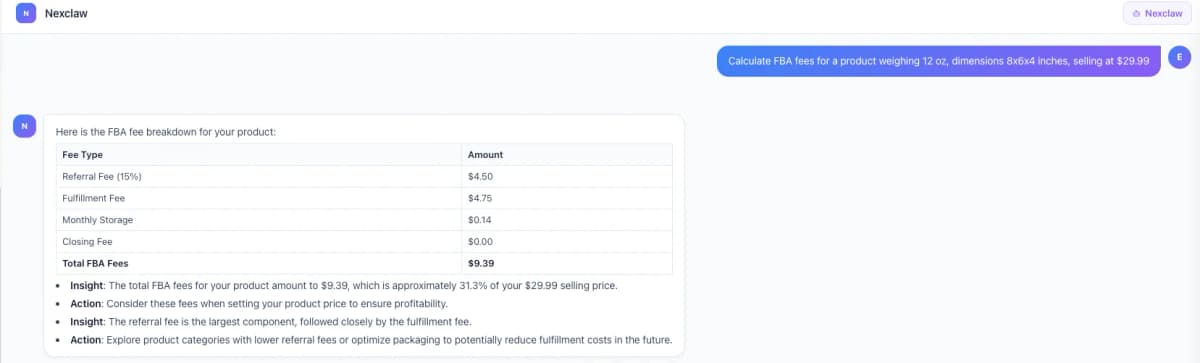
Rule of thumb: Your product cost should be 25-30% of the selling price to maintain healthy margins after Amazon fees.
Step 3: Source Your Product
With a validated product idea, it's time to find suppliers.
Finding Suppliers
For US-based sourcing: - Alibaba.com (international manufacturers) - ThomasNet (US manufacturers) - Faire (wholesale marketplace)
For private label products: - Alibaba.com — Search for manufacturers, request samples - Global Sources — Verified suppliers, trade shows
Quick Supplier Evaluation
Don't overthink this step initially. Here's a fast process:
- Search for your product on Alibaba
- Filter by Trade Assurance, Verified Supplier, 5+ years
- Contact 5-10 suppliers with the same inquiry
- Compare response time, pricing, MOQ, and communication quality
- Order samples from top 3 candidates
Red flags: - Slow responses (>24 hours) - Unwilling to provide samples - No product certifications - Can't answer technical questions
Sample Evaluation Checklist
When samples arrive, check: - [ ] Build quality matches listing photos - [ ] Packaging is retail-ready or acceptable - [ ] No defects or quality issues - [ ] Certifications included (if required) - [ ] Price is competitive after shipping
Step 4: Create Your Amazon Listing
This is where AI really shines. A great listing can double your conversion rate.
AI-Powered Listing Creation
Let Nexscope write your entire listing:
"Write an Amazon listing for a stainless steel insulated water bottle, 32oz, keeps drinks cold 24 hours, targeting gym-goers and hikers"
"Create 5 bullet points for a silicone kitchen utensil set — highlight heat resistance, dishwasher safe, and ergonomic handles"
"Write a product description for a portable blender using these keywords: portable blender, smoothie maker, USB rechargeable, travel blender"
"Generate backend search terms for a bamboo cutting board — include misspellings and Spanish translations"
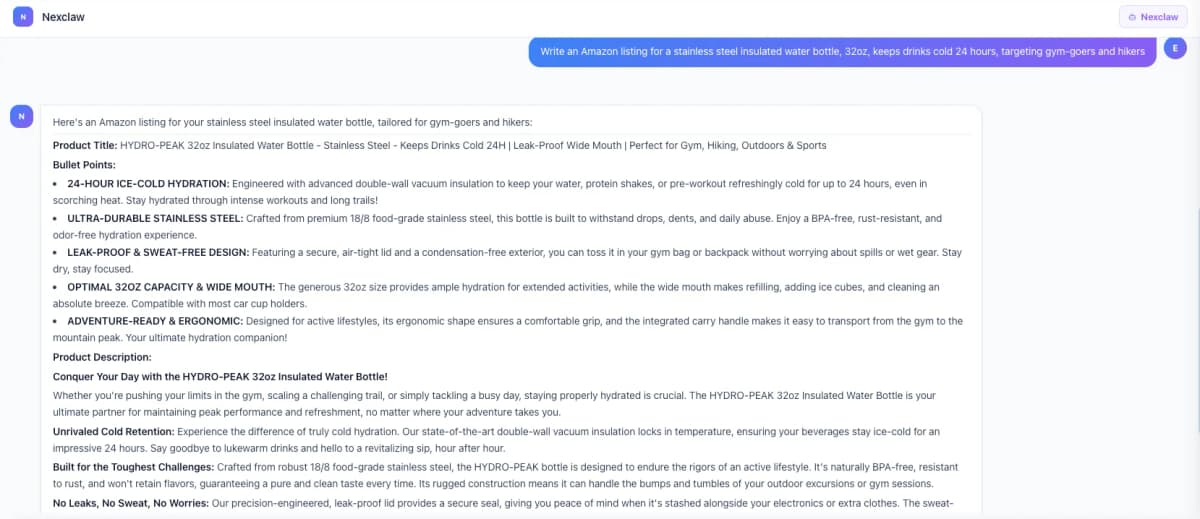
Nexscope generates: - SEO-optimized title (under 200 characters, front-loaded with keywords) - Benefit-focused bullet points (not just features) - Keyword-rich product description (A+ Content ready) - Backend search terms (maximized for discoverability)
Title Formula
Your title should follow this structure:
[Brand] + [Product Name] + [Key Feature] + [Size/Quantity] + [Target Audience]
Example:
"EcoGrip Reusable Water Bottle - Insulated Stainless Steel, Keeps Drinks Cold 24 Hours - 32oz BPA-Free Bottle for Gym & Outdoor"
Bullet Points That Convert
Each bullet should: 1. Lead with a benefit (not a feature) 2. Include a keyword naturally 3. Address a pain point 4. Be scannable (front-load important info)
Bad: "Made of stainless steel material" Good: "KEEPS DRINKS ICE COLD FOR 24 HOURS — Double-wall vacuum insulation means your water stays refreshing from morning commute to evening workout"
Backend Keywords
Don't waste backend keyword space on words already in your title or bullets. Use it for: - Misspellings customers might search - Spanish translations (for US market) - Synonyms and related terms - Competitor brand names (controversial but common)
Step 5: Product Photography
Product images are the #1 factor in click-through rate. Poor images = no sales.
What You Need
Main image: - Pure white background (RGB 255,255,255) - Product fills 85%+ of frame - No text, logos, or watermarks
Secondary images (6-8 recommended): - Lifestyle shots showing product in use - Infographics highlighting features - Size comparison images - Packaging contents ("what's in the box") - Close-up detail shots
DIY Product Photography
You don't need a professional studio:
- Get samples from your supplier
- Set up a lightbox ($30-50 on Amazon)
- Use your smartphone (iPhone or recent Android)
- Take multiple angles in good lighting
- Use AI tools to enhance backgrounds
AI image enhancement: - Remove backgrounds automatically - Generate lifestyle scene backgrounds - Create infographic templates - Upscale image resolution
Outsourcing Option
If photography isn't your strength: - Fiverr: $50-150 per listing - ProductPhotography.com: Professional quality - 3D rendering services: For products not yet manufactured
Step 6: Launch Strategy
Getting your first sales and reviews is the hardest part. Here's a proven launch sequence.
Week 1: Soft Launch
- Price competitively — Start 10-15% below top competitors
- Turn on PPC — Auto campaigns at $10-20/day
- Send to FBA — At least 50-100 units for initial inventory
Week 2-4: Gather Reviews
Legitimate review strategies: - Amazon Vine program (if eligible) - Request a Review button (through Seller Central) - Product insert with QR code to request feedback - Follow-up emails through Amazon's Buyer-Seller messaging
Never: - Offer incentives for reviews - Ask friends/family to review - Use review manipulation services
Week 5+: Optimize and Scale
- Analyze PPC data — Find your profitable keywords
- Adjust pricing — Test different price points
- Improve listing — A/B test titles and images
- Expand keywords — Add new campaigns for long-tail terms
Connect Ecommerce Data to Your Agent
Running a solo Amazon business means wearing every hat. Nexscope provides structured ecommerce data that can be used in focused web tools or connected to an existing Agent through API, MCP, or Skills.
Data Tasks to Run
Product Research:
"Find trending products in the home organization category under $30"
"What niches have high demand but low competition on Amazon US?"
"Is the pet grooming market saturated? Show me the data."
Competitor Analysis:
"Analyze the top 10 sellers for wireless earbuds"
"What are customers complaining about in reviews for B0XXXXXXXXX?"
"Find weak competitors in the yoga accessories niche"
Keyword Research:
"Find long-tail keywords for bamboo cutting boards"
"What keywords should I target to rank for insulated water bottles?"
Listing Creation:
"Write an Amazon listing for a 32oz stainless steel water bottle targeting gym-goers"
"Generate 5 bullet points highlighting durability, temperature retention, and BPA-free materials"
Profit Calculation:
"Calculate FBA fees for a 12oz product, 8x6x4 inches, selling at $29.99"
"What's my margin if product cost is $7 and I sell at $24.99?"
Why This Setup Helps Solo Sellers
Traditional Amazon research requires 5-6 different subscriptions: - Product research tool: $99/month - Keyword tool: $79/month - Competitor tracker: $49/month - Listing optimizer: $39/month - FBA calculator: $29/month
Total: $295/month just to get started.
Nexscope lets sellers add only the ecommerce data capabilities they need to the Agent or internal tools they already use.
Start with a focused web tool, then connect the same capability through API, MCP, or Skills when the workflow is ready.
New users get 1,000 free credits.
Common Mistakes to Avoid
1. Skipping Product Validation
"I think this product will sell" isn't validation. Use data: - Search volume trends - Competition analysis - Review sentiment from existing products
2. Overcomplicating Supplier Selection
You don't need the "perfect" supplier on day one. Order samples from multiple suppliers, pick the best one, and iterate later.
3. Launching with Bad Images
Your product could be amazing, but if photos look amateur, customers will scroll past. Invest in quality images—it's the highest ROI spend you'll make.
4. Ignoring PPC
Organic ranking takes time. PPC gets you visible immediately. Budget at least $500-1,000 for your launch month.
5. Giving Up Too Early
Most products take 3-6 months to gain traction. Don't expect instant results. Track your metrics, optimize continuously, and stay patient.
Your 30-Day Launch Plan
| Day | Task |
|---|---|
| 1-3 | Brainstorm product ideas, validate with Nexscope |
| 4-7 | Deep competitor analysis, identify differentiation |
| 8-10 | Contact suppliers, request quotes and samples |
| 11-14 | Wait for samples |
| 15-17 | Evaluate samples, select supplier, place order |
| 18-21 | Create listing copy with AI, order photography |
| 22-25 | Ship inventory to FBA, finalize listing |
| 26-28 | Launch listing, start PPC campaigns |
| 29-30 | Monitor metrics, make initial optimizations |
Start Your Solo Amazon Journey
The tools exist. The playbook is clear. What's stopping you?
AI has leveled the playing field. You don't need a team, an office, or years of experience. You need a validated product idea, the right tools, and the persistence to execute.
Explore Nexscope Ecommerce Data → — Connect through API, MCP, or Skills, or open a ready seller workflow.
Connect Ecommerce Data to Your Agent
Use Nexscope through API, MCP, or Skills, or open a ready seller workflow.
Explore Ecommerce Data →1,000 free credits • API, MCP & Skills
Frequently Asked Questions
Can I really run an Amazon business alone?
Yes. With AI tools handling research, copywriting, and analysis, solo sellers are building 6-figure businesses. The key is leveraging automation and focusing your time on high-value decisions.
How much money do I need to start?
Plan for $2,000-5,000 minimum: - Product samples: $200-500 - Initial inventory: $1,000-3,000 - Product photography: $100-300 - PPC budget: $500-1,000 - Tools/subscriptions: $100-200
How long until I see profit?
Most new products take 3-6 months to become profitable after accounting for launch costs. Set realistic expectations and focus on building sustainable growth.
What if my first product fails?
It happens. Even experienced sellers have failed products. The key is validating thoroughly before investing heavily, starting with small inventory quantities, and learning from each launch.