

What Is Retail Arbitrage and How Does It Work?

Retail arbitrage is buying products at a discount from retail stores and reselling them on Amazon for a profit. You find clearance items at Walmart, Target, or CVS, scan them with an app to check Amazon prices, and sell the winners through FBA or FBM.
It's one of the lowest-barrier ways to start selling on Amazon—no brand needed, no manufacturer relationships, no minimum orders. Just a smartphone, some cash, and time to hunt for deals.
This guide covers what retail arbitrage is, whether it's still profitable, how to get started, and the best tools to use.
What Is Retail Arbitrage?
Retail arbitrage is a simple business model: buy low at retail stores, sell higher on Amazon.
How It Works in Practice
- You visit stores like Walmart, Target, or CVS
- You scan clearance and sale items with a scanning app
- The app shows you the Amazon selling price and fees
- If there's profit, you buy the item
- You list it on Amazon (FBA or FBM)
- Amazon customer buys it at full price
- You pocket the difference
A Real Example
You find a toy on clearance at Target for $8. Your app shows it sells on Amazon for $24.99. After Amazon fees (~$8) and FBA costs (~$4), you net about $5 profit per unit. You buy all 12 units on the shelf = $60 profit from one product.
Is Retail Arbitrage Legal?
Yes, retail arbitrage is completely legal. Once you buy a product, you own it and can resell it however you want.
First Sale Doctrine
In the United States, the "First Sale Doctrine" gives you the legal right to resell products you've legitimately purchased. This applies to retail arbitrage—you bought it legally, you can sell it legally.
Amazon's Policy
Amazon allows retail arbitrage. You can sell products purchased from retail stores as long as:
- The products are authentic (not counterfeit)
- The products are in new condition
- You're not violating brand restrictions
What Can Go Wrong
Some brands are "gated" on Amazon, meaning you need approval to sell them. If you buy a gated brand without approval, you won't be able to list it. Always check restrictions before buying in bulk.
How Does Retail Arbitrage Work?
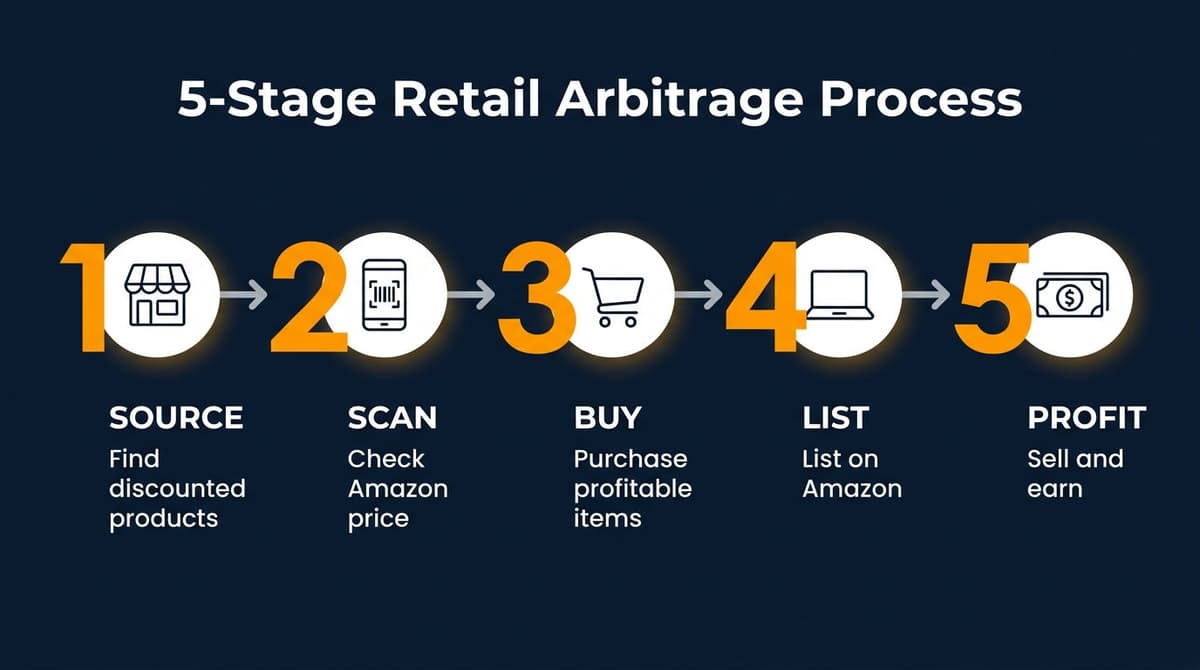
The retail arbitrage process has five main stages:
Stage 1: Sourcing Products
You physically visit retail stores to find discounted products. The best opportunities are:
Where to Look
- Clearance sections and end caps
- Seasonal closeouts (post-holiday, end of season)
- Store-closing sales
- Damaged packaging sections (products still new inside)
Stage 2: Scanning and Analysis
Before buying anything, you scan the barcode with a sourcing app. The app tells you:
Key Data Points
- Current Amazon selling price
- Amazon fees and FBA costs
- Sales rank (how fast it sells)
- Number of competing sellers
- Estimated monthly sales
- Your potential profit
Stage 3: Purchasing
If the numbers work, you buy the product. Most arbitrage sellers look for:
Buying Criteria
- Minimum 30% ROI (return on investment)
- Sales rank under 100,000 in the category
- At least $3-5 profit per unit
- Reasonable competition (not 50+ sellers on the listing)
Stage 4: Listing and Fulfillment
You have two options for selling:
FBA (Fulfillment by Amazon)
Send products to Amazon's warehouse. Amazon handles storage, shipping, and customer service. You get the Prime badge. Higher fees but less work. Learn more about FBA and how it works.
FBM (Fulfillment by Merchant)
You store and ship products yourself. Lower fees but more work. No Prime badge unless you qualify for Seller Fulfilled Prime.
Stage 5: Getting Paid
When your product sells, Amazon deposits funds to your bank account every two weeks (or daily if you enable that option). Your profit is: Sale Price - Product Cost - Amazon Fees - Shipping Costs.
Retail Arbitrage vs Other Amazon Business Models
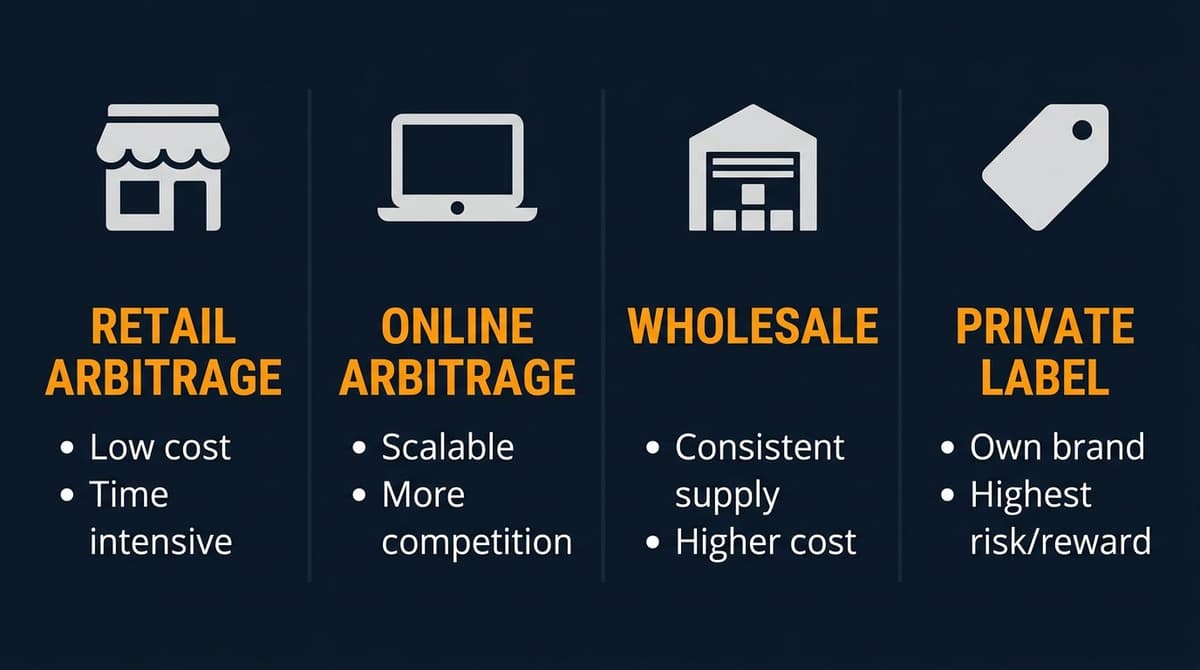
Retail Arbitrage vs Online Arbitrage
| Factor | Retail Arbitrage | Online Arbitrage |
|---|---|---|
| Sourcing | Physical stores | Online retailers |
| Time | Driving + shopping | Computer research |
| Scalability | Limited by geography | More scalable |
| Competition | Less (local finds) | More (everyone sees same deals) |
| Best for | People who enjoy hunting | People who prefer remote work |
Retail Arbitrage vs Wholesale
| Factor | Retail Arbitrage | Wholesale |
|---|---|---|
| Startup cost | $100-500 | $2,000-10,000+ |
| Supplier relationship | None needed | Required |
| Consistency | Unpredictable inventory | Reliable reordering |
| Scalability | Hard to scale | Highly scalable |
| Best for | Beginners | Established sellers |
Retail Arbitrage vs Private Label
| Factor | Retail Arbitrage | Private Label |
|---|---|---|
| Startup cost | $100-500 | $3,000-15,000+ |
| Brand ownership | None | You own the brand |
| Competition | Sharing listings | Own listing (exclusive) |
| Profit margins | 20-40% | 30-70% |
| Risk | Low | Higher upfront |
| Best for | Testing the waters | Building long-term business |
Pros and Cons of Retail Arbitrage
Advantages
1. Low Startup Cost
You can start with $100-500. Buy a few products, sell them, reinvest profits. No need for thousands in inventory upfront.
2. Fast to Start
Create a seller account today, go shopping tomorrow, have products listed by the weekend. No waiting for overseas shipments or manufacturer samples.
3. Learn Amazon Without Big Risk
Before investing in wholesale or private label, retail arbitrage teaches you how Amazon works—listings, fees, FBA, customer expectations—with minimal risk.
4. Immediate Cash Flow
Products often sell within days or weeks. Compare that to private label where you might wait months to see returns.
5. The Thrill of the Hunt
Many arbitrage sellers genuinely enjoy the treasure-hunt aspect. Finding a $50 item marked down to $5 is exciting.
Disadvantages
1. Time-Intensive
You're trading time for money. Driving to stores, walking aisles, scanning hundreds of products—it adds up. This isn't passive income.
2. Hard to Scale
Your income is limited by how many stores you can visit. You can't just "order more" like with wholesale. Growing requires hiring people or transitioning to other models.
3. Inconsistent Inventory
Found a winning product? Great—but what happens when the store runs out? Retail arbitrage has unpredictable supply, making it hard to build a stable business.
4. Competition
When you find a clearance deal, other arbitrage sellers might find it too. Racing to the bottom on price can kill margins.
5. Restrictions and Gating
Some brands and categories require approval to sell. You might buy products you can't actually list.
How to Start Retail Arbitrage (Step-by-Step)
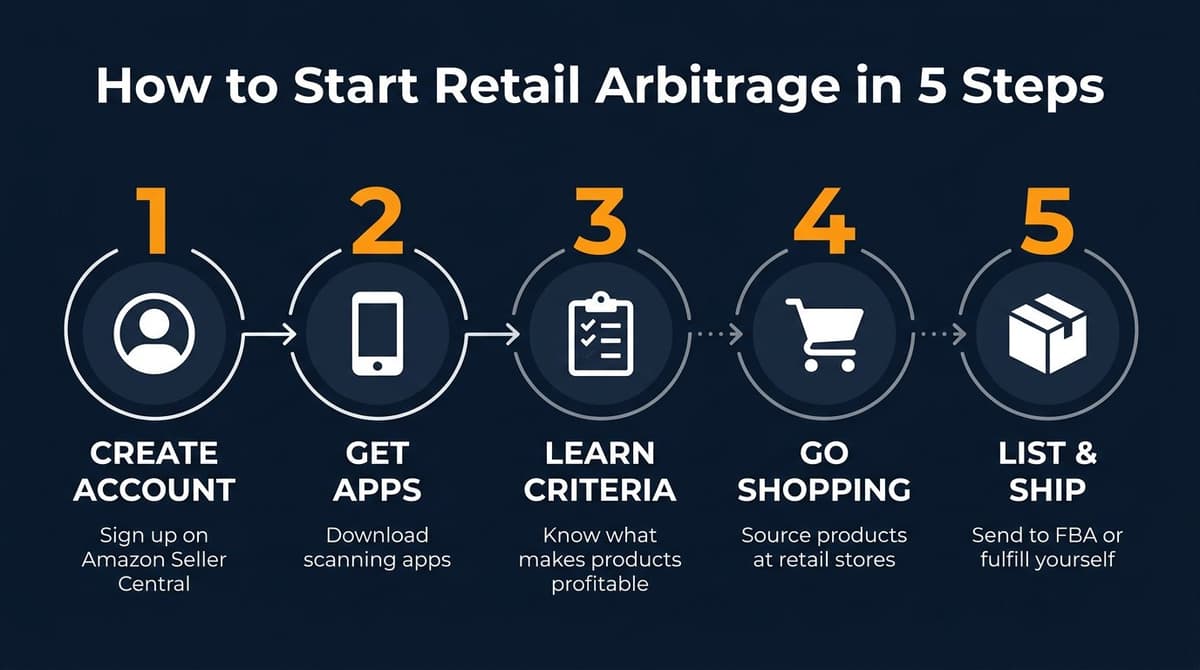
Step 1: Create an Amazon Seller Account
Go to sellercentral.amazon.com and sign up.
Which Plan to Choose
- Individual Plan: Free, but $0.99 per item sold. Good if selling <40 items/month.
- Professional Plan: $39.99/month, no per-item fee. Better for serious sellers.
Start with Individual if you're just testing. Upgrade when you're selling consistently.
Step 2: Download Scanning Apps
You need an app to scan products and see Amazon data.
Free Option
Amazon Seller App — Free with your seller account. Shows price, fees, sales rank, and restrictions. Enough for beginners.
Paid Options
- Scoutify (InventoryLab): ~$69/month. Better profit calculations, historical data.
- ScanPower: ~$39/month. Good for beginners upgrading from free.
- Profit Bandit: One-time $15. Budget-friendly step up.
Step 3: Learn What to Look For
Before you shop, understand what makes a product worth buying.
Criteria for Profitable Products
- ROI > 30%: If you're making less than 30% return, it's often not worth the effort.
- Sales Rank < 100,000: In most categories, this means the product actually sells. Lower is better.
- Profit > $3-5: Small profits get eaten by mistakes, returns, and price drops.
- < 10 FBA Sellers: Too many sellers means price competition.
Step 4: Start Sourcing
Time to hit the stores.
Beginner-Friendly Approach
- Pick one store (Walmart or Target)
- Go to the clearance section
- Scan every item with a yellow clearance sticker
- Look for 30%+ ROI with decent sales rank
- Buy small quantities (2-5 units) to test
- Track what sells and what doesn't
What to Scan First
- Toys (especially post-holiday)
- Health & personal care
- Grocery (limited categories)
- Home & kitchen
- Office supplies
Step 5: List and Ship Your Products
Once you've bought products, get them on Amazon.
FBA Route
- Create shipment in Seller Central
- Label products with FNSKU barcodes
- Pack in boxes meeting Amazon's requirements
- Ship to assigned fulfillment center
- Wait for check-in (usually 3-7 days)
FBM Route
- List products as Merchant Fulfilled
- Store at your location
- Ship when orders come in (within handling time)
- Provide tracking to Amazon
Best Stores for Retail Arbitrage
Tier 1: Clearance Goldmines
Walmart
Clearance in almost every aisle. Look for items with prices ending in $.03 or marked "Clearance." Hidden clearance often in back corners.
Target
Excellent clearance sections. End caps with red stickers. Post-holiday toy clearance is legendary.
CVS and Walgreens
Health, beauty, and seasonal items. Often 75% off clearance. Smaller stores mean less competition.
Tier 2: Worth Checking
Kohl's
Home goods, toys, apparel accessories. Frequent 70-80% off clearance events.
Big Lots
Already discounted prices plus clearance. Grocery and home goods.
HomeGoods / TJ Maxx / Marshalls
Unique finds, but harder to match to Amazon listings. Better for experienced sellers.
Tier 3: Occasional Wins
Staples / Office Depot
Office supplies, tech accessories. Store closing sales are great.
Bed Bath & Beyond (if still open in your area)
Kitchen gadgets and home items.
Best Retail Arbitrage Apps
Free Apps
| App | Cost | Best For |
|---|---|---|
| Amazon Seller App | Free | Beginners, basic scanning |
| eBay App | Free | Cross-listing research |
Paid Apps
| App | Cost | Best For |
|---|---|---|
| Scoutify (InventoryLab) | $69/month | Serious sellers, accounting integration |
| ScanPower | $39/month | Mid-level sellers |
| Profit Bandit | $15 one-time | Budget upgrade from free |
| ScoutIQ | $30/month | Book arbitrage specifically |
What to Look for in a Scanning App
Must-Have Features
- Real-time Amazon price and fees
- Sales rank and Buy Box info
- Restriction alerts (gated products)
- Profit calculator
Nice-to-Have Features
- Historical price data
- Keepa integration
- Multi-marketplace support
- Inventory management
Tips for Success
Manage Your Time
Efficiency Tips
- Plan routes hitting multiple stores in one trip
- Go early morning (restocked shelves, fewer crowds)
- Don't scan everything—focus on clearance and deals
- Set a time limit per store (45-60 minutes)
Avoid Restricted Products
Before Buying in Bulk
- Open Amazon Seller App
- Scan the product
- Look for "You can't sell this product" warnings
- Check if approval is available (sometimes you can apply)
Track Your Numbers
Know Your Metrics
- Cost of goods (what you paid)
- Selling price (what you got)
- All fees (referral, FBA, shipping to Amazon)
- Actual profit per item
- ROI by store, category, and product type
Use a spreadsheet or tool like InventoryLab to track everything. What gets measured gets improved.
Don't Ignore Returns
Returns Eat Profits
Amazon's generous return policy means some products come back. Factor a 5-10% return rate into your calculations. Some categories (apparel, electronics) have higher return rates.
Conclusion
Retail arbitrage is buying low at stores and selling higher on Amazon. It's legal, accessible, and a great way to learn Amazon selling without massive upfront investment.
The reality: It's more work than passive income gurus suggest. You're trading time for money, and scaling is hard. But for beginners, side hustlers, or anyone who enjoys the treasure hunt, it's a legitimate way to make money.
Best for: - Learning how Amazon works - Starting with limited capital - Testing products before committing to wholesale or private label - Making extra income in your spare time
Not ideal for: - Building a "hands-off" business - Scaling to six figures without transitioning to other models - People who hate shopping
If you're on the fence, start small. Invest $100, go to one store, and see if you enjoy the process. The skills you learn transfer directly to bigger Amazon business models.
Ready to Scale Beyond Arbitrage?
Once you understand what sells, Nexscope can add structured product, keyword, and competitor data to focused web tools or the Agent environment a team already uses.
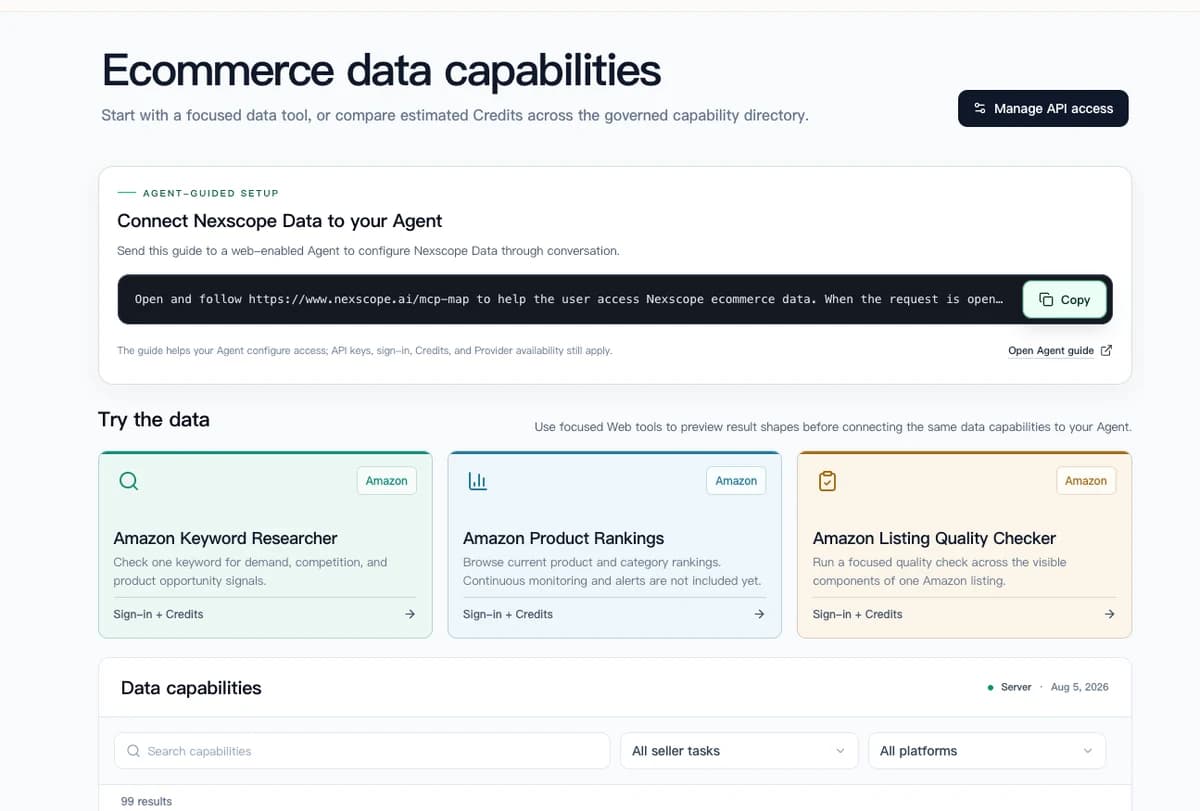
Connect Ecommerce Data to Your Agent
Use Nexscope through API, MCP, or Skills, or open a ready seller workflow.
Explore Ecommerce Data →1,000 free credits • API, MCP & Skills
FAQs
Is retail arbitrage still profitable in 2026?
Yes, but it's more competitive than it was 5-10 years ago. Success requires efficiency, good sourcing locations, and smart product selection. Many sellers still earn $1,000-5,000/month doing it part-time.
How much money do I need to start retail arbitrage?
You can start with as little as $100-200. Buy a few products, sell them, reinvest profits. Most successful sellers recommend starting with $300-500 to have enough variety.
Is retail arbitrage allowed on Amazon?
Yes. Amazon explicitly allows selling products purchased from retail stores, as long as they're authentic and in new condition. However, some brands and categories are restricted (gated).
What products sell best for retail arbitrage?
Toys (especially Q4), health and beauty, grocery items, home goods, and office supplies tend to work well. Look for clearance items with sales rank under 100,000 and at least 30% ROI.
Can I do retail arbitrage part-time?
Absolutely. Many sellers do it evenings and weekends, earning extra income without quitting their day job. Even 5-10 hours a week can produce meaningful results.
What's the difference between retail arbitrage and online arbitrage?
Retail arbitrage sources from physical stores; online arbitrage sources from websites (Walmart.com, Target.com, etc.). Online arbitrage is more scalable but often has tighter margins and more competition.
Sources
- Amazon Seller Central: Selling Policies and Guidelines
- First Sale Doctrine (17 U.S.C. § 109)
- Jungle Scout: State of the Amazon Seller Report 2026