

What to Sell on Amazon in 2026 (Beginner's Guide)

Deciding what to sell on Amazon is the most important decision you'll make as a new seller. Pick the right product, and you're on your way to a profitable business. Pick the wrong one, and you'll burn through cash before making your first sale.
The good news: finding profitable products isn't about luck or insider knowledge. It's about understanding what makes a product succeed on Amazon and validating your ideas with data before you invest.
This guide walks you through exactly what to look for, which categories work best for beginners, and how to make sure your product idea is worth pursuing.
What Makes a Good Amazon Product
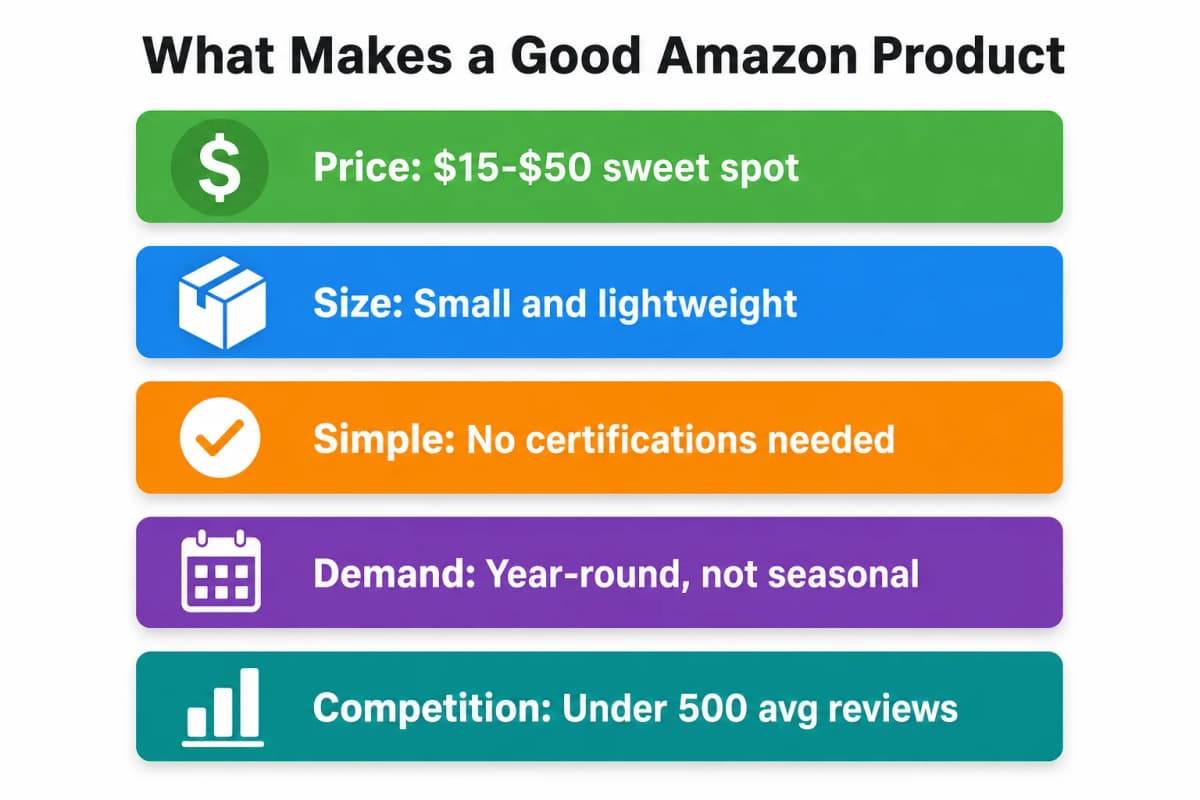
Before looking at specific products or categories, understand the criteria that separate winners from money pits.
The Ideal Price Range
Products priced between $15 and $50 hit the sweet spot for Amazon FBA:
- Under $15: Margins are too thin after Amazon fees. You need high volume to make money, which requires more capital and risk.
- $15-50: Customers buy without overthinking. Impulse purchases are common. Margins are healthy after fees.
- Over $50: Customers research more carefully. Competition with established brands intensifies. Returns cost more.
Size and Weight Matter
Amazon FBA fees are based on product dimensions and weight. Smaller, lighter products mean:
- Lower fulfillment fees
- Lower storage fees
- Cheaper shipping from suppliers
- Easier inventory management
Target: Products that fit in a small standard-size box (under 1 lb if possible).
Avoid Complexity
As a beginner, stay away from products that require:
- Certifications: Electronics, food, supplements, children's products, and cosmetics often need safety certifications that cost thousands and take months.
- Fragile handling: Glass, ceramics, and delicate items break during shipping, leading to returns and negative reviews.
- Variations overload: Products with 20 color/size combinations multiply your inventory investment and complexity.
- Batteries: Lithium batteries have strict shipping requirements and can get your listings suspended.
Consistent Demand
Look for products people need year-round, not just during holidays or specific seasons:
- Good: Kitchen organizers, phone accessories, pet supplies
- Risky: Halloween costumes, pool floats, Christmas decorations
Seasonal products can work, but they require precise timing and leave you with dead inventory if you miss the window.
Competition You Can Beat
The best opportunities have:
- Top 10 competitors with fewer than 500 reviews on average
- No Amazon-branded products dominating the first page
- Listings with obvious weaknesses (poor images, weak copy, missing features)
- Price gaps you can fill
If the first page is dominated by listings with 10,000+ reviews, breaking in will be extremely difficult and expensive.
Best Product Categories for Beginners
Some categories are friendlier to new sellers than others. Here's where to focus:
Home and Kitchen
Why it works: - Massive category with endless subcategories - Many products are simple to manufacture - Low certification requirements for most items - Customers always looking for organization and convenience solutions
Examples: Drawer organizers, cutting boards, kitchen utensil holders, spice racks, cabinet organizers, dish drying mats.
Pet Supplies
Why it works: - Pet owners spend freely on their animals - Emotional purchases with less price sensitivity - Repeat purchase potential (consumables) - Growing market as pet ownership increases
Examples: Pet grooming tools, food bowls, leash accessories, pet beds, training aids, travel carriers.
Sports and Outdoors
Why it works: - Active lifestyle trend continues growing - Many products are lightweight and compact - Accessory opportunities around major equipment - Seasonal peaks but baseline demand year-round
Examples: Resistance bands, yoga accessories, camping utensils, bike accessories, hiking gear organizers.
Office Products
Why it works: - Remote work has expanded the home office market - Products are typically small and lightweight - Low complexity, few certification needs - Consumable and replacement items drive repeat purchases
Examples: Desk organizers, monitor stands, cable management, notebook holders, ergonomic accessories.
Automotive Accessories
Why it works: - Car owners constantly look for convenience upgrades - Low competition in many subcategories - Products are typically durable (fewer returns) - High search volume, low complexity
Examples: Phone mounts, seat organizers, trunk organizers, sun shades, cleaning accessories.
Categories to Avoid as a Beginner
Some categories look attractive but create headaches for new sellers:
Electronics
Problems: - Certification requirements (FCC, UL) - High defect rates and returns - Rapid obsolescence - Dominated by established brands - Liability concerns
Clothing and Fashion
Problems: - Size and fit issues cause high return rates - Inventory complexity (sizes × colors = many SKUs) - Fashion trends change quickly - Photography and modeling costs - Brand loyalty is strong
Health and Beauty
Problems: - FDA regulations for supplements and cosmetics - Ingredient restrictions vary by country - Expiration dates create inventory risk - High liability if products cause reactions - Gated category requiring approval
Toys and Games
Problems: - Strict safety certifications (CPSIA, ASTM) - Heavy seasonality (Q4 dominates) - Large brands dominate - Kids' products face intense scrutiny
Food and Grocery
Problems: - Expiration dates and storage requirements - FDA facility registration - Labeling requirements - Cold chain logistics for some products - Low margins, high competition
How to Validate Your Product Idea
Having a product idea is just the start. Before investing money, validate that the opportunity is real.
The traditional approach involves juggling multiple tools: keyword research software, competitor trackers, FBA calculators, and review analyzers. Each costs money and takes time to learn.
Nexscope provides structured ecommerce data and focused seller workflows. Teams can use Nexscope's web tools directly or connect governed capabilities to their existing Agent through API, MCP, or Skills. Ready workflows include Keyword to Ads, Video Clone, and Buy Box Repricer.
Here's how to validate any product idea with Nexscope:
Check Search Demand
High search volume means customers are actively looking for this product. Copy this prompt into Nexscope:
"What's the search volume for silicone kitchen utensil sets on Amazon?"
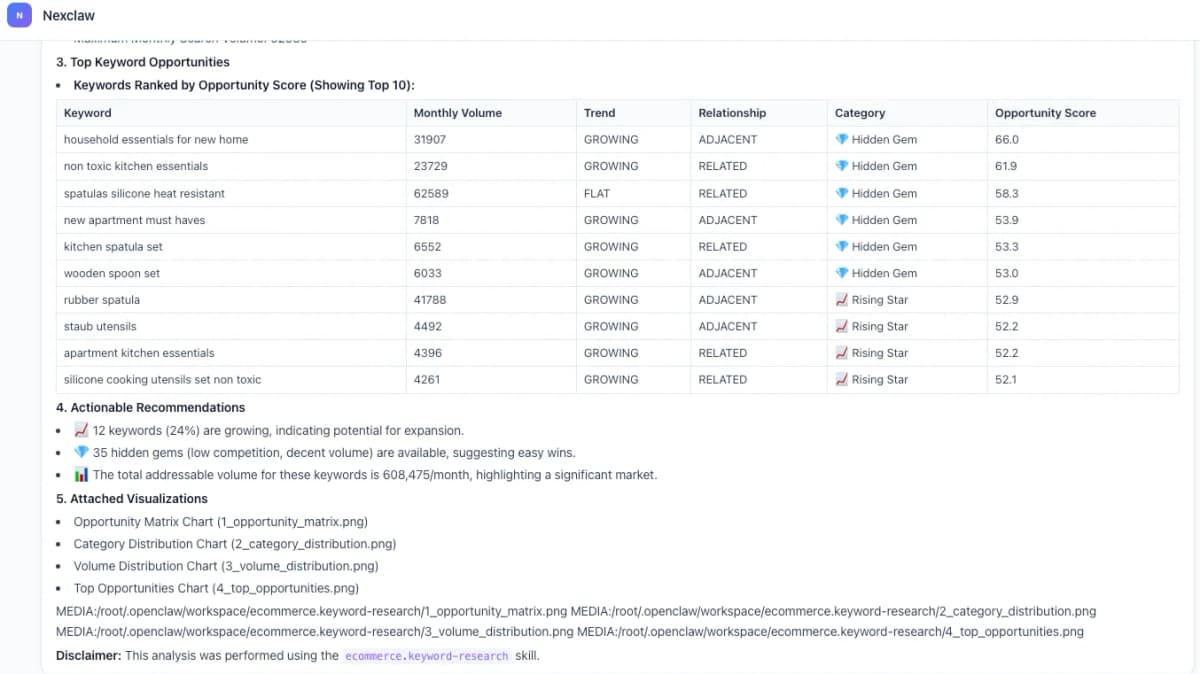
Nexscope returns a complete keyword research report — search volume, competition level, related keywords, and opportunity scores:
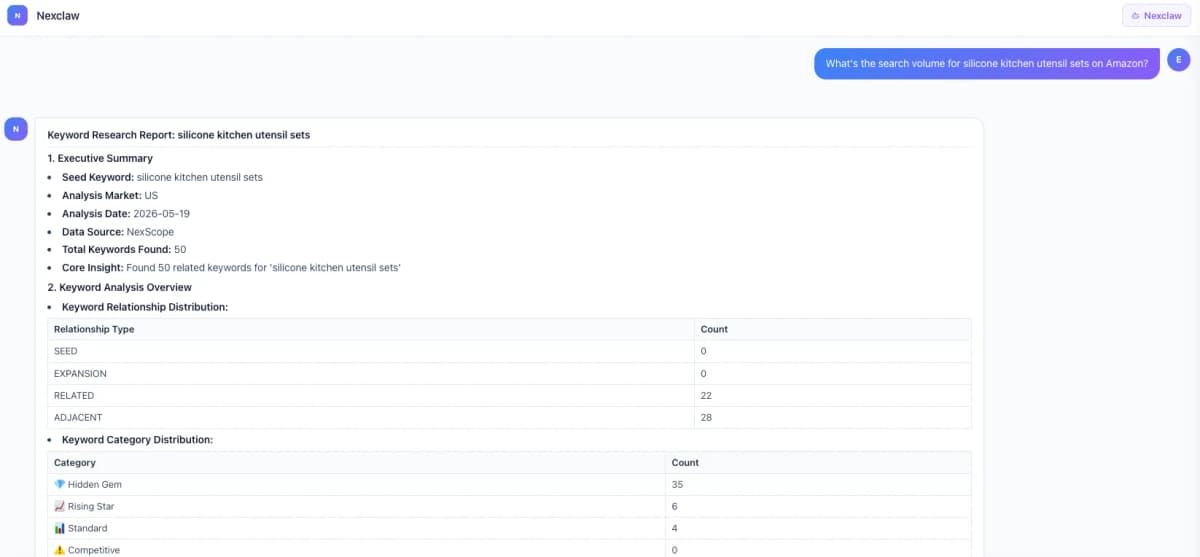
The report identifies "Hidden Gems" (low competition, decent volume) and "Rising Stars" (growing trends) — exactly what you need for product selection.
More prompts to try:
"Is demand growing or declining for portable laptop stands?"
"Show me seasonal trends for outdoor camping accessories"
Look for products with at least 3,000 monthly searches. Lower volume can work in specialized niches, but you'll have a smaller ceiling.
Analyze the Competition
Understanding who you're competing against is crucial. Try these prompts:
"Analyze the top 10 sellers for bamboo drawer organizers"
"What's the average review count for top sellers in the pet grooming category?"
"Find weak competitors in the desk organization niche"
Green flags: - Average reviews under 500 - Some listings with poor images or weak copy - Price gaps in the market - Complaints in reviews you can solve
Red flags: - Multiple listings with 5,000+ reviews - Amazon's own brands on page one - Prices so low margins would be impossible - Identical products from dozens of sellers
Calculate Your Margins
Before committing, make sure the numbers work:
"Calculate FBA fees for a 12oz product, dimensions 8x6x4 inches, selling at $24.99"
"What's my profit margin if product cost is $6, selling price $22.99, and shipping to FBA is $2.50?"
Target: At least 30% net margin after all costs. Lower margins leave no room for advertising, mistakes, or market changes.
For detailed profit calculations, see our guide on how to use Amazon FBA Calculator.
Read Competitor Reviews
Customer reviews reveal what existing products get wrong. This is your opportunity to differentiate:
"What are customers complaining about in reviews for silicone baking mats?"
"What features do customers wish pet water fountains had?"
For a complete methodology, see our guide on how to analyze Amazon reviews.
The Bottom Line on Validation
With Nexscope, you can validate a product idea in 10 minutes instead of spending hours across multiple tools. You'll know:
- Demand: Is anyone actually searching for this product?
- Competition: Can you realistically compete?
- Margins: Will you make money after all fees?
- Opportunities: What keywords and angles should you target?
This data-driven approach eliminates guesswork and prevents costly mistakes.
Try Nexscope Free → — Get 3 days free with 1,000 credits to validate your product ideas.
Product Ideas That Work in 2026
Now that you understand the selection criteria and validation process, you might be wondering: what's actually selling well right now?
We maintain a regularly updated list of high-demand products across multiple categories. Check out our complete guide: 20 High-Demand Products to Sell in 2026.
That guide covers specific product opportunities in: - Home and kitchen - Pet supplies - Health and wellness - Tech accessories - Outdoor and fitness
Each product recommendation includes demand data, competition analysis, and profit potential — so you can validate opportunities quickly using the criteria from this guide.
From Idea to Validation with Nexscope
Finding the right product to sell requires research across multiple dimensions: demand, competition, margins, and customer sentiment.
Nexscope provides structured ecommerce data and focused seller workflows. Teams can use Nexscope's web tools directly or connect governed capabilities to their existing Agent through API, MCP, or Skills. Ready workflows include Keyword to Ads, Video Clone, and Buy Box Repricer.
"Find product opportunities in home organization under $25 with low competition"
"Is the resistance band market too saturated for a new seller?"
"Compare the pet grooming and pet feeding categories for a beginner seller"
"What products are trending in the office accessories category?"
Nexscope analyzes real market data and returns actionable insights: opportunity scores, competition levels, margin estimates, and specific product recommendations.
New users get 3 days free with 1,000 credits — enough to research multiple categories and validate your product ideas before spending a dollar on inventory.
Common Mistakes to Avoid
Chasing Trends Too Late
By the time you see a product going viral on social media, dozens of sellers have already placed orders. You'll arrive when the market is saturated and prices have crashed.
Instead: Look for steady demand growth, not spikes.
Ignoring the Math
Excitement about a product idea often overshadows realistic profit analysis. Always calculate: - Product cost + shipping to Amazon - FBA fulfillment fees - FBA storage fees - Advertising budget (assume 15-20% of revenue initially) - Returns and refunds (budget 3-5%)
Copying Exactly What's Selling
If you sell the exact same product as established competitors, you're competing purely on price and reviews — a battle you'll lose as a new seller.
Instead: Find what's missing. Better packaging, improved features, addressing specific complaints.
Over-Diversifying Too Early
Launching 10 products at once spreads your capital, attention, and learning too thin. Most successful sellers started with one product, learned the process, then expanded.
Instead: Pick your best opportunity. Master it. Then add products.
Skipping Product Research
Some new sellers pick products based on personal interest or hunches. Your passion for a product doesn't mean customers will buy it.
Instead: Let data drive decisions. Validate demand before investing.
Your Next Steps
Finding what to sell on Amazon comes down to this:
- Understand the criteria — Price range, size, complexity, demand consistency
- Focus on beginner-friendly categories — Home, pets, office, sports accessories
- Validate with data — Search volume, competition, margins, reviews
- Differentiate — Don't just copy; improve on what exists
- Start with one product — Master it before expanding
The sellers who succeed don't have secret products or inside information. They do the research, validate their ideas, and execute consistently.
Ready to Find Your First Product?
Stop guessing and start researching. Nexscope gives you instant access to the market data you need to make confident product decisions.
Connect Ecommerce Data to Your Agent
Use Nexscope through API, MCP, or Skills, or open a ready seller workflow.
Explore Ecommerce Data →1,000 free credits • API, MCP & Skills
Frequently Asked Questions
What is the most profitable thing to sell on Amazon?
Profitability depends on your specific costs, not just the product category. Generally, products priced $20-40 with low competition and healthy margins (30%+) perform best for new sellers. Home organization, pet supplies, and office accessories often fit these criteria.
How much money do I need to start selling on Amazon?
Plan for $2,000-5,000 minimum to launch your first product properly. This covers initial inventory, product samples, photography, and advertising budget for launch. Starting with less is possible but limits your options significantly.
Can I sell on Amazon without inventory?
Yes, through retail arbitrage (buying discounted products to resell), online arbitrage, or wholesale. However, private label (your own branded products) typically offers better long-term margins and control. See our guide on Amazon dropshipping for alternatives.
How do I find products that aren't saturated?
Look for subcategories within popular niches. "Kitchen organization" is competitive, but "under-sink pull-out organizer for cleaning supplies" might have fewer competitors. Use specific, long-tail keywords to find these opportunities.
Should I sell products I'm personally interested in?
Personal interest helps with motivation but shouldn't override data. You need to enjoy the process, but your product choice should be validated by market demand and competition analysis, not just personal preference.
How long does it take to make money on Amazon?
Most new products take 3-6 months to become profitable after accounting for launch costs. Expect to reinvest profits initially to build reviews and rankings. Sustainable profitability typically comes after 6-12 months.
Sources
- Amazon Seller Central. (2026). FBA Fee Structure. Retrieved from sellercentral.amazon.com
- Jungle Scout. (2026). State of the Amazon Seller Report. Retrieved from junglescout.com
- Helium 10. (2026). Amazon Market Trends Analysis. Retrieved from helium10.com