

How to Do Amazon Competitor Analysis (Step-by-Step Guide)

Amazon competitor analysis is the process of studying rival sellers to understand their strategies, strengths, and weaknesses. Sellers who skip this step often waste money on products that can't compete or miss obvious opportunities hiding in plain sight.
This guide covers how to identify competitors, what data to collect, and how to turn those insights into actionable improvements for your own listings.
What Is Amazon Competitor Analysis?
Amazon competitor analysis means systematically studying other sellers in your market to understand:
- What products they sell and at what prices
- How they optimize their listings (titles, bullets, images)
- How customers respond (reviews, ratings)
- Their sales performance (BSR trends)
- Their advertising strategy (sponsored vs organic)
Why Competitor Analysis Matters
1. Avoid Entering Losing Battles
Some markets have entrenched competitors with thousands of reviews and rock-bottom prices. Competitor analysis reveals these barriers before investing in inventory.
2. Find Gaps and Opportunities
Competitors often miss keywords, ignore customer complaints, or leave price gaps. These are opportunities waiting to be exploited.
3. Improve Your Own Listings
Studying what works (and what doesn't) for competitors provides a blueprint for optimization.
4. Track Market Changes
Markets evolve. New competitors enter, prices shift, and customer preferences change. Regular analysis keeps sellers informed.
How to Identify Your Amazon Competitors
Not every seller in your category is a true competitor. Focus on those actually competing for the same customers.
Direct Competitors
These sell nearly identical products at similar price points. They appear in the same search results and compete for the same keywords.
How to Find Them
- Search your main keyword and note the first 10-20 organic results
- Look at the "Customers also viewed" section on your listing
- Check the "Compare with similar items" table
Indirect Competitors
These sell substitute products that solve the same problem differently. A seller of glass water bottles competes indirectly with stainless steel bottle sellers.
Why They Matter
- They may capture customers who would otherwise buy from you
- Their growth could signal shifting customer preferences
Which Competitors to Track
Don't try to track everyone. Focus on:
- Top 5-10 organic results for your main keywords
- Products with similar price points (within 20% of your price)
- New entrants gaining momentum (rising BSR, growing reviews)
What to Analyze in Competitor Listings
Once competitors are identified, dig into the details.
Title and Keywords
The title reveals which keywords competitors prioritize.
What to Look For
- Primary keyword placement (first 80 characters)
- Secondary keywords included
- Brand positioning
- Feature highlights
Questions to Ask
- Are there high-value keywords they're missing?
- Do they keyword-stuff or write naturally?
- How does their title compare to yours?
Bullet Points and Description
Bullet points show how competitors communicate value.
What to Analyze
- Which benefits do they lead with?
- What features do they emphasize?
- How do they handle objections?
- Do they use formatting effectively?
Images and A+ Content
Visual presentation significantly impacts conversion.
What to Compare
- Main image quality and style
- Infographic usage
- Lifestyle photography
- A+ Content structure and messaging
Pricing Strategy
Price positioning affects both conversion and profit margins.
What to Track
- Current price vs historical price
- Price relative to competitors
- Coupon and deal usage
- Subscribe & Save discounts
Reviews and Ratings
Reviews reveal customer sentiment and product weaknesses.
What to Look For
- Overall rating and review count
- Common complaints (1-3 star reviews)
- Praised features (4-5 star reviews)
- Recent review trends (improving or declining?)
Sales Performance (BSR)
Best Seller Rank indicates relative sales velocity.
What to Monitor
- Current BSR and category
- BSR trends over time (stable, rising, falling)
- BSR spikes (indicating promotions or external traffic)
Put Ecommerce Data to Work
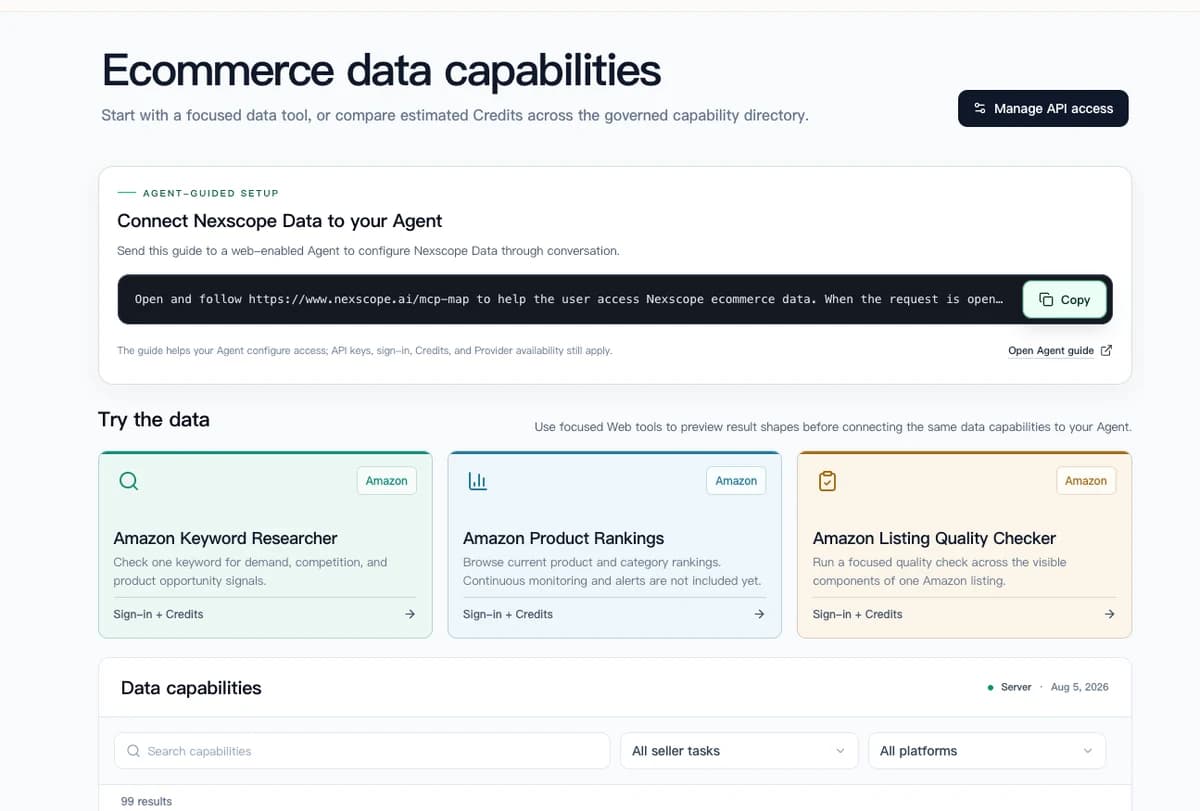
Manually collecting competitor keywords, rankings, listing details, reviews, and price signals takes hours. Nexscope gives ecommerce teams structured data they can use in focused web tools or connect to an existing Agent through API, MCP, or Skills.
Nexscope acts as the data and workflow layer behind the decision. Sellers can keep the Agent environment they already use, bring in governed ecommerce capabilities, and move from research to execution.
Connect Data to Your Agent
The Nexscope Ecommerce Data directory provides focused capabilities for marketplace research. For Amazon competitor analysis, useful starting points include:
- Amazon Keyword Researcher for demand, competition, and product opportunity signals
- Amazon Product Rankings for current product and category ranking views
- Amazon Listing Quality Checker for reviewing the visible components of a competitor listing
- Marketplace data capabilities for product discovery, keyword intelligence, reviews, price history, traffic, and market research where a live Provider is available
Teams can access these capabilities in three ways:
- API for products, dashboards, and internal automations
- MCP for compatible Agents that need structured ecommerce context
- Skills for packaging repeatable seller tasks inside an Agent workflow
API keys, sign-in, Credits, and live Provider availability still apply to each request.
Move From Research to Execution
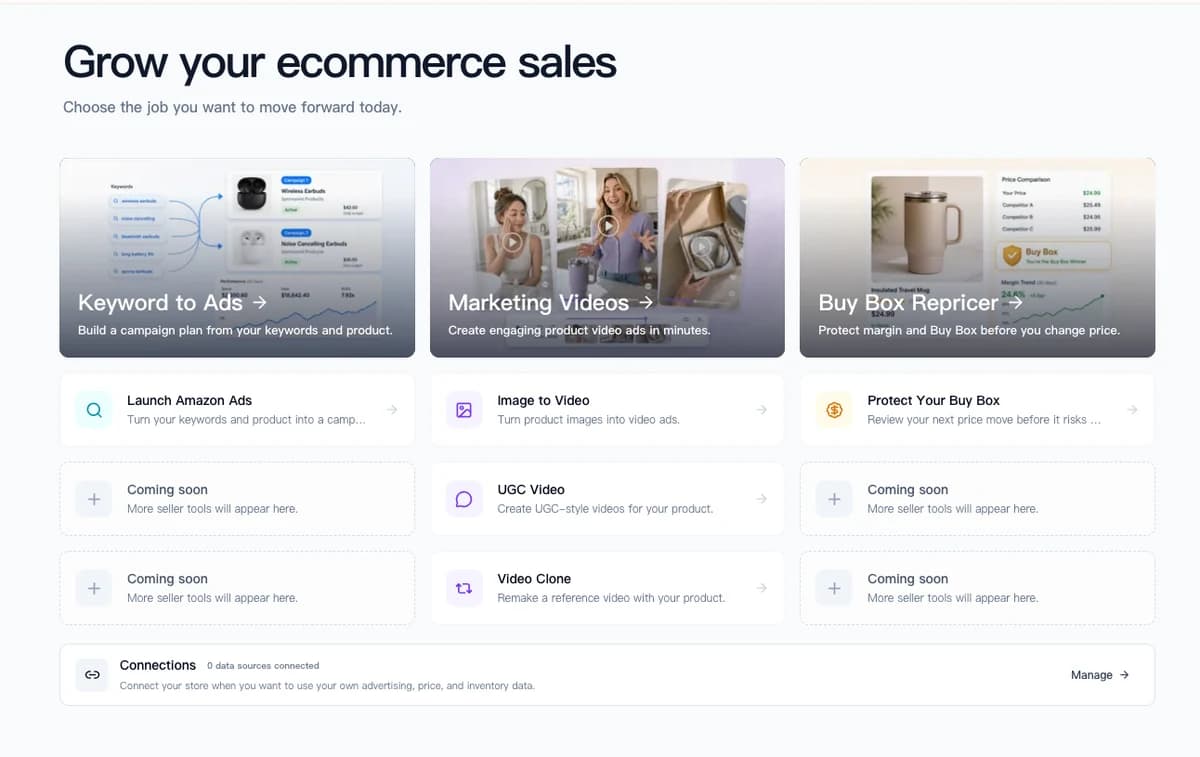
Nexscope also packages three high-value seller jobs into focused workflows:
- Keyword to Ads turns keyword and product evidence into a review-ready Amazon campaign plan.
- Video Clone remakes a reference video with the seller's verified product inputs.
- Buy Box Repricer evaluates price moves against margin and Buy Box guardrails before a change is made.
Competitor evidence becomes more useful when it can feed the next decision. Keyword gaps can move into campaign planning, competitor creative can inform a video remake, and pricing signals can support a controlled repricing review. Human review remains part of each workflow before execution.
How to Use Competitor Insights
Data without action is worthless. Here's how to apply competitor analysis.
-
Find Keyword Gaps — Compare competitor keywords to your own listing. Missing high-volume keywords represent immediate optimization opportunities. Validate them with the Amazon Keyword Researcher, then move approved terms into the Keyword to Ads workflow.
-
Improve Your Listing — Identify what top competitors do well and adapt those elements. If competitors use infographics effectively, create your own. If their bullet points address specific objections, do the same. If their A+ Content tells a brand story, develop yours.
-
Adjust Pricing Strategy — Understand where your price sits relative to competitors. If positioned as premium, ensure your listing justifies the price. If competing on value, highlight cost savings. Consider strategic price points (e.g., $19.99 vs $21.99).
-
Address Customer Pain Points — Competitor reviews reveal product weaknesses across the market. If customers complain about durability, emphasize your product's quality. If packaging issues appear frequently, highlight your secure packaging. Use competitor complaints as bullet point content.
-
Monitor Ongoing Changes — Competitor analysis isn't a one-time task. Set up monthly competitor reviews, track BSR trends for early warning signs, and monitor new entrants to your market.
Common Competitor Analysis Mistakes
-
Only Analyzing the #1 Competitor — The top-ranked product isn't always the best benchmark. They may have advantages (brand recognition, review count) that are impossible to replicate. Better approach: Analyze competitors at similar stages—those with comparable review counts and time in market.
-
Ignoring Review Analysis — Many sellers look at competitor listings but skip the reviews. This misses crucial customer insights. Better approach: Read at least 50-100 reviews per competitor, focusing on 1-3 star feedback.
-
Analyzing Once and Forgetting — Markets change constantly. A competitor analysis from six months ago may be completely outdated. Better approach: Schedule quarterly deep-dive analysis and monthly quick checks.
-
Copying Instead of Differentiating — The goal isn't to become a clone. It's to understand the market and find your unique position. Better approach: Use competitor analysis to identify gaps and opportunities, not to replicate.
-
Focusing Only on Top Sellers — Rising competitors often signal market shifts before they're obvious. Better approach: Track new entrants with improving BSR and growing review counts.
Conclusion
Amazon competitor analysis reveals what's working in your market and where opportunities exist. The sellers who win aren't necessarily those with the best products—they're the ones who understand their competitive landscape and adapt accordingly.
Start by identifying true competitors, analyze their listings systematically, and turn those insights into concrete improvements for your own business.
To move beyond manual research, Nexscope provides ecommerce data that teams can use directly or connect to their own Agent through API, MCP, or Skills. The same evidence can then move into Keyword to Ads, Video Clone, and Buy Box Repricer workflows.
New users get 3 days free with 1,000 credits. No credit card is required.
Connect Ecommerce Data to Your Agent
Use Nexscope through API, MCP, or Skills, then move from research into focused seller workflows.
Explore Ecommerce Data →1,000 free credits • API, MCP & Skills
Frequently Asked Questions
How often should I analyze competitors?
Conduct a deep-dive analysis quarterly and quick checks monthly. Monitor BSR trends weekly for your top 5 competitors to catch significant changes early.
How many competitors should I track?
Focus on 5-10 direct competitors. More than that becomes unmanageable without automation tools. Prioritize those at similar price points and review counts.
Can I see a competitor's backend keywords?
Not directly—Amazon doesn't expose backend search terms. However, reverse ASIN tools can estimate which keywords a competitor ranks for based on their search visibility.
What's the most important competitor metric?
It depends on your goals. For market entry decisions, review count and BSR matter most. For listing optimization, focus on their keyword strategy and customer feedback.
Should I analyze competitors on other platforms?
Yes, if they sell on multiple channels. A competitor's Shopify store or eBay listings may reveal additional keywords, pricing strategies, or product variations.
How do I track competitor price changes?
Use price history data to establish a baseline, then review price moves in Nexscope's Buy Box Repricer. Manual tracking works for a few competitors but becomes impractical at scale.
Sources
- Amazon Seller Central. (2026). Competitive Analysis Best Practices. Retrieved from sellercentral.amazon.com
- Jungle Scout. (2025). Amazon Competitor Research Guide. Retrieved from junglescout.com
- Feedvisor. (2025). E-commerce Competitive Intelligence Report. Retrieved from feedvisor.com