
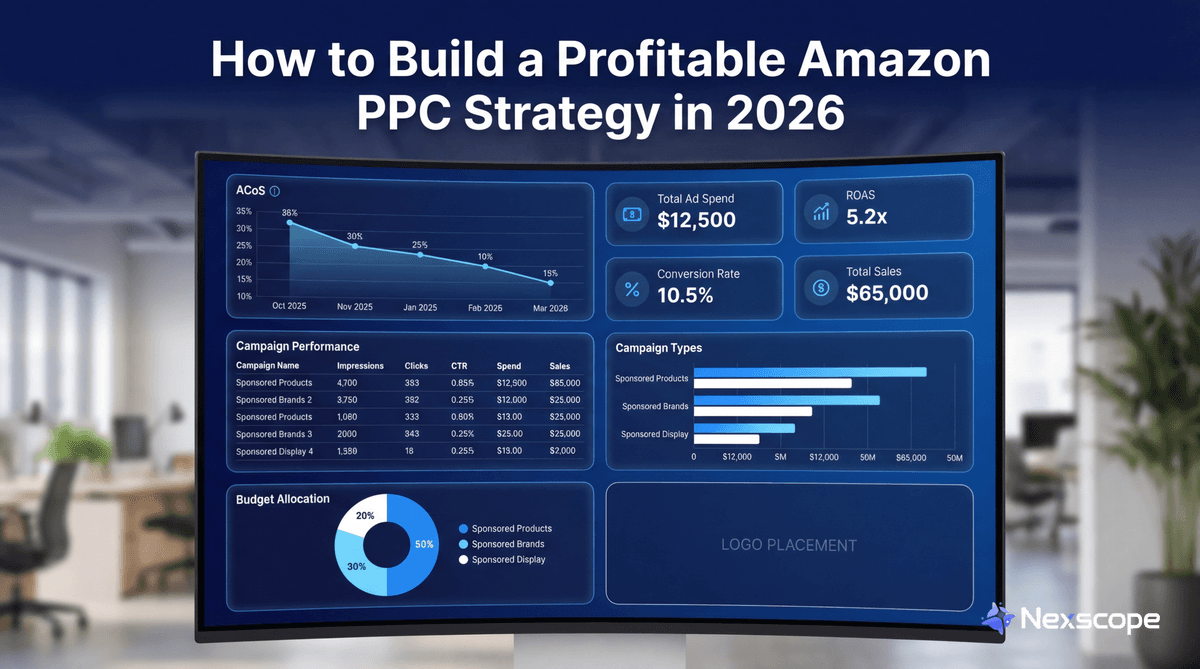
How to Build a Profitable Amazon PPC Strategy in 2026

Amazon PPC has become essential for sellers in 2026. Organic ranking alone no longer guarantees visibility. Thousands of new products launch daily, and competition for search placement intensifies every quarter. Sellers who master paid advertising gain a significant advantage over those relying solely on organic traffic.
This guide covers everything needed to build a profitable Amazon PPC strategy. From campaign structure and keyword research to bid optimization and AI automation, each section provides actionable steps that reduce ACoS and increase sales.
What Is Amazon PPC and Why It Matters in 2026
Amazon PPC (Pay-Per-Click) is Amazon's advertising platform where sellers pay only when shoppers click their ads. These ads appear in search results, on product detail pages, and across Amazon's network of sites.
How Amazon PPC Works
The system operates like an auction. Sellers bid on keywords relevant to their products. When a shopper searches for those keywords, Amazon runs an instant auction among all advertisers targeting that term. The winners appear in sponsored placements.
Amazon considers two factors when selecting winners:
- Bid amount — The maximum price a seller will pay per click
- Relevance score — How well the product matches the search query
A higher bid does not guarantee the top position. A product with strong conversion history and listing quality can outrank higher bidders because Amazon prioritizes shopper experience.
Why PPC Is Essential for New Sellers
New products face a cold start problem. Without sales history, Amazon has no data to determine organic ranking. PPC solves this by generating immediate visibility and sales velocity.
These early sales create a feedback loop:
- PPC drives initial sales
- Sales improve organic ranking
- Higher ranking brings organic traffic
- Organic sales reduce reliance on paid ads
For established sellers, PPC defends market share against competitors and captures shoppers searching for category terms rather than specific brands.
The 3 Amazon Ad Types You Need to Know
Amazon offers three primary ad formats. Each serves a different purpose in the advertising funnel.
Sponsored Products (Your Primary Driver)
Sponsored Products ads appear directly in search results and on product detail pages. They look nearly identical to organic listings, marked only by a small "Sponsored" label.
These ads drive the highest return on investment for most sellers because they capture shoppers with immediate purchase intent. Budget allocation typically ranges from 60% to 80% of total ad spend on Sponsored Products.
Sponsored Brands (Brand Building)
Sponsored Brands ads display a brand logo, custom headline, and multiple products in a banner format at the top of search results. Only sellers enrolled in Amazon Brand Registry can access this ad type.
These ads work best for:
- Building brand awareness
- Driving traffic to Amazon Storefronts
- Capturing category-level searches
Sponsored Brands typically receive 10% to 20% of total ad budget.
Sponsored Display (Retargeting)
Sponsored Display ads reach shoppers both on and off Amazon. They appear on product detail pages, customer review pages, and external websites in Amazon's advertising network.
The primary use case is retargeting shoppers who viewed a product but did not purchase. Conversion rates for retargeting campaigns often reach 2x to 4x higher than cold traffic campaigns.
💡 Pro Tip: AI coding agents like OpenClaw, Claude Code, and Codex can automate PPC campaign setup. Copy this command into your AI agent to install the Amazon PPC skill:
npx skills add nexscope-ai/Amazon-Skills --skill amazon-ppc-campaign -gOnce installed, simply ask your AI agent to generate campaign structures, calculate target ACoS, or get bid recommendations based on your product margins.
Step 1 — Keyword Research That Actually Converts
Keyword research determines which searches trigger your ads. Poor keyword selection wastes budget on irrelevant clicks. Strategic keyword research targets shoppers ready to buy.
Finding High-Intent Keywords
High-intent keywords signal purchase readiness. These terms typically include:
- Product type + modifier (wireless earbuds for running)
- Brand + product (Sony headphones)
- Problem + solution (waterproof phone case)
Avoid informational keywords that attract researchers rather than buyers. Terms like "best wireless earbuds" or "earbuds comparison" indicate early-stage research with lower conversion probability.
Long-Tail vs Short-Tail Strategy
Short-tail keywords (1-2 words) have high search volume but intense competition and lower conversion rates. Examples include "earbuds" or "phone case."
Long-tail keywords (3+ words) have lower search volume but higher conversion rates and lower cost-per-click. Examples include "wireless earbuds with long battery life" or "waterproof phone case for iPhone 15."
A balanced strategy targets both:
- Short-tail keywords for visibility and brand awareness
- Long-tail keywords for efficient conversions and lower ACoS
Using Search Term Reports
Search Term Reports reveal the actual queries that triggered your ads. This data identifies:
- Converting terms to add as exact match keywords
- Non-converting terms to add as negative keywords
- New keyword opportunities from customer language
Review Search Term Reports weekly. Move high-performing search terms into dedicated campaigns with higher bids.
💡 Pro Tip: Use your AI agent to mine long-tail keywords from Amazon's autocomplete across 12 marketplaces. Install with
npx skills add nexscope-ai/Amazon-Skills --skill amazon-keyword-research -gto discover keywords competitors miss.
Step 2 — Campaign Structure for Maximum Control
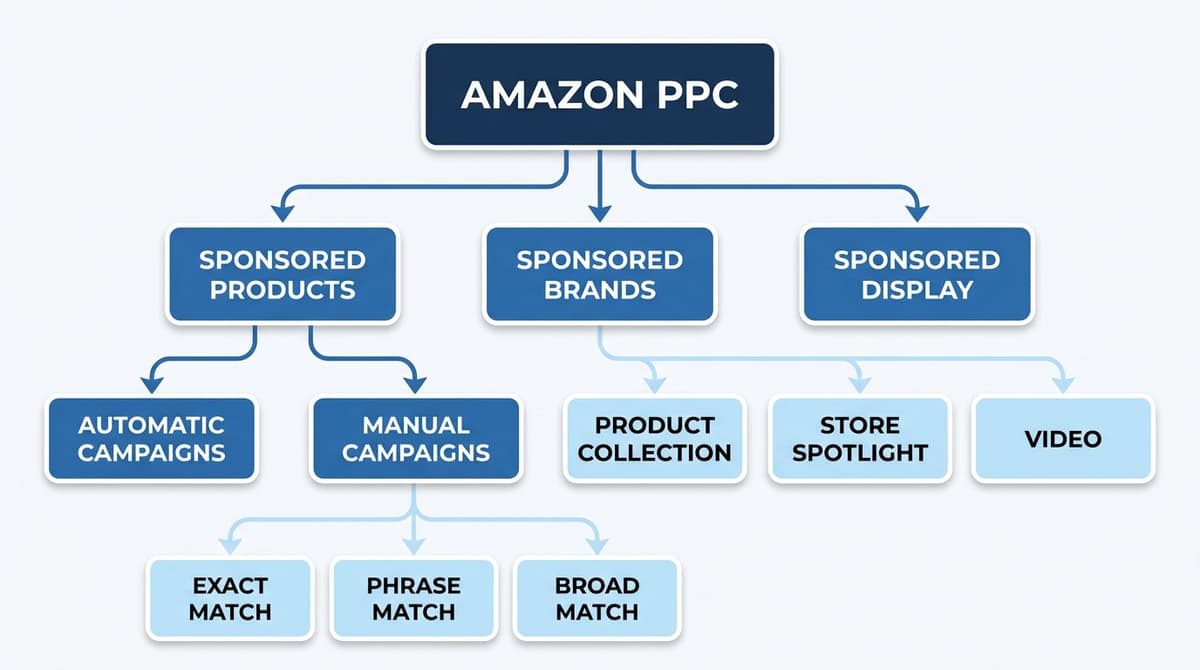
Campaign structure determines how easily you can optimize performance. Poor structure creates confusion and wasted spend. Clean structure enables precise control over every dollar.
Automatic vs Manual Campaigns
Automatic campaigns let Amazon choose which keywords trigger your ads based on listing content. These campaigns serve two purposes:
- Keyword discovery for new products
- Catching long-tail variations you might miss
Manual campaigns give full control over keyword targeting. You choose exactly which terms to bid on and how much to pay.
The recommended approach uses both:
- Launch automatic campaigns to gather keyword data
- Analyze Search Term Reports after 2-3 weeks
- Move winning keywords to manual campaigns
- Keep automatic campaigns running at lower bids for ongoing discovery
Single Keyword Ad Groups (SKAG)
Single Keyword Ad Groups contain one keyword per ad group. This structure provides maximum control over bid adjustments and performance tracking.
Benefits of SKAG structure:
- Precise bid control per keyword
- Clear performance attribution
- Easy identification of winners and losers
The trade-off is management complexity. Start with SKAG for your top 20-30 keywords, then group similar keywords together for the long tail.
Budget Allocation by Campaign Type
Budget allocation varies by product lifecycle and goals. A common starting framework:
| Campaign Type | Budget % | Purpose |
|---|---|---|
| Sponsored Products - Exact | 40% | High-intent conversions |
| Sponsored Products - Phrase | 20% | Moderate reach |
| Sponsored Products - Auto | 15% | Keyword discovery |
| Sponsored Brands | 15% | Brand building |
| Sponsored Display | 10% | Retargeting |
Adjust percentages based on performance data. If Exact match campaigns deliver strong ACoS, shift more budget there.
Step 3 — Bidding Strategies That Protect Margins
Bidding directly impacts profitability. Overbidding erodes margins. Underbidding loses visibility to competitors. Strategic bidding balances both.
Understanding Bid Types
Amazon offers three bidding strategies:
Fixed bids — Amazon uses your exact bid amount without adjustment. Best for testing and gathering baseline data.
Dynamic bids (down only) — Amazon reduces bids when conversion is unlikely. Safer option that protects against wasted spend.
Dynamic bids (up and down) — Amazon increases bids up to 100% for high-conversion opportunities and decreases for low-conversion situations. Higher risk but can capture competitive placements.
New campaigns should start with Dynamic bids (down only) until sufficient data exists to justify the up-and-down option.
Setting Target ACoS by Product
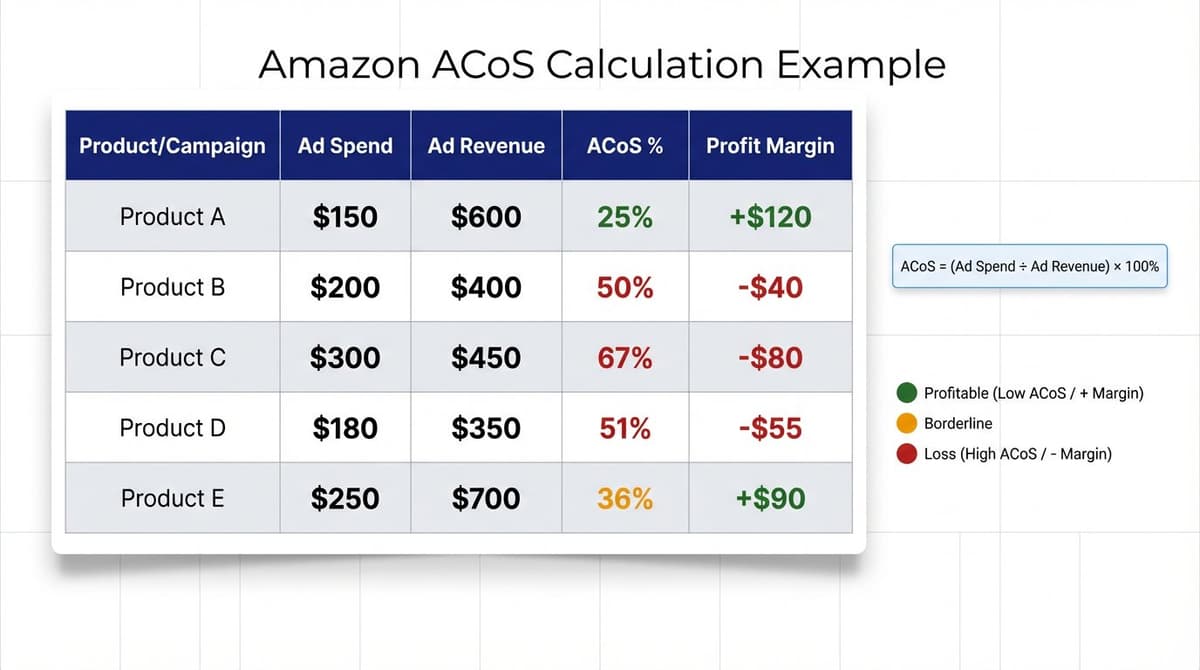
ACoS (Advertising Cost of Sales) measures ad spend as a percentage of ad revenue. The formula:
ACoS = (Ad Spend ÷ Ad Revenue) × 100
Target ACoS depends on profit margins. Calculate your break-even ACoS first:
Break-even ACoS = Profit Margin %
If a product has a 30% profit margin before advertising, the break-even ACoS is 30%. Any ACoS below 30% generates profit. Any ACoS above 30% loses money on that sale.
Target ACoS typically sits 5-10 percentage points below break-even to ensure healthy profits.
When to Use Dynamic Bidding
Dynamic bids (up and down) work best when:
- Products have strong conversion history
- Listing quality scores are high
- Sufficient budget exists to handle bid increases
- Competition requires aggressive placement
Avoid dynamic bidding on:
- New products without conversion data
- Low-margin products where bid increases eliminate profit
- Categories with unpredictable conversion patterns
Step 4 — Optimization Cycle (Weekly Routine)
PPC success requires consistent optimization. Set a weekly routine to review performance and make adjustments.
Monitoring ACoS and TACoS
ACoS measures advertising efficiency for ad-attributed sales only.
TACoS (Total Advertising Cost of Sales) measures ad spend against total sales, including organic. The formula:
TACoS = (Ad Spend ÷ Total Revenue) × 100
TACoS reveals the true impact of advertising on overall business health. A rising ACoS with stable TACoS indicates PPC is driving organic growth.
Weekly monitoring targets:
- ACoS by campaign and keyword
- TACoS trend over 4-week periods
- Conversion rate changes
- Click-through rate (CTR) patterns
Negative Keyword Harvesting
Negative keywords prevent ads from showing on irrelevant searches. Without them, budgets leak to non-converting terms.
Weekly negative keyword process:
- Pull Search Term Report
- Filter for terms with 15+ clicks and zero orders
- Review each term for relevance
- Add irrelevant terms as negative exact keywords
- Add patterns (like "free" or "cheap") as negative phrase keywords
Aggressive negative keyword management can reduce wasted spend by 15-25% within the first month.
Scaling Winners, Killing Losers
Not all keywords deserve equal investment. Weekly optimization identifies which keywords to scale and which to pause.
Scale winners: - Keywords with ACoS below target and consistent conversions - Increase bids by 10-15% to capture more impressions - Consider creating dedicated campaigns for top performers
Kill losers: - Keywords with ACoS 2x above target after 1000+ impressions - Reduce bids by 20-30% or pause entirely - Reallocate budget to proven performers
Common Amazon PPC Mistakes to Avoid
Most sellers make predictable mistakes that drain budgets. Avoiding these errors accelerates profitability.
Mistake 1: Launching without proper listing optimization PPC drives traffic, but listings convert that traffic. Poor images, weak copy, or missing A+ Content waste ad spend on visitors who never purchase. Optimize listings before scaling ads.
Mistake 2: Ignoring Search Term Reports Search Term Reports contain the actual queries triggering your ads. Sellers who skip this data miss keyword opportunities and continue paying for irrelevant clicks.
Mistake 3: Setting and forgetting campaigns PPC requires ongoing optimization. Campaigns left untouched become inefficient as competition changes and keyword performance shifts.
Mistake 4: Targeting only high-volume keywords High-volume keywords attract the most competition and highest CPCs. Long-tail keywords often deliver better ACoS despite lower volume.
Mistake 5: No negative keyword strategy Without negative keywords, Amazon shows ads on partially relevant searches that rarely convert. Regular negative keyword updates are essential.
💡 Pro Tip: Before running PPC, ensure your listings are fully optimized. Use your AI agent with
npx skills add nexscope-ai/Amazon-Skills --skill amazon-listing-optimization -gto audit listings and identify conversion blockers.
How AI Is Changing Amazon PPC in 2026
Artificial intelligence has transformed Amazon advertising. Manual optimization alone cannot compete with AI-assisted campaign management.
Automated Bid Management
AI tools analyze performance data continuously and adjust bids faster than any human operator. These systems:
- React to conversion pattern changes within hours
- Adjust bids based on time-of-day performance
- Optimize across hundreds of keywords simultaneously
- Predict seasonal shifts before they impact performance
Sellers using AI bid management typically see 10-20% ACoS improvements compared to manual optimization alone.
AI-Powered Keyword Discovery
Traditional keyword research relies on tools that report historical data. AI systems identify emerging keywords before they become competitive by analyzing:
- Search trend velocity
- Competitor keyword gaps
- Seasonal pattern predictions
- Cross-category keyword relationships
Early adoption of emerging keywords provides a significant advantage before CPC inflation.
Nexscope provides structured ecommerce data that teams can use in focused web tools or connect to their existing Agent through API, MCP, or Skills. Ready workflows include Keyword to Ads, Video Clone, and Buy Box Repricer.
Conclusion
Building a profitable Amazon PPC strategy in 2026 requires systematic execution across four areas: keyword research, campaign structure, bid optimization, and ongoing refinement. Sellers who master these fundamentals consistently outperform competitors who approach advertising casually.
Start with proper campaign structure and conservative bids. Gather data through automatic campaigns and Search Term Reports. Move winning keywords to manual campaigns with precise bid control. Implement weekly optimization routines to scale winners and eliminate waste.
AI tools accelerate every step of this process. Automated bid management, keyword discovery, and performance analysis free up time for strategic decisions while improving results.
The sellers who succeed with Amazon PPC in 2026 treat advertising as a core competency rather than an afterthought. Invest the time to build proper foundations, and PPC becomes a profitable growth engine rather than a budget drain.
Connect Ecommerce Data to Your Agent
Use Nexscope through API, MCP, or Skills, or open a ready seller workflow.
Explore Ecommerce Data →1,000 free credits • API, MCP & Skills
Frequently Asked Questions
What is a good ACoS for Amazon PPC? A good ACoS depends on profit margins. Calculate break-even ACoS by determining profit margin percentage before advertising. Target ACoS should be 5-10 percentage points below break-even. For most products, ACoS between 15% and 30% indicates healthy performance.
How much should I spend on Amazon PPC per day? New sellers should start with $30-50 per day to gather meaningful data. Scale budget based on ACoS performance. If campaigns are profitable, increase daily budget by 20-30% weekly until reaching diminishing returns.
How long does it take for Amazon PPC to work? Initial results appear within 24-48 hours of campaign launch. However, meaningful optimization requires 2-4 weeks of data collection. Allow 60-90 days to fully optimize campaigns and establish stable performance patterns.
Should I use automatic or manual campaigns? Use both. Automatic campaigns discover new keywords and catch long-tail variations. Manual campaigns provide precise control over proven keywords. Start with automatic campaigns for new products, then build manual campaigns from Search Term Report data.
What are negative keywords in Amazon PPC? Negative keywords prevent ads from showing on specific search terms. Adding "free" as a negative keyword stops ads from appearing when shoppers search "free phone case." Negative keywords reduce wasted spend on irrelevant clicks.
Can I run Amazon PPC without Brand Registry? Yes. Sponsored Products campaigns are available to all sellers with a Professional selling plan. Sponsored Brands and some Sponsored Display features require Brand Registry enrollment.
Sources
- Amazon Advertising. (2026). Sponsored ads best practices. Retrieved from advertising.amazon.com
- Jungle Scout. (2025). Amazon advertising benchmarks report. Retrieved from junglescout.com
- eMarketer. (2026). Amazon advertising revenue statistics. Retrieved from emarketer.com
- Marketplace Pulse. (2026). Amazon advertising competition analysis. Retrieved from marketplacepulse.com