

How to Build an Amazon Pricing Strategy That Maximizes Profit

Amazon pricing strategy determines whether a product generates profit or bleeds money. Price too high and customers buy from competitors. Price too low and margins disappear. The sweet spot exists somewhere in between—and finding it requires data, not guesswork.
This guide covers how to build a pricing strategy that balances competitiveness with profitability, including the formulas, frameworks, and tools that successful sellers use.
Why Pricing Strategy Matters on Amazon
Pricing isn't just about profit margins. On Amazon, price affects nearly every aspect of selling success.
Price Affects Buy Box
The Buy Box is where 82% of Amazon sales happen. While price isn't the only factor, it's one of the most important. Products priced significantly higher than competitors rarely win the Buy Box—even with better seller metrics.
Price Affects Conversion Rate
Shoppers compare prices constantly. A product priced 20% higher than alternatives needs a compelling reason (better reviews, Prime shipping, brand recognition) to convert at the same rate.
Price Affects Ranking
Sales velocity influences Amazon's search algorithm. If high prices reduce sales, rankings drop. Lower rankings mean less visibility, fewer sales, and a downward spiral.
The Race to the Bottom
Many sellers respond to competition by cutting prices. This works temporarily—until competitors match. The result: everyone makes less money. A smart pricing strategy avoids this trap.
Types of Amazon Pricing Strategies
Different situations call for different approaches.
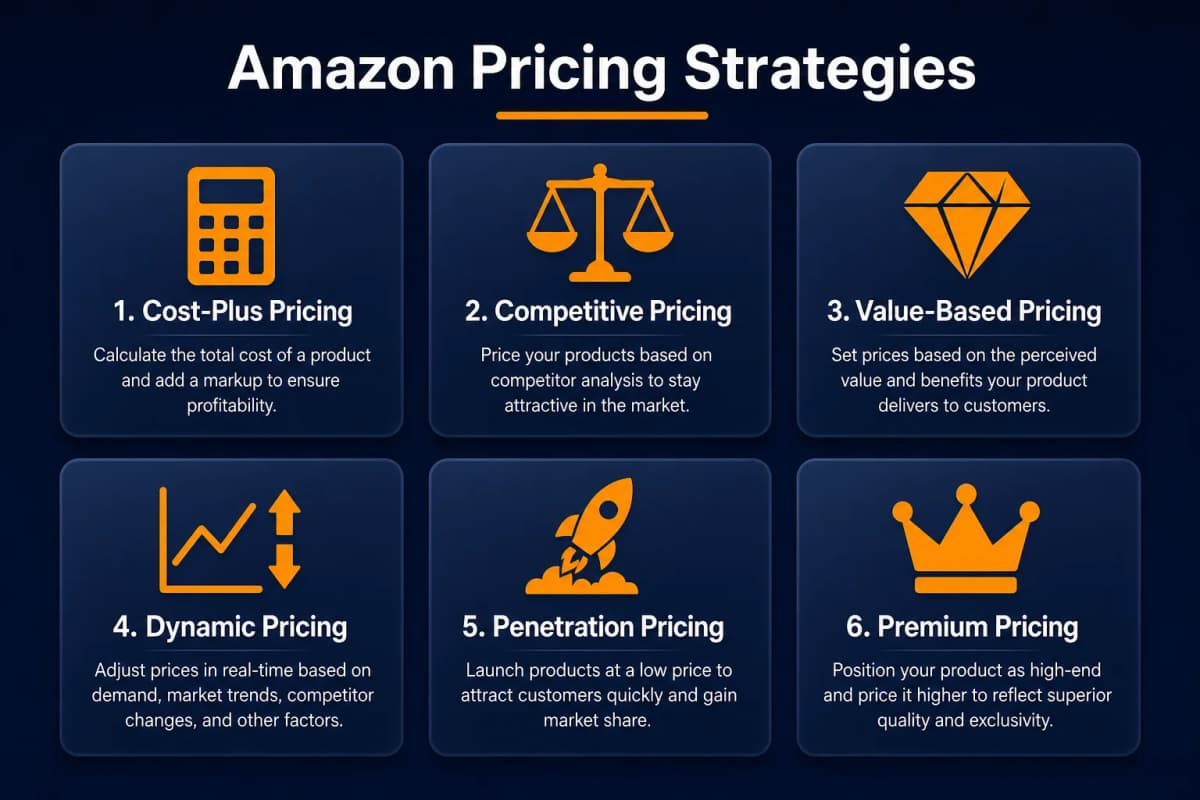
Cost-Plus Pricing
How It Works
Calculate total costs, add a fixed profit margin.
When to Use
- New products with unknown market demand
- Unique products with few direct competitors
- When cost stability is more important than market optimization
Example
Product cost: $10 | Amazon fees: $5 | Target margin: 30% Price = ($10 + $5) / (1 - 0.30) = $21.43
Competitive Pricing
How It Works
Set prices based on competitor prices, typically matching or slightly undercutting.
When to Use
- Commodity products with many similar alternatives
- Markets where price is the primary differentiator
- When competing for Buy Box against identical products
Risks
Can trigger price wars that destroy margins for everyone.
Value-Based Pricing
How It Works
Price based on perceived value to the customer, not costs or competition.
When to Use
- Products with unique features or benefits
- Strong brand recognition
- When customer reviews and ratings support premium positioning
Example
A yoga mat with unique grip technology prices at $49 while competitors sell basic mats for $25—because customers value the differentiation.
Dynamic Pricing
How It Works
Adjust prices automatically based on demand, competition, inventory, and other factors.
When to Use
- High-volume sellers with many SKUs
- Markets with frequent price fluctuations
- When manual price management becomes impractical
Tools
Amazon's Automate Pricing, third-party repricers, or AI-powered analysis.
Penetration Pricing
How It Works
Launch at a low price to gain market share, then raise prices once established.
When to Use
- New product launches
- Entering competitive markets
- Building review count and sales history
Risks
May attract price-sensitive customers who leave when prices increase.
Premium Pricing
How It Works
Price above competitors to signal quality and exclusivity.
When to Use
- Luxury or high-end products
- Strong brand with loyal customers
- Products with demonstrable quality advantages
Requirements
Listing must justify the premium through professional images, A+ Content, and strong reviews.
How to Calculate Your Minimum Viable Price
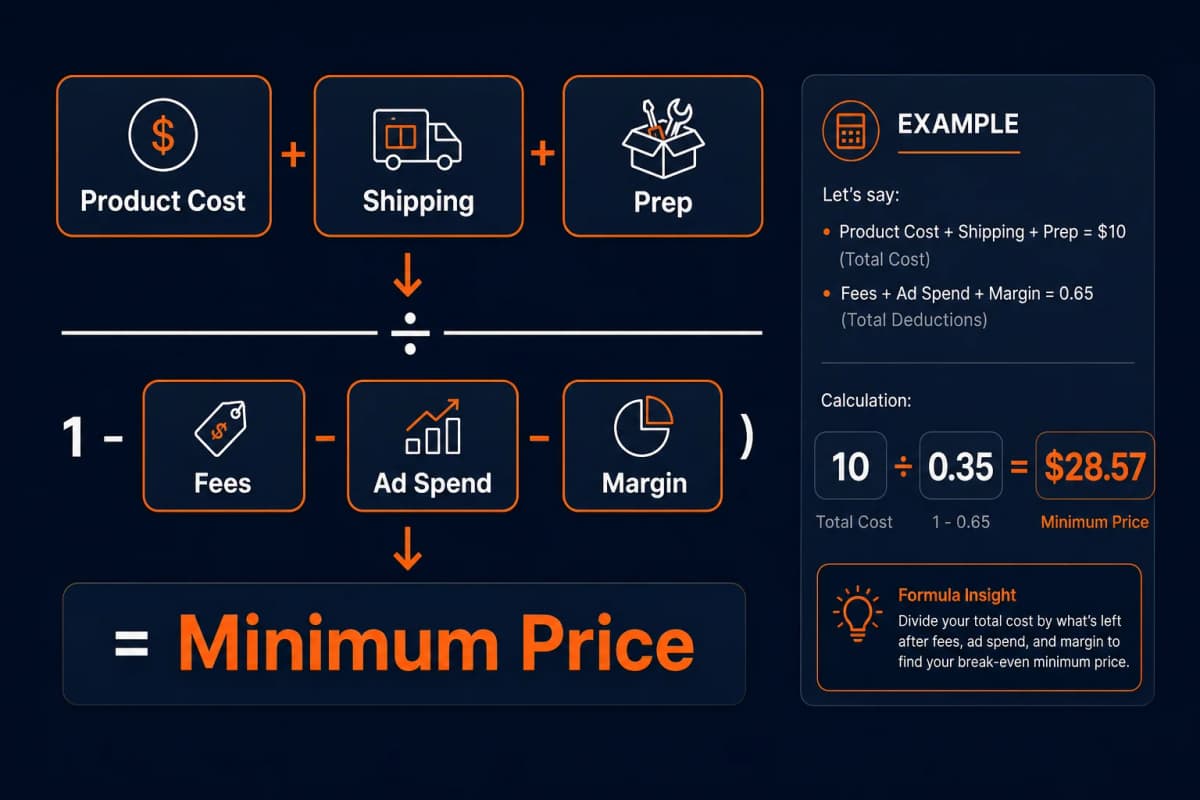
Before setting any price, calculate the floor—the minimum price that generates profit.
Factor 1: Product Cost
The landed cost of goods, including: - Manufacturing or wholesale price - Shipping to Amazon warehouse - Customs and duties (for imports) - Packaging and labeling
Factor 2: Amazon Fees
Amazon charges multiple fees: - Referral fee: 8-15% depending on category (most categories: 15%) - FBA fulfillment fee: Based on size and weight - Monthly storage fee: Per cubic foot - Long-term storage fee: For inventory over 365 days
Use Amazon's FBA Revenue Calculator or an FBA calculator tool for accurate estimates.
Factor 3: Shipping and Prep
Costs to get products Amazon-ready: - Inbound shipping to FBA warehouses - Prep services (labeling, poly bagging, bundling) - Inspection fees
Factor 4: Advertising Costs
Most products need PPC advertising to generate sales: - Estimate ACoS (Advertising Cost of Sale) for your category - Factor in ongoing ad spend as a percentage of revenue - Typical range: 10-30% of revenue for competitive categories
Factor 5: Target Profit Margin
What's left after all costs. Healthy Amazon margins typically range from 15-30%.
The Formula
Minimum Price = (Product Cost + Shipping + Prep) / (1 - Referral Fee % - FBA Fee % - Ad Spend % - Profit Margin %)
Example Calculation
- Product cost: $8
- Shipping/prep: $2
- Referral fee: 15%
- FBA fee: 15% (of price)
- Ad spend: 15%
- Target margin: 20%
Minimum Price = ($8 + $2) / (1 - 0.15 - 0.15 - 0.15 - 0.20)
Minimum Price = $10 / 0.35
Minimum Price = $28.57
Any price below $28.57 loses money with these assumptions.
How to Research Competitor Pricing
Knowing competitor prices reveals the market reality. For a complete guide on Amazon competitor analysis, see our dedicated article.
Analyze the Price Range
For any product category, note: - Lowest price point - Highest price point - Average and median prices - Where the best sellers cluster
Track Price History
Current prices don't tell the full story. Historical data reveals: - Seasonal patterns (prices rise before holidays) - Promotional cycles (when competitors run deals) - Long-term trends (is the market getting more or less competitive?)
Identify Pricing Patterns
Watch for: - Time-based changes (prices drop on weekends) - Inventory-based changes (prices rise when competitors run low) - Event-based changes (Prime Day, Black Friday patterns)
How to Use Nexscope for Pricing Analysis
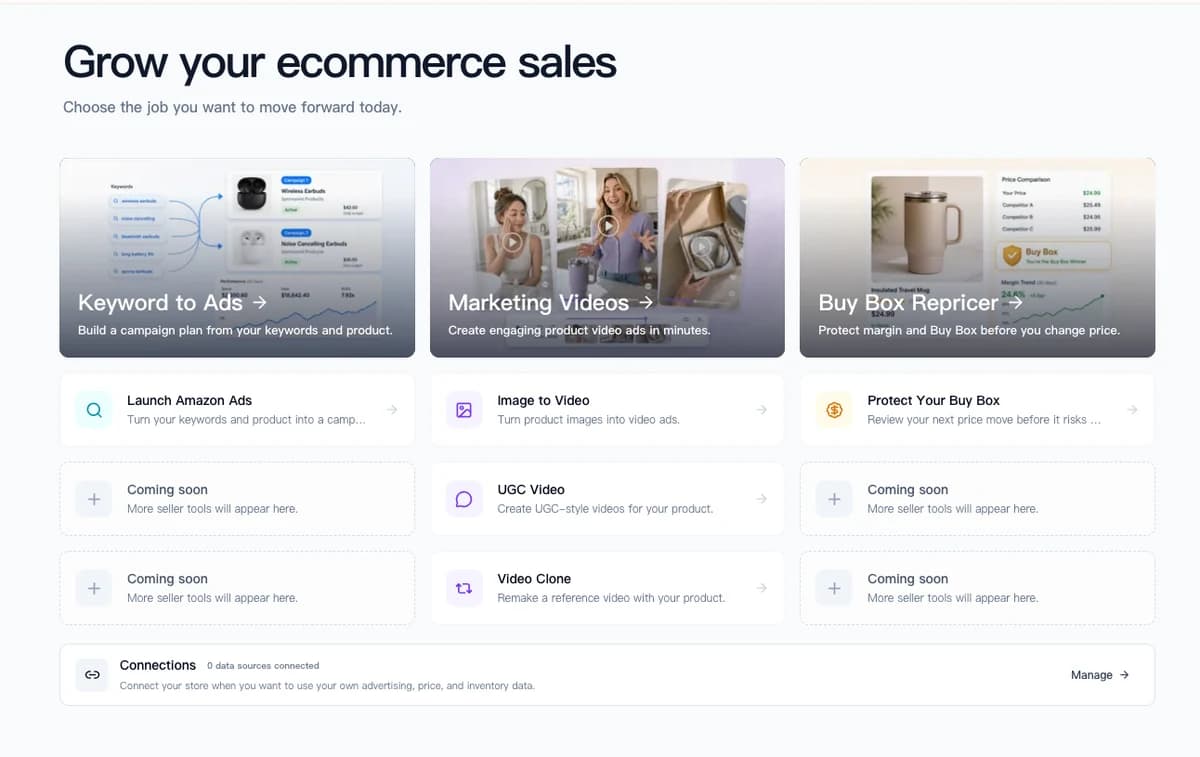
Manually tracking competitor prices across dozens of products is impractical. Nexscope provides ecommerce pricing data and a focused Buy Box Repricer workflow.
Two Ways to Get Started
Option 1: Use the Buy Box Repricer
Open the seller workspace, choose Buy Box Repricer, and review competitor price and margin context before changing your offer price.
Option 2: Connect Pricing Data to Your Agent
Use API, MCP, or Skills when your own Agent or internal application needs the pricing capability.
What You'll Get
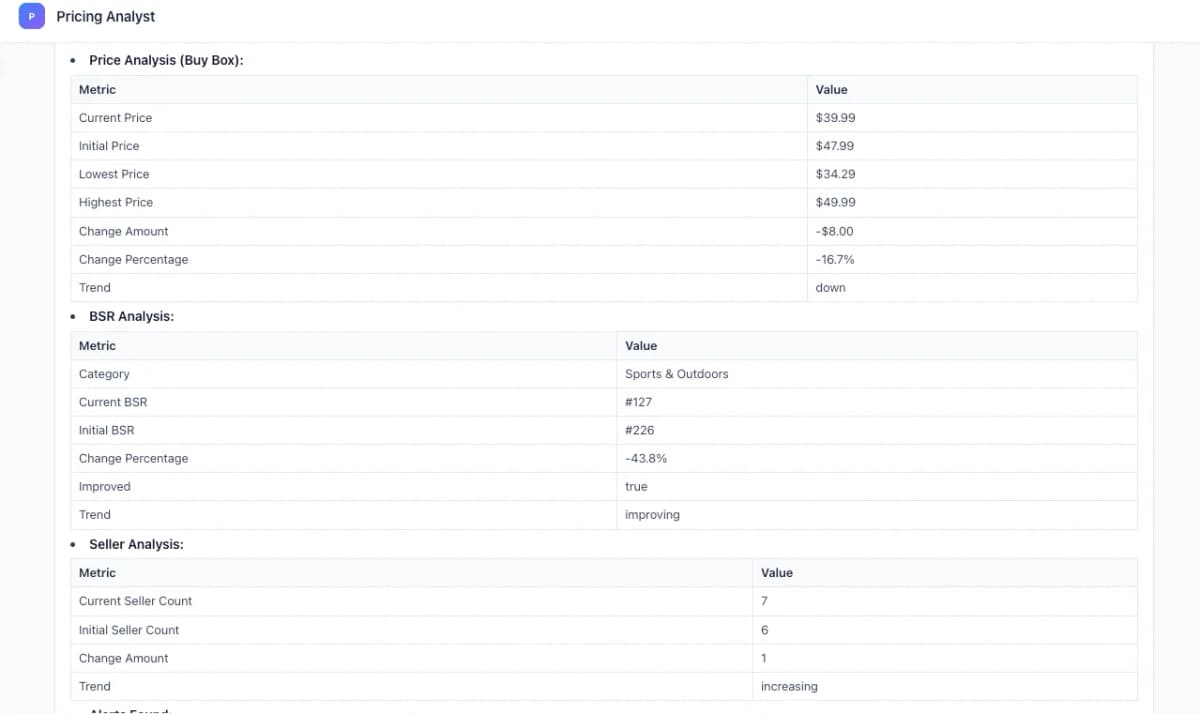
Nexscope returns a comprehensive Price Monitoring Report with charts and data tables:
Price Summary and Trends
Visual charts showing price changes, BSR trends, and alert summaries over your monitoring period.
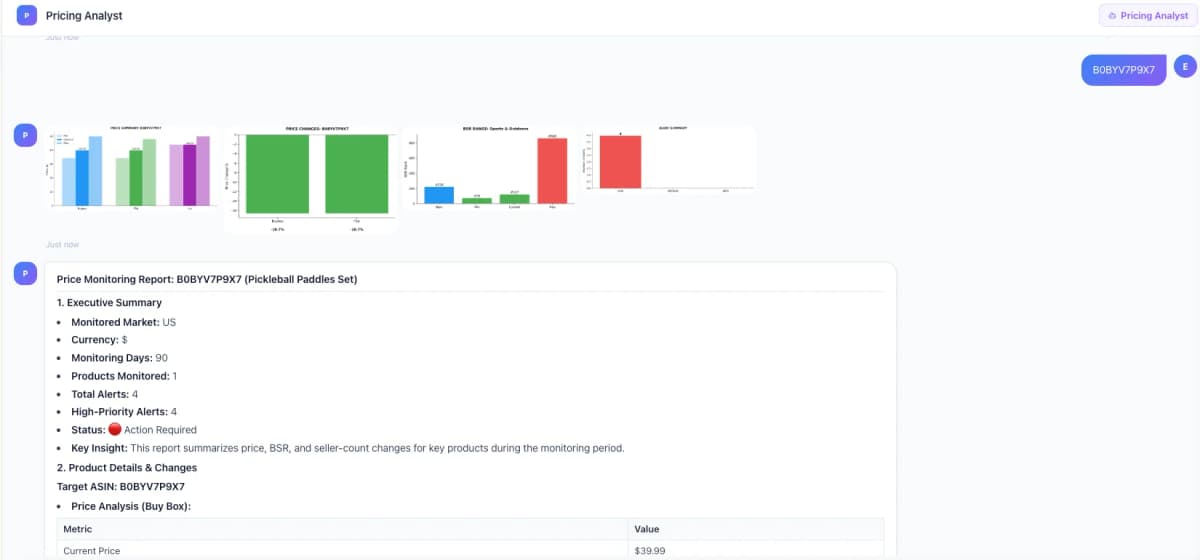
Detailed Analysis Tables
Structured data on Buy Box price analysis, BSR analysis, and seller count analysis—including current values, historical changes, and trend direction.
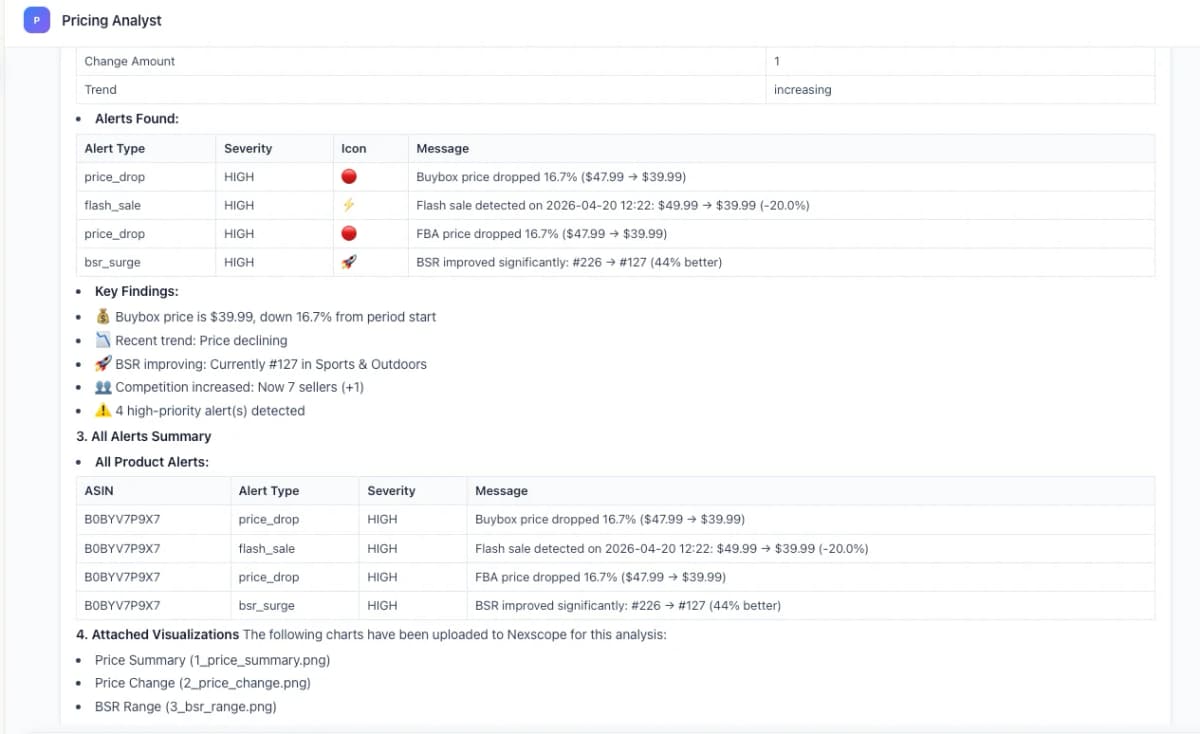
Alerts and Key Findings
Automated detection of price drops, flash sales, and BSR changes with severity ratings and actionable insights.
New users get 3 days free with 1,000 credits—enough for extensive pricing research, even using Claude Opus 4.6.
Try Nexscope Free → 3 Days + 1,000 Credits
When to Raise or Lower Prices
Pricing isn't set-and-forget. Market conditions change, and prices should adapt.
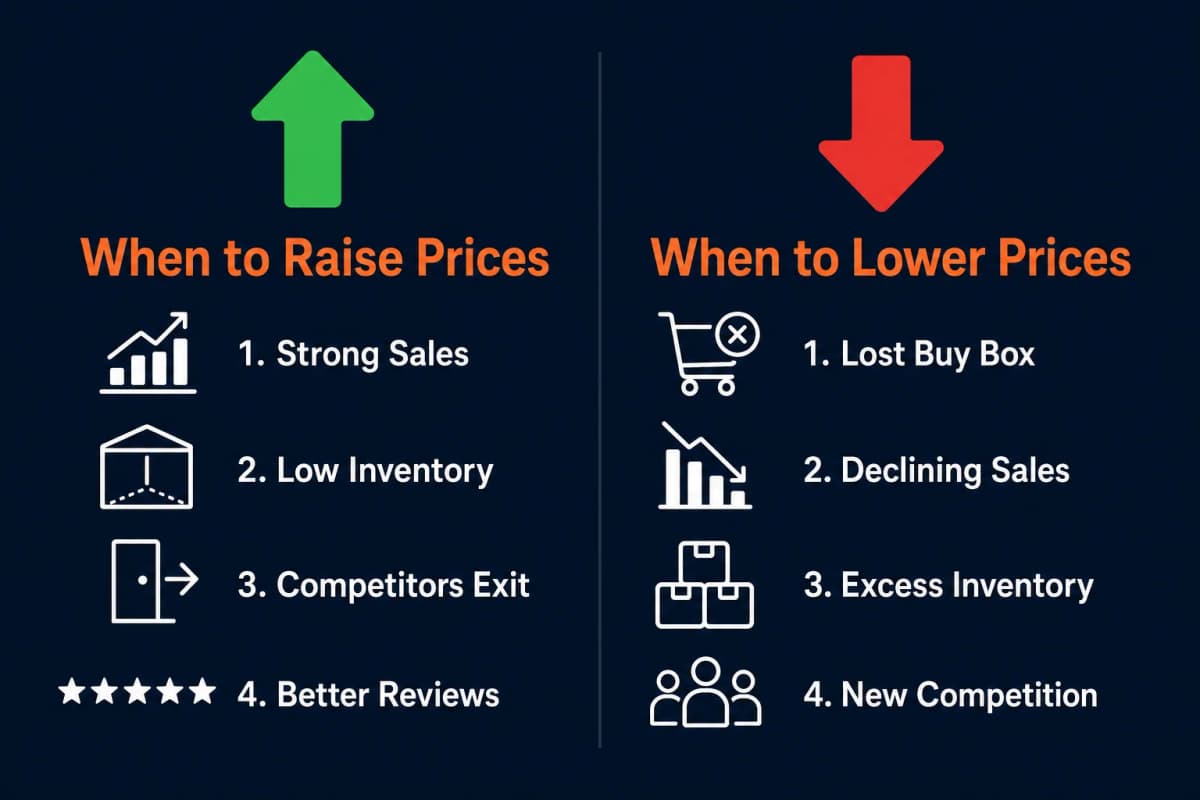
When to Raise Prices
Strong Sales Velocity
If products sell out quickly, the price may be too low. Test incremental increases (5-10%) and monitor conversion rate.
Low Inventory
When stock runs low, raising prices slows sales velocity and extends inventory until replenishment arrives.
Competitors Exit
If competitors raise prices or go out of stock, capture the opportunity with strategic price increases.
Improved Reviews
Better ratings justify higher prices. A product that moved from 3.8 to 4.5 stars can often support a 10-20% price increase.
When to Lower Prices
Lost Buy Box
If the Buy Box goes to competitors, price is often the culprit. Analyze competitor pricing and adjust.
Declining Sales
When sales drop without explanation, price may have become uncompetitive. Check if competitors lowered prices.
Excess Inventory
Long-term storage fees eat into margins. Lower prices to move inventory before fees accumulate.
New Competition
When new competitors enter at lower prices, evaluate whether to match, differentiate, or hold position.
Seasonal Adjustments
Q4 Holiday Season
Demand peaks. Prices can often increase 10-20% without hurting conversion.
Post-Holiday
Demand drops. Prices may need to decrease to maintain sales velocity.
Category-Specific Seasons
Tax software peaks in March-April. Outdoor products peak in summer. Adjust prices to match demand cycles.
Common Amazon Pricing Mistakes
Only Looking at the Lowest Price
The cheapest competitor isn't always the benchmark. They may be liquidating inventory, making mistakes, or operating unsustainably. Focus on profitable competitors with similar positioning.
Ignoring Total Costs
Many sellers forget advertising costs, returns, or long-term storage fees when calculating margins. The result: prices that look profitable but actually lose money.
Changing Prices Too Frequently
Constant price changes confuse Amazon's algorithm and frustrate repeat customers. Make strategic changes, not reactive ones.
Ignoring Brand Positioning
A premium brand that cuts prices damages its positioning. Customers who paid $40 last month feel cheated when the price drops to $25. Maintain pricing consistency that aligns with brand identity.
Not Testing Price Points
Many sellers guess at optimal prices. Better approach: test different prices systematically and measure impact on conversion, sales velocity, and profit.
Forgetting Psychological Pricing
$19.99 converts better than $20.00. $29 converts better than $32. Use pricing psychology—charm pricing, anchoring, and bundling—to maximize perceived value.
Conclusion
Amazon pricing strategy balances three competing forces: competitiveness (winning sales), profitability (making money), and sustainability (long-term success).
Start by calculating true costs and minimum viable prices. Research competitor pricing to understand market positioning. Then choose a strategy—cost-plus, competitive, value-based, or dynamic—that fits the product and market.
Most importantly, treat pricing as an ongoing process. Markets change, competitors adjust, and customer preferences evolve. The sellers who win are those who monitor, adapt, and optimize continuously.
Nexscope provides structured ecommerce data and focused seller workflows. Teams can use Nexscope's web tools directly or connect governed capabilities to their existing Agent through API, MCP, or Skills. Ready workflows include Keyword to Ads, Video Clone, and Buy Box Repricer.
New users get 3 days free with 1,000 credits. No credit card required.
Connect Ecommerce Data to Your Agent
Use Nexscope through API, MCP, or Skills, or open a ready seller workflow.
Explore Ecommerce Data →1,000 free credits • API, MCP & Skills
Frequently Asked Questions
How often should I adjust prices on Amazon?
Review prices monthly at minimum. Adjust when market conditions change significantly—competitor price moves, inventory changes, seasonal shifts, or performance metrics decline.
Should I always match the lowest competitor price?
No. Matching the lowest price often triggers a race to the bottom. Instead, understand why competitors price lower (liquidation, errors, different cost structure) and compete on value when possible.
How does pricing affect Buy Box eligibility?
Price is one of several Buy Box factors, alongside seller metrics, fulfillment method, and shipping speed. Significantly higher prices reduce Buy Box share, but the lowest price doesn't guarantee the Buy Box.
What's a healthy profit margin for Amazon FBA?
Target 20-30% net margin after all costs including advertising. Margins below 15% leave little room for error. Margins above 40% may indicate pricing power that could be tested higher.
Can I use Amazon's automatic repricing?
Yes, Amazon's Automate Pricing tool adjusts prices based on rules you set. It's useful for competitive markets but lacks the intelligence of dedicated repricing tools or AI-powered analysis.
How do I handle competitors who undercut aggressively?
First, verify they're profitable—many aggressive pricers lose money and eventually exit. If they persist, differentiate through better listings, bundling, or superior customer service rather than matching unsustainable prices.
Sources
- Amazon Seller Central. (2026). Pricing Best Practices. Retrieved from sellercentral.amazon.com
- Feedvisor. (2025). Amazon Pricing Strategy Report. Retrieved from feedvisor.com
- Jungle Scout. (2025). State of the Amazon Seller Report. Retrieved from junglescout.com