

Claude Opus 4.7 for Ecommerce: 5 AI vs Manual Metrics

Anthropic just released Claude Opus 4.7, its most capable AI model yet. OpenAI keeps pushing ChatGPT forward. The AI toolkit available to online sellers has never been stronger — or more confusing.
A cross-border seller running stores on Amazon, TikTok Shop, and Shopee decided to cut through the noise with a straightforward test. Two stores, similar product categories, comparable ad budgets. Store A ran with a fully manual team. Store B integrated AI tools — primarily Claude Opus 4.7 for analysis and strategy, alongside ChatGPT for content generation — into daily operations. After one full quarter, the results were clear.
This article walks through the 5 metrics that separated the two stores, explains why the latest AI models matter specifically for ecommerce, and provides a 7-day starter framework for sellers who haven't adopted AI tools yet.
The Side-by-Side Comparison: 5 Key Metrics
Both stores operated in the $30K-$50K monthly GMV range. Same product category, same platforms, same quarter. The only difference was operational method.
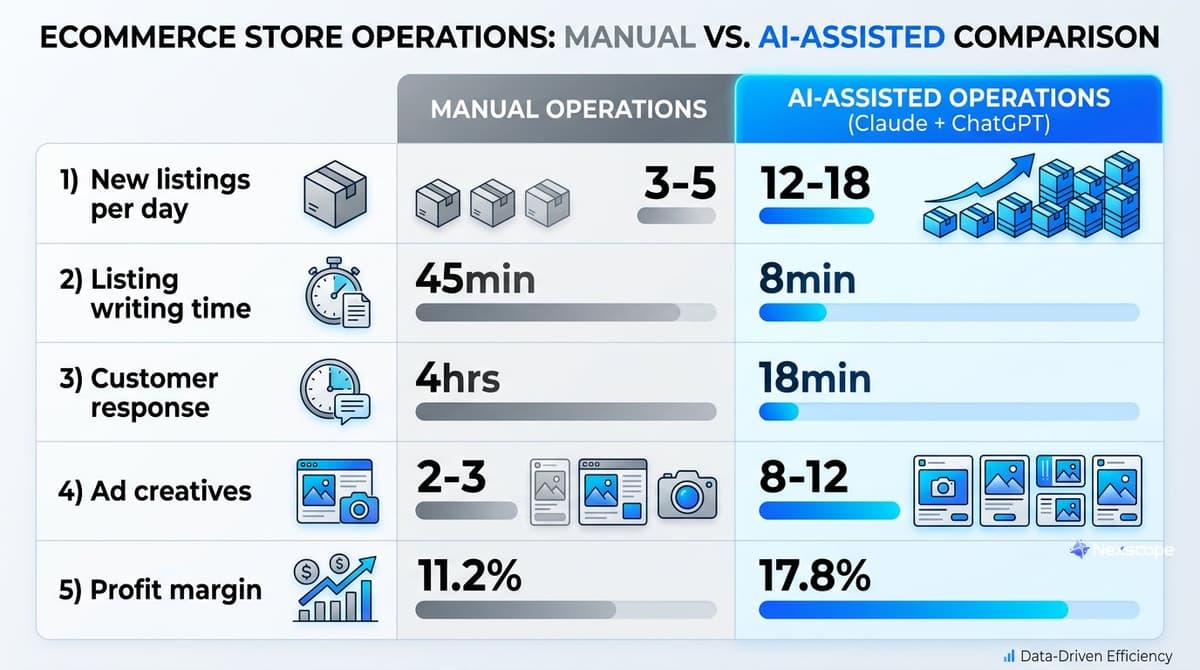
| Metric | Manual Store | AI-Assisted Store | Difference |
|---|---|---|---|
| New listings per day | 3-5 | 12-18 | +300% |
| Listing writing time | 45 min each | 8 min each | -82% |
| Customer response time | 4 hours avg | 18 minutes avg | -92% |
| Ad creatives per day | 2-3 sets | 8-12 sets | +300% |
| Q1 net profit margin | 11.2% | 17.8% | +6.6 points |
The bottom line is the most telling. Revenue stayed comparable. The profit margin gap came from operational efficiency. The AI-assisted store freed up hours every day that went into higher-value work: sourcing negotiations, ad spend optimization, and product selection strategy.
Why Claude Opus 4.7 Matters for Ecommerce
Claude Opus 4.7 is Anthropic's most capable model to date. Several of its features directly address ecommerce operational pain points.
Extended Thinking for Deep Analysis
Claude Opus 4.7 uses extended thinking — a step-by-step reasoning process that works through complex problems before delivering a final answer. For ecommerce, this means feeding in a spreadsheet of 200 competitor products and getting back a structured analysis: pricing tiers, keyword gaps, review sentiment patterns, and differentiation opportunities. The depth of analysis rivals what a dedicated research analyst would produce in a full workday.
200K Context Window for Full-Category Research
With a 200,000-token context window, Claude Opus 4.7 can process an entire product category's worth of data in a single conversation. Competitor listings, customer reviews, Q&A sections, pricing histories — all analyzed together rather than in disconnected batches. The result is research that captures patterns a piecemeal approach would miss.
Agentic Capabilities
Claude Opus 4.7 can use tools, browse the web, and execute code within a single workflow. For sellers, this means asking Claude to pull competitor data, run a pricing analysis, and draft optimized listings — all in one session without switching between applications. This agentic approach turns what used to be a multi-step, multi-tool process into a single conversation.
Multilingual Precision
Cross-border sellers targeting Southeast Asia, Europe, or the Middle East need content in 6-8 languages. Claude Opus 4.7 produces localized content that reads naturally in each market, not machine-translated stiffness. For sellers on Shopee, Lazada, or Ozon, this removes what used to be a full-time translation role.
How ChatGPT and Claude Work Together
Most successful AI-adopting sellers do not rely on a single model. The practical approach combines strengths:
- Claude Opus 4.7 excels at deep analysis, structured reasoning, and complex multi-step tasks. Use it for competitor research, pricing strategy, data interpretation, and workflow automation.
- ChatGPT (GPT-4o and newer) is strong at creative content generation, ad copy variations, and quick conversational tasks. Use it for listing copy, social media content, and customer response templates.
- Gemini and other tools fill specific gaps: image generation, visual content creation, and platform-specific integrations.
The AI-assisted store in the test used this multi-model approach. Claude handled the analytical heavy lifting. ChatGPT generated the high-volume content. The combination outperformed either tool alone.
Platform-Specific AI Playbooks
Each platform has different operational bottlenecks. AI should target the highest-friction areas first.
Amazon: Listing + PPC
AI generates SEO-optimized titles, bullet points, and backend keywords by analyzing top-ranking competitor listings. For PPC, batch-generated ad copy variations and automated search term analysis cut the time spent on campaign management significantly. Claude's extended thinking is particularly useful for dissecting complex PPC data and recommending bid adjustments.
TikTok Shop: Content Velocity
Success on TikTok Shop depends on posting frequency. AI generates 10-20 short video scripts per day, builds creator outreach templates, and monitors comment sentiment. Content fatigue hits within days on TikTok, so the ability to produce fresh creative continuously is a direct revenue driver.
Shopee and Lazada: Multi-Language at Scale
Six to eight country storefronts, each requiring native-quality listings in Thai, Vietnamese, Malay, Filipino, or Indonesian. AI handles localization that goes beyond language, adapting cultural context, local holiday references, and pricing display formats for each market.
Shopify: Store Building and Optimization
For independent Shopify stores, AI assists with everything from initial store setup to ongoing listing optimization. Claude can analyze store analytics, identify conversion bottlenecks, and suggest specific page improvements based on the data.
A 7-Day Starter Framework
For sellers who haven't integrated AI into operations yet, this is the minimum viable starting point.
Days 1-2: Listing Rewrite Test - Pick the 10 worst-performing listings by click-through rate - Use Claude or ChatGPT to rewrite titles, bullets, and descriptions with proper keyword optimization - Publish and track CTR changes over 2 weeks
Days 3-4: Customer Service Templates - Categorize the top 20 most frequent customer questions - Generate AI response templates for each category - Set up semi-automated responses (AI drafts, human approves)
Days 5-7: Competitor Analysis Report - Feed Claude Opus 4.7 the top 20 competitors in a primary category - Generate a report covering pricing, review themes, and listing gaps - Identify 3 potential differentiation angles
After seven days, the question shifts from "should I use AI" to "where do I apply it next." Most sellers report that by week three, going back to fully manual operations feels impossible.
Common Mistakes to Avoid
- Publishing AI listings without human review. Technical specifications, certification claims, and compliance details must be verified manually. Errors in these areas lead to listing takedowns or account suspensions.
- Feeding customer PII into public AI models. Shipping addresses, payment info, and personal data should never enter third-party AI tools. Use AI for content generation, not customer data processing.
- Ignoring platform AI content policies. TikTok Shop requires disclosure for certain AI-generated media. Amazon reviews AI-composed images. Each platform's rules differ and change frequently.
- Using only one AI tool for everything. Claude, ChatGPT, and Gemini each have strengths. Forcing one model to do everything produces mediocre results across the board.
- Expecting full automation from day one. AI handles roughly 80% of repetitive tasks. The remaining 20% — quality control, brand voice, strategic decisions — requires human judgment. Treat AI as a multiplier, not a replacement.
Conclusion
The data from this side-by-side test points to a clear pattern: the gap between AI-adopting sellers and manual-only sellers is growing each quarter. A 6.6-point profit margin difference is not marginal. Over a year, it compounds into a fundamental competitive divide.
Claude Opus 4.7 and the latest ChatGPT models make previously impractical workflows — full-category analysis, real-time multi-language operations, agentic automation — routine. The technology is no longer the bottleneck. Adoption speed is.
Nexscope provides structured ecommerce data that teams can use in focused web tools or connect to their existing Agent through API, MCP, or Skills. Ready workflows include Keyword to Ads, Video Clone, and Buy Box Repricer.
Connect Ecommerce Data to Your Agent
Use Nexscope through API, MCP, or Skills, or open a ready seller workflow.
Explore Ecommerce Data →1,000 free credits • API, MCP & Skills
Frequently Asked Questions
What makes Claude Opus 4.7 different from ChatGPT for ecommerce?
Claude Opus 4.7 uses extended thinking to reason step-by-step through complex problems, making it stronger for data analysis, competitor research, and strategic planning. ChatGPT excels at creative content generation and quick conversational tasks. Most successful sellers use both tools for different parts of their workflow.
How much time does AI save in daily ecommerce operations?
Based on the side-by-side test, AI reduced listing writing time by 82% and customer response time by 92%. A seller managing 50-100 active SKUs can realistically save 15-20 hours per week on repetitive tasks, freeing that time for strategy, sourcing, and market analysis.
Does AI-assisted selling work on all ecommerce platforms?
Yes. The core applications (listing optimization, customer service, ad creative generation, competitor analysis) apply across Amazon, Shopify, TikTok Shop, Shopee, Lazada, Ozon, AliExpress, and eBay. Platform-specific differences exist in format requirements and compliance rules, but the workflows transfer.
Should I use Claude or ChatGPT for my ecommerce store?
Use both. Claude Opus 4.7 is better for analytical tasks: competitor analysis, pricing strategy, data interpretation, and complex research. ChatGPT is better for high-volume content: listing copy, ad variations, social media posts, and customer response drafts. The combination outperforms either tool alone.
What is the minimum budget to start using AI for ecommerce?
Zero additional cost to start. Both Claude and ChatGPT offer free tiers that handle listing writing and customer service templates for initial testing. Paid plans for heavier usage run $20-$100 per month, far less than equivalent human labor.
Will AI replace ecommerce operations staff?
AI replaces repetitive execution, not strategic thinking. A three-person team with AI produces the output of a six-person manual team. The humans shift from writing and translating to reviewing, strategizing, and making judgment calls.
Is AI-generated content penalized by ecommerce platforms?
No major platform penalizes AI-generated content based on production method. Quality standards apply equally to human and AI content. TikTok Shop requires disclosure for certain AI media, and Amazon may review AI-composed model images. Meet the quality bar and compliance rules, and the production method is irrelevant.
Sources
- Anthropic. (2026). Claude Opus 4.7 Model Card and Capabilities. Retrieved from anthropic.com
- OpenAI. (2026). ChatGPT for Business: Enterprise Use Cases. Retrieved from openai.com
- Amazon. (2026). New Seller Incentives: Europe Marketplace Expansion Program. Retrieved from sellercentral.amazon.com
- Statista. (2025). Cross-Border E-Commerce Market Size and Growth Projections. Retrieved from statista.com