
How AI Content Affects Amazon Listing Optimization

AI writing tools have become standard equipment for Amazon sellers. ChatGPT, Claude, Jasper, and dozens of specialized tools promise to generate optimized product listings in seconds. But a critical question remains: does AI-written content actually help or hurt Amazon listing optimization?
A recent study analyzed over 500 Amazon listings across 10 product categories, using two AI detection models to score each listing. The results challenge common assumptions about AI content and its impact on sales performance.
The short answer: Amazon's algorithm does not care whether your listing was written by AI or humans. There is no ranking penalty for AI content, and no ranking boost either. But the data reveals more nuanced insights about what actually impacts performance—and why simply using AI is not enough.
This article breaks down the methodology, key findings, and practical implications for sellers deciding whether to use AI for their Amazon listings.
Research Methodology
Products Analyzed
The study aimed for diversity across Amazon's marketplace. Rather than focusing on a single category, listings were pulled from 10 different product types that represent real purchasing behavior:
- Wireless earbuds
- Gaming headsets
- Phone cases
- Crossbody bags
- Dog beds
- Office chairs
- Shower heads
- Yoga mats
- Travel pillows
- Laptop stands
Data Collection
On February 23, 2026, the top 50 search results for each keyword were captured, including both organic and sponsored positions. For each listing, the following data points were recorded:
- ASIN (Amazon Standard Identification Number)
- Product title and price
- Star rating and total review count
- Search result position (1-50)
- Sponsored status
- All bullet points and product description
- Presence of A+ Content
AI Detection Method
Two AI models independently analyzed each listing's text content:
- ChatGPT 5.2
- Claude Opus 4.6
Both models scored each listing on a 0-100 scale, where higher scores indicate higher probability of AI-generated content. The final AI score for each listing was calculated by averaging the two model scores.
Key Findings
1. Nearly 1 in 5 Listings Are Clearly AI-Written
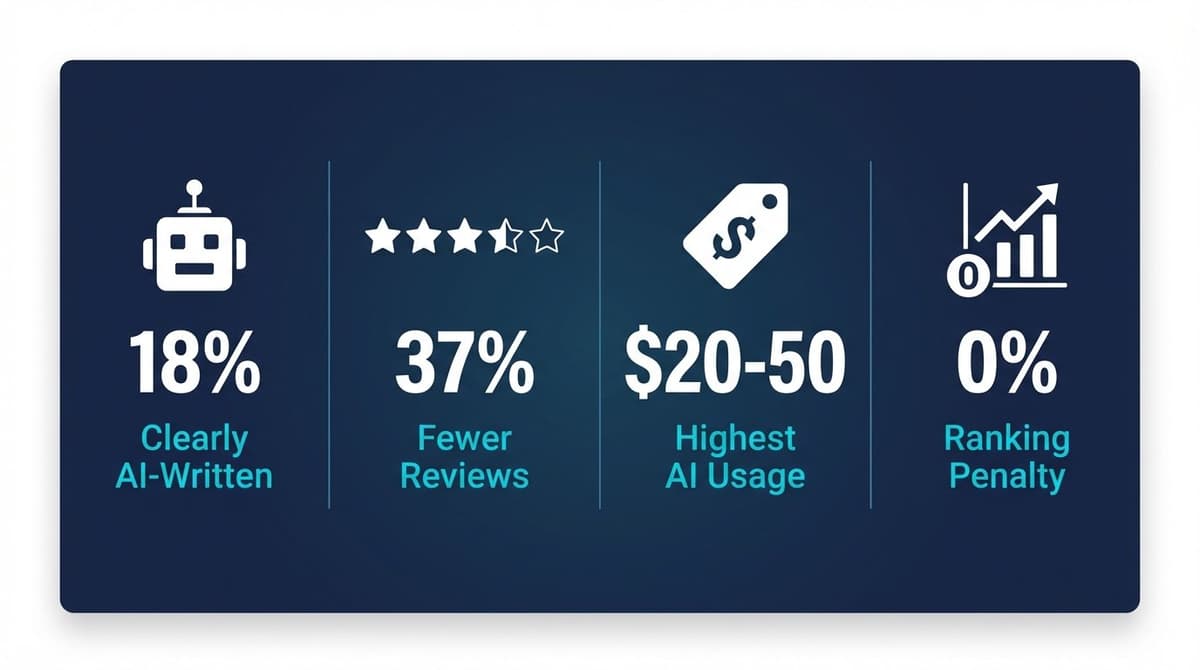
Out of 500+ listings analyzed, 88 (approximately 18%) scored high enough on both models to be classified as clearly AI-generated.
Another 40% fell into a "suspicious but uncertain" category.
Only about one-third of listings appeared clearly human-written according to both detection models.
2. New Brands Use AI More Often
Review count served as a proxy for brand maturity. Brands with fewer than 100 reviews were classified as new.
| Brand Status | Average AI Score | Clearly AI Percentage |
|---|---|---|
| New brands (<100 reviews) | 37.8 | 24% |
| Growing (100-999 reviews) | 36.6 | 23% |
| Established (1K-10K reviews) | 35.8 | 20% |
| Major brands (10K+ reviews) | 35.1 | 16% |
New brands were approximately 50% more likely to be flagged as AI-written compared to major brands. However, even established brands with tens of thousands of reviews still showed 16% AI detection rates.
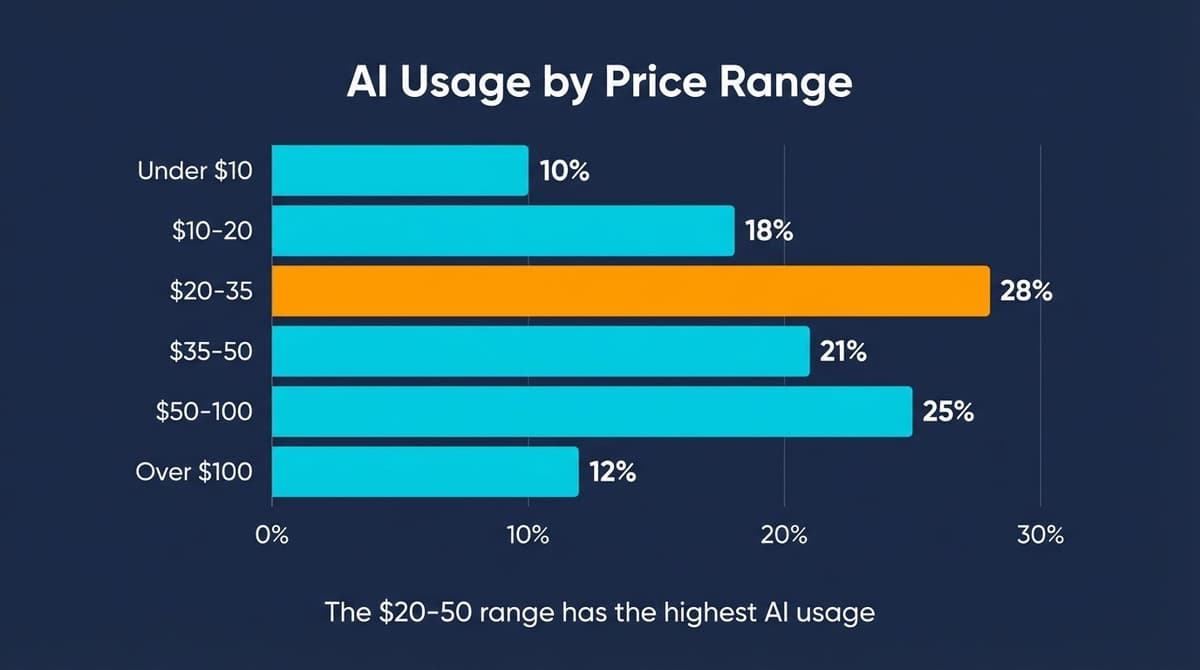
3. The $20-50 Price Range Has the Highest AI Usage
The data revealed an unexpected pattern. The assumption was that cheaper products would use more AI content due to tighter margins. The reality was different.
| Price Range | Average AI Score | Clearly AI Percentage |
|---|---|---|
| Under $10 | 32.7 | 10% |
| $10-20 | 34.9 | 18% |
| $20-35 | 37.5 | 28% |
| $35-50 | 37.6 | 21% |
| $50-100 | 35.6 | 25% |
| Over $100 | 36.2 | 12% |
Products under $10 scored low primarily because many had minimal copy—just a title and a few bullet points, giving detection models little to analyze.
Products over $100 also scored low. Premium brands typically invest in professional copywriters or develop distinctive brand voices that differ from AI templates.
The $20-50 range represents Amazon's most competitive segment. Every listing fights for attention. Sellers in this price range appear to rely heavily on AI to produce professional-looking copy without the cost of hiring writers.
4. Longer Copy Correlates with Higher AI Scores
A clear relationship emerged between copy length and AI detection scores.
| Copy Length | Average AI Score | Average Rating | Average Reviews |
|---|---|---|---|
| Under 50 words | 18.0 | 4.6 stars | 14,137 |
| 50-149 words | 23.0 | 4.5 stars | 17,625 |
| 150-299 words | 36.4 | 4.5 stars | 11,831 |
| 300-499 words | 41.0 | 4.4 stars | 9,895 |
| 500+ words | 43.1 | 4.1 stars | 5,694 |
Listings with over 300 words were nearly twice as likely to appear AI-written compared to those under 150 words.
But the last two columns tell a different story: the shortest copy had the highest ratings and most reviews. Listings with 500+ words had the lowest ratings and fewest reviews.
This correlation may simply reflect that products with thousands of reviews have been selling longer, regardless of copy quality. But the data suggests that more words do not equal more sales. In many cases, the relationship appears inverse.
5. AI-Written Listings Have 37% Fewer Reviews
Comparing the top 25% (highest AI scores) against the bottom 25% (lowest AI scores) revealed significant differences:
| Metric | Lowest AI (Bottom 25%) | Highest AI (Top 25%) |
|---|---|---|
| Average rating | 4.44 ★ | 4.50 ★ |
| Average reviews | 12,135 | 7,630 |
| Average price | $42 | $54 |
| Average word count | 177 | 323 |
Listings that appeared most AI-written had 37% fewer customer reviews on average.
This does not necessarily mean AI content drives away buyers. More likely, AI tools are disproportionately used for newer products that have not yet accumulated review history.
6. Amazon Search Rankings Show No AI Penalty
The expectation was that AI content might correlate with search position—either positively or negatively. The data showed neither.
| Search Position | Average AI Score |
|---|---|
| Position 1-10 | 36.7 |
| Position 11-25 | 36.2 |
| Position 26-40 | 35.9 |
| Position 41-50 | 34.4 |
The difference across the entire first page was just 2.3 points—essentially negligible.
Amazon's search algorithm appears completely indifferent to whether product copy was written by humans, machines, or anything in between. Rankings are driven by sales velocity, conversion rates, review counts, and advertising spend. The text content influences whether shoppers click "Add to Cart," but the algorithm does not evaluate content origin.
7. Branded vs. Non-Branded: Similar AI Usage
Listings were categorized as "branded" (title starts with brand name, like "Razer BlackShark V2") or "non-branded" (title starts with product description, like "Orthopedic Dog Bed").
| Type | Average AI Score | Clearly AI % | Average Price | Average Reviews |
|---|---|---|---|---|
| Branded | 36.7 | 21.8% | $60 | 13,095 |
| Non-branded | 37.6 | 21.7% | $38 | 3,434 |
Both categories showed nearly identical AI detection rates. The assumption that generic sellers would use more AI than established brands did not hold.
8. Exactly 5 Bullet Points = Higher AI Probability
Amazon's official guidance recommends using exactly 5 bullet points per listing. In the dataset, 66.8% of listings followed this advice.
However:
| Bullet Points | % of All Listings | Clearly AI % |
|---|---|---|
| Exactly 5 | 66.8% | 26.3% |
| Other amounts | 33.2% | 14.5% |
Listings with exactly 5 bullet points were 82% more likely to appear AI-written.
The likely explanation: AI writing tools are trained on Amazon's best practices. They default to 5 bullet points because that is the recommendation. Human writers are more flexible—writing 3 points for simple products or 7 for feature-rich items. AI follows templates more rigidly.
What This Means for Sellers
The data leads to a straightforward conclusion: Amazon does not care whether listings are AI-written.
AI content does not trigger ranking penalties. It does not suppress listings in search results. The algorithm evaluates performance metrics, not content authenticity.
However, AI content also provides no special advantage. Using AI does not boost rankings or improve visibility. It simply produces "good enough" copy faster and cheaper than hiring writers.
The most effective approach is not avoiding AI—it is using AI while not sounding like everyone else using AI. When 18% of listings follow the same AI templates, differentiation becomes the competitive edge.
Practical recommendations:
- Use AI as a starting point, then customize heavily
- Avoid generic phrases that appear in every AI-generated listing
- Focus on unique product benefits rather than category-standard features
- Test shorter, more direct copy rather than maximizing word count
- Prioritize factors that actually drive rankings: reviews, pricing, advertising, conversion optimization
💡 Pro Tip: If you use an AI agent (OpenClaw, Claude Code, Cursor, etc.), you can install our free Amazon Listing Optimization Skill to analyze competitor listings, generate SEO-optimized copy, and identify keyword gaps—without sounding like every other AI-generated listing.
bash
npx skills add nexscope-ai/Amazon-Skills --skill amazon-listing-optimization -g
What This Means for Buyers
For shoppers, the research suggests a simple heuristic: ignore how polished the copy sounds and focus on reviews.
A listing with beautiful prose, 87 reviews, and a 4.9-star rating is fundamentally different from a listing with basic copy, 14,000 reviews, and a 4.4-star rating. Based on this data, the second option is typically the better choice.
Review count indicates real purchase volume and sustained customer satisfaction. Eloquent product descriptions indicate access to AI writing tools—which costs nothing and proves nothing about product quality.
Conclusion
AI-written content is now a standard part of Amazon's marketplace. Nearly one in five listings show clear signs of AI generation, and the actual percentage is likely higher when including partially AI-assisted content.
For sellers focused on Amazon listing optimization, the data provides clarity: AI content neither helps nor hurts search rankings. Amazon's algorithm is content-origin agnostic. What matters is sales velocity, conversion rates, and review accumulation.
The competitive advantage lies not in whether to use AI, but in how to use it differently than competitors. When everyone has access to the same tools, the winners are those who add human judgment, brand voice, and genuine product knowledge on top of AI-generated foundations.
For sellers looking to optimize their Amazon presence with data-driven insights, Nexscope provides AI-powered tools for product research, competitor analysis, and listing optimization—helping identify what actually moves rankings rather than what sounds impressive.
Write listings that outrank the other 18%
Nexscope analyzes competitor listings, finds keyword gaps, and generates optimized copy — so yours doesn't sound like every other AI listing
Get Started Free →No coding required • Instant access
FAQs
Does Amazon penalize AI-written listings?
No. The data shows no correlation between AI detection scores and search rankings. Amazon's algorithm evaluates performance metrics (sales, conversions, reviews) rather than content origin.
Do AI-written listings have lower conversion rates?
The study found AI-written listings had 37% fewer reviews on average, but this likely reflects that AI is used more heavily for newer products rather than causing lower conversions. Direct conversion rate data was not available.
Should sellers use AI for Amazon listings?
AI can be a useful tool for generating initial drafts quickly. The key is customization—avoid sounding like every other AI-generated listing by adding unique product insights and brand voice.
Why do listings with exactly 5 bullet points show higher AI scores?
AI writing tools are trained on Amazon's best practices, which recommend 5 bullet points. Human writers vary more based on product complexity. The rigid adherence to recommendations is a detectable AI signature.
Does longer copy improve Amazon listing performance?
The data suggests the opposite. Listings with shorter copy (under 150 words) had higher ratings and more reviews than those with 500+ words. More content does not equal better performance.
Sources
- Original study data collected February 23, 2026
- AI detection performed using ChatGPT 5.2 and Claude Opus 4.6
- Sample size: 500+ Amazon listings across 10 product categories