

How to Make Your Shopify Store AI-Ready in 2026

Shopify is opening its backend to AI. That sentence has been circulating in e-commerce circles for weeks, but most merchants still aren't sure what it actually means for their day-to-day operations.
Here's the practical reality: Shopify is gradually turning product data, AI sales channels, and certain low-risk backend actions into capabilities that AI can read, use, and execute. This isn't about AI writing a few product descriptions. It's about backend operations becoming callable by AI workflows.
The merchants who benefit first won't be the ones who write the best prompts. They'll be the ones whose product data and operational boundaries are already clean and structured.
This guide breaks down what's changing, what to do first, and what to avoid handing over to AI—at least for now.
The Three Layers of Shopify's AI Shift
Shopify's AI changes aren't one monolithic feature. They're happening across three distinct layers, each with different implications for merchants.
Layer 1: AI Sales Channels
Shopify has connected Agentic Storefronts to major AI platforms including ChatGPT, Microsoft Copilot, Google AI Mode, and Gemini. For qualifying stores, these AI channels can bring orders directly back to Shopify admin.
What this means: customers can discover and purchase products through AI conversations, not just traditional search or social media. The AI acts as a sales channel, not just a content generator.
Layer 2: Making Stores Readable by AI
Shopify is pushing merchants to structure their data in ways AI can understand:
- Catalog data with consistent attributes
- Knowledge Base for FAQs and policies
- Metafields with standardized schemas
- Product descriptions that follow clear patterns
The implication is significant: whether AI can correctly understand and recommend products depends less on having items listed and more on having product information and common questions organized clearly.
Stores with messy data won't get AI amplifying their strengths. They'll get AI amplifying their chaos faster.
Layer 3: Backend Actions Become API-Callable
Shopify's AI Toolkit documentation explicitly states that AI tools can use documentation, schemas, and validation capabilities—and can manage Shopify stores through CLI's store execute function.
This means backend operations are shifting from "only humans clicking through admin" to "AI workflows can call these actions, with humans reviewing and approving."
The change isn't instant or total. But the direction is clear: repetitive backend tasks are becoming automatable through AI, not just through apps or manual work.
5 Things Shopify Merchants Should Do First
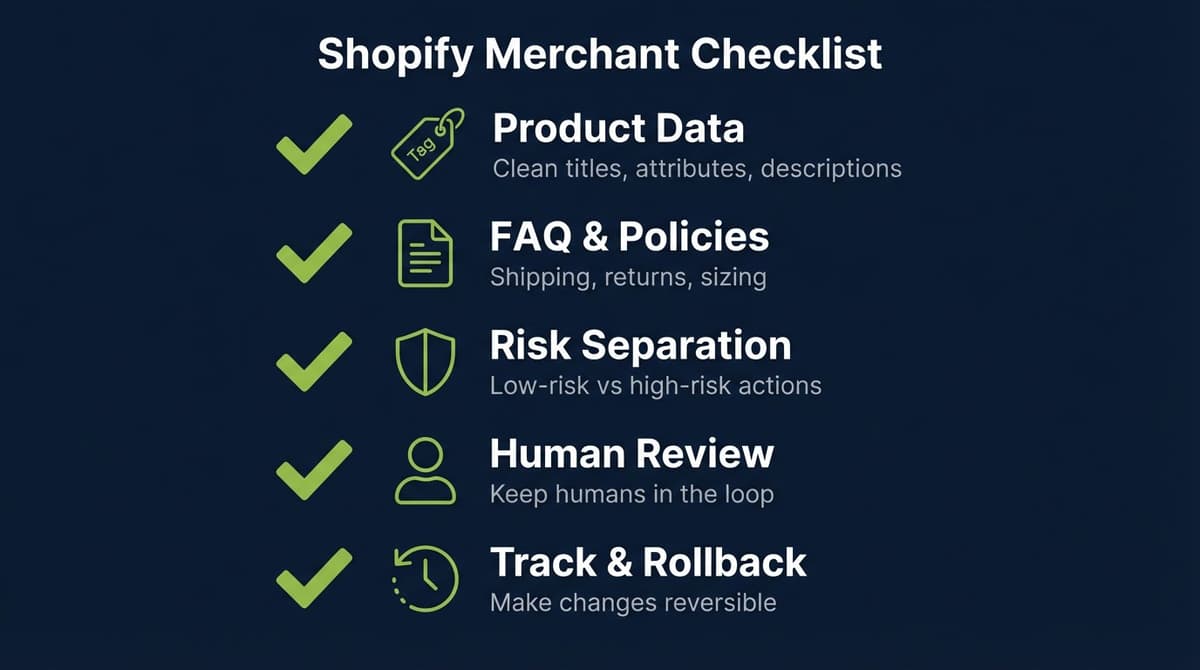
Before chasing AI tools or prompt templates, merchants should focus on the foundational work that makes AI actually useful.
1. Clean Up Product Titles, Attributes, Descriptions, and Images
Product data quality has always mattered. In an AI-driven discovery environment, it matters more.
What to fix: - Titles that follow a consistent format (Brand + Product Type + Key Attribute) - Attributes filled in completely, not left blank - Descriptions that include searchable terms customers actually use - Image alt text that describes what's shown, not generic placeholders
AI systems use this data to understand what products are and who they're for. Incomplete or inconsistent data leads to poor recommendations and missed discovery opportunities.
2. Complete FAQ, Return Policy, Shipping, and After-Sales Information
Shopify's Knowledge Base documentation is direct about this: FAQs may not display on the storefront, but they serve as trusted data sources for AI platforms generating answers.
When customers ask AI assistants about shipping times, return windows, or sizing, the accuracy of AI responses depends on whether this information exists in the store's backend.
What to document: - Shipping timeframes by region - Return and exchange policies with clear conditions - Sizing guides and product care instructions - Common customer questions and accurate answers
3. Separate Low-Risk and High-Risk Actions
Not all backend operations carry the same risk. AI should handle some tasks before others.
Low-risk (good for AI automation): - Batch updating product descriptions - Filling in missing metafields - Generating FAQ drafts - Organizing tags and categories - Creating initial content for review
High-risk (keep human control): - Pricing changes - Inventory adjustments - Order modifications - Customer data changes - Payment and discount rules
Start by automating the low-risk, high-repetition tasks. Keep humans in the loop for anything that affects money or customer relationships directly.
4. Keep Human Review in the Loop
AI-generated content and actions should go through human review before going live. This isn't about distrust—it's about catching errors before they reach customers.
Practical workflow: 1. AI generates draft (description, FAQ, tag structure) 2. Human reviews and edits 3. Human approves final version 4. Changes go live
This "AI drafts, human approves" model captures most of the efficiency gains while preventing AI mistakes from reaching customers.
5. Make Changes Trackable and Reversible
Any system that allows AI to modify store data should include:
- Audit logs showing what changed, when, and why
- Rollback capability to undo problematic changes
- Attribution linking changes to specific AI actions or human approvals
If something goes wrong, the team needs to know what happened and how to fix it. This becomes critical as AI handles more backend operations.
What NOT to Hand Over to AI Yet
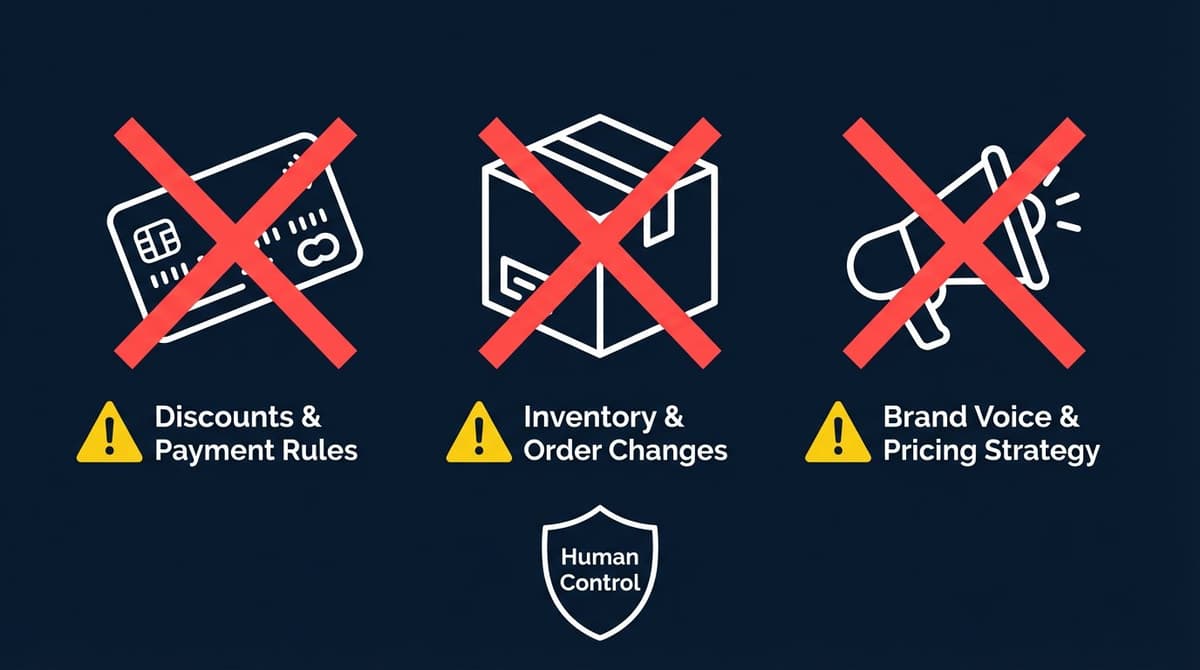
Some areas should remain under direct human control, even as AI capabilities expand.
Discounts, Payment, and Shipping Rules
These directly affect revenue and customer expectations. A misconfigured discount can cost thousands. A shipping rule error can create fulfillment nightmares.
Shopify's own documentation notes that AI channels don't have access to full admin private data, complete order history, or entire customer databases. This boundary exists for good reason.
Inventory, Orders, and Customer Data Modifications
High-risk changes to core business data should require human approval:
- Adjusting inventory counts
- Modifying existing orders
- Changing customer records
- Processing refunds or cancellations
AI can flag issues, suggest actions, and prepare workflows. But the final action should come from a human who understands the context.
Brand Voice, Pricing Strategy, and Offer Positioning
AI can generate content, but it can't understand brand strategy. Decisions about:
- How the brand sounds and feels
- What price points signal about quality
- Which offers to promote and when
These require human judgment about market positioning, competitive dynamics, and long-term brand building.
4 Predictions for the Next 1-2 Years
Based on Shopify's current direction, here's what merchants should expect:
1. AI-Ready Becomes a Default Requirement
Merchants will face a new question: Can AI correctly understand and reference my products and brand?
Product structure, FAQs, policies, and brand information will shift from "nice to have" to "basic requirements." Stores that aren't AI-readable will miss discovery opportunities in AI channels.
2. Product Operations Enter "AI Drafts, Human Reviews" Mode
The first area to change at scale won't be advertising strategy. It will be product operations itself.
Merchants will increasingly adopt this workflow: - AI generates initial titles, descriptions, attributes, and FAQ drafts - Humans review, edit, and approve final versions
This directly changes how many SKUs a store can manage and how much operational density a small team can handle.
3. Backend Shifts from Clickable Interface to Callable System
Once backend capabilities can be reliably called by AI workflows, merchants will shift from "I go click in admin" to "I define rules, AI executes, I review and roll back if needed."
This is a fundamental change in how store operations work—not just a new feature.
4. App and Partner Competition Moves to AI Entry Points
App value will increasingly depend on: - Whether Sidekick can find and use the app - Whether the app integrates into AI workflows - Whether results flow back into merchants' natural operation paths
Partners will face similar shifts: the valuable work won't just be "doing tasks for clients" but "organizing which tasks AI can handle and setting boundaries."
Conclusion
The merchants who benefit most from Shopify's AI shift won't be the ones who rush to automate everything. They'll be the ones who:
- Get their product data clean and structured
- Document policies and FAQs completely
- Start with low-risk automation and keep humans reviewing
- Build systems that track and reverse changes when needed
AI will handle repetitive backend work faster than humans. But the prerequisite is having a clean foundation to build on. Messy data doesn't become better through AI—it becomes messier, faster.
Want AI Without the Technical Setup?
Shopify's AI Toolkit is powerful, but it requires MCP configuration, authentication setup, and developer-level understanding. For most merchants, that's a barrier.
Nexscope provides ecommerce data that Shopify teams can connect to an existing Agent through API, MCP, or Skills, while focused web tools let teams preview result formats first.
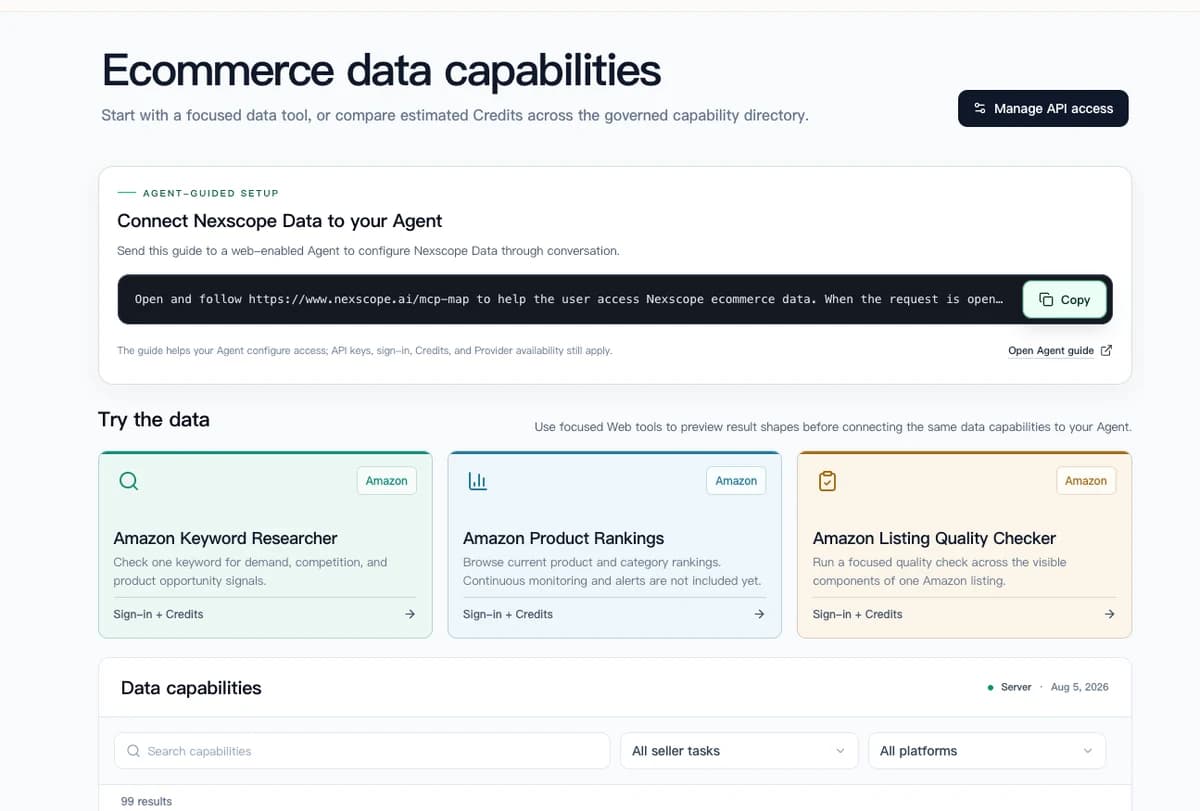
Connect Ecommerce Data to Your Agent
Use Nexscope through API, MCP, or Skills, or open a ready seller workflow.
Explore Ecommerce Data →1,000 free credits • API, MCP & Skills
FAQs
What does "AI-ready" mean for a Shopify store?
An AI-ready store has clean, structured product data that AI systems can understand and use. This includes consistent titles, complete attributes, documented FAQs, and clear policies. AI discovery and automation work better when the underlying data is organized.
Should small Shopify stores worry about AI readiness?
Yes, but the work isn't complicated. Start with cleaning up product data and documenting common customer questions. These improvements help regardless of AI—they also improve SEO and customer experience directly.
How long before AI handles most Shopify backend work?
The shift is gradual. Low-risk, repetitive tasks (descriptions, tags, FAQ drafts) are already automatable. High-risk operations (pricing, inventory, orders) will stay human-controlled for the foreseeable future. Expect 1-2 years before "AI drafts, human reviews" becomes the standard workflow for most operations.
What's the biggest risk of rushing AI automation?
Automating on top of messy data. If product information is inconsistent, AI will amplify that inconsistency across more touchpoints. Clean the data first, then automate.
Do I need technical skills to make my store AI-ready?
No. The core work is operational: organizing product data, writing clear policies, documenting FAQs. Technical AI setup (like Shopify's AI Toolkit) is a separate layer that comes after the foundational data work is complete.
Sources
- Shopify News: The agentic commerce platform
- Shopify News: Millions of merchants can sell in AI chats
- Shopify Help Center: Shopify Knowledge Base
- Shopify Dev: Shopify AI Toolkit documentation