

Where Does Temu Ship From? 5 Logistics Facts for Sellers

Where does Temu ship from? The short answer is that Temu still depends heavily on China-based manufacturing and suppliers, but the package a shopper receives may ship from China, a local warehouse, or a locally based seller depending on the country, product, and current fulfillment model.
That distinction matters for ecommerce sellers. Temu's low prices are not only a product-cost story. They are also a sourcing, inventory, customs, and last-mile logistics story. For independent sellers, marketplace merchants, and new ecommerce operators, understanding Temu's fulfillment model helps explain why some Temu products arrive in days, why others take longer, and why local inventory has become more important after US de minimis changes.
This guide breaks down where Temu ships from, how its local warehouse model works, what changed in the United States, and how sellers can use these signals to plan sourcing, pricing, delivery promises, and product research more intelligently.
Quick Answer: Where Does Temu Ship From?
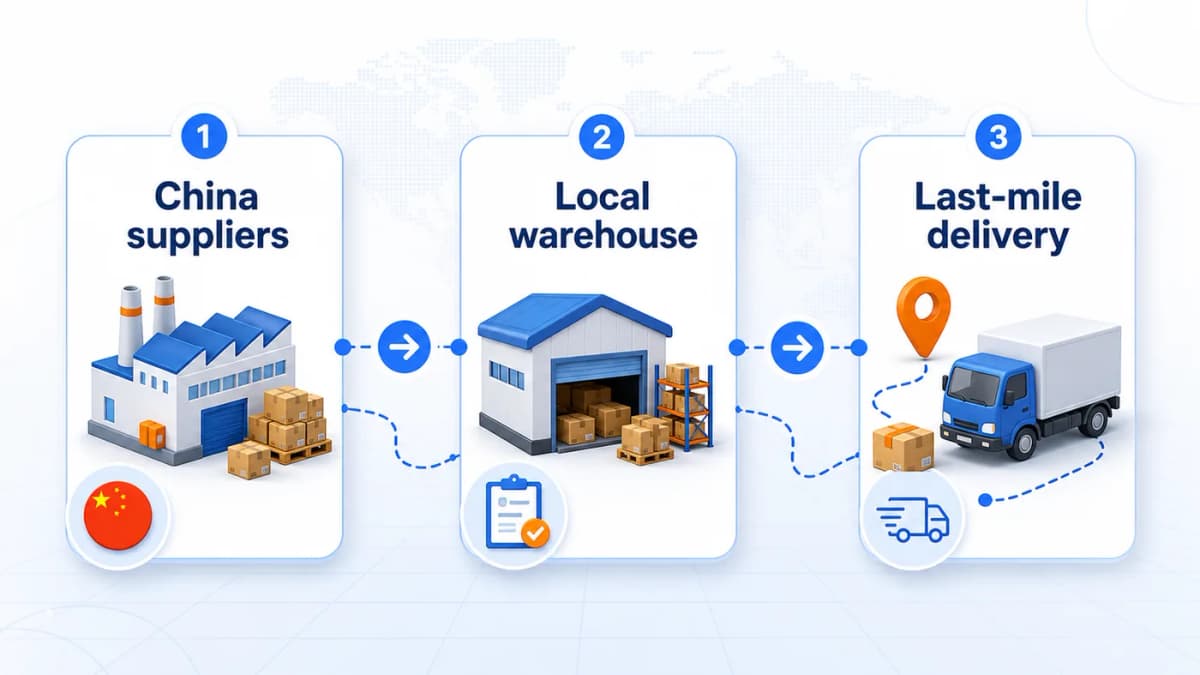
Temu ships from a mix of origins. Many products are sourced from China-based manufacturers and sellers. Some orders ship internationally from China after purchase. Other products are stocked in local warehouses or handled by local sellers, especially in markets where Temu is trying to shorten delivery times or adapt to customs rules.
For US shoppers, Temu has shifted more heavily toward local fulfillment, local inventory, and locally based sellers since the May 2, 2025 China and Hong Kong de minimis restrictions took effect. For Europe, Temu and DHL announced a local-to-local initiative that expects local fulfillment to become a major part of European sales. In other markets, availability varies by country and product category.
For sellers, the practical answer is:
- Product origin may still be China, even when the parcel ships locally.
- Package origin may be China, the US, Europe, or another local warehouse region.
- Delivery time depends on whether the item is already stocked near the shopper.
- Landed cost depends on duties, customs treatment, bulk import strategy, local storage, and last-mile carrier costs.
This is why two Temu items in the same cart can show different delivery dates or shipping labels. Temu is not operating one single logistics path. It is operating a hybrid system.
Fact 1: Many Temu Products Still Start in China
Temu's marketplace is built around access to manufacturers, brands, and business partners. The company describes itself as a global ecommerce platform connecting consumers with millions of manufacturers, brands, and business partners across more than 90 markets. That broad supplier base is one reason Temu can offer wide selection and aggressive pricing.
China remains central to Temu's supply base
Many Temu products begin with China-based factories, wholesalers, or merchants. The seller may manufacture the product, send bulk inventory to a processing warehouse, or place stock in a third-party warehouse closer to the buyer.
This matters because "ships from" can mean two different things:
- Where the product was made or sourced
- Where the parcel begins its final trip to the shopper
A kitchen gadget may be manufactured in Shenzhen, stored in a US warehouse, and delivered by a US carrier. From the shopper's perspective, the order may look domestic. From the seller's perspective, the product economics still depend on China sourcing, bulk freight, import duties, storage, and demand forecasting.
Temu's original advantage came from direct supply and tight control
Temu grew by combining low-cost supply, broad assortment, centralized pricing, and cross-border delivery. Marketplace Pulse reported in 2024 that most goods on Temu were sold through a consignment-style model where manufacturers sent products in bulk to Temu processing warehouses in China, while Temu handled listing, marketing, fulfillment, customer service, pricing, and seller payment after sale.
That model helped Temu control customer experience and price presentation. It also gave Temu a direct-from-supply-chain edge over sellers that depend on traditional wholesale markups.
For online sellers, the lesson is not to copy Temu's model blindly. It is to understand the operational tradeoff. Direct-from-China shipping can support low prices and broad assortment, but it can also create longer delivery times, customs exposure, policy risk, and weaker control over urgent replenishment.
Pro Tip: Use an AI agent to estimate whether a Temu-like price is realistic after fulfillment costs. Compare dimensional weight, domestic storage, pick-pack cost, return allowance, and delivery assumptions before matching a low competitor price.
Fact 2: Local Warehouses Are Now a Bigger Part of Temu Shipping
Temu has increasingly used local warehouses and local fulfillment partners to reduce delivery time. This does not mean every Temu product is locally stocked. It means Temu can show faster delivery for products that have already been imported, stored, or assigned to a domestic seller or local warehouse partner.
How local warehouse shipping works
Local warehouse shipping usually follows this pattern:
- A supplier or seller moves inventory in bulk from the manufacturing region to a local market.
- Inventory is stored in a local warehouse, third-party logistics facility, or recommended fulfillment provider.
- When a shopper places an order, the parcel ships domestically through a local carrier.
- Delivery speed improves because the item no longer needs to clear international parcel customs after the shopper buys it.
Local warehouse shipping can make Temu feel like a domestic ecommerce site from the shopper's point of view. The product may arrive in a few days instead of traveling internationally after checkout.
Local inventory creates a new tradeoff
Local inventory is faster, but it is not free. Someone must pay for bulk freight, import duties, warehouse storage, inventory risk, unsold stock, returns handling, and domestic fulfillment. That cost can narrow the gap between Temu and local ecommerce sellers.
For a new ecommerce seller, this creates a more useful competitive question than "Can Temu sell cheaper?"
The better question is: Can the seller beat Temu on a specific combination of delivery speed, product quality, trust, bundle design, content, and support?
If Temu's local warehouse price is close to other ecommerce offers, sellers may have room to compete with better product images, clearer instructions, stronger reviews, faster replacement policies, or differentiated bundles. Listing quality becomes more important when price differences shrink.
Fact 3: The US Model Changed After De Minimis Restrictions
The United States is the market where Temu's shipping story changed most visibly. Before 2025, low-value direct shipments from China could often benefit from the US de minimis framework. That framework allowed many packages under $800 to enter with simplified duty treatment.
What changed on May 2, 2025
US Customs and Border Protection stated that, effective 12:01 a.m. EDT on May 2, 2025, products of China and Hong Kong would no longer receive the de minimis administrative exemption under 19 U.S.C. 1321(a)(2)(C), in compliance with Executive Order 14256.
This policy shift directly affected platforms that relied on low-value China-to-US parcel shipping. WIRED reported on May 1, 2025 that the US version of Temu began showing only local products shortly before the change, and Temu stated that US operations had transitioned to local fulfillment, with sales handled by locally based sellers and orders fulfilled from within the country.
What this means for sellers
For ecommerce sellers, the US change has three implications:
- Direct China-to-US parcel economics became less predictable. Duties, clearance rules, and platform-level policy responses can change quickly.
- Domestic inventory became more strategic. Sellers that already hold US inventory can make faster delivery promises and reduce customs uncertainty at the order level.
- Bulk import planning matters more. A seller may still source from China, but the winning model may involve importing in bulk, storing locally, and managing demand more carefully.
Sellers already face a version of this decision when choosing between self-fulfillment, third-party logistics, and hybrid fulfillment. Temu's pivot makes that decision more visible across the discount marketplace landscape. A seller should compare not only transaction and fulfillment fees, but also the cost of holding local stock against the lost conversions from slow delivery.
Pro Tip: Calculate local-stock economics before copying Temu's delivery promise. Model storage, fulfillment, returns, transaction fees, and net margin at different price points before deciding whether domestic inventory is worth the risk.
Fact 4: Europe Is Moving Toward Local-to-Local Fulfillment
Temu's local fulfillment strategy is not limited to the United States. In April 2025, DHL Group and Temu announced a memorandum of understanding to support Temu's local-to-local initiative in Europe. The announcement said DHL would support Temu's European operations, including a model that enables local merchandise partners to sell on the platform and supports local fulfillment. It also stated that Temu expects up to 80% of its total sales in Europe to come from the local-to-local model.
Why Europe matters
Europe has fragmented languages, VAT requirements, consumer protection rules, carrier networks, and delivery expectations. A single direct-from-China logistics model can become less attractive as Temu scales across Germany, France, Spain, Italy, the Netherlands, Austria, the UK, and other European markets.
Local-to-local fulfillment helps Temu:
- Reduce delivery time for popular products
- Support local sellers and local inventory
- Improve compliance and trade handling
- Create a marketplace experience closer to regional ecommerce standards
DHL also says it is a Temu-recommended fulfillment provider for merchants selling through Temu, with warehouse support across Europe and the US. That signals a broader ecosystem around Temu merchants, not only a single Temu-controlled warehouse network.
What sellers should watch
For online sellers, Temu's European shift creates a new benchmark. It is no longer enough to compare only product price. Sellers should also compare:
- Delivery promise by country
- Returns location and returns friction
- VAT-inclusive pricing clarity
- Local language listing quality
- Local trust signals and customer support
- Inventory availability during seasonal peaks
When Temu localizes fulfillment, sellers need to localize the total offer, not only the shipping label. Product research is stronger when it includes competitor delivery dates, review complaints, return pain points, image quality, demand signals, and logistics assumptions.
Fact 5: Shipping Origin Affects Price, Speed, and Assortment
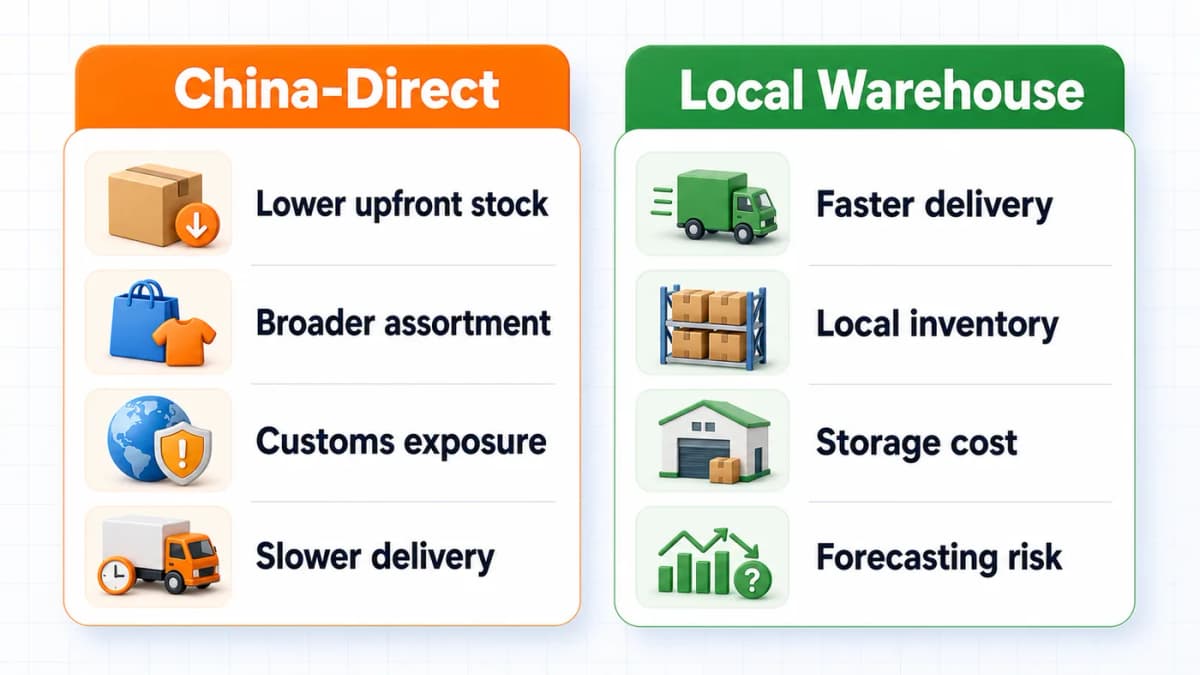
Temu's hybrid model creates a constant tradeoff between price, delivery speed, selection size, and inventory risk.
China-direct shipping
China-direct shipping can support broad assortment and lower inventory risk because products do not need to be pre-positioned in every market. It also allows the platform to test many SKUs without committing local warehouse space.
The drawbacks are slower delivery, customs exposure, higher disruption risk, and weaker customer confidence when the shopper expects fast domestic delivery.
Local warehouse shipping
Local warehouse shipping is faster and more predictable. It can support higher conversion rates, better delivery badges, and easier returns. It also makes Temu more competitive with domestic ecommerce sellers on speed.
The drawbacks are storage cost, inventory forecasting risk, higher operational complexity, and potentially narrower selection. Local stock must be chosen carefully. Slow-moving products can become expensive when warehousing fees and markdowns accumulate.
Seller takeaway
For competing sellers, shipping origin is a strategic signal. A Temu item that ships locally may indicate proven demand, enough velocity to justify local stock, or a category where delivery speed drives conversion. A Temu item that still ships internationally may indicate a long-tail SKU, a lower-velocity test product, or a price-sensitive category where shoppers accept slower delivery.
The best product research process should capture both. Demand alone is not enough. A seller should evaluate whether the product can support profitable local fulfillment, differentiated content, reliable sourcing, and a clear reason to buy outside Temu.
Pro Tip: Use product research and sales estimates together. A product needs enough repeatable demand to justify local inventory, especially when storage fees, markdowns, and returns can erase the advantage of faster delivery.
How Sellers Can Compete With Temu's Shipping Model
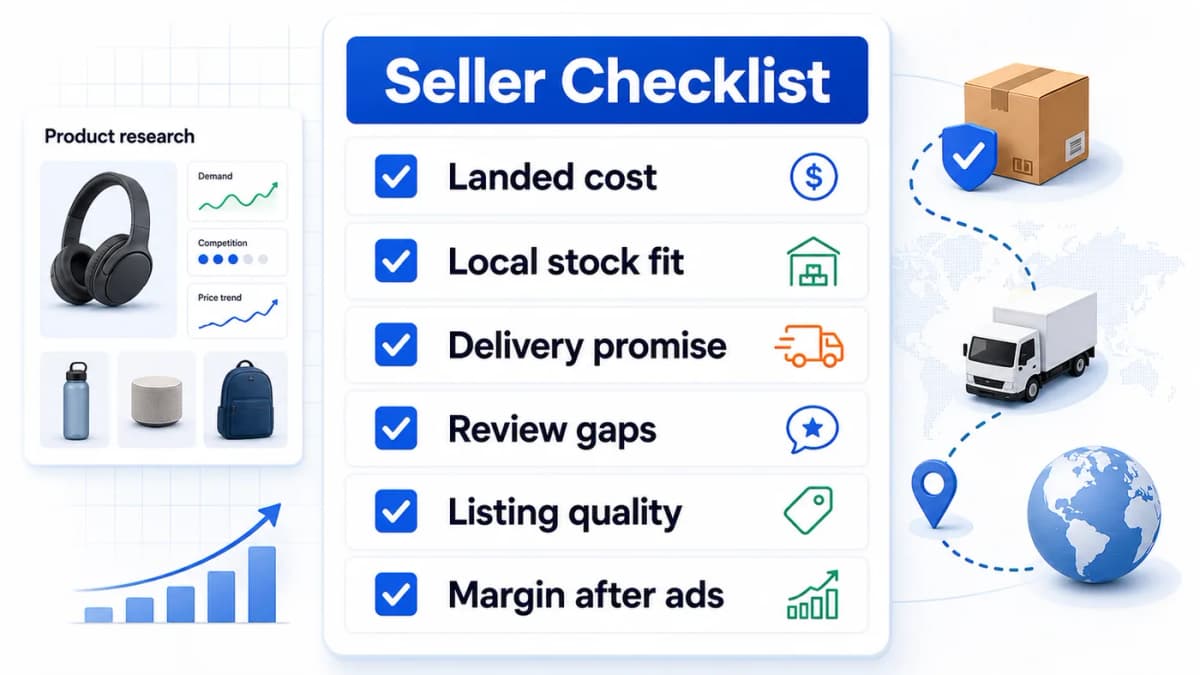
Temu's shipping model can feel difficult to compete with because it blends China sourcing, bulk logistics, local warehouses, and platform-level pricing. But most independent ecommerce sellers do not need to compete with every Temu item. They need to choose the right products and design a better offer for a specific buyer.
1. Separate product cost from landed cost
The supplier quote is only the first number. Sellers should calculate:
- Product unit cost
- Packaging and labeling
- Freight to the destination market
- Duties, taxes, and customs brokerage
- Warehouse receiving
- Storage and pick-pack cost
- Returns and replacement allowance
- Marketplace fees or payment processing fees
- Ad cost and promotional discounts
A product that looks cheap at the factory can become uncompetitive after landed cost, storage, returns, and customer acquisition are included.
2. Use local inventory only where speed changes conversion
Not every product deserves local stock. Local inventory works best when customers care about speed, the product has predictable demand, and the margin can absorb storage and domestic fulfillment.
Good candidates include replenishable consumables, problem-solving home products, seasonal products with strong timing, accessories with high review confidence, and products where returns are manageable.
Weak candidates include fragile goods, unpredictable trend products, oversized low-margin items, or SKUs where demand is too shallow to justify bulk import.
3. Differentiate where Temu is weakest
Temu often competes on price and variety. Sellers can compete on:
- Better product bundles
- Clearer sizing and compatibility information
- Stronger product images and videos
- Better packaging and instructions
- Faster customer support
- More reliable replacement policies
- Niche-specific positioning
- Brand story and trust signals
This is especially important for products where buyers worry about quality, safety, fit, or post-purchase support. AI tools can help analyze reviews, improve listing content, and identify product gaps that price-only competitors leave open.
4. Watch Temu's local badges and delivery estimates
Temu's delivery estimate can be a useful competitive signal. If a product shows fast local delivery, the category may have enough demand to support pre-positioned inventory. If the estimate is slow, a seller with local stock may be able to win with a faster promise.
Sellers should capture:
- Product category
- Price range
- Delivery estimate
- Local warehouse or local seller badge
- Review count and complaint themes
- Product image quality
- Bundle or variant structure
- Similar listings across relevant marketplaces
This turns Temu from a pricing threat into a research source.
Use Ecommerce Data to Analyze Temu-Like Competition
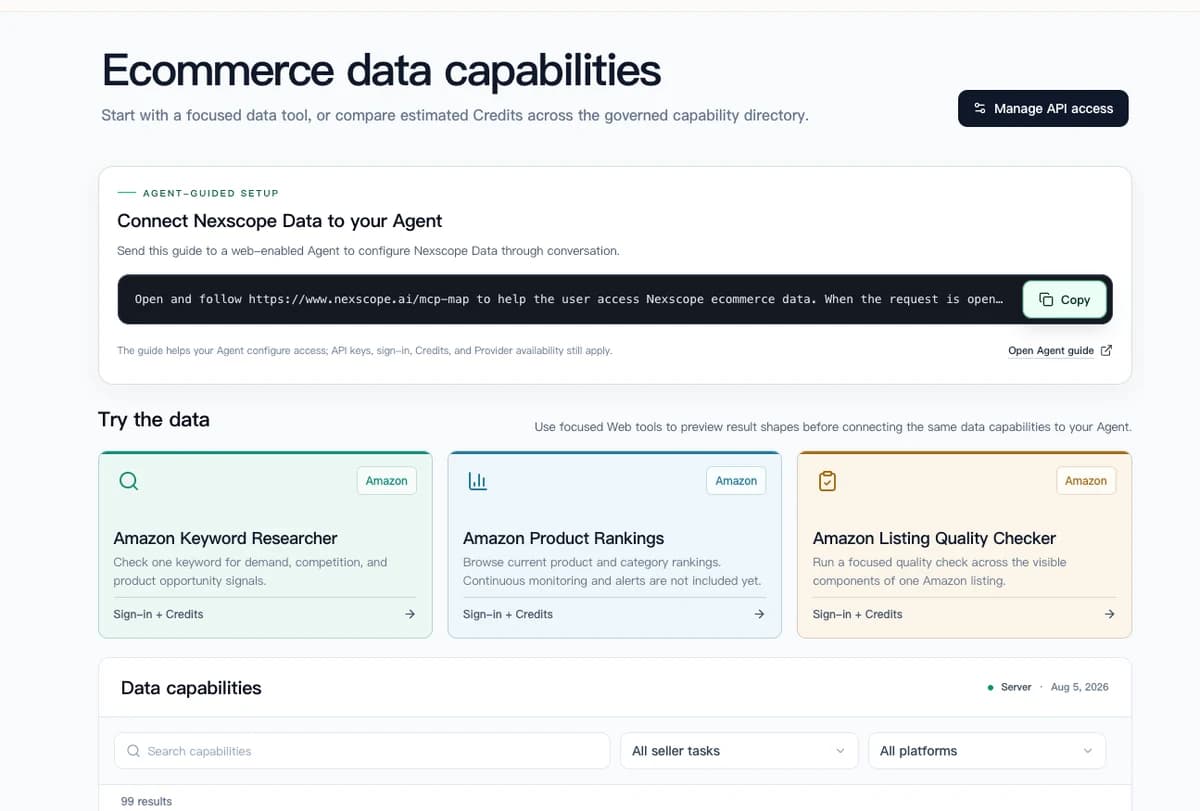
Nexscope provides structured ecommerce data and focused seller workflows. Teams can use Nexscope's web tools directly or connect governed capabilities to their existing Agent through API, MCP, or Skills. Ready workflows include Keyword to Ads, Video Clone, and Buy Box Repricer.
Connect ecommerce data for Temu-like competitor analysis
Use plain-English workflows to compare product demand, review gaps, pricing pressure, sourcing signals, fulfillment assumptions, and visual opportunities before choosing what to sell.
Get Started Free →No coding required • Instant access
For a topic like Temu shipping, Nexscope can help sellers structure the questions that matter:
- Which competing products appear to ship locally?
- Which categories show enough demand to justify local inventory?
- Which review complaints suggest a better product angle?
- Which keywords reveal buyer urgency around shipping speed, quality, or trust?
- Which price points still leave room after fulfillment, storage, and ads?
- Which product concepts need patent or IP risk screening before sourcing?
The goal is not to copy Temu. The goal is to understand where Temu's supply-chain advantage is real, where it is weaker, and where a seller can build a more trusted product offer.
For sellers who want expert help instead of doing the research alone, Nexscope's E-commerce Growth Services support product research, competitor and review analysis, listing optimization, AI product creatives, marketplace advertising, and custom launch workflows for ecommerce channels.
Need expert help turning research into growth?
Nexscope E-commerce Growth Services help sellers turn market research, competitive insights, listing strategy, product creatives, and launch planning into a clearer execution plan.
Talk to an Expert →Product research • Creatives • Launch support
Conclusion
So, where does Temu ship from? Temu ships through a hybrid model. Many products still originate from China-based suppliers and manufacturers, but the final parcel may ship from China, a local warehouse, a domestic distributor, or a locally based seller depending on the market and product.
For ecommerce sellers, the important lesson is that shipping origin is a business signal. China-direct shipping can reveal price pressure and assortment breadth. Local warehouse shipping can reveal stronger demand, faster delivery expectations, and a shift toward domestic fulfillment economics. US de minimis changes and Europe's local-to-local push both show that the cross-border discount marketplace model is becoming more logistics-heavy and policy-sensitive.
The next step is practical: compare Temu products by source, delivery estimate, category, price, review quality, and fulfillment assumptions. Then choose products where a seller can win through faster delivery, better content, stronger trust, clearer differentiation, and realistic landed-cost planning.
Frequently Asked Questions
Where does Temu ship from?
Temu ships from multiple origins. Many products are sourced from China-based manufacturers and sellers, and some still ship internationally from China. Other products ship from local warehouses, domestic distributors, or locally based sellers in markets where Temu has built local fulfillment. The exact origin depends on the shopper's country, the product, the seller model, and whether inventory has already been stocked locally.
Does Temu ship from China?
Yes, many Temu products still originate from China, and some orders may ship from China depending on the market and product. However, "made or sourced in China" is not always the same as "shipped from China." A product can be manufactured in China, imported in bulk, stored in a US or European warehouse, and then shipped locally after a shopper places an order.
Does Temu have warehouses in the United States?
Temu has used US-based local fulfillment and warehouse partners, and reports show that the platform shifted more heavily toward US local fulfillment after the May 2, 2025 de minimis restrictions for China and Hong Kong products. In practice, US shoppers may see local products that ship from inventory already inside the country. Availability can vary by product category and seller.
Why do some Temu orders arrive faster than others?
Temu delivery speed depends on whether the product is already stored near the customer. Local warehouse items can move through domestic carriers and arrive faster. China-direct or international items need more time for export processing, air freight or line-haul transport, customs handling, and final-mile delivery. Delivery estimates can also vary by product size, carrier capacity, season, and customs policy.
What does local warehouse mean on Temu?
Local warehouse usually means the product is already stocked in or near the shopper's market before purchase. The product may still have been manufactured overseas, but the final parcel ships domestically or regionally. For shoppers, this usually means faster delivery. For sellers, it means the platform or merchant accepted the cost and risk of importing inventory before the order was placed.
Is Temu shipping similar to domestic fulfillment?
Temu's local warehouse strategy can resemble domestic fulfillment from the shopper's perspective because products can be stored near customers and delivered faster. The operating model is not identical to a standard third-party logistics setup. Temu uses a mix of marketplace, consignment, local sellers, and fulfillment partners depending on the market.
How can ecommerce sellers compete with Temu shipping?
Sellers can compete by choosing products where quality, trust, speed, packaging, instructions, support, and brand differentiation matter. Matching Temu's lowest price is rarely the best strategy. A better approach is to calculate landed cost, use local inventory only where delivery speed increases conversion, improve listing images and content, analyze review complaints, and build bundles or offers that solve buyer problems more clearly.
Sources
- Temu and DHL Group. (2025). DHL Group and Temu sign Memorandum of Understanding to support local businesses. Retrieved from prnewswire.com
- U.S. Customs and Border Protection. (2025). De Minimis Restrictions for China and Hong Kong Effective 12:01 a.m. EDT May 2, 2025. Retrieved from content.govdelivery.com
- Marketplace Pulse. (2024). Temu Sets Up U.S. Warehouses. Retrieved from marketplacepulse.com
- WIRED. (2025). Temu Blocks US Shoppers From Seeing Products Shipped From China. Retrieved from wired.com
- DHL Fulfillment Network. (2026). Temu Integration. Retrieved from dhl.com