

AI Shopping Agents in Europe: What Sellers Need to Know

AI shopping agents are beginning to influence how European consumers discover products, compare options, and narrow a purchase shortlist. A shopper looking for running shoes under €100 can now describe budget, terrain, fit, and delivery needs in a single prompt. The AI can summarize suitable products and explain the trade-offs without requiring the shopper to open ten search results.
That experience can look like fully automated shopping, but the market has not reached that point at scale. Most AI-assisted journeys still separate product discovery from payment and fulfillment. The assistant helps form the decision, while a marketplace or retailer completes the transaction and supplies the trust signals surrounding it. For cross-border sellers, this changes where competition begins. Search rankings still matter, yet clear product data, independent evidence, localized policies, and machine-readable information now influence whether a product enters an AI-generated shortlist. This guide explains the current state of AI shopping in Europe and the practical steps ecommerce sellers can take without abandoning the channels that already drive sales.
What Are AI Shopping Agents?
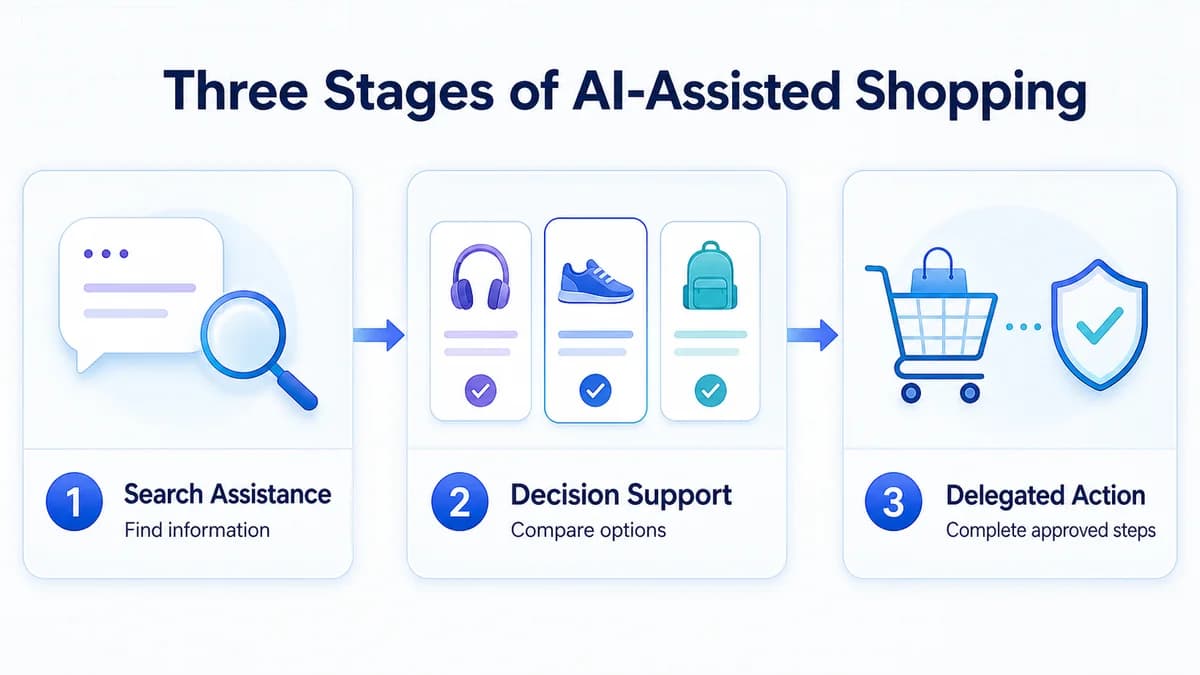
AI shopping agents are systems that interpret a shopper’s request, collect or synthesize relevant product information, compare options, and recommend a next action. Their role can range from answering a simple product question to helping a customer prepare a cart.
The term “agent” can be misleading when every recommendation is treated as an autonomous purchase. In practice, AI-assisted shopping exists on a spectrum. Some experiences resemble conversational search. Others compare products across retailers or use structured catalog data to support a decision. A smaller set can take actions such as creating a basket or directing the shopper to checkout.
From Search Assistance to Decision Support
At the first stage, an assistant answers questions such as “Which materials are easiest to clean?” or “What size is suitable for a small apartment?” The response helps the shopper formulate a better search.
At the second stage, the system becomes a decision aid. It can compare specifications, summarize reviews, identify products that meet several constraints, and explain why one option may suit a use case better than another. This is the stage with the clearest current impact because it changes which products receive consideration before a customer reaches a product page.
The Three Stages of AI-Assisted Shopping
- Search assistance: The system interprets a natural-language request and retrieves relevant information.
- Decision support: The system compares products, summarizes evidence, and narrows the options.
- Delegated action: The system performs an approved step, such as assembling a cart, initiating checkout, or placing an order within defined limits.
The third stage receives the most attention, but European adoption remains concentrated earlier in the journey. McKinsey found that 38% of surveyed European consumers use AI tools to research products and services or decide what to purchase. The strongest current influence is upstream of the transaction, where preferences are formed and choices are narrowed.
How Shopping Agents Differ From Search Engines
A conventional search engine returns pages that match a query. An AI shopping agent attempts to interpret the buyer’s complete need and synthesize an answer. That difference makes attributes such as dimensions, materials, compatibility, use cases, price, availability, delivery, and return conditions easier to compare within one response.
Search and AI discovery increasingly overlap, so the two channels should not be treated as separate systems. The broader shift described in AI shopping and product search is better understood as a change in the discovery mix. Search engines, marketplaces, social content, retailer sites, and AI answers can all influence the same purchase.
Where Europe’s AI Shopping Market Stands Today
Europe is moving from experimentation toward regular AI-assisted product research. The available data also shows that research adoption is ahead of transaction adoption. That distinction matters when sellers allocate resources.
AI Already Influences Product Research
McKinsey’s European research found that 38% of consumers surveyed in France, Germany, and the United Kingdom use AI when researching products or deciding what to buy. Usage is particularly relevant in categories where shoppers need to evaluate several trade-offs, such as apparel, electronics, healthcare products, and travel.
A separate ChannelEngine survey of 4,500 marketplace shoppers across the United States, United Kingdom, France, Germany, and the Netherlands found that 58% had used AI tools to research products. The geographic scope differs from the McKinsey study, so the two percentages should not be combined as one European adoption rate. Together, they support a narrower conclusion: AI has become a meaningful research channel, including in major European ecommerce markets.
Most Consumers Still Want Control Over Checkout
The same ChannelEngine study found that 37% of respondents had started a purchase journey through an AI assistant, while only 17% were comfortable completing a purchase through AI. Reviews, delivery certainty, price clarity, and marketplace trust still influence where a shopper completes the order.
This creates a practical boundary. AI can have substantial influence over product consideration even when it does not process the transaction. A brand can lose visibility before the customer reaches Amazon, Shopify, or another storefront, yet the selected retailer still needs to earn the final conversion.
Product Discovery and Transaction Execution Are Separating
Product discovery and transaction execution increasingly occur in different environments:
- AI assistants support discovery by interpreting needs, comparing options, and explaining trade-offs.
- Retailers and marketplaces support execution through current inventory, payments, fulfillment, returns, customer service, and purchase protection.
- Shoppers move between the two as they verify claims, compare prices, and decide where to place the order.
An Ecommerce News Europe summary of a PSE Consulting survey reported that 74% of AI-shopping users preferred independent assistants such as ChatGPT, while 90% expected their marketplace use to remain the same or increase. The sample covered AI-shopping users in the United Kingdom, United States, France, and Germany. The result does not suggest that marketplaces are disappearing. It suggests that discovery can start outside them.
Why Marketplaces Are Not Disappearing
Marketplaces hold data and operational capabilities that a generated answer may not reliably reproduce: live stock, final price, seller identity, delivery date, returns, customer support, and payment protection. Those functions become more important when a customer moves from interest to commitment.
For sellers, the implication is straightforward. Marketplace SEO and listing quality remain important, while AI discovery adds another layer of competition. A product needs to be understandable before it reaches the shortlist and credible when the shopper verifies it on a transaction platform.
What AI Shopping Agents Change for Cross-Border Sellers
The traffic model becomes more distributed when AI participates in product discovery. A marketplace listing can remain the main transaction page, but the evidence used to describe and evaluate a product may come from several sources.
Product Visibility Extends Beyond Marketplace Search
AI-generated answers may draw on accessible product pages, retailer feeds, marketplace listings, editorial coverage, creator reviews, community discussions, and other public sources. Sellers therefore need a consistent product footprint rather than a single optimized listing surrounded by incomplete or contradictory information.
This is one reason generative engine optimization matters to ecommerce brands. GEO focuses on whether AI systems can find, interpret, and use information about a brand or product. It complements marketplace SEO and conventional search optimization.
Clear and Consistent Product Data Matters More
Shopping systems need enough detail to match a product to a specific request. A title such as “Premium Everyday Running Shoe” gives an AI system little usable information. A complete product record can describe terrain, cushioning, heel-to-toe drop, available widths, upper material, weight, weather resistance, size range, and return conditions.
The product name, identifiers, core specifications, variant data, price, availability, and policy details should agree across channels. When a brand website lists one material and a marketplace listing shows another, the inconsistency creates uncertainty for both shoppers and automated systems.
Structured data can help machines interpret a page. Google documents ecommerce structured data for information such as price, availability, ratings, shipping, returns, variants, and identifiers. Google also recommends combining website structured data with Merchant Center feeds where relevant because the two inputs can improve eligibility and help verify product information. A technical GEO foundation for Shopify stores starts with the same basics: crawlable pages, consistent product data, structured markup, and accessible policy information.
Reviews and Independent Evidence Shape Trust
Product claims become more useful when independent sources support them. Authentic customer reviews can confirm fit, durability, ease of use, or limitations that a product description cannot prove on its own. Creator demonstrations and editorial comparisons can add context for use cases.
The goal is not to manufacture mentions. Low-quality placements, copied reviews, and undisclosed endorsements can damage credibility. Sellers should prioritize evidence that reflects real product use and gives buyers enough detail to evaluate the claim.
Compliance and Localization Support European Market Trust
European expansion requires more than translating a product title. Sellers may need localized instructions, safety information, customer support, return terms, tax handling, packaging obligations, and product-specific documentation. Requirements vary by category and destination market.
EU guidance on CE marking illustrates why blanket advice is risky. CE marking applies only to products covered by EU rules that specifically require it. Toys, some electronics, machinery, personal protective equipment, and medical devices are among the covered categories. Products outside those rules should not automatically carry the mark. Manufacturers, importers, authorized representatives, and distributors can have different responsibilities, so sellers need category-specific guidance.
Compliance should not be described as a proven AI ranking factor. Accurate compliance and policy information still matters because it helps marketplaces, retailers, customers, and business partners evaluate whether a product can be sold and supported in the target market.
Four Steps Ecommerce Sellers Can Take Now
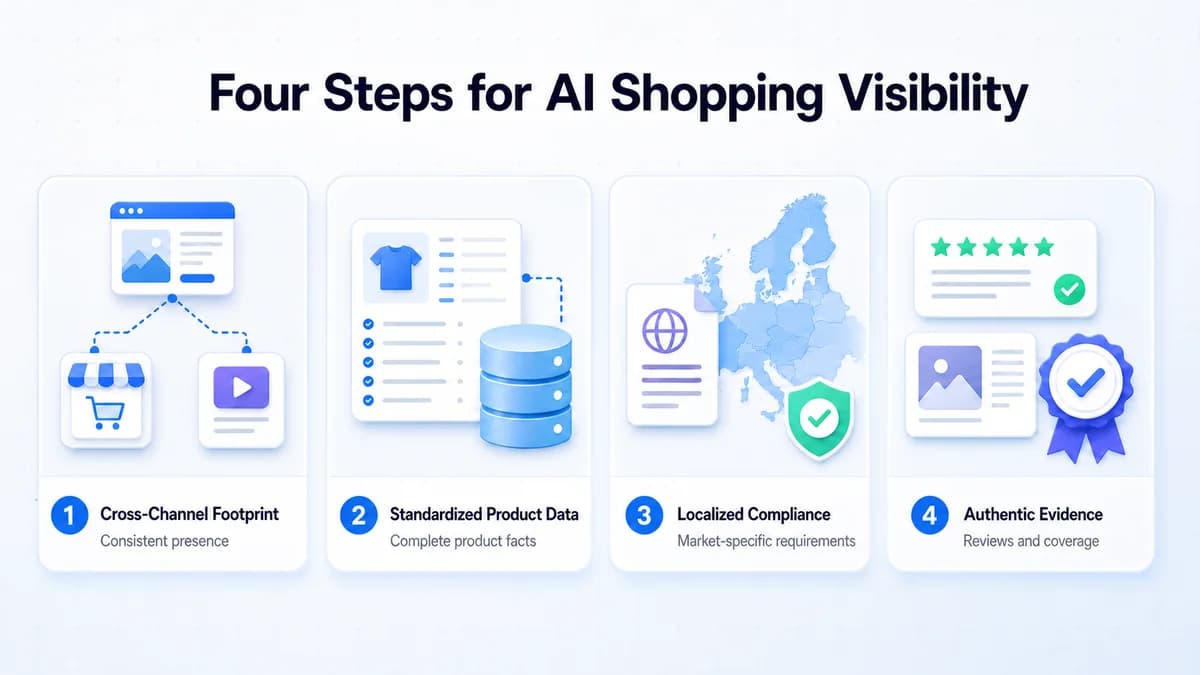
The following four actions preserve the practical preparation model from the original discussion while keeping each recommendation within a defensible evidence boundary.
1. Build a Cross-Channel Product Footprint
Every priority product should have a clear source of truth on the brand’s own site, even when most sales occur on a marketplace. That page can explain the product, document variants, answer common questions, and link to applicable policies. Marketplace listings, creator content, social profiles, and third-party coverage should reinforce the same identity and value proposition.
A useful review starts with buyer questions. Sellers can list the prompts a shopper might use before purchasing, then check whether accessible sources provide complete and consistent answers. Missing answers reveal where new content or product data is needed.
2. Standardize Product Data Across Every Channel
Create a master product record for each SKU and define which fields every channel must use:
- Identity: Brand, product name, model, GTIN, MPN, SKU, and variant identifiers
- Physical attributes: Dimensions, weight, materials, color, capacity, and included components
- Performance: Compatible uses, limitations, care instructions, and relevant test results
- Commercial details: Current price, availability, shipping estimates, warranty, and returns
- Evidence: Ratings, review counts, certifications, and links to supporting documentation
The information should then flow into the brand website, product feeds, retailer listings, and structured data. This work also improves the fundamentals behind getting a product recommended in ChatGPT Shopping because the system needs specific, accessible information before it can match a product to a detailed request.
3. Localize Product, Policy, and Compliance Information
Localization should cover the complete purchase context, not only marketing copy. Product pages may need local-language specifications, measurements, safety information, delivery estimates, return instructions, warranty terms, and customer service details.
Sellers should map obligations by product and country. Depending on the situation, this may include VAT, packaging and recycling obligations, responsible economic operators, CE documentation, product labeling, or other sector-specific rules. A legal or compliance specialist should review uncertain cases before a product is placed on the market.
4. Earn Authentic Reviews and Third-Party Coverage
Authentic evidence is strongest when it answers a question that the product page cannot answer alone. A running-shoe review might address fit after 100 kilometers. A kitchen-appliance demonstration might show noise, cleanup, and counter space. A comparison article might explain where a lower-priced model performs well and where it falls short.
Sellers can support this process by providing accurate specifications, review units, testing guidance, and clear disclosure expectations. They should not script positive opinions or suppress material limitations. Detailed, independent content is more useful to shoppers and gives AI systems clearer context to synthesize.
How to Measure a Product’s AI Visibility
The preparation steps above improve a product’s information environment, but page readiness does not prove that an AI assistant actually mentions or recommends the product. Measurement needs to observe real outputs across realistic buyer questions.
Page Readiness and Observed Visibility Measure Different Things
A readiness audit checks whether a page is crawlable, structured, complete, and supported by trust signals. An observed visibility test asks a different question: when shoppers prompt AI systems about a product category, does the product appear, where is it positioned, which competitors appear, and what sources support the answer?
Both measurements are useful. Readiness identifies input problems. Observed visibility shows the result that customers may encounter.
Metrics Sellers Can Track
- Mention rate: The share of relevant buyer questions that produce a product mention
- Average recommendation position: Where the product appears when an answer presents several options
- Primary recommendation rate: How often the product is selected as the leading option
- Buyer-question coverage: Which intents and use cases include the product
- Citation coverage: Which sources support the product or competing recommendations
- Competitive share: Which brands appear more often and for which prompts
These metrics should be tracked across a stable question set. Prompts need to reflect real purchase constraints, such as budget, use case, material, delivery location, compatibility, or comparison criteria.
Check Product Visibility With Nexscope
Nexscope provides an AI Product Visibility Tool that checks how a product appears in AI shopping answers. A seller can submit a product URL, name, or ASIN and evaluate buyer-question coverage across ChatGPT, Claude, Gemini, and DeepSeek.
The report covers a visibility scorecard, query-level evidence, LLM and competitor benchmarks, citations and signal gaps, and a prioritized action plan. A public sample AI product visibility report shows how these dimensions fit together.
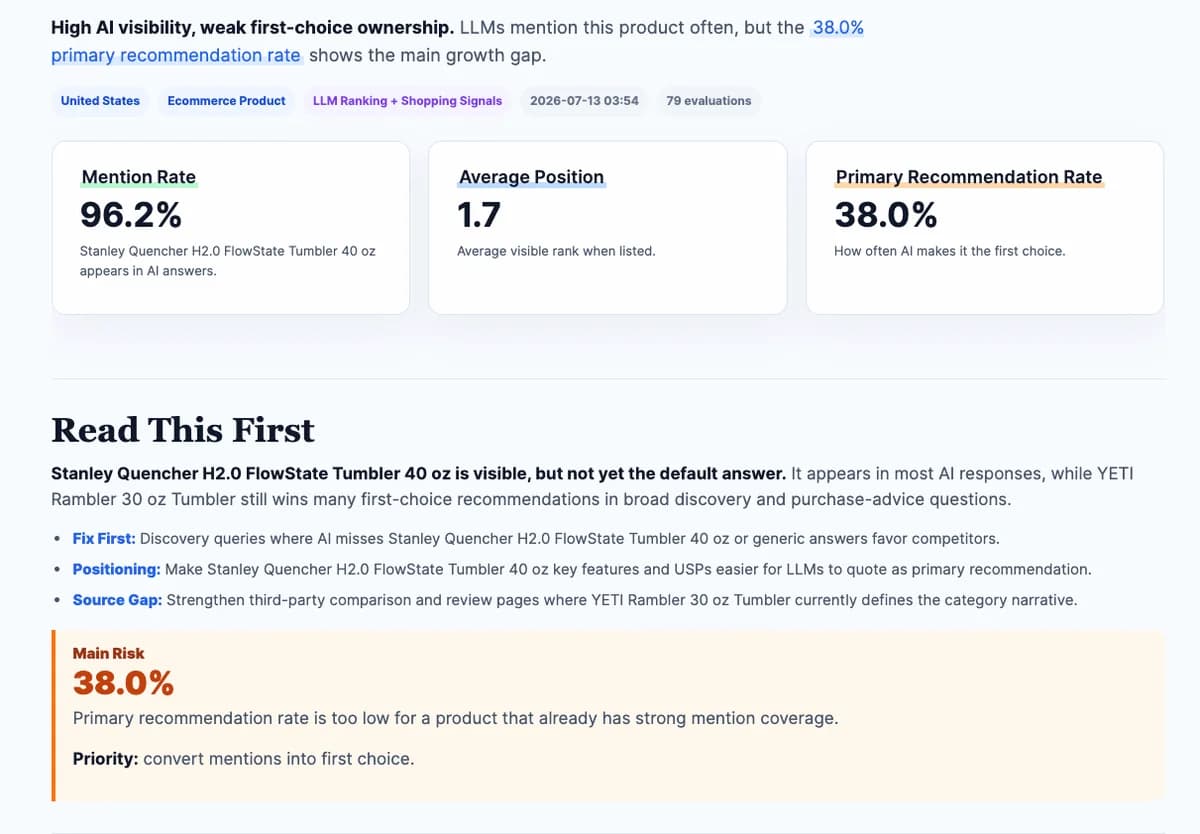
AI answers can vary by prompt, platform, location, and time. A visibility report is therefore a measured snapshot rather than a guarantee of future ranking. Repeating the same buyer-question set after meaningful product-data or content changes can show whether visibility is improving.
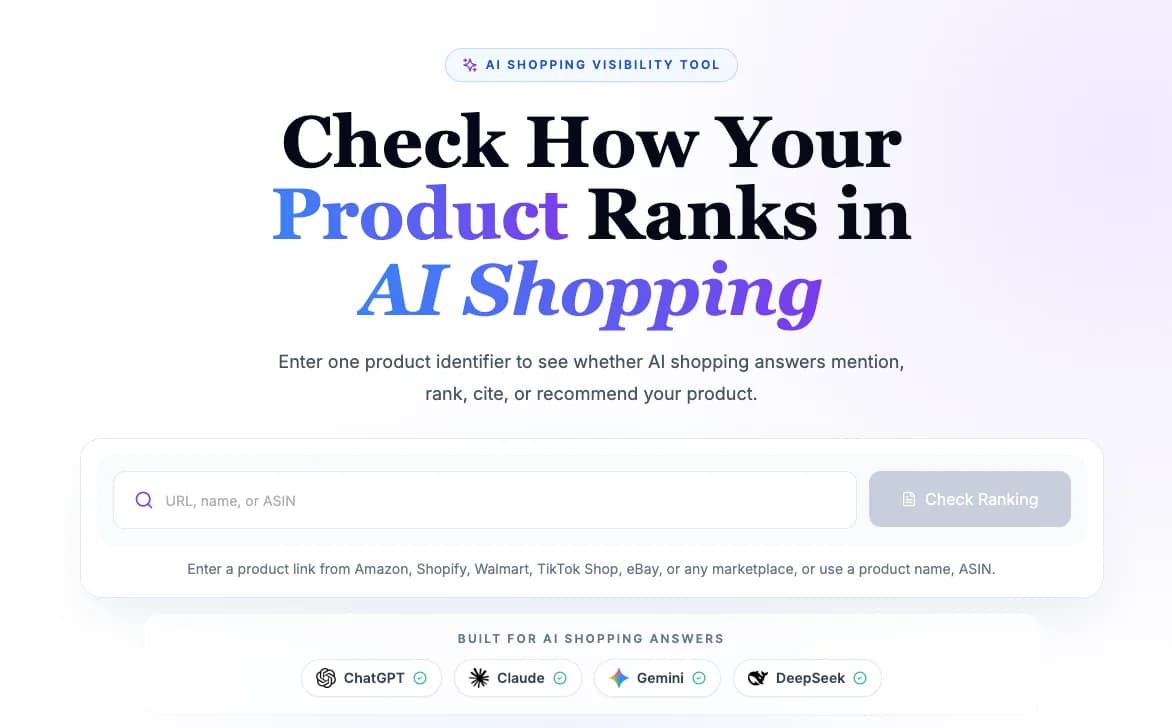
See Where Your Product Appears in AI Shopping Answers
Check whether ChatGPT, Claude, Gemini, and DeepSeek mention, rank, or cite your product—then uncover the visibility gaps holding it back.
Run an AI Visibility Check →Use a product URL, name, or ASIN • Instant workflow
Common Mistakes to Avoid
- Relying on marketplace SEO alone: Marketplace search remains important, but product discovery can begin in AI answers, social content, editorial pages, or a brand website.
- Treating autonomous checkout as universal: Research and decision support are more mature than fully delegated purchasing. Strategy should reflect the current behavior.
- Publishing conflicting product information: Differences in dimensions, materials, price, or compatibility weaken trust and make comparison harder.
- Calling compliance an AI ranking trick: Compliance is a legal and operational requirement where applicable. It should not be reduced to an unproven visibility tactic.
- Creating artificial third-party evidence: Fake reviews and low-quality placements can damage credibility. Useful evidence comes from real use and transparent disclosure.
- Abandoning marketplaces too early: Marketplaces still provide transaction infrastructure, fulfillment, service, and trust. AI discovery adds an upstream layer.
Conclusion: Prepare for AI Discovery Without Abandoning Marketplaces
AI shopping agents are changing the point at which ecommerce products enter consideration. In Europe, the strongest evidence currently sits in product research and decision support. Fully delegated purchasing remains less common, and marketplaces continue to play a central role in checkout, fulfillment, returns, and buyer confidence.
Sellers can prepare without chasing speculative tactics. The practical foundation is a consistent cross-channel product footprint, complete product data, appropriate structured markup, localized policies, category-specific compliance, and authentic third-party evidence. These elements help shoppers understand a product and give AI systems clearer information to evaluate.
The next step is measurement. A seller that tests realistic buyer questions can see whether its products appear, which competitors receive stronger recommendations, and which information gaps require attention. That creates a repeatable process for improving AI product visibility while protecting the channels that already convert demand into sales.
Make Your Product Easier for AI Shoppers to Find
Benchmark your AI presence, compare competing recommendations, and prioritize the product-data and content improvements that can strengthen visibility.
Improve Your AI Product Visibility →Built for ecommerce sellers • No manual prompt setup
Frequently Asked Questions
What is an AI shopping agent?
An AI shopping agent is a system that interprets a shopper’s needs, gathers or synthesizes product information, compares suitable options, and recommends a next step. Some agents only assist with research, while others can create a cart or initiate a transaction. The term covers several levels of automation, so a conversational recommendation should not automatically be treated as a fully autonomous purchase.
Are AI shopping agents already widely used in Europe?
AI-assisted product research has meaningful adoption in major European markets, although fully automated purchasing is less common. McKinsey reported that 38% of surveyed consumers in France, Germany, and the United Kingdom use AI to research products or decide what to buy. Current usage is strongest before checkout, when shoppers discover brands, compare options, and narrow a shortlist.
Will AI shopping agents replace Amazon and other marketplaces?
Current evidence does not support an immediate replacement. AI assistants can influence discovery and comparison, while marketplaces retain important functions such as live inventory, final pricing, payments, fulfillment, returns, customer service, and buyer protection. The more likely near-term model separates discovery from execution: an AI assistant helps select an option, and a marketplace or retailer completes the order.
How can ecommerce sellers make products more visible to AI?
Sellers can improve the underlying information available to AI systems by publishing clear product pages, using consistent names and identifiers, documenting specifications and use cases, adding appropriate structured data, localizing policies, and earning authentic reviews or third-party coverage. These steps improve discoverability and understanding, but no individual change guarantees that an AI system will recommend a product.
Which product data helps AI understand an ecommerce product?
Useful fields include the brand, model, GTIN or MPN, SKU, variant identifiers, dimensions, materials, compatibility, capacity, included components, use cases, limitations, price, availability, shipping, warranty, and returns. The information should remain consistent across the brand website, marketplaces, product feeds, and structured data. Detailed attributes help match a product to specific buyer constraints.
Do CE, EPR, and VAT directly affect AI recommendations?
There is no established universal rule showing that CE, EPR, or VAT directly determines AI recommendation rankings. These requirements matter because sellers need to place products on the market legally and communicate accurate information to retailers and customers. Applicability varies by product and country. CE marking, for example, is required only for product categories covered by specific EU rules.
How can sellers measure whether AI platforms recommend their products?
Sellers can build a repeatable set of buyer questions and test them across relevant AI platforms. Useful metrics include mention rate, average recommendation position, primary recommendation rate, buyer-question coverage, cited sources, and competitor share. Because answers change over time and by prompt, the tests should use a stable question set and be repeated after meaningful content or product-data updates.
Sources
- McKinsey & Company. (2026). Europe’s Agentic Commerce Moment: Decision Influence Is Here; Execution Is Coming. Retrieved from mckinsey.com
- ChannelEngine. (2026). Marketplace Shopping Behavior Report 2026. Retrieved from channelengine.com
- Ecommerce News Europe. (2026). AI Is Becoming Active Participant in Purchasing. Retrieved from ecommercenews.eu
- Google Search Central. (2026). Structured Data for Ecommerce Sites. Retrieved from developers.google.com
- European Commission. (2026). CE Marking and EU Product Requirements. Retrieved from europa.eu