

How to Optimize Your Shopify Store for GEO (Technical Guide)

GEO (Generative Engine Optimization) isn't about writing more content. It's about making your existing pages machine-readable, verifiable, and reusable by AI systems.
When ChatGPT or Google AI Overview recommends a product, it needs to understand what you sell, verify the information is accurate, and trust that your store is legitimate. Your job is to remove every barrier that prevents AI from reading and recommending your store.
This guidems Actually Read on Your Store
AI systems don't read your store the way humans do. They prioritize pages and information based on extractability and verifiability.
Here's what AI typically consumes, ranked by importance:
Product Pages (PDP)
The most critical pages for e-commerce GEO:
- Price and availability
- Product specifications and features
- Customer reviews and ratings
- Shipping and return policies
- High-quality images with descriptive alt text
Collection Pages (PLP)
Category and collection pages help AI understand relationships and categories:
- Filtering and sorting logic
- Ccriteria
- Use case recommendations
FAQ and Help Center
High-value for AI extraction:
- Shipping timeframes and costs
- Tax and duty information
- Return and exchange processes
- Warranty terms
- Material and n- Press mentions and awards
Off-Site Signals
External sources AI systems reference:
- Reviews on Trustpilot, Google, and industry platforms
- Reddit discussions and mentions
- PR backlinks from authoritative sites
- Partner and certification listings
Technical Foundation for GEO
GEO requires a solid technical base. AI systems are extremely sensitive to signal conflicts—if your schema says one price but your page shows another, trust drops immediately.
Product Schema: 5 Things You Must Get Right
Use JSON-LD format for structured data. It's cleaner than microdata and less affected by frontend changes.
Required Fields
Your Product schema must include:
Critical Rules
- Dynamic fields must actually be dynamic — Price and availability can't be hardcoded if they change
- Variants must be consistent — When users switch colors or sizes, the corresponding price and stock must update in schema
- Don't mix URLs across markets — Same URL shouldn't show different prices based on IP
- Reviews must be verifiable — Don't use vague aggregate numbers
- Feed, schema, and visible page content must match — Any conflict kills trust
Implementing Schema in Shopify
Option 1: Manual (theme.liquid)
Add JSON-LD directly to your theme's <head> section. Full control but requires maintenance.
Option 2: Shopify Apps
Recommended apps for automatic schema generation: - JSON-LD for SEO - SEO Manager - Smart SEO
Option 3: Validate
Always test with Google Rich Results Test after implementation. n
Product Feed Optimization
Even if you're not running shopping ads, product feeds are critical GEO inputs.
Why Feeds Matter for GEO
AI systems pull from multiple data sources. Google Merchant Center and Microsoft Merchant Center feeds are structured, standardized, and easy for AI to process.
GEO core logic: AI prefers to recommend comparable, calculable products.
Best Practices
- Establish page vs. feed consistency checks — Audit regularly
- Use item_group_id for variants — Helps AI understand product relationships
- Structure tax and shipping clearly — Transparent, verifiable terms
Crawlability and Rendering
If AI agents can't access or fully render your pages, everything else is wasted effort.
Common Problems
| Issue | Impact |
|---|---|
| Heavy JS rendering | Price and stock invisible on first load |
| Page size > 2MB | Google only partially crawls and indexes |
| Forced login or popups | Blocks crawler access |
| Region redirect loops | Confuses crawlers |
| Uncontrolled URL parameters | Duplicate content issues |
Recommendations
- Key product fields visible in initial HTML — Don't rely solely on JS rendering
- Optimize page structure — Compress images, reduce redundant code, split large pages
- Popups shouldn't block crawling — Use delayed triggers or scroll-based activation
- Clean canonical and pagination — Proper rel=canonical implementation
- Sitemap and robots.txt — Configured correctly
- Hreflang for multi-language — Accurate regnal targeting
Shopify-Specific Notes
Most modern Shopify themes handle rendering well. But always test:
- View page source (not inspect element) — Can you see product data in raw HTML?
- Test with Google's URL Inspection tool
- Check Mobile-Friendly Test results
Content Structure That AI Can Extract
AI prefers content blocks that are structured and information-dense.
Product Page Structure Template
Follow the "Intent → Evidence → Details → Constraints" framework:
1. One-Sentence Positioning
State the use case and core benefit in one clear sentence.
"A 30L backpack designed for daily commuting and weekend trips, featuring water-resistant fabric and ergonomic back support."
2. 3-5 Quantified Benefits
Give specific data, not vague claims:
- Fits laptops up to 15.6"
- Water-resistant (IPX4 rated)
- Weighs only 1.2 lbs
- 30L capacity with expandable pockets
3. Use Cases and Limitations
State who this is for clearly—this reduces returns and builds trust:
Best for: - Daily commuting - Weekend trips - Carry-on travel
Not ideal for: - Extended hiking (no hip belt) - Heavy loads over 20 lbs
4. Specifications Table
Tables are the easiest format for AI to extract:
| Spec | Value |
|---|---|
| Capacity | 30L |
| Dimensions | 18" x 12" x 6" |
| Weight | 1.2 lbs |
| Material | 600D recycled polyester |
5. Comparison Module
Explain differences and selection logic—don't bash competitors:
"Compared to our 20L model, the 30L adds a dedicated laptop sleeve and expandable side pockets, ideal for those who carry more gear daily."
6. FAQ Section
Address high-frequency purchase decisions:
- Does this fit airline carry-on requirements?
- Is the material machine washable?
- What's included in the 2-year warranty?
Collection Pages as Buying Guides
Don't just list products. Add the information AI needs to build recommendation lists:
- Selection criteria — What factors matter for this category?
- Use case recommendations — "Best for X" groupings
- Comparison tables — Key specs across products
- Category FAQ — Common questions for the product type
This structure is naturally suited for AI to generate "recommendation lists."
Context and Multimodal Signals
AI systems increasingly understand images and relationships. Help them.
Images and Video
- File names and alt text — Write clear descriptions: "product-name-feature-scene.jpg" (e.g., "travel-backpack-laptop-compartment.jpg")
- Video transcripts — Provide text versions for AI to crawl and cite
- Consistent naming conventions — Makes retrieval and reuse easier
Compatibility and Relationship Data
Help AI make combination decisions:
- Frequently bought together — Explicit pairings
- Compatible with — Device or accessory compatibility
- Not compatible with — Equally important to state limitations
Trust Signals for AI Recommendations
AI recommendation is essentially risk transfer. AI systems prefer to recommend brands with clear, verifiable, consistent signals.
Reviews
- Verified purchases — Platform-verified reviews carry more weight
- Information density — Reviews mentioning specific use cases, sizing, pros/cons
- Allow reasonable negatives — Perfect 5-star profiles look fake
Authority Signals
- Certifications and compliance — Display relevant standards (FDA, CE, ISO, etc.)
- PR and media coverage — Backlinks from authoritative publications
- Verifiable partnerships — Real, checkable business relationships
- Domain authority — Strong DA/DR signals trust
Consistency
- Avoid absolute claims — "Best in the world" without proof hurts credibility
- Unified messaging — Same specs, policies, and claims across all pages
- Clear terms — Transparent shipping, returns, and warranty policies
Building GEO as an Organizational Capability
GEO requires cross-functional collaboration:
| Team | Responsibility |
|---|---|
| Content | Produce modular, structured content |
| Engineering | Ensure data consistency and crawlability |
| Growth | Build and amplify external authority signals |
The Mindset Shift
GEO is not a "new traffic hack." It's about reducing the understanding cost and trust friction to near zero when AI reads your store.
When the machine understanding cost approaches zero, recommendation probability naturally rises.
Scale Your Research with Nexscope
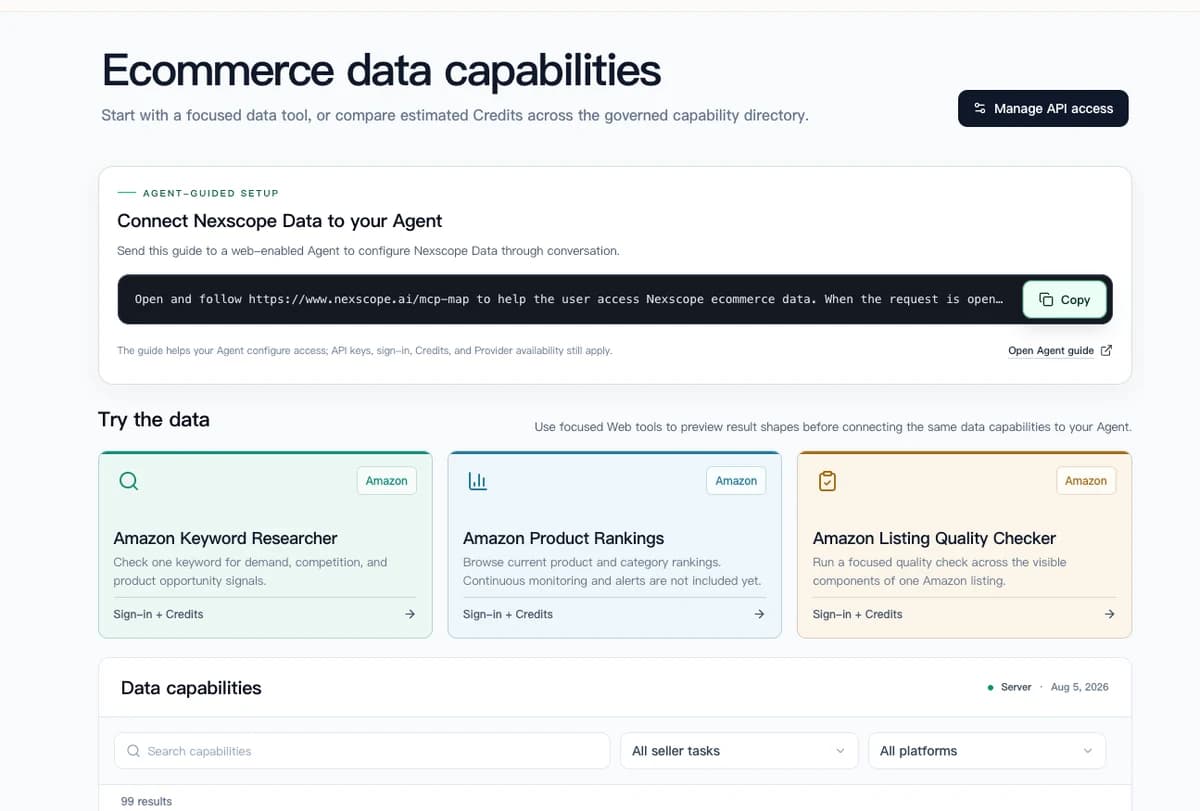
Building a GEO-optimized Shopify store? Nexscope ecommerce data can support competitor and keyword research in focused tools or connect to your Agent through API, MCP, or Skills.
Core Tools:
- Competitor Research — See how top stores structure their content
- Review Analysis — Extract the language customers use to describe products
- Keyword Research — Find high-intent keywords that drive AI citations
- Market Research — Identify trends and opportunities in your niche
Need Hands-On Help?
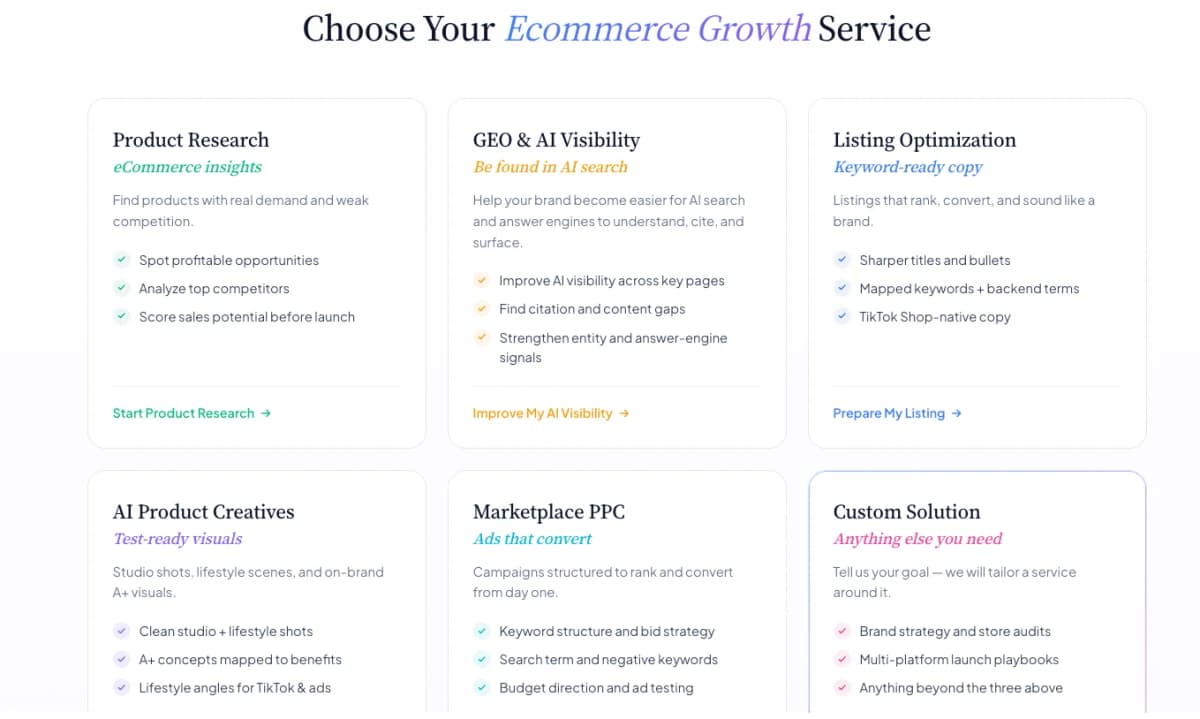
E-commerce Growth Services — Our specialists can audit your Shopify store's GEO readiness, implement structured data, and build a technical foundation for AI visibility.
Connect Ecommerce Data to Your Agent
Use Nexscope through API, MCP, or Skills, or open a ready seller workflow.
Explore Ecommerce Data →1,000 free credits • API, MCP & Skills
FAQ
What structured data does Shopify need for GEO?
At minimum, implement Product schema with offers (price, availability), brand, SKU/GTIN, images, and aggregate ratings. Also add FAQ schema to product pages and Organization schema site-wide. Use JSON-LD format for cleanest implementation.
Do I need a developer to implement Schema markup?
Not necessarily. Shopify apps like "JSON-LD for SEO" can handle most implementations automatically. However, for custom requirements or troubleshooting conflicts, developer help is valuable. Always validate with Google Rich Results Test after any changes.
How do I test if AI can read my store?
Three methods: (1) View page source to check if product data appears in raw HTML, (2) Use Google's Rich Results Test and URL Inspection tools, (3) Actually ask ChatGPT or Perplexity about your product category and see if your store appears.
Does Shopify's default theme support GEO?
Most modern Shopify themes (Dawn, Refresh, etc.) have decent baseline support. However, they often lack comprehensive Product schema and FAQ markup. You'll likely need to add or enhance structured data manually or via apps.
How important is product feed for GEO if I don't run ads?
Very important. Product feeds (Google Merchant Center, Microsoft Merchant Cent) are standardized data sources that AI systems readily consume. Even without ad spend, having an accurate, synced feed significantly improves your GEO foundation.
Sources
- Google. (2026). Structured Data Guidelines. Retrieved from developers.google.com
- Schema.org. (2026). Product Schema Specification. Retrieved from schema.org
- Shopify. (2026). SEO Best Practices. Retrieved from shopify.dev