

How to Start Amazon Dropshipping in 2026 (Complete Guide)

Amazon dropshipping lets you sell products without holding inventory. A supplier ships directly to your customers, and you keep the margin between your selling price and supplier cost.
Sounds simple. But most people get it wrong.
They source from AliExpress, use retail arbitrage suppliers, or ignore Amazon's policies entirely. Then their accounts get suspended.
This guide covers how to dropship on Amazon the right way—following Amazon's rules, finding legitimate suppliers, and building a sustainable business.
What Is Amazon Dropshipping?
Amazon dropshipping is a fulfillment method where you list products on Amazon without stocking inventory. When a customer orders, you forward that order to a supplier who ships directly to the customer.
You never touch the product. You're essentially a middleman connecting suppliers to Amazon's 300+ million customers.
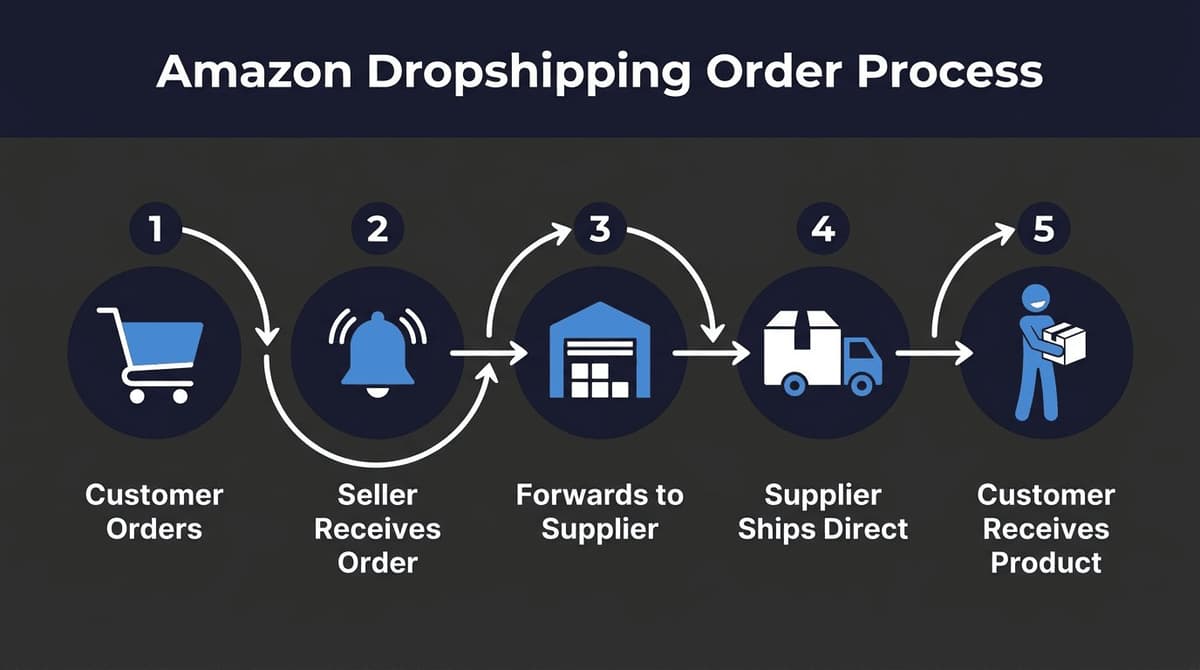
How the Order Flow Works
- Customer places order on your Amazon listing
- You receive the order notification
- You forward order details to your supplier
- Supplier ships the product directly to the customer
- Customer receives the package (with your branding, not the supplier's)
The key difference from traditional ecommerce: you don't pre-purchase inventory. This eliminates upfront investment but requires reliable suppliers who can fulfill orders consistently.
Is Dropshipping Allowed on Amazon?
Yes, but with strict rules.
What Amazon Allows
Amazon's Drop Shipping Policy permits dropshipping only if:
- You are the seller of record for all orders
- You identify yourself as the seller on all packaging, packing slips, and invoices
- You remove any third-party branding, pricing, or promotional materials before shipping
- You handle all customer service and returns
What's NOT Allowed
- Purchasing from another retailer (Walmart, Target, AliExpress) and having them ship to customers
- Using packing slips or invoices that show a different seller
- Any indication that the product came from anywhere other than you
This is where most dropshippers fail. They source products from retail stores or consumer marketplaces, and Amazon detects it through packaging, invoices, or customer complaints.
If you want a legitimate dropshipping business, you need wholesale suppliers who understand Amazon's requirements and can ship with your branding.
Pros and Cons of Amazon Dropshipping
Before starting, understand what you're getting into.
Advantages
- Low startup cost — No inventory investment. You only pay for products after customers order.
- No warehouse needed — Suppliers handle storage and fulfillment.
- Easy to test products — Launch new listings without committing to bulk orders.
- Scalable — Add products without operational complexity.
Disadvantages
- Thin margins — Typically 10-20% after Amazon fees. Lower than FBA or private label.
- Limited quality control — You can't inspect products before they ship.
- Shipping time dependency — Your supplier's speed becomes your speed.
- High competition — Low barriers mean many sellers compete on the same products.
- Account risk — Policy violations can result in suspension.
Dropshipping works best as a testing ground or supplementary business model, not as a primary strategy for building a brand.
Amazon Dropshipping vs FBA vs FBM
Understanding your fulfillment options helps you decide where dropshipping fits.
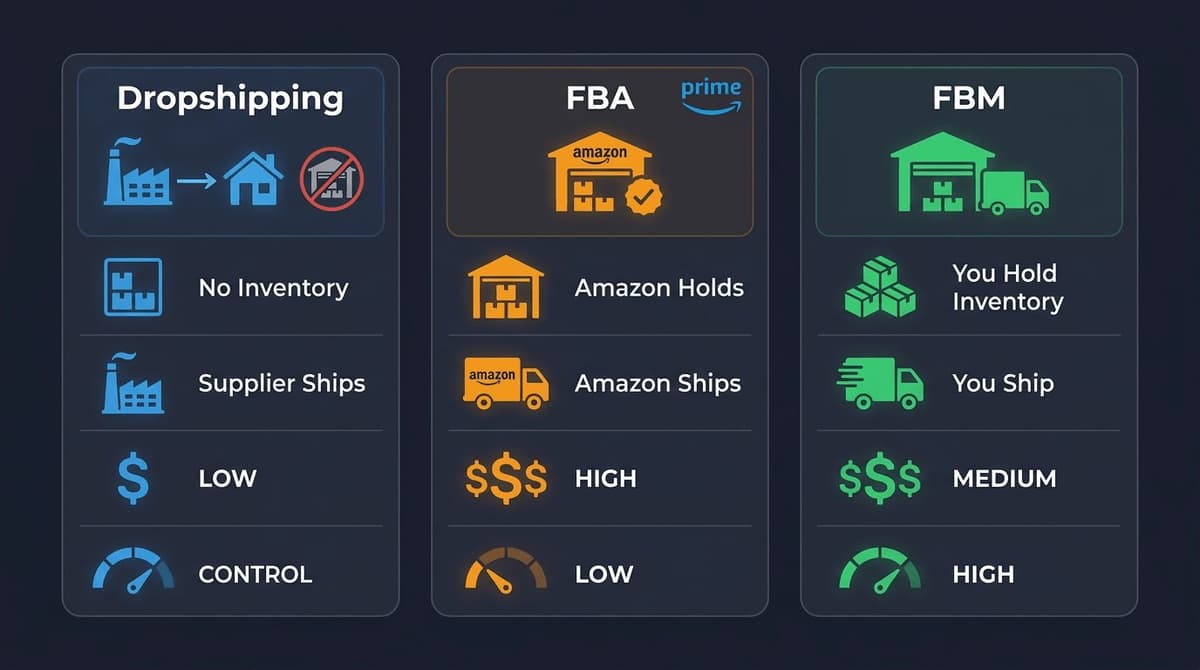
| Factor | Dropshipping | FBA | FBM |
|---|---|---|---|
| Inventory | None | Amazon warehouse | Your warehouse |
| Upfront cost | Very low | Medium-high | Medium |
| Shipping | Supplier handles | Amazon handles | You handle |
| Prime eligibility | No | Yes | Seller Fulfilled Prime only |
| Profit margins | 10-20% | 20-40% | 25-50% |
| Control | Lowest | Medium | Highest |
| Scalability | High | High | Limited by operations |
Most successful Amazon sellers use FBA for their core products and test new items with dropshipping before committing to inventory.
How to Start Amazon Dropshipping (Step by Step)
Step 1: Create an Amazon Seller Account
Go to sellercentral.amazon.com and choose your plan:
| Plan | Monthly Fee | Per-Item Fee | Best For |
|---|---|---|---|
| Individual | $0 | $0.99/sale | Testing (<40 sales/month) |
| Professional | $39.99 | $0 | Scaling (40+ sales/month) |
Professional accounts unlock bulk listing tools, advertising, and the Buy Box—essential for serious dropshippers.
You'll need:
- Business email address
- Credit card for fees
- Tax information (SSN or EIN)
- Phone number for verification
- Bank account for deposits
Step 2: Find Profitable Products
Not every product works for dropshipping. Look for:
Good Dropshipping Products
- Consistent demand (not seasonal spikes)
- $15-50 price range (covers fees while staying impulse-buy territory)
- Lightweight (shipping costs eat margins on heavy items)
- Not dominated by Amazon or major brands
- No complex variations (size/color matrices increase errors)
Products to Avoid
- Electronics with high return rates
- Products requiring certifications (FDA, FCC)
- Items with frequent listing hijackers
- Anything Amazon already sells directly
Use Amazon's Best Sellers, Movers & Shakers, and product research tools to identify opportunities. The same product research methods apply here—you're just not committing to inventory upfront.
Step 3: Find Reliable Suppliers
This is the most critical step. Your supplier determines your success.
Where to Find Suppliers
| Source | Pros | Cons |
|---|---|---|
| Wholesale directories (SaleHoo, Worldwide Brands) | Vetted suppliers | Membership fees |
| Trade shows | Direct relationships | Time investment |
| Manufacturer outreach | Best pricing | Higher MOQ for samples |
| Domestic wholesalers | Fast shipping | Higher costs |
Questions to Ask Suppliers
- Do you offer blind dropshipping? (No supplier branding)
- What's your average fulfillment time?
- Can you include custom packing slips?
- What's your return policy?
- Do you have experience with Amazon sellers?
- What's your inventory update frequency?
Avoid suppliers who can't provide blind shipping or custom invoices—they'll get your account suspended.
Step 4: Create Optimized Listings
Your listing competes with established FBA sellers who have Prime badges. You need stronger copy and competitive pricing.
Listing Essentials
- Title: Include main keywords naturally. Follow Amazon's format guidelines.
- Bullet points: Focus on benefits, not just features. Address common questions.
- Description: Expand on use cases and differentiation.
- Images: High-quality photos (supplier-provided is okay if professional).
- Backend keywords: Include search terms customers use.
Since you won't win the Prime badge, compete on price and listing quality. For listing optimization, focus on conversion—every visitor counts when you're paying higher fees.
Step 5: Process Orders and Manage Fulfillment
When orders come in:
- Forward to supplier immediately — Delays hurt your metrics
- Confirm shipping with tracking — Upload tracking within 24 hours
- Monitor delivery — Follow up on any delays
- Handle customer service — You're responsible, not the supplier
Automate Where Possible
- Order forwarding software (AutoDS, DSM Tool)
- Inventory sync to prevent overselling
- Price monitoring to maintain margins
- Tracking upload automation
Your Order Defect Rate (ODR) must stay below 1%. Late shipments, A-to-z claims, and negative feedback all count against you.
Common Mistakes That Get Accounts Suspended
Mistake 1: Sourcing From Retail Stores
Buying from Walmart and shipping to Amazon customers violates policy. Amazon detects this through:
- Retail packaging and receipts
- Customer complaints about retail store bags
- Price monitoring across platforms
- Tracking numbers linked to retail orders
This is called retail arbitrage when you resell, but using retailers as dropship suppliers crosses the line.
Mistake 2: Using AliExpress for Direct Fulfillment
AliExpress suppliers ship from China with 2-4 week delivery times and Chinese packaging. Customers complain, metrics tank, account gets suspended.
If you want to source from China, use agents who provide US warehousing and blind shipping.
Mistake 3: Ignoring Inventory Sync
Selling products that your supplier ran out of leads to cancellations. Cancellation rates above 2.5% trigger account reviews.
Sync inventory at least daily, and delist items immediately when suppliers report stockouts.
Mistake 4: Pricing Without Calculating Fees
Amazon fees add up:
- Referral fee: 8-15% depending on category
- Per-item fee: $0.99 (Individual plan only)
- FBA fees if using fulfillment by Amazon (not applicable for dropshipping)
A product with 30% margin from the supplier might leave you with 10% after Amazon takes their cut.
Mistake 5: Slow Customer Response
Amazon expects responses within 24 hours. Dropshippers often forget they're responsible for customer service, not the supplier.
Set up templates for common questions and check messages multiple times daily.
Is Amazon Dropshipping Worth It in 2026?
When Dropshipping Makes Sense
Dropshipping works for you if:
- Want to test product ideas before investing in inventory
- Have limited capital to start
- Understand it's a lower-margin business
- Can find legitimate wholesale suppliers
- Accept the operational complexity
When Dropshipping Doesn't Work
Dropshipping isn't right for you if:
- Want to build a brand with Prime eligibility
- Expect high profit margins
- Can't handle daily order management
- Plan to compete on delivery speed
For most sellers, dropshipping works best as one component of a larger strategy. Test products with dropshipping, then move winners to FBA or private label.
Research Smarter with an AI Agent
Finding profitable dropshipping products requires research—analyzing competition, checking margins, and validating demand.
Nexscope provides structured ecommerce data and focused seller workflows. Teams can use Nexscope's web tools directly or connect governed capabilities to their existing Agent through API, MCP, or Skills. Ready workflows include Keyword to Ads, Video Clone, and Buy Box Repricer.
- "Find low-competition products in home organization under $30"
- "What's the estimated margin on this ASIN after Amazon fees?"
- "Show me the sales history and BSR trend for this product"
- "Analyze the top 10 sellers in this niche"
Instead of juggling multiple research tools with questionable data, you ask questions and get accurate, actionable insights backed by official marketplace data.
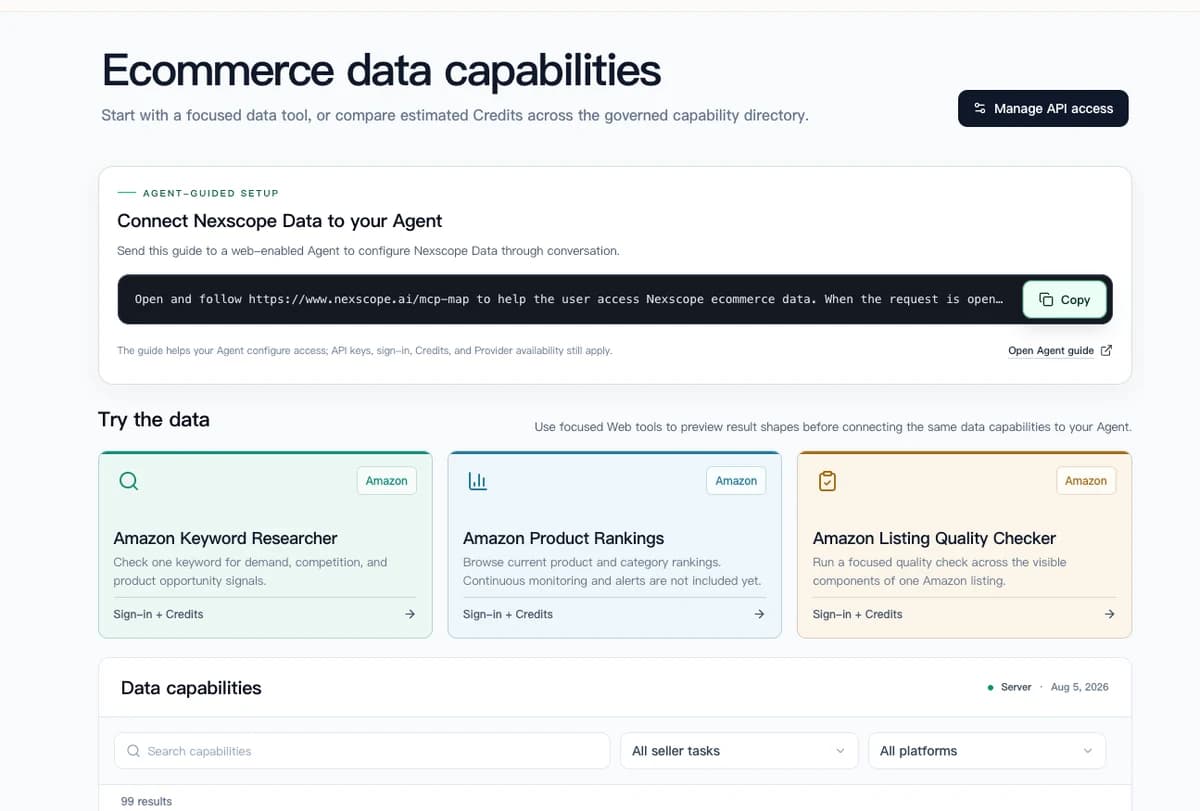
If you're validating dropshipping products or analyzing competition, Nexscope gives you the real numbers to make confident decisions.
Connect Ecommerce Data to Your Agent
Use Nexscope through API, MCP, or Skills, or open a ready seller workflow.
Explore Ecommerce Data →Frequently Asked Questions
Is dropshipping on Amazon legal?
Yes, dropshipping is legal and allowed by Amazon—as long as you follow their policy. You must be the seller of record, remove all third-party branding, and handle customer service yourself.
Can you dropship from AliExpress to Amazon?
Technically possible, but not recommended. Long shipping times (2-4 weeks), Chinese packaging, and quality issues lead to poor metrics and account suspension. Use US-based suppliers or Chinese suppliers with domestic warehousing.
How much money do you need to start Amazon dropshipping?
You can start with $500-1,000 covering: Amazon Professional account ($39.99/month), product samples for quality checks ($100-200), software tools ($50-100/month), and initial advertising budget. No inventory investment required.
What's the profit margin for Amazon dropshipping?
Typical margins range from 10-20% after Amazon fees. A product you buy for $10 and sell for $20 might net $2-4 profit. Volume matters more than per-item profit in dropshipping.
Is Amazon FBA better than dropshipping?
FBA offers higher margins, Prime eligibility, and better conversion rates—but requires inventory investment. Dropshipping has lower barriers but thinner margins. Many sellers use dropshipping to test products before committing to FBA inventory.
Sources
- Amazon. (2026). Amazon Services Business Solutions Agreement. Retrieved from sellercentral.amazon.com
- Amazon. (2026). Drop Shipping Policy. Retrieved from sellercentral.amazon.com/help
- Amazon. (2026). Seller Performance Measurement. Retrieved from sellercentral.amazon.com