

7 Proven Methods to Research Products to Sell on Amazon

Learning how to research products to sell on Amazon requires more than finding a product with a low review count or a high Best Sellers Rank. A viable opportunity needs repeatable demand, manageable competition, workable unit economics, a realistic supply path, and a clear reason for shoppers to choose the new offer.
This guide keeps product selection focused on the research process. It covers seven methods that can be used together, then turns the findings into a validation checklist before samples or inventory are ordered. Sellers looking for software comparisons can use the separate guide to Amazon product research tools.
No single metric proves that a product will succeed. The goal is to collect independent signals, document uncertainty, and reject weak ideas before money is tied up in manufacturing, freight, packaging, photography, and advertising.
Strong Product Criteria
Before opening a research tool, define the conditions that would make an idea worth testing. The exact threshold changes by category, marketplace, price, fulfillment method, and seller capability.
| Criterion | Directional check | Why it matters |
|---|---|---|
| Demand | Sales and search signals remain visible across several periods | A temporary spike can disappear before inventory arrives |
| Competition | The first page is not controlled entirely by entrenched brands and very high-review listings | A new offer needs a realistic path to visibility |
| Margin | The product remains profitable after product cost, freight, Amazon fees, returns, discounts, and advertising | Gross margin can disappear after operating costs |
| Differentiation | Reviews reveal a problem that a new product, bundle, size, material, or presentation can address | Similar products need a clear buyer reason to switch |
| Sourcing | Multiple credible suppliers can meet specifications, testing, lead time, and order requirements | A good demand signal is unusable without reliable supply |
| Compliance | Claims, materials, certifications, intellectual property, and category rules can be verified | Compliance problems can stop a launch or create liability |
These are screening criteria, not universal pass scores. A seller should benchmark against comparable products in the same subcategory and marketplace rather than copying a fixed BSR, price, or review threshold from another niche.
Amazon Best Sellers
Amazon's Best Sellers and Movers & Shakers pages provide a fast view of products with current marketplace activity. They work best as discovery inputs, not as final proof.
Research Process
- Start with a broad category, then move into relevant subcategories.
- Record products that appear repeatedly across several observation dates.
- Compare price, rating, review depth, variation count, size, material, and brand concentration.
- Check whether demand is distributed across several listings or concentrated in one dominant offer.
- Note product formats that appear in Movers & Shakers, then confirm whether momentum continues.
Useful Signals
- Several listings show demand without one brand controlling the page
- Buyers choose multiple sizes, materials, bundles, or use cases
- Newer listings can gain meaningful visibility
- Pricing leaves room for fees, advertising, and returns
- The product is simple enough to source and explain accurately
Method Limits
Best Sellers shows what already performs. It does not reveal profit, advertising cost, supplier quality, patent risk, or whether a seller entered the category before demand became visible. Use it to create a shortlist, then validate each idea with the remaining methods.
Product Opportunity Explorer
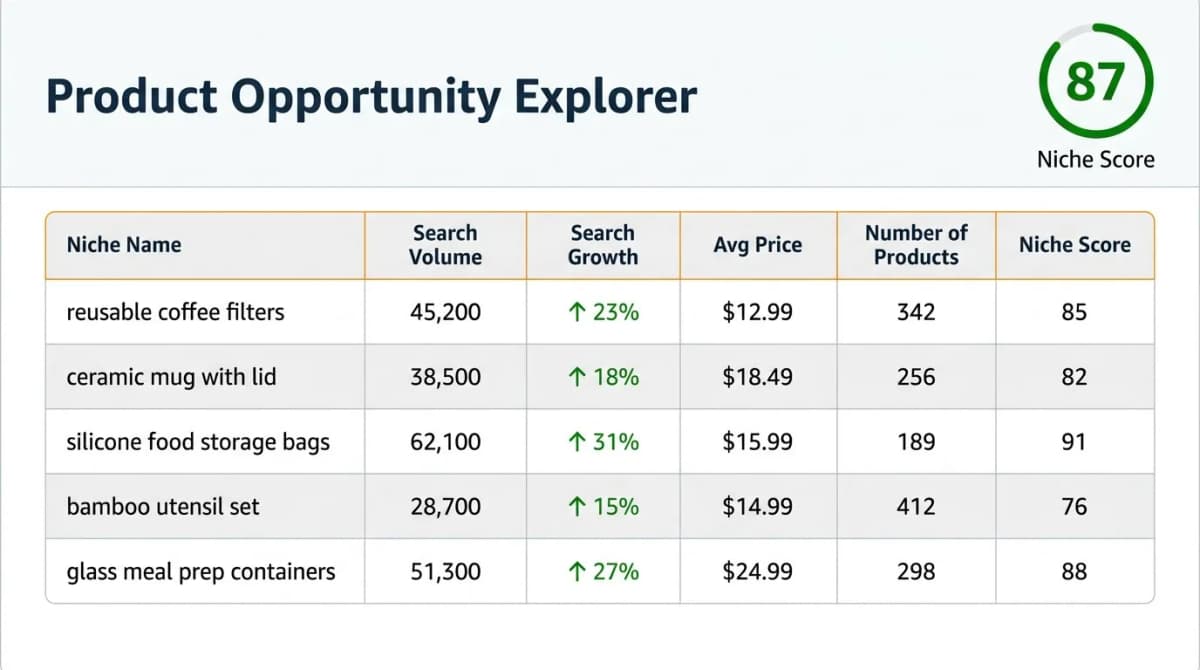
Amazon Product Opportunity Explorer gives eligible Seller Central users first-party information about customer needs, search behavior, products, and niches. Because it uses Amazon marketplace signals, it is especially useful after a seller has selected a category or seed term.
Research Process
- Open Product Opportunity Explorer in Seller Central.
- Search a product type, customer need, or category term.
- Compare niche size, search behavior, product count, pricing, and change over time.
- Review the products and search terms grouped into the niche.
- Save niches that combine visible demand with a product gap the seller can actually address.
Key Questions
- Is the niche stable, rising, declining, or highly seasonal?
- Do shoppers use several related terms for the same need?
- Are results dominated by a few products or spread across many offers?
- Do the current products leave a gap in size, material, bundle, design, or use case?
- Can the opportunity support acceptable margin after all costs?
First-party data is valuable, but it still needs review analysis, unit economics, supplier checks, and compliance review before a launch decision.
Competitor Review Gaps
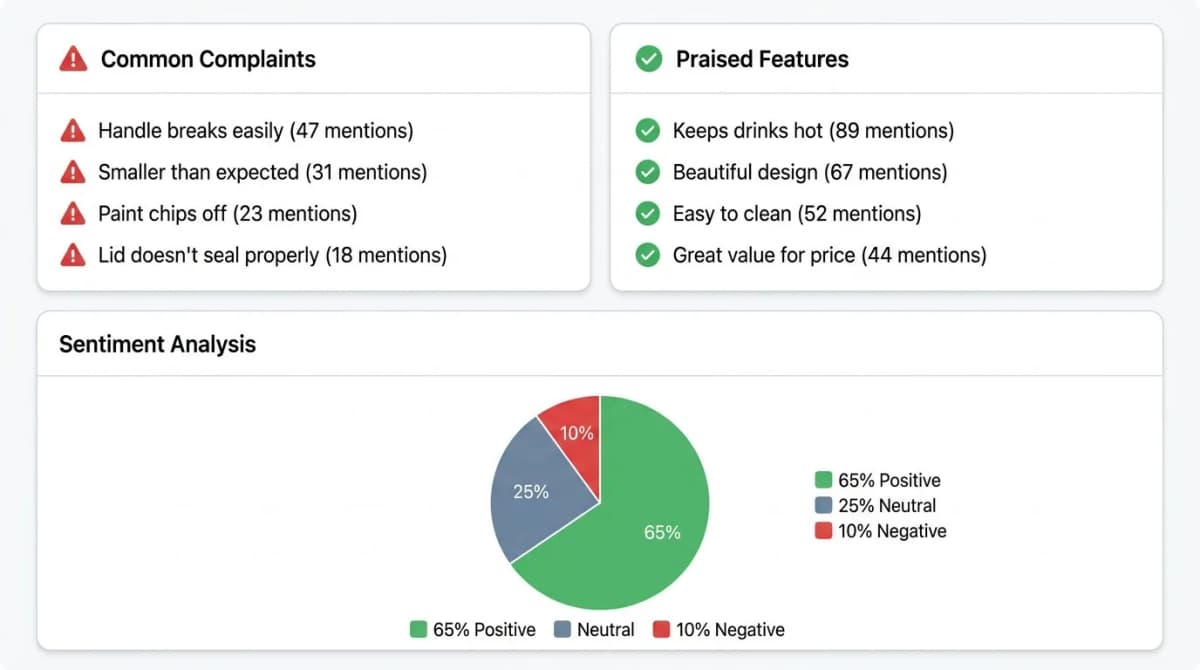
Competitor reviews can reveal why a product sells and why buyers remain dissatisfied. This method starts with products that have meaningful demand, then looks for repeated problems that can be addressed through product design, packaging, instructions, sizing, or positioning.
Research Process
- Select several comparable products from the same search results.
- Separate recent reviews from older reviews so outdated versions do not distort the analysis.
- Group complaints by product quality, fit, usability, durability, packaging, instructions, and expectations.
- Count repeated themes and note which product variations they affect.
- Confirm whether a proposed improvement is feasible, affordable, and easy to communicate.
Example Pattern
For a ceramic travel mug, repeated complaints might mention a weak handle, misleading capacity, poor lid fit, or incompatibility with common cup holders. A differentiated offer could improve one or more of those points, but only after a supplier confirms the specification and samples pass testing.
Evidence Limits
Reviews are not a representative survey of every customer. Some complaints come from misuse, shipping damage, old product versions, or expectations that no product can meet. A strong opportunity appears across several competing products and remains relevant to the intended buyer.
Keyword-Led Research
Keyword-led research begins with the need shoppers describe, then evaluates the products currently serving that need. It can uncover feature, audience, compatibility, and problem-specific opportunities that are less visible in broad category browsing.
Research Process
- Start with a seed term in Amazon search autocomplete or a keyword tool.
- Collect modifiers related to features, materials, audiences, sizes, problems, and use cases.
- Review the first-page products for each important variation.
- Compare search intent with the products currently ranking.
- Shortlist terms where the buyer need is clear but the available products or listings answer it poorly.
For example, autocomplete variations around a coffee mug may reveal demand for a lid, warmer, travel format, specific capacity, or gift audience. The opportunity is not the keyword alone. It is the gap between that expressed need and the products buyers can currently choose.
Sellers who need software for volume, competitor, review, and product-finder workflows can compare the dedicated Amazon research tools. Tool output should support the research process rather than replace it.
Social Listening
Amazon data records marketplace behavior. Social listening can expose earlier-stage frustrations, use cases, and vocabulary before the demand becomes obvious in Amazon search.
Research Sources
| Source | Useful signal | Validation need |
|---|---|---|
| Reddit and specialist forums | Repeated product frustrations and detailed use cases | Confirm the problem appears across multiple discussions |
| TikTok and short-form video | Product formats, demonstrations, and fast-moving interest | Check whether interest persists beyond a viral post |
| Customer communities | Technical requirements and buyer language | Confirm the community is relevant to the intended market |
| Search trends | Direction and seasonality of broader interest | Compare with Amazon-specific demand and actual sales evidence |
Research Process
- Search for recommendations, complaints, workarounds, and phrases such as "I wish" or "does anyone make."
- Record the exact problem and the context in which it occurs.
- Check whether current Amazon products address the need.
- Confirm demand using keyword, marketplace, and competitor evidence.
- Reject ideas that depend on one post, one creator, or a short-lived event.
Social signals are most useful when they explain a need that also appears in marketplace behavior.
Supplier-First Validation
Supplier-first research begins with manufacturing capability, then checks whether the resulting products solve a real marketplace need. It prevents a seller from selecting an idea that cannot be produced at the required quality, cost, lead time, or order quantity.
Research Process
- Search established supplier directories and industry sources for the product type.
- Identify several suppliers with relevant experience and export capability.
- Request specifications, minimum order quantities, lead times, testing documents, customization options, and sample pricing.
- Compare the available manufacturing options with the customer problems found in reviews and keywords.
- Calculate landed cost and order samples before making a demand forecast operational.
Supplier Screening
- Verify company identity, facility, product experience, and export history
- Request current test reports and certifications relevant to the product
- Confirm materials, tolerances, packaging, labeling, and quality-control steps in writing
- Compare at least two or three samples under the same test conditions
- Include freight, duties, inspection, damage allowance, and rework in the cost model
Low quoted cost does not create a good product. Reliable specifications and repeatable quality matter more than the first price a supplier provides.
Structured Data Automation
Automation is useful after the research process is defined. It can collect comparable fields, summarize reviews, organize keyword groups, and flag changes. It should not turn incomplete or estimated data into a confident recommendation.
Nexscope is an ecommerce data source and data platform. Teams can use structured product, market, keyword, review, competitor, pricing, sales, and trend data inside Nexscope's web product, or connect supported data to their own Agent through REST API or MCP.
A practical automated workflow can:
- Build a consistent product and competitor dataset.
- Group review themes and preserve examples for human review.
- Compare keyword, pricing, sales, and trend signals across periods.
- Mark estimates, missing values, source dates, and unsupported conclusions.
- Produce a shortlist for sample, margin, compliance, and supplier validation.
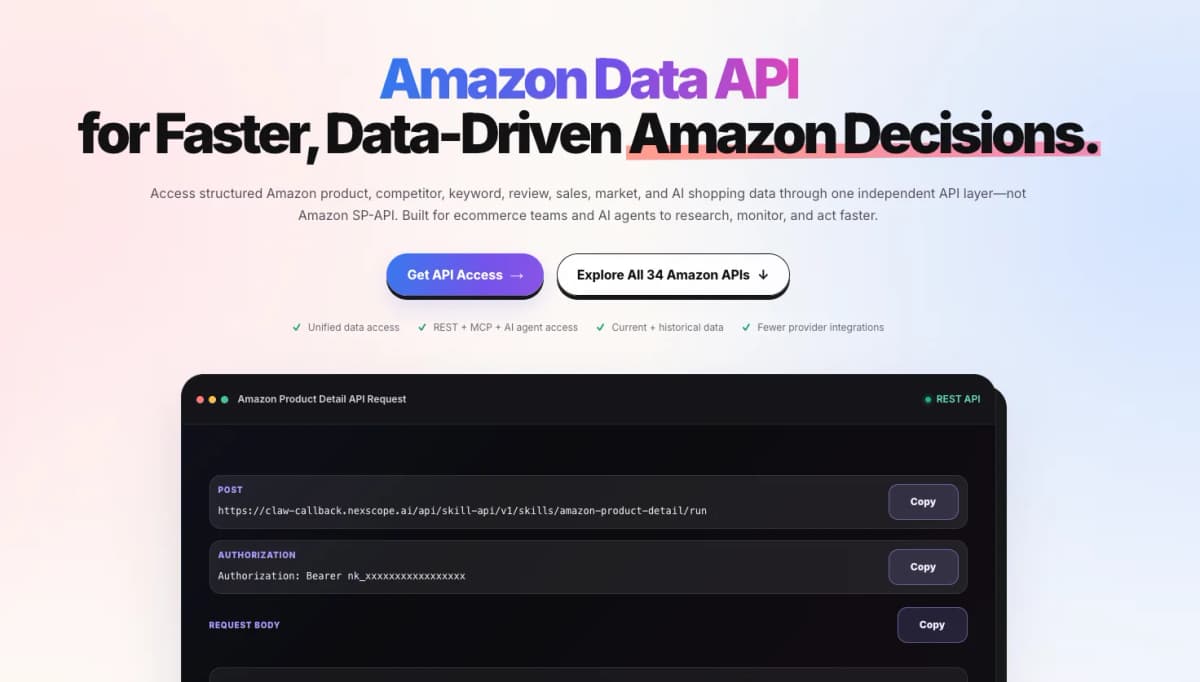
The Amazon Data API supports reusable Amazon research data. New users receive 1,000 free credits, and the lowest paid plan is $9 per month with 3,000 monthly credits.
Product Validation Checklist
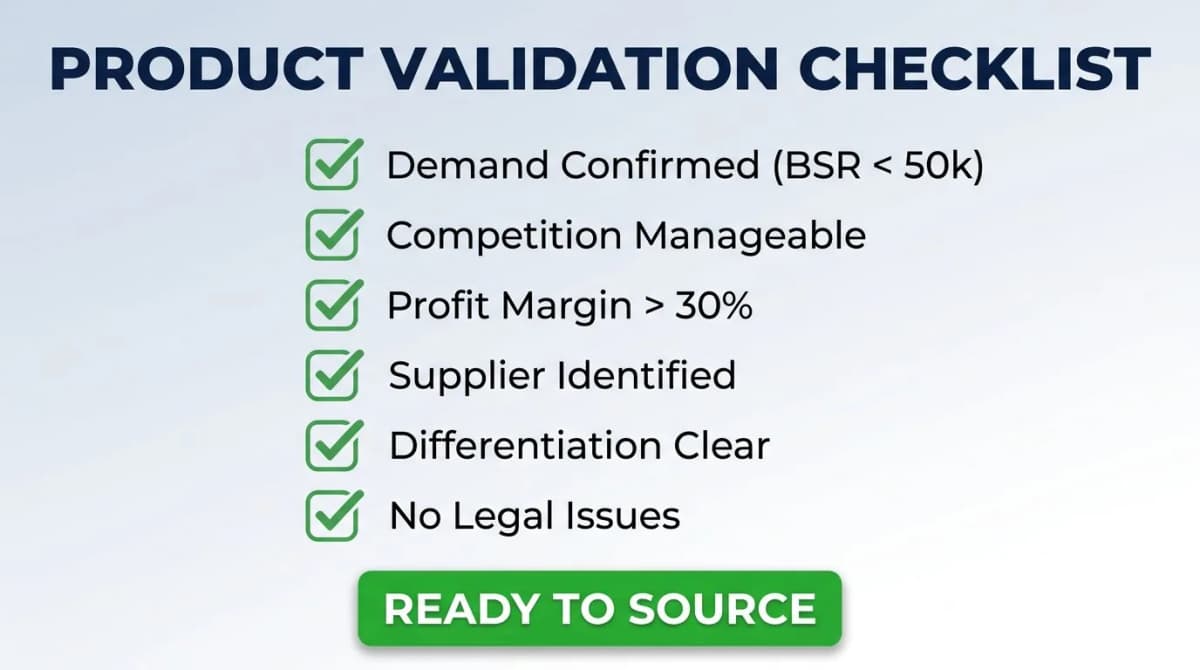
Before ordering inventory, document the evidence for every check.
| Check | Evidence to collect | Reject or pause when |
|---|---|---|
| Demand | Search, sales, category, and trend signals across multiple periods | The idea depends on one short spike or one listing |
| Competition | Brand concentration, review depth, ad density, offer quality, and new-entry visibility | Entrenched competitors leave no realistic launch path |
| Margin | Product cost, freight, duties, Amazon fees, advertising, returns, and discounts | Profit disappears under a conservative scenario |
| Sourcing | Multiple suppliers, samples, lead time, quality controls, and backup capacity | Specifications or quality cannot be repeated |
| Differentiation | Repeated buyer problem and feasible product or offer improvement | The only difference is cosmetic or easy to copy |
| Compliance | Category rules, claims, testing, labeling, intellectual property, and documentation | Required evidence is missing or ownership is unclear |
The margin model should use the current Amazon FBA cost structure, not only product cost and selling price. The launch plan should also account for the work required to build an accurate Amazon listing.
Common Research Mistakes
Late Trend Entry
A viral product may already have large purchase orders, aggressive advertising, and many incoming competitors. Trend evidence needs supplier lead-time and inventory analysis before it becomes actionable.
Seasonality Blindness
Current sales can misrepresent annual demand. Compare several periods and identify holidays, weather, events, or replacement cycles that change the category.
Fixed Thresholds
A review count, price range, or BSR that works in one category may be meaningless in another. Benchmark comparable products within the same marketplace and subcategory.
Incomplete Unit Economics
Product cost alone is not margin. Freight, duties, Amazon fees, storage, advertising, returns, inspection, discounts, and damaged inventory all affect the decision.
Unsupported Differentiation
Adding a color or bundle does not solve a buyer problem by itself. The proposed difference should connect to repeated evidence and survive supplier, cost, compliance, and listing checks.
Conclusion
The most reliable way to research products to sell on Amazon is to combine independent methods. Best Sellers and Product Opportunity Explorer reveal marketplace activity. Reviews expose product gaps. Keywords and social listening clarify buyer needs. Supplier-first validation checks feasibility. Structured data automation keeps the evidence comparable and reusable.
A product should move forward only when demand, competition, margin, sourcing, differentiation, and compliance support the same decision. The next step is ordering samples, testing the product against written specifications, and updating the financial model before inventory is committed.
Find your winning niche in minutes
Discover high-opportunity products with proven research methods
Get Started Free →No coding required • Instant access
Frequently Asked Questions
How long should Amazon product research take?
The timeline depends on product complexity and access to reliable data. Initial screening can take a few days, while supplier outreach, sample review, compliance checks, and cost validation often take several weeks. Speed should not remove required evidence. A seller can automate data collection and review grouping, but supplier verification, product testing, and final judgment still need deliberate human review.
What price range is best for Amazon products?
There is no universal price range. The right selling price must support product cost, freight, duties, Amazon fees, advertising, returns, discounts, and an acceptable profit under a conservative scenario. Buyers also need to accept the price for that category and use case. Sellers should compare relevant competitors and calculate unit economics before applying a generic range.
How can a seller tell if an Amazon niche is too competitive?
A niche may be too competitive when the first page is dominated by entrenched brands, very high-review listings, heavy advertising, strong price pressure, and offers that already solve the main buyer problems. The decision should also consider whether newer listings can gain visibility and whether the seller has a defensible product, supply, content, or cost advantage.
Can Amazon product research be done for free?
Yes. Amazon Best Sellers, Movers & Shakers, search autocomplete, Product Opportunity Explorer for eligible sellers, customer reviews, Google Trends, forums, and supplier directories can support a strong initial process. Paid tools save time and make comparison easier. They should be added when the seller understands which data or workflow gap the subscription needs to solve.
What BSR is good for an Amazon product?
BSR is category-specific and changes over time, so one universal cutoff can mislead sellers. Compare BSR within the same main category and similar products, then observe several periods instead of one snapshot. BSR should be combined with price, reviews, keyword demand, brand concentration, seasonality, margin, and the visibility of newer listings.
How many products should be researched before choosing one?
A broad shortlist helps prevent attachment to the first attractive idea. Sellers can screen dozens of ideas quickly, then take a smaller group through deeper review, keyword, margin, supplier, sample, and compliance analysis. The correct number is the point at which the final choice wins on documented evidence, not the point at which research becomes tiring.
Sources
- Amazon. (2026). Best Sellers and Movers & Shakers. Retrieved from amazon.com
- Amazon Seller Central. (2026). Product Opportunity Explorer. Retrieved from sell.amazon.com
- United States Patent and Trademark Office. (2026). Trademark and Patent Search Resources. Retrieved from uspto.gov
- Google. (2026). Google Trends. Retrieved from trends.google.com