

What Is Amazon Merch on Demand? How to Start Selling in 2026

Selling custom merchandise usually requires upfront inventory, storage space, and shipping logistics. Amazon Merch on Demand removes all of that. You upload designs, Amazon prints and ships products when customers order, and you collect royalties.
No inventory. No shipping. No customer service. Just design and earn.
This guide covers how Amazon Merch on Demand works, how to apply, and what it takes to build a profitable print-on-demand business on Amazon's platform.
What Is Amazon Merch on Demand?
Amazon Merch on Demand is Amazon's print-on-demand service. You create designs, upload them to the platform, and Amazon handles everything else—printing, fulfillment, shipping, and customer service.
When a customer buys a product with your design, Amazon produces it on demand and ships it directly. You earn a royalty on each sale without touching inventory.
Products You Can Sell
Amazon Merch supports multiple product types:
- T-shirts (standard and premium)
- Long sleeve shirts
- Hoodies and sweatshirts
- Tank tops
- PopSockets
- Phone cases
- Throw pillows
- Tote bags
T-shirts remain the most popular and competitive category. PopSockets and phone cases offer lower competition for newer sellers.
How It Works
- You upload a design with product details, keywords, and pricing
- Amazon lists the product on Amazon.com
- Customer places an order through Amazon's marketplace
- Amazon prints and ships the product directly to the customer
- You receive a royalty deposited to your bank account
The entire process is hands-off after the initial upload. Your job is creating designs and optimizing listings for Amazon search.
How Much Can You Earn?
Amazon pays royalties based on a simple formula: List Price - Amazon's Costs = Your Royalty
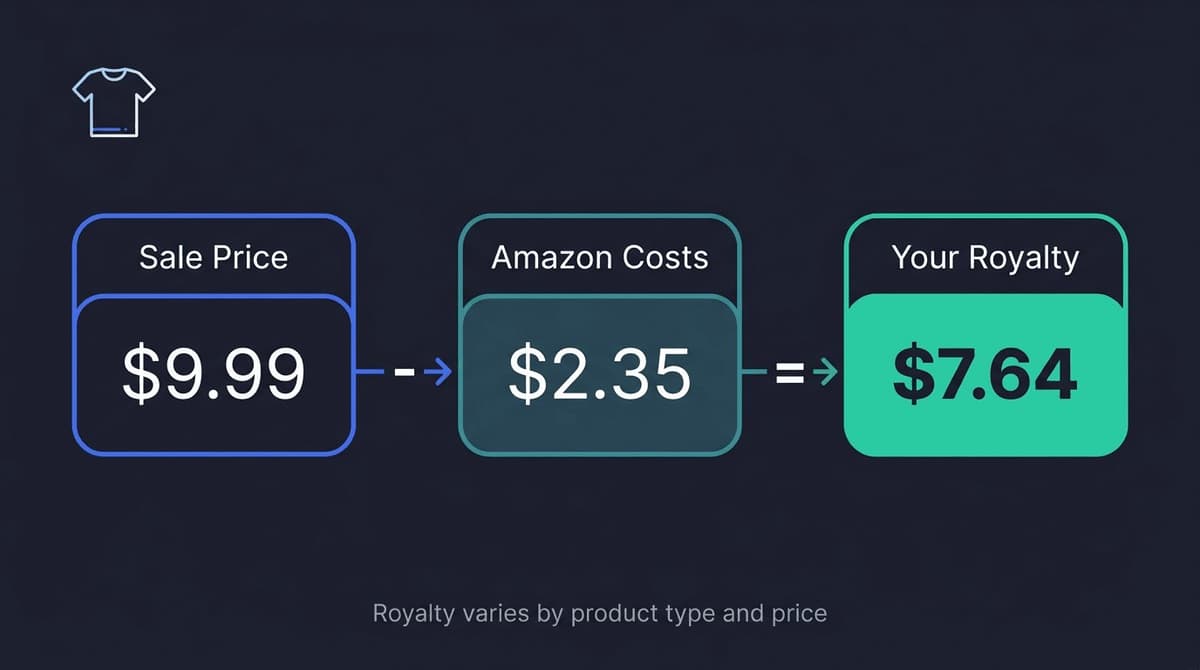
Example Royalty Calculation
For a standard t-shirt priced at $19.99:
| Component | Amount |
|---|---|
| List Price | $19.99 |
| Amazon's Costs | $12.35 |
| Your Royalty | $7.64 |
Royalties vary by product type, size, and price point. Premium t-shirts have higher base costs but can command higher prices. Phone cases and PopSockets typically yield $2-4 per sale.
Realistic Income Expectations
Income depends entirely on design volume and niche selection:
- Beginner (Tier 10-100): $0-500/month
- Intermediate (Tier 500-1000): $500-3,000/month
- Advanced (Tier 4000+): $3,000-20,000+/month
The key variable is upload slots. More slots mean more designs live, which means more potential sales. This is controlled by Amazon's tier system.
The Tier System Explained
Amazon limits how many designs you can upload through a tier system. You start at Tier 10 and advance by making sales.
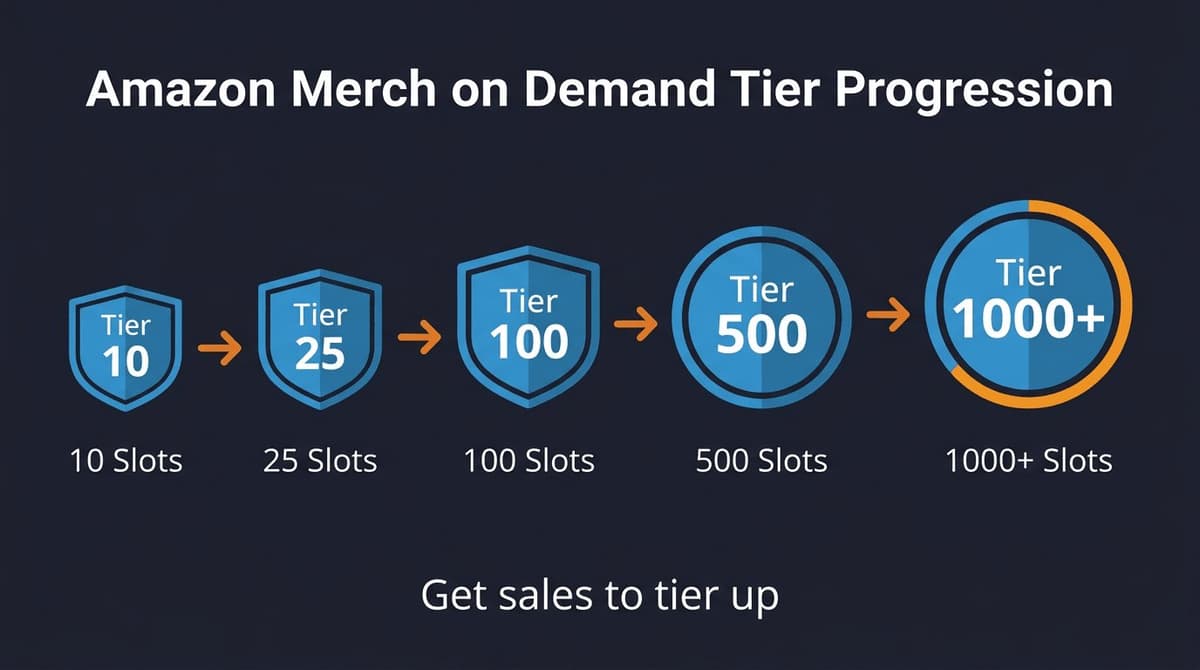
Tier Progression
| Tier | Upload Slots | Requirement |
|---|---|---|
| Tier 10 | 10 designs | Starting tier |
| Tier 25 | 25 designs | ~10 sales |
| Tier 100 | 100 designs | ~25 sales |
| Tier 500 | 500 designs | ~100 sales |
| Tier 1000 | 1,000 designs | ~500 sales |
| Tier 2000+ | 2,000+ designs | Continued sales |
How to Tier Up Faster
Amazon reviews accounts periodically and promotes sellers showing consistent sales activity:
- Fill every slot — Empty slots don't help you. Upload designs for all available slots.
- Focus on niches — Targeted designs in specific niches convert better than generic designs.
- Optimize keywords — Amazon listing optimization principles apply to Merch listings too.
- Remove non-performers — Delete designs with zero sales after 90 days and replace them.
Tier progression typically takes 3-6 months to reach Tier 100, assuming consistent uploads and moderate sales.
How to Apply for Amazon Merch on Demand
Unlike open platforms like Redbubble or Etsy, Amazon Merch uses an invitation system. You submit an application and Amazon decides whether to approve you.
What You Need Before Applying
- Amazon account — A standard Amazon buyer account works
- Tax information — SSN (US), EIN (business), or W-8BEN (international)
- Bank account — For royalty deposits (no PayPal or digital wallets)
- Business description — The most important part of your application
Application Process
- Go to merch.amazon.com
- Click "Request invitation"
- Sign in with your Amazon account
- Enter personal and tax information
- Add bank details for royalty payments
- Write your business description
- Submit and wait for review
Writing an Application That Gets Approved
The business description determines whether you get accepted. Amazon wants to see:
- Specific niche focus — Name your target audience and design style
- Design capability — Explain how you create designs
- Policy understanding — Reference content and IP guidelines
- Business intent — Show this is a real business, not a hobby experiment
Example that works:
"I create original designs for pet owners, specifically targeting dog breed communities like golden retrievers and french bulldogs. I use Adobe Illustrator and Canva to create vector artwork and have reviewed Amazon's content policies and intellectual property guidelines. I plan to start with 10 niche-specific designs and expand my catalog consistently to build a sustainable print-on-demand business."
What NOT to write:
- "I want to make passive income selling shirts"
- "I saw this on YouTube and want to try it"
- Anything suggesting you'll copy existing designs
Common Rejection Reasons
- Vague application — Generic descriptions without specific plans
- Account issues — Past violations or payment problems on Amazon
- Multiple applications — Submitting more than one at a time
- International backlog — Non-US applicants face longer waits
If rejected, wait 30 days and reapply with a stronger, more specific application.
How to Create Designs That Sell
Design skill matters less than niche selection and keyword research. Simple text-based designs often outsell complex artwork.
Finding Profitable Niches
The best niches have:
- Passionate audiences — People who identify strongly with a topic
- Searchable keywords — Terms buyers actually search on Amazon
- Low competition — Fewer existing designs targeting the same terms
Examples of proven niches:
- Specific professions (nurses, teachers, electricians)
- Dog/cat breeds (golden retriever mom, french bulldog dad)
- Hobbies (fishing, camping, gaming)
- Family relationships (grandpa, aunt, bonus mom)
- Local pride (city names, state pride)
Design Tools
You don't need expensive software:
- Canva — Free tier works for most designs
- Adobe Illustrator — Professional vector graphics
- Photoshop — Photo manipulation and effects
- AI tools — Midjourney, DALL-E for design inspiration (check Amazon's AI policy)
Keyword Optimization
Amazon Merch listings have two keyword fields:
- Title — Include primary keywords naturally
- Bullet points — Additional keywords and product details
- Brand — Your brand name (can include a keyword)
Research what buyers search using Amazon's autocomplete and competitor analysis. The same product research methods that work for physical products apply here.
Amazon Merch vs Other POD Platforms
How does Merch compare to alternatives?
| Platform | Traffic | Fees | Control | Best For |
|---|---|---|---|---|
| Amazon Merch | Built-in (300M+ customers) | Royalty-based | Limited | Passive income, scale |
| Redbubble | Built-in (lower than Amazon) | Higher margins | Limited | Artists, diverse products |
| Etsy POD | Built-in + ads available | Listing fees + transaction fees | More control | Handmade aesthetic |
| Shopify + Printful | You drive traffic | Monthly fee + product costs | Full control | Brand building |
Amazon Merch wins on traffic. You're listing products where millions of customers already shop. The tradeoff is less control and Amazon taking a larger cut.
For sellers focused on dropshipping or brand building, Shopify with a POD provider offers more flexibility. For passive income with minimal marketing effort, Amazon Merch is hard to beat.
Tips for Long-Term Success
Avoid Trademark Issues
Trademark violations result in design takedowns and potentially account termination. Before uploading:
- Search the USPTO trademark database
- Avoid celebrity names, sports teams, TV shows, and brand names
- Don't use phrases that might be trademarked (check "Let's Go Brandon," "Girl Boss," etc.)
When in doubt, don't upload it.
Upload Consistently
Treat Merch like a business, not a lottery ticket:
- Set a weekly upload goal (10-20 designs minimum)
- Track which niches and designs perform
- Double down on what works
Diversify Across Niches
Don't put all designs in one niche. Seasonal niches (Christmas, Halloween) spike and crash. Evergreen niches (professions, hobbies) provide steady baseline income.
A healthy portfolio might be:
- 40% evergreen niches
- 30% trending/seasonal
- 30% experimental new niches
Run Your Ecommerce Business with an AI Agent
Amazon Merch is one piece of a larger ecommerce operation. Whether you're researching niches, optimizing listings, or scaling to other platforms, managing it all takes time.
Nexscope provides structured ecommerce data and focused seller workflows. Teams can use Nexscope's web tools directly or connect governed capabilities to their existing Agent through API, MCP, or Skills. Ready workflows include Keyword to Ads, Video Clone, and Buy Box Repricer.
- "What niches are trending for t-shirt designs right now?"
- "Analyze this Merch listing and suggest keyword improvements"
- "Compare my design's keywords to top competitors"
- "What's the search volume for 'dog mom' related terms?"
Instead of switching between research tools, you ask questions and get answers.
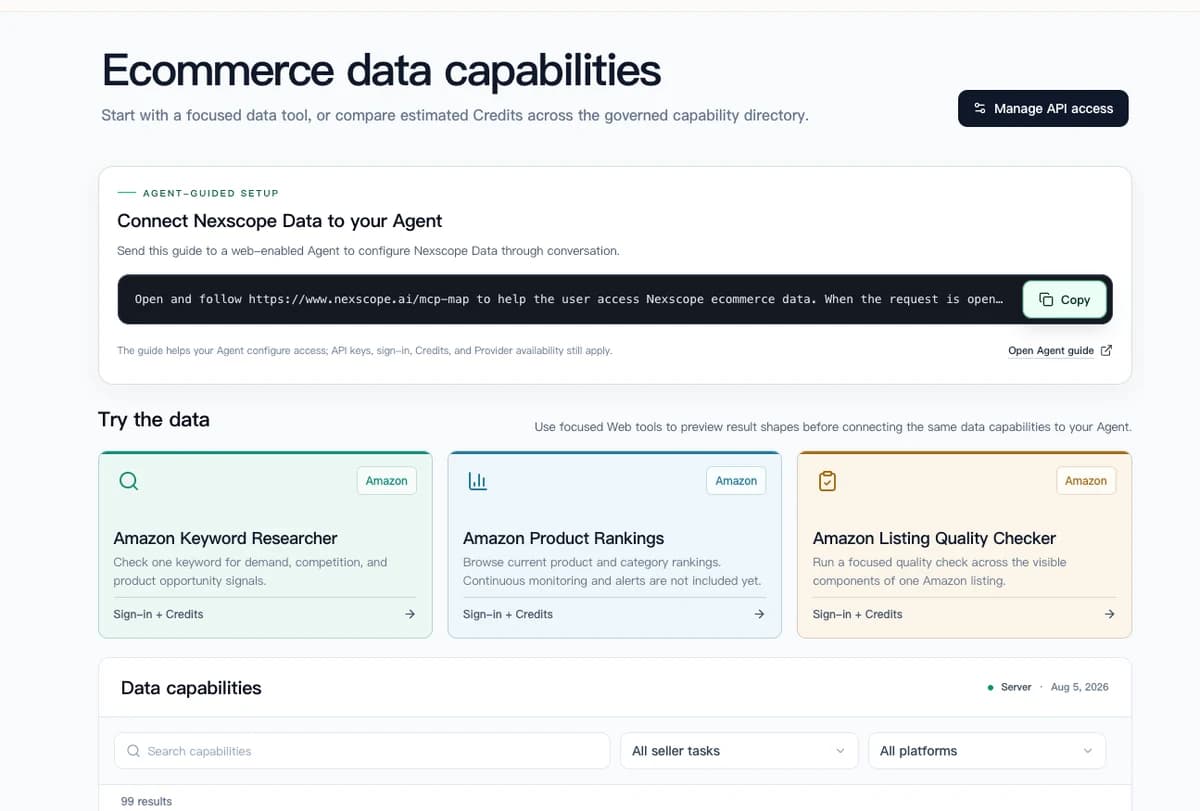
If you're building a Merch business alongside other ecommerce ventures, Nexscope helps you research faster and optimize smarter.
Connect Ecommerce Data to Your Agent
Use Nexscope through API, MCP, or Skills, or open a ready seller workflow.
Explore Ecommerce Data →Frequently Asked Questions
Is Amazon Merch on Demand free to join?
Yes. There's no cost to apply or maintain an account. Amazon takes their cut through the royalty structure—you only earn when products sell.
How long does Amazon Merch approval take?
Typically 2-8 weeks. US-based applicants often get approved faster. Strong applications with specific niche plans tend to process quicker than vague ones.
Can I use AI-generated designs on Amazon Merch?
Amazon's policy requires you to have rights to all designs. AI-generated images are generally acceptable if you created them, but check Amazon's current content policy for updates. Don't use AI to copy existing copyrighted designs.
How much does Amazon take from each sale?
Amazon's cut varies by product and price point. For a standard t-shirt at $19.99, Amazon keeps roughly $12.35, leaving you with a $7.64 royalty. Higher-priced items yield higher royalties.
Can I sell the same designs on other platforms?
Yes. You retain rights to your designs. Many sellers upload to Redbubble, Etsy, and their own Shopify stores simultaneously.
Sources
- Amazon. (2026). Merch on Demand Program Policies. Retrieved from merch.amazon.com
- Amazon. (2026). Royalty Information. Retrieved from merch.amazon.com
- USPTO. (2026). Trademark Electronic Search System. Retrieved from uspto.gov