

How to Analyze Amazon Reviews for Product Research

Amazon reviews are a goldmine of customer insights. Every day, millions of shoppers share exactly what they love, hate, and wish was different about the products they buy. For sellers and product developers, this feedback is invaluable.
But there's a problem: reading through hundreds or thousands of reviews manually is impossibly time-consuming. And even if you could read them all, how do you turn scattered opinions into actionable insights?
This guide shows you how to analyze Amazon reviews systematically, extract meaningful patterns, and turn customer feedback into better products and smarter business decisions.
Why Amazon Review Analysis Matters
Reviews aren't just social proof for shoppers. They're a direct line to customer thoughts that would cost thousands of dollars to gather through traditional market research.
Validate Product Ideas Before You Invest
Before sourcing a product, analyze reviews of existing competitors. You'll discover: - Whether customers actually have the pain points you think they do - What features matter most to buyers - Deal-breakers that cause returns and negative reviews - Price sensitivity and value perception
This validation can save you from launching products that look promising on paper but fail in the real market. For more on product validation, see our guide on how to find products to sell on Amazon.
Find Competitor Weaknesses to Exploit
Every negative review on a competitor's listing is a potential opportunity for you. Review analysis is a core part of Amazon competitor analysis. Common complaints reveal: - Quality issues you can solve with better manufacturing - Missing features customers desperately want - Poor customer service experiences you can improve upon - Confusing instructions or difficult assembly you can simplify
Guide Product Improvements
For existing products, review analysis shows exactly what to fix: - Which complaints appear most frequently - What's causing returns - Features customers love (double down on these) - Suggestions customers make repeatedly
Optimize Your Listing Copy
Reviews tell you the exact language customers use to describe products. This is invaluable for Amazon SEO and listing optimization. This language belongs in your: - Bullet points (address common concerns proactively) - Product descriptions (highlight what matters most) - A+ Content (answer frequently asked questions) - Backend keywords (capture how customers actually search)
The Four Dimensions of Review Analysis
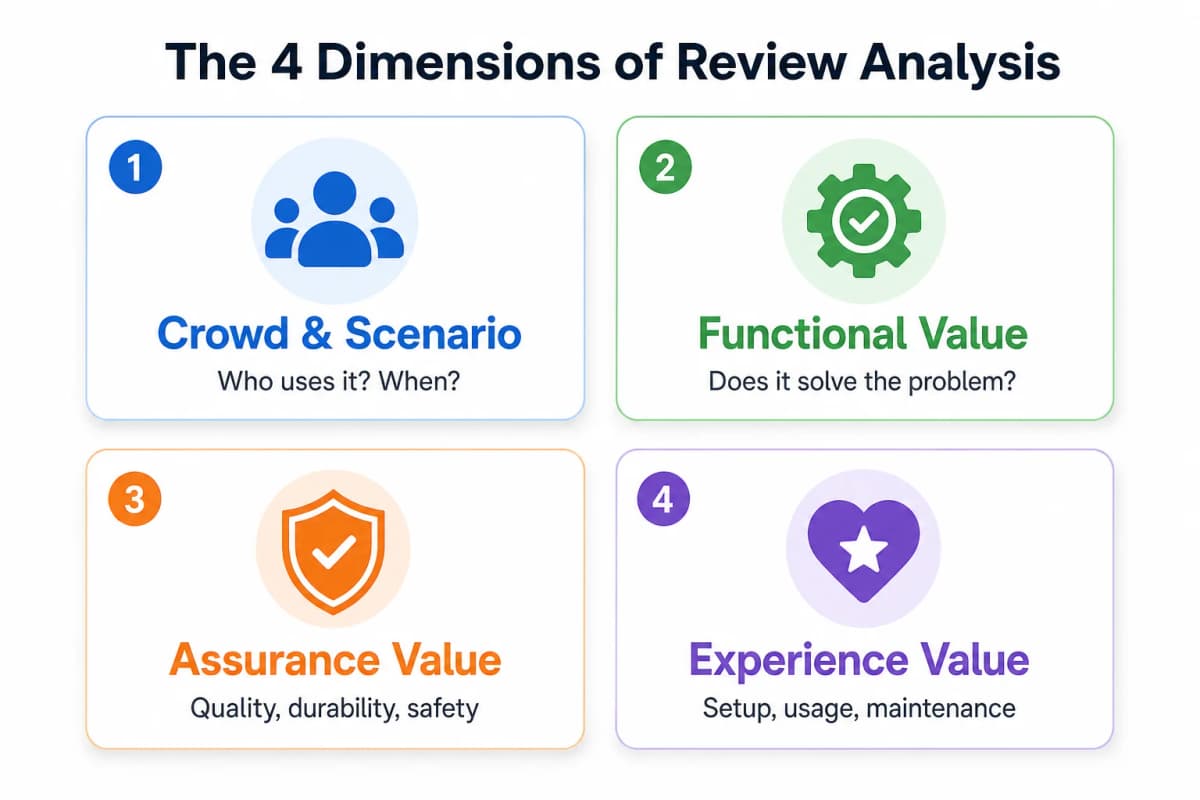
Not all feedback is equal. To analyze reviews effectively, categorize insights into four value dimensions:
1. Crowd and Scenario
Who is using this product and when?
This dimension reveals: - Customer demographics (parents, pet owners, professionals, hobbyists) - Use cases you didn't anticipate - Environmental factors (home, office, outdoor, travel) - Purchase motivations (gift, replacement, upgrade, first-time buyer)
Example insights:
"Bought this for my elderly mother who has arthritis..." "Perfect for our RV trips when space is limited..." "As a professional photographer, I need something reliable..."
These insights help you understand if your target audience matches actual buyers, and may reveal new market segments.
2. Functional Value
Does the product solve the problem it claims to solve?
This dimension covers: - Core performance (does it work as advertised?) - Feature effectiveness (which features deliver, which disappoint?) - Comparison to alternatives (better or worse than competitors?) - Limitations and edge cases
Example insights:
"Cleans well on hardwood but struggles on carpet..." "Battery lasts about 2 hours, not the 4 hours advertised..." "The timer function is useless, but the auto-shutoff is great..."
3. Assurance Value
Can customers trust this product?
This dimension includes: - Build quality and materials - Durability over time - Safety concerns - Brand reputation and customer service - Warranty and return experiences
Example insights:
"Broke after 3 months of normal use..." "Customer service replaced it immediately, no questions asked..." "The plastic feels cheap but it's held up for a year now..."
4. Experience Value
What's it like to actually use this product?
This dimension covers: - Setup and installation experience - Daily usage convenience - Maintenance and cleaning - Aesthetic appeal - Sensory factors (noise, smell, texture)
Example insights:
"Took 2 hours to assemble with unclear instructions..." "So quiet I forget it's running..." "Looks much better in person than in the photos..."
Why Traditional Review Analysis Falls Short
Before AI, sellers had limited options for analyzing reviews. Each approach has significant drawbacks:
Manual Reading
Reading every review gives you deep understanding but doesn't scale. A product with 500 reviews would take hours to read thoroughly. With multiple competitors, the time investment becomes impractical.
Problem: You can't read fast enough to analyze the market comprehensively.
Keyword Counting
Counting how often words appear (like "quality" or "broken") gives you surface-level patterns. But it misses context entirely. "Great quality" and "poor quality" both contain the word "quality."
Problem: Numbers without context lead to misleading conclusions.
Subjective Interpretation
When different people analyze the same reviews, they often reach different conclusions. Without standardized criteria, analysis becomes inconsistent and unreliable.
Problem: Your insights depend on who's doing the analysis.
Sample Size Limitations
To save time, some sellers only read 1-star and 5-star reviews. But this misses the nuanced feedback in 2-4 star reviews, where customers often provide the most detailed critiques.
Problem: You miss important insights hidden in moderate reviews.
How AI Transforms Review Analysis
AI changes what's possible with review analysis. Modern language models can:
Process Volume at Scale
Analyze thousands of reviews in minutes instead of days. This means you can research entire categories, not just individual products.
Maintain Consistent Standards
AI applies the same analytical framework to every review, eliminating human inconsistency. The 500th review gets the same careful analysis as the first.
Extract Deeper Insights
Beyond keyword counting, AI understands context and sentiment. It can identify: - Underlying emotions (frustration, delight, disappointment) - Implicit needs customers don't state directly - Patterns across different customer segments - Contradictions between what customers say and what they mean
Generate Actionable Outputs
Instead of raw data, AI produces structured insights: - Ranked lists of pain points by frequency - Sentiment breakdowns by feature - Customer segment profiles - Specific recommendations for product development
How to Analyze Amazon Reviews with AI
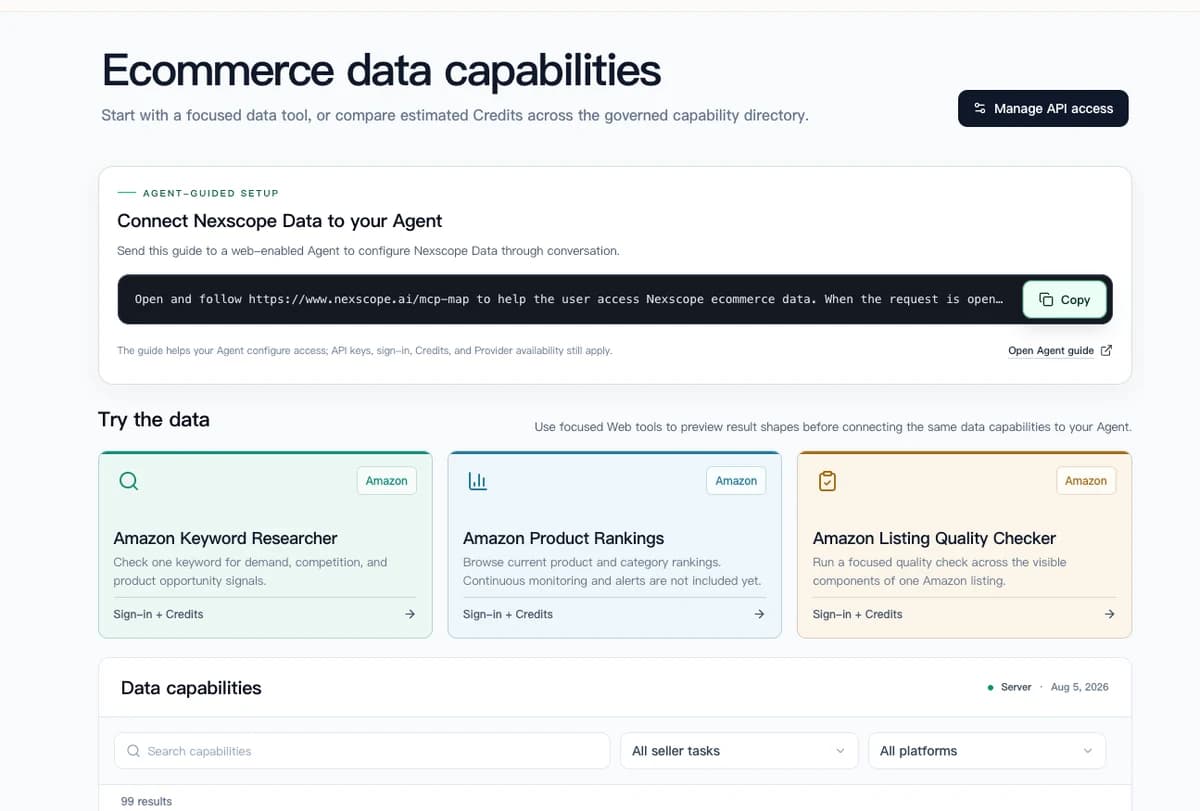
The most efficient review-analysis setup combines structured ecommerce data with an Agent that understands the seller's question and output requirements.
Nexscope provides structured ecommerce data and focused seller workflows. Teams can use Nexscope's web tools directly or connect governed capabilities to their existing Agent through API, MCP, or Skills. Ready workflows include Keyword to Ads, Video Clone, and Buy Box Repricer.
Getting Started
Preview the relevant data capability in a focused tool, or connect it to your Agent through API, MCP, or Skills. Then define the analysis you need:
"Analyze the reviews for this portable blender ASIN: B0XXXXXXXXX"
"What are customers complaining about most in the yoga mat category?"
"Compare review sentiment between these three competitors"
Collect Structured Reviews with an API
Before an Agent can analyze review patterns, it needs a consistent set of review records. For repeatable research across multiple ASINs, an Amazon reviews API is more practical than copying review text manually into a spreadsheet or prompt.
The Nexscope Amazon Reviews List API returns review-level data for a selected ASIN. Documented fields include the review title and text, star rating, date, verified-purchase and Vine signals, helpful votes, media URLs, product context, and variation information. You can select one of 15 marketplace domain codes and control the number of reviews requested for each star rating.
The request also supports three useful research filters:
- Use
sortBy: recentto investigate current complaints or product changes. - Use
sortBy: helpfulto inspect reviews that shoppers have found useful. - Use
reviewerType: avp_only_reviewsto create a verified-purchase segment, while retainingall_reviewsas a comparison group.
Do not collect only one-star reviews. A balanced sample across all five ratings shows both what customers want preserved and what they want fixed. Three- and four-star reviews are particularly useful for finding tradeoffs: the product worked, but a specific issue prevented a stronger recommendation.
Once the records are collected, pass the review text together with its rating, date, marketplace, and variation context into the analysis framework below. This keeps the Agent's conclusions traceable to individual evidence instead of producing an unsupported summary.
Developers can follow the complete Amazon Reviews API market-intelligence guide for request design, field selection, competitor sampling, and data-quality checks.
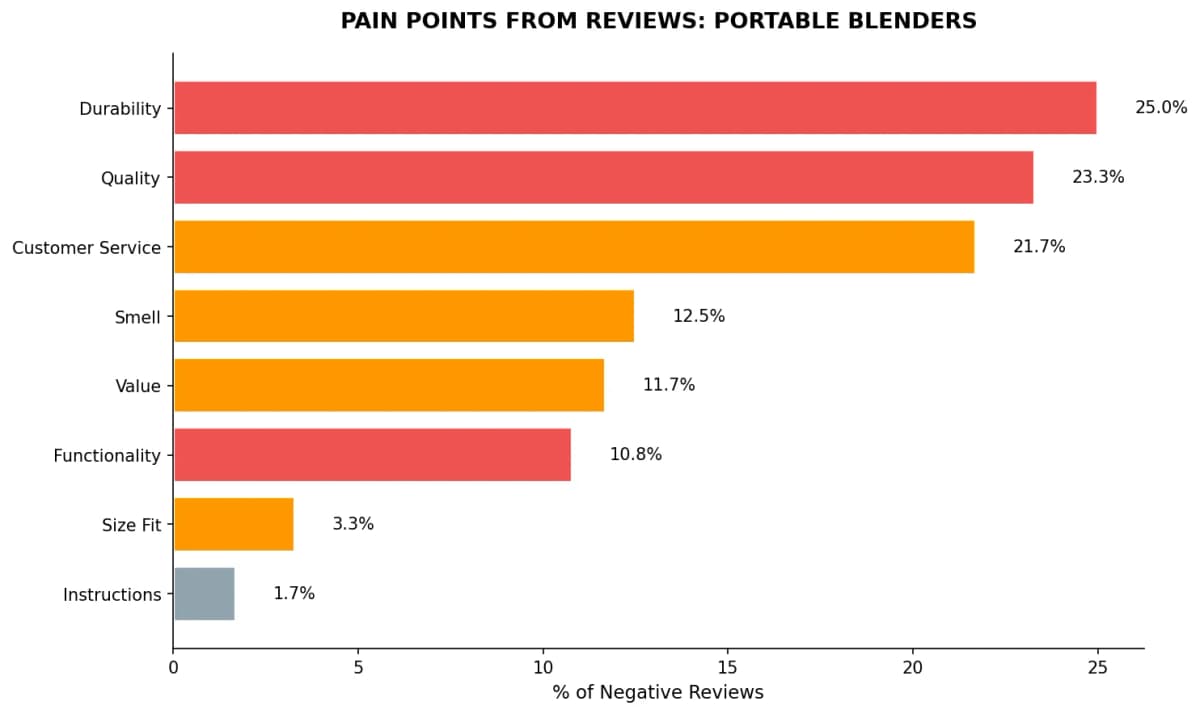
Understanding Pain Points
Identify what frustrates customers most:
"What are the top 5 pain points mentioned in reviews for insulated water bottles?"
"Why are customers giving 1-star reviews to this product?"
"What quality issues are mentioned most frequently?"
Visualizing Patterns
Nexscope generates clear reports and charts that make patterns easy to spot:
Finding Opportunities
Discover what customers want but aren't getting:
"What features do customers wish this product had?"
"What improvements are customers suggesting most often?"
"Are there customer segments being underserved in this category?"
Competitive Analysis
Understand how competitors stack up:
"How does review sentiment compare between Brand A and Brand B?"
"What does Brand A do better than Brand B according to reviews?"
"Which competitor has the most complaints about durability?"
With Nexscope, you skip the manual work entirely. No spreadsheets, no hours of reading, no inconsistent analysis. Just ask your question and get actionable insights backed by real customer data.
Start analyzing competitor reviews in minutes with structured ecommerce data and Agent-ready workflows.
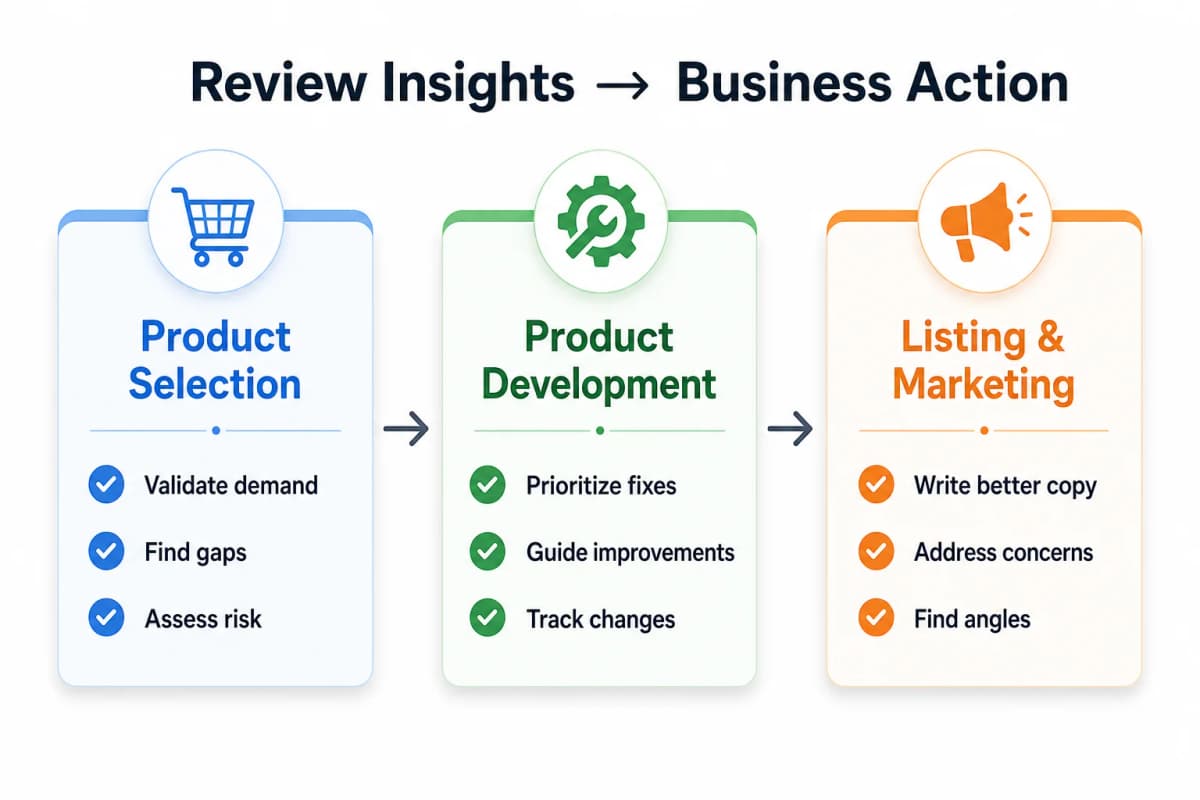
Turning Review Insights into Action
Analysis is only valuable if it drives decisions. Here's how to apply what you learn:
For Product Selection
Before committing to a product, review analysis answers critical questions:
Is there real demand? Customers describe specific problems the product solves. If reviews consistently mention pain points your product addresses, demand is validated.
Can I differentiate? Competitors have consistent weaknesses you can address. Look for recurring complaints that you can solve with better design or quality.
What's the risk? Common complaints reveal potential failure modes. If competitors struggle with durability, you'll need to invest in better materials.
Who's actually buying? Customer profiles may differ from assumptions. Reviews reveal whether actual buyers match your target audience.
Decision framework: - Many complaints about solvable problems = Opportunity - Few complaints, high satisfaction = Hard to differentiate - Fundamental product flaws = Avoid the category
For Product Development
Prioritize improvements based on frequency and severity:
High frequency + High severity: Fix immediately - Safety issues, core functionality failures
High frequency + Low severity: Address in next iteration - Minor inconveniences, "nice to have" features
Low frequency + High severity: Monitor closely - May indicate batch issues or specific use cases
Low frequency + Low severity: Deprioritize - Edge cases that don't affect most customers
For Listing Optimization
Use review language directly in your copy:
Bullet points: Address the top 3-5 concerns proactively
"EASY 5-MINUTE ASSEMBLY — No tools required, unlike other brands that take hours to put together"
Product description: Highlight praised features
"Customers love the whisper-quiet motor that won't disturb sleeping babies"
Images: Show solutions to common complaints
Include size comparison photos if "smaller than expected" is a frequent complaint
For Marketing Angles
Reviews reveal what resonates emotionally:
- Gift-giving: "My husband was thrilled" → Market as a gift
- Problem-solving: "Finally, something that actually works" → Lead with the pain point
- Lifestyle fit: "Perfect for my small apartment" → Target specific living situations
Best Practices for Review Analysis
Analyze Sufficient Volume
A handful of reviews can be misleading. Aim to analyze: - At least 100 reviews for individual product insights - 500+ reviews across competitors for category-level patterns
Include All Star Ratings
Don't just read extremes. 3-star reviews often contain the most balanced, detailed feedback.
Consider Review Recency
Product quality and features change over time. Weight recent reviews more heavily, but check older reviews for durability insights.
Cross-Reference Multiple Products
Single-product analysis can be skewed by outliers. Look for patterns that appear across multiple competitors.
Verify with Other Data
Reviews are one data source. Combine with: - Search volume trends - Best Seller Rank history - Return rate data (if available) - Customer questions on listings - Amazon Vine reviews for early product feedback
Common Mistakes to Avoid
Confirmation Bias
Don't just look for reviews that support your existing hypothesis. Actively seek disconfirming evidence.
Over-Indexing on Negative Reviews
Negative reviews are valuable, but they represent a vocal minority. Most satisfied customers don't leave reviews.
Ignoring Context
"Too small" might be negative for one use case and positive for another. Always consider who's writing the review and why.
Analysis Paralysis
You don't need perfect information. Get enough insights to make a directionally correct decision, then iterate based on results.
Conclusion
Amazon reviews contain everything you need to know about what customers want, what competitors get wrong, and how to build better products. The challenge has always been extracting those insights efficiently.
AI has removed that barrier. What once took days of manual reading now takes minutes of conversation. The sellers who embrace this capability will make faster, better-informed decisions than those still reading reviews one by one.
Key takeaways:
- Reviews reveal customer needs that surveys and focus groups miss
- Analyze across four dimensions: crowd/scenario, functional, assurance, and experience value
- Traditional methods (manual reading, keyword counting) don't scale
- AI enables comprehensive analysis of thousands of reviews in minutes
- Turn insights into action: product selection, development, listing optimization, and marketing
Start Analyzing Reviews Smarter
Stop guessing what customers think. Nexscope provides ecommerce data capabilities that can support review and competitor research in focused tools or connect to your Agent through API, MCP, or Skills.
New users get 3 days free with 1,000 credits — enough to analyze your competitors, research new categories, and uncover opportunities you've been missing.
Grow your ecommerce business
AI-powered intelligence for smarter selling decisions
Get Started Free →No coding required • Instant access
Frequently Asked Questions
How many reviews should I analyze for reliable insights?
For individual products, aim for at least 100 reviews. For category-level insights, analyze 500+ reviews across multiple competitors. More data leads to more reliable patterns.
Can I analyze reviews from competitors' products?
Yes. Competitor review analysis is one of the most valuable applications. Understanding what customers complain about with existing products helps you build something better.
How do I handle fake or incentivized reviews?
Look for patterns rather than individual reviews. Fake reviews tend to be generic and lack specific details. AI analysis that focuses on detailed, specific feedback naturally filters out low-quality reviews.
Should I focus on negative or positive reviews?
Both. Negative reviews reveal problems to solve, while positive reviews show what to preserve and emphasize. Don't ignore 3-star reviews, which often contain the most balanced feedback.
How often should I re-analyze reviews?
For your own products, monthly analysis helps catch emerging issues. For competitor research, quarterly analysis is usually sufficient unless you're in a fast-moving category.
Can review analysis predict product success?
It reduces risk but doesn't guarantee success. Strong negative patterns in competitor reviews suggest opportunities, but execution still matters. Use review insights alongside other validation methods.
Sources
- Amazon Seller Central. (2026). Customer Reviews Best Practices. Retrieved from sellercentral.amazon.com
- Jungle Scout. (2025). State of the Amazon Seller Report. Retrieved from junglescout.com
- Helium 10. (2026). Product Research Methodology. Retrieved from helium10.com