

How to Get Your Ecommerce Store Recommended by AI Search

More shoppers now ask ChatGPT or Gemini for product recommendations instead of scrolling through Google results. They trust AI to do the research for them—comparing specs, reading reviews, filtering options. By the time they click a link, the purchase decision is nearly made.
This changes what matters for your store.
An outdoor gear brand spent $10,000 on website design. Full-screen hero images, animated transitions, video banners. The site looked premium.
When asked to recommend hiking backpacks, ChatGPT didn't mention them.
The store owner sent the product link directly to the AI and asked for analysis. The response: "Return policy unclear, inventory status unknown, price-to-spec ratio questionable. Recommend caution."
The owner checked: return policy was in the footer, inventory showed in real-time, pricing was accurate.
The problem wasn't missing information. The problem was the AI couldn't read it.
How AI Search Actually Works
AI doesn't browse your website like humans do. They don't see your CSS, your theme, your carefully designed product pages.
They go straight to the data layer and extract structured attributes.
Here's what matters: Google's shopping-related queries have a crawl-to-recommendation ratio of 8.2:1. For every 8.2 times AI crawls your site, it generates 1 recommendation.
Gemini and Google AI Overviews pull 80% of their product recommendations from the Google Shopping Graph. That graph gets its data primarily from two sources:
- Google Merchant Center feeds
- Structured data markup on your site
The AI isn't being selective. It's working with whatever data you provide. If your data is incomplete, inconsistent, or unreadable, you don't get recommended.
This is Generative Engine Optimization (GEO)—making your store machine-readable so AI can actually understand and recommend your products.
Shopify Optimization for AI Search
Shopify recently introduced "Agentic Storefronts" architecture. This is part of the broader shift where AI shopping is replacing Google search as the primary product discovery channel. Here's what that means in practice:
When AI processes Shopify stores, it bypasses the entire frontend. CSS styles, Liquid templates, interactive buttons, video banners—all ignored.
They go directly into the Shopify Catalog and extract raw structured attribute data.
For AI, your Shopify Catalog IS your storefront. Theme investment doesn't matter. Catalog data quality determines whether AI recommends you.
Product Taxonomy: Stop Using Marketing Labels
Many merchants categorize products with labels like "Fall Collection," "Best Sellers," or "Limited Edition."
These make sense to humans. To AI, they're noise.
AI needs Shopify's official Product Taxonomy—the deep classification system that tells it "Women's Athletic Apparel > Running Tops > Moisture-Wicking."
Not "Seasonal Favorites."
Action: Go through every product and assign the official Shopify taxonomy category. Remove custom marketing labels from your category structure.
Metafields: Consistency Is Everything
Check your product metafields right now. You'll probably find:
- One product says "100% Cotton"
- Another says "Pure Cotton"
- Another says "Cotton Blend"
- Several have nothing filled in
Large language models can't extract material characteristics from inconsistent data. Products with messy metafields get removed from recommendation lists entirely.
Not downranked. Removed.
Action: Create a metafields standardization doc:
- Materials: Always English, always specific ("100% Organic Cotton")
- Sizes: International standard format ("US 8 / EU 38")
- Colors: Standardized color names, not marketing terms
Apply it to every product. No exceptions.
Requirements for Agentic Storefronts
One caveat: Shopify's Agentic Storefronts currently only support stores registered in the US, settling in USD, with Shopify Payments enabled. If your setup doesn't match, this feature isn't available yet—but you can still make your Shopify store AI-ready with proper schema markup.
WooCommerce and WordPress Optimization
WordPress sites face a different challenge—and opportunity.
Model Context Protocol (MCP) is an open standard initiated by Anthropic. WordPress now functions as a two-way MCP server through its Abilities API and MCP Adapter.
AI agents like Claude can now directly call WordPress backend capabilities. They don't need to open your webpage or use a browser. They read your content, query your products, and check your inventory through standardized protocols.
WooCommerce with native MCP support means AI agents can:
- Search your product catalog with filters
- Extract complete specifications for individual products
- Query real-time inventory status
Sounds great. But here's the problem.
If your WooCommerce fields are vague, your variant logic is messy, or your data is inconsistent, AI agents will either hallucinate incorrect information or flag your store as unreliable and skip recommendations entirely.
Layer 1: Required Product Identifiers
Product Schema must include:
- GTIN (Global Trade Item Number)
- MPN (Manufacturer Part Number)
WooCommerce doesn't display these fields by default. Go into settings and enable them manually.
Missing GTIN? Missing MPN? AI marks you as high-risk and doesn't recommend.
Layer 2: Entity Disambiguation
Your Organization Schema needs the sameAs field populated with all your official profiles:
- Facebook page URL
- Instagram profile URL
- LinkedIn company page URL
- Any other official presence
This tells AI "this Facebook account, this Instagram account, this WordPress site—they're all the same brand."
Without it, AI might attribute competitor reviews or negative mentions from similarly-named businesses to you.
Layer 3: Trust Signals in Code
Return policies and shipping information can't just live in your Terms page as text. They need to be in structured code.
MerchantReturnPolicy in your Product Schema:
{
  "@type": "MerchantReturnPolicy",
  "returnPolicyCategory": "https://schema.org/MerchantReturnFiniteReturnWindow",
  "merchantReturnDays": 30,
  "returnMethod": "https://schema.org/ReturnByMail"
}
ShippingDetails with handling and transit times:
{
  "@type": "OfferShippingDetails",
  "shippingRate": {
    "@type": "MonetaryAmount",
    "value": "0",
    "currency": "USD"
  },
  "deliveryTime": {
    "@type": "ShippingDeliveryTime",
    "handlingTime": {
      "@type": "QuantitativeValue",
      "minValue": 1,
      "maxValue": 2,
      "unitCode": "DAY"
    },
    "transitTime": {
      "@type": "QuantitativeValue",
      "minValue": 3,
      "maxValue": 7,
      "unitCode": "DAY"
    }
  }
}
AI uses this to calculate delivery estimates based on user location. Text on a page doesn't count.
Entity-First Architecture for AI Search
Traditional SEO optimizes pages. This landing page targets "waterproof backpack." That category page targets "outdoor gear."
GEO optimizes entities.
You need to manage three core entity types:
| Entity Type | Schema Type | Critical Fields | AI Use |
|---|---|---|---|
| Brand | Organization | sameAs, logo, name | Entity disambiguation |
| Product | Product | GTIN, MPN, name, offers | Recommendations, comparisons |
| Author | Person | sameAs, affiliation | E-E-A-T trust signals |
The rule: One product must have identical information everywhere it appears.
- Product page says "Waterproof Backpack 45L"
- Feed says "45 Liter Outdoor Backpack"
- Description says "Large Capacity Hiking Pack"
Same product, three different names. AI treats these as three different entities.
Schema markup, product feeds, and page copy must match exactly. Same name, same price, same specs, same GTIN. Everywhere. This consistency is also critical for Amazon listing optimization—AI judges your entire data footprint, not just individual pages.
One brand did entity restructuring over 6 months. Their mentions in Google AI Overviews increased 447%. Not from better content—from more machine-readable data.
Managing AI Crawlers
Not all AI crawlers deserve access to your site.
- CCBot (Common Crawl): Scrapes data to train models. Doesn't send traffic back.
- GPTBot (ChatGPT): Scrapes and cites. Sends traffic.
- Google-Extended: Affects how Gemini understands your brand.
Update your robots.txt:
User-agent: GPTBot
Allow: /

User-agent: Google-Extended
Allow: /

User-agent: CCBot
Disallow: /
The llms.txt File
This is a new standard emerging in 2026. Create a file at yourdomain.com/llms.txt listing the pages you most want AI to read:
# Llms.txt - AI Reading Guide
# Priority pages for AI understanding

## Brand Information
/about
/our-story

## Top Products
/products/flagship-backpack
/products/bestseller-tent

## Trust & Policy
/shipping-policy
/return-policy
/faq
Think of it as an official reading guide for AI agents. You're telling them where to find your most important information.
Nearly 80% of major publishers now block at least one AI training crawler. They're protecting their data. Ecommerce sellers can do the opposite—actively open structured data to AI while competitors stay closed.
That's the arbitrage opportunity. The right AI tools for ecommerce can help you automate much of this optimization work.
Why This Matters: Conversion Rates
AI search converts at 10-40%. Traditional SEO converts at 1-2%.
The difference isn't traffic volume. It's intent quality.
When AI recommends a product, it's already processed hundreds of pages of reviews, comparisons, and specifications. Users who click have effectively completed their research. They arrive with purchase intent.
Your relationship with AI is shifting from "being searched" to "being called."
The difference isn't keyword rankings. It's data interface quality.
Run Your Ecommerce Business with an AI Agent
Optimizing for AI search is one piece. Running the full operation—product research, competitor analysis, listing optimization, keyword tracking, PPC campaigns—requires constant work across multiple tools.
Nexscope provides structured ecommerce data and focused seller workflows. Teams can use Nexscope's web tools directly or connect governed capabilities to their existing Agent through API, MCP, or Skills. Ready workflows include Keyword to Ads, Video Clone, and Buy Box Repricer.
- "Analyze my listing's schema markup and tell me what's missing"
- "How does my product data compare to top competitors?"
- "Which of my products have incomplete metafields?"
- "Suggest improvements to make this listing more AI-readable"
- "What keywords are competitors ranking for that I'm missing?"
The agent pulls real-time data, audits your structured data, and gives you actionable recommendations—like having a GEO specialist and research analyst available 24/7.
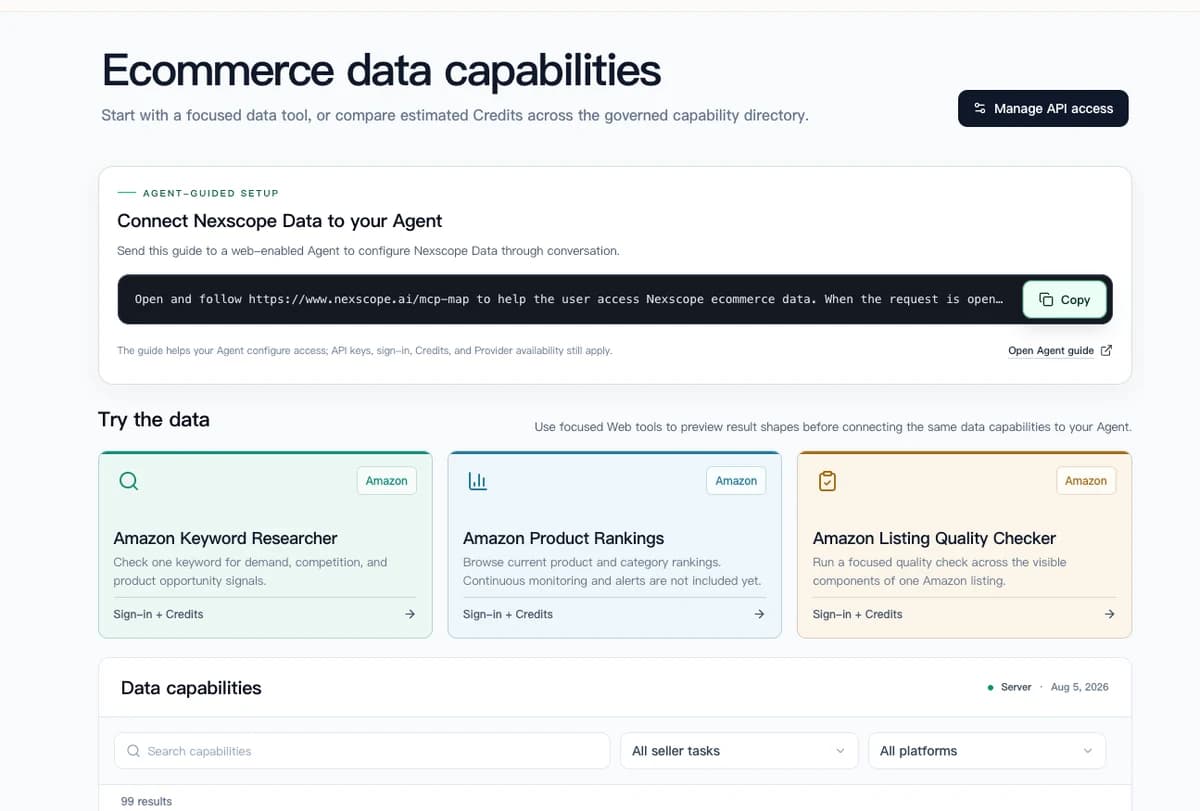
If you're optimizing your store for AI recommendations, Nexscope helps you identify gaps and fix them faster.
Connect Ecommerce Data to Your Agent
Use Nexscope through API, MCP, or Skills, or open a ready seller workflow.
Explore Ecommerce Data →Frequently Asked Questions
What is Generative Engine Optimization (GEO)?
GEO is the practice of optimizing your website and product data so AI systems (like ChatGPT, Gemini, and AI Overviews) can accurately understand and recommend your content. Unlike traditional SEO which focuses on search rankings, GEO focuses on making your data machine-readable.
Does AI search actually look at my website design?
No. AI bypasses your frontend entirely—CSS, themes, images, and interactive elements are ignored. They extract structured data directly from your catalog, feeds, and schema markup. Your data quality matters; your design doesn't affect AI recommendations.
What's the most important schema markup for ecommerce?
Product schema with complete GTIN and MPN fields, plus MerchantReturnPolicy and ShippingDetails. Organization schema with sameAs fields for entity disambiguation is also critical. Missing these fields can result in products being excluded from AI recommendations entirely.
How long does GEO optimization take to show results?
Most stores see changes in AI crawl behavior within 2-4 weeks of implementing proper schema markup and data standardization. Significant improvements in AI recommendations typically appear within 90 days, assuming consistent data quality across all products.
Should I block AI crawlers from my site?
Block training-only crawlers like CCBot that scrape data without sending traffic. Allow crawlers that generate recommendations and citations, like GPTBot and Google-Extended. Create an llms.txt file to guide AI to your most important pages.
Sources
- Google. (2026). Shopping Graph Documentation. Retrieved from developers.google.com
- Shopify. (2026). Agentic Storefronts Architecture. Retrieved from shopify.dev
- Anthropic. (2026). Model Context Protocol Specification. Retrieved from anthropic.com
- Schema.org. (2026). Product Schema Markup. Retrieved from schema.org