
How to Use AI to Build a Profitable Shopify Store

Running a Shopify store used to mean endless hours writing product descriptions, managing customer service tickets, and manually optimizing ad campaigns. Solo entrepreneurs burned out. Teams scaled costs faster than revenue. The traditional e-commerce playbook demanded either deep pockets or unsustainable hustle.
AI has changed the equation. Store owners now automate content creation, analyze customer behavior in real-time, and run 24/7 customer service without hiring a single employee. The result: higher margins, faster scaling, and businesses that run while their owners sleep.
This guide covers the practical AI stack for Shopify store owners who want to work smarter, not harder.
The Old Way vs The AI Way
| Task | Traditional Approach | AI-Powered Approach |
|---|---|---|
| Ad Creatives | Hire designer, wait days, pay $50-200/piece | Generate 100 variations in hours, test freely |
| Product Descriptions | Write manually or outsource at $20-50/product | Bulk generate with brand voice consistency |
| Customer Service | Hire VA or handle personally, limited hours | AI chatbot handles 80%+ queries 24/7 |
| Data Analysis | Export to spreadsheets, manual interpretation | AI summarizes insights and recommends actions |
| Email Marketing | Template-based, generic segmentation | Personalized content per customer behavior |
The shift is not about replacing human judgment. It is about eliminating repetitive tasks so store owners can focus on strategy, product development, and customer relationships.
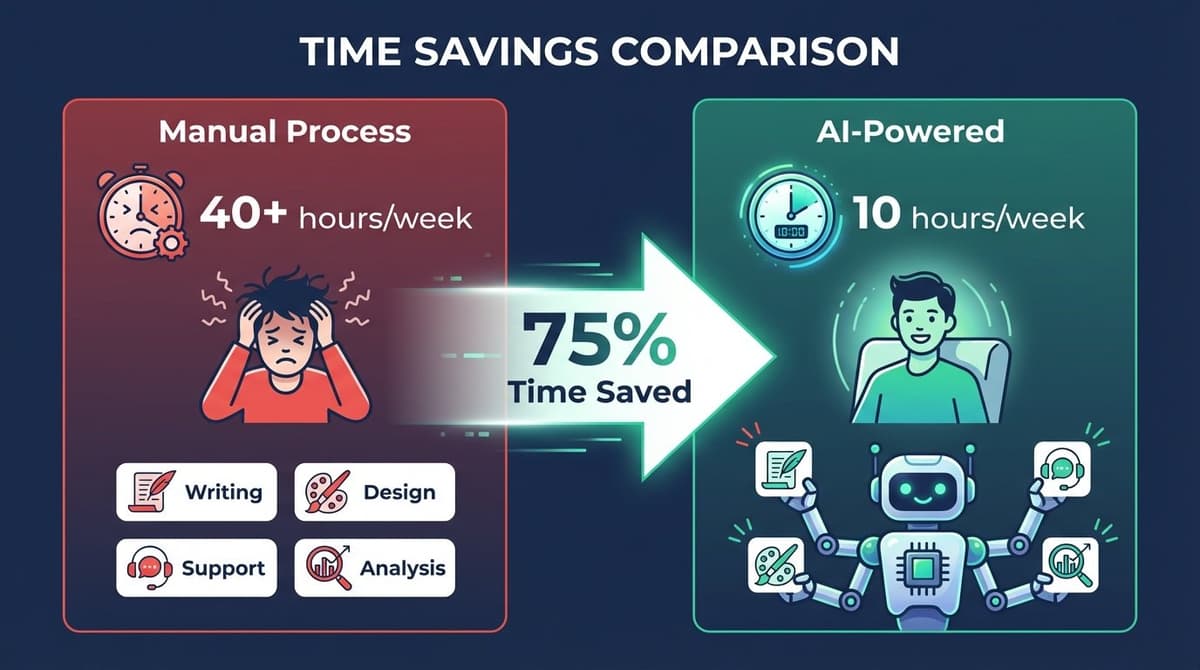
4 Ways AI Transforms Your Shopify Business
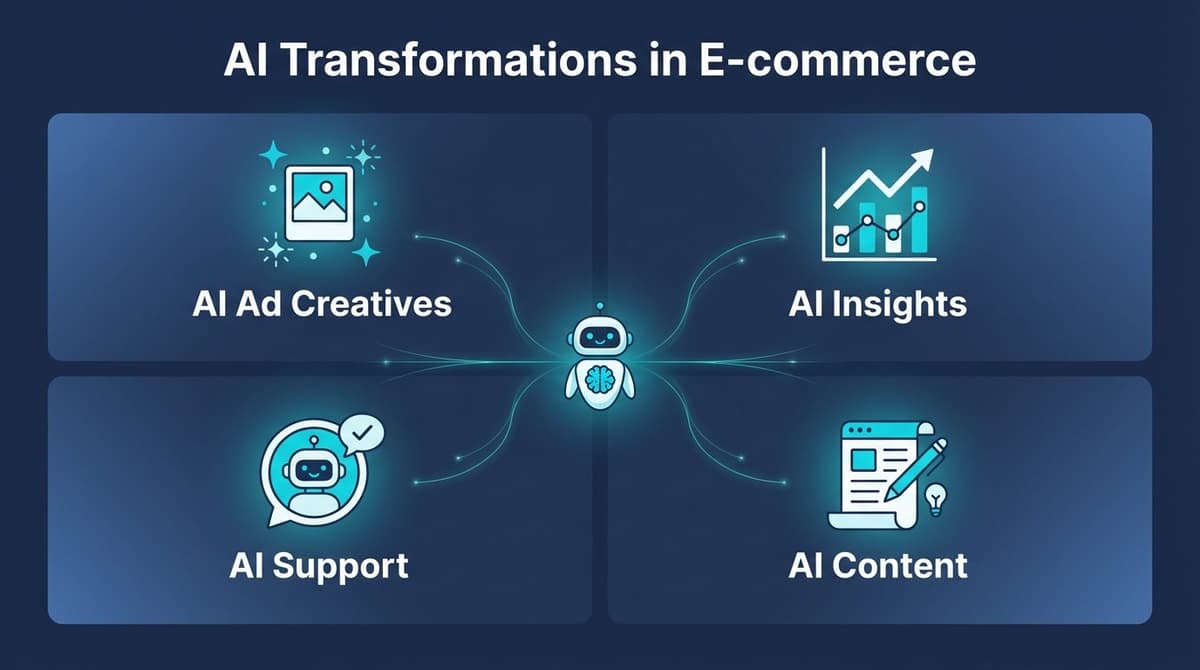
1. AI-Powered Ad Creatives
Paid advertising remains the primary growth lever for most Shopify stores. But creative fatigue kills campaigns. The same ad shown repeatedly loses effectiveness as audiences tune out.
AI solves this by enabling rapid creative iteration.
The Modern Stack:
- Nano Banana Pro (Google's Gemini-powered image generator) — Generate product visuals, lifestyle shots, and ad backgrounds
- Claude or ChatGPT — Write ad copy variations, headlines, and CTAs
- Canva AI — Quick edits and format adaptation for different platforms
- AI Agents (OpenClaw, Nexscope) — Orchestrate multiple AI tools through natural language commands, automating entire workflows instead of individual tasks
Workflow Example:
- Feed product photos and brand guidelines to Claude
- Generate 20 headline variations and 10 body copy options
- Use Nano Banana Pro to create matching visuals
- Upload combinations to Meta Ads Manager
- Let the algorithm find winners while you generate the next batch
Results: Store owners report 3-5x more creative variations tested per week, with significantly lower cost per creative. Winners emerge faster because testing volume increases.
💡 Pro Tip: For advanced AI automation workflows, see 5 AI Employees That Scaled E-commerce to $300K/Month.
2. AI Customer Insights
Most Shopify store owners drown in data but lack insights. Google Analytics shows what happened. AI explains why and what to do next.
What AI Can Analyze:
- Customer journey patterns (where do visitors drop off?)
- Purchase timing (when do customers buy? when do they abandon?)
- Product affinity (which products are frequently bought together?)
- Review sentiment (what do customers love or hate?)
Practical Application:
Upload your GA4 export or Shopify analytics to Claude with a prompt like:
Analyze this data and identify:
1. Top 3 conversion bottlenecks
2. Customer segments by behavior
3. Products that should be bundled
4. Optimal times for email campaigns
Real Example: One store owner discovered that 40% of cart abandonments happened within 2 hours of adding items. The AI recommendation: implement a 90-minute abandoned cart email instead of the default 24-hour delay. Conversion rate on recovery emails increased 25%.
3. AI-Driven Customer Service
Customer service is the hidden profit killer for small e-commerce businesses. Each support ticket costs time, and slow responses lose customers.
AI Customer Service Stack:
- Shopify Inbox + AI — Auto-responds to common questions
- Tidio or Gorgias — AI-powered helpdesk with Shopify integration
- Custom GPT — Train on your FAQ, policies, and product details
What AI Handles Well:
| Query Type | AI Capability |
|---|---|
| Order status | ✅ Fully automated |
| Shipping questions | ✅ Fully automated |
| Product specifications | ✅ Fully automated |
| Return requests | ⚠️ Semi-automated (needs human approval) |
| Complaints | ⚠️ AI drafts, human reviews |
| Complex issues | ❌ Escalate to human |
Implementation:
- Export your last 100 customer service conversations
- Identify the top 10 question types (usually covers 80% of volume)
- Create AI response templates for each
- Set up escalation rules for edge cases
Results: Stores typically automate 60-80% of customer service volume, freeing hours per week while improving response times from hours to seconds.
4. AI Content Marketing
Paid ads get expensive. Content marketing builds organic traffic that compounds over time. But content creation is time-intensive — unless AI handles the heavy lifting.
AI Content Workflow:
| Content Type | AI Role | Human Role |
|---|---|---|
| Blog posts | Draft full articles | Edit, add expertise, fact-check |
| Product descriptions | Generate bulk variations | Select best, add brand voice |
| Email sequences | Write personalized flows | Set strategy, review tone |
| Social media | Generate post ideas and copy | Approve, schedule, engage |
Blog Strategy Example:
- Use Nexscope SkillHub keyword research skills to find topics
- Generate article outlines with Claude
- Draft full posts (AI writes 80%, human refines 20%)
- Publish consistently (2-4 posts per week becomes achievable)
Impact: Stores using AI-assisted content report reducing ad dependency from 80% to 30-40% of revenue within 6-12 months. Organic traffic compounds while ad costs stay flat.
💡 Pro Tip: Already selling on Amazon? See how to automate that channel too: OpenClaw for Amazon Sellers: 12 Automation Skills.
The AI Tool Stack for Shopify
Free/Low-Cost Tier
| Tool | Use Case | Cost |
|---|---|---|
| ChatGPT Free | Copy, analysis, brainstorming | Free |
| Canva Free | Basic image editing | Free |
| Shopify Magic | Product descriptions, email subject lines | Included with Shopify |
Professional Tier
| Tool | Use Case | Cost |
|---|---|---|
| Claude Pro | Advanced writing, analysis, coding | $20/month |
| Nano Banana Pro | Image generation (via Google AI) | Included with Google One AI |
| Tidio | AI customer service | $29/month+ |
| Klaviyo | AI-powered email marketing | Free up to 250 contacts |
Enterprise Tier
| Tool | Use Case | Cost |
|---|---|---|
| Gorgias | Full AI helpdesk | $60/month+ |
| Triple Whale | AI analytics and attribution | $129/month+ |
| Jasper | Brand-trained AI content | $49/month+ |
Realistic Timeline: From Setup to Profit
Month 1-2: Foundation
- Set up AI writing workflow (Claude/ChatGPT)
- Implement basic AI customer service
- Start generating ad creative variations
- Expected outcome: 5-10 hours/week saved
Month 3-4: Optimization
- Analyze first data with AI insights
- Refine customer service automation
- Scale ad testing volume
- Expected outcome: Ad ROAS improves, support costs drop
Month 5-6: Scaling
- Launch AI-assisted content marketing
- Automate email personalization
- Build systems that run without daily input
- Expected outcome: Revenue grows while time investment stays flat
Common Mistakes to Avoid
1. Over-Automating Too Fast
AI works best when trained on your specific business. Deploying generic AI responses before customization leads to robotic, off-brand communication.
Fix: Start with your highest-volume, lowest-complexity tasks. Expand gradually.
2. Ignoring Quality Control
AI generates content quickly. But speed without review means publishing errors, inaccuracies, or off-brand messaging.
Fix: Build a review step into every AI workflow. Human oversight is non-negotiable.
3. Expecting Immediate ROI
AI tools require setup time, learning curves, and iteration. The payoff comes from compounding efficiency over months.
Fix: Commit to 90 days before evaluating ROI. Track time saved, not just revenue impact.
4. Using AI for Everything
Some tasks benefit from human touch: brand strategy, customer relationship building, product innovation. AI handles execution, not vision.
Fix: Define what AI should and should not do for your business. Protect the human elements that differentiate your brand.
Conclusion
AI does not replace the need to build a real business with real products that solve real problems. It eliminates the busywork that prevents store owners from focusing on what matters: product quality, customer experience, and strategic growth.
The store owners winning in 2026 are not the ones working 80-hour weeks. They are the ones who built AI-powered systems that handle the repetitive while they focus on the creative.
Start with one workflow. Automate ad creative generation or customer service responses. Measure the time saved. Then expand. Within months, the business that used to demand constant attention runs largely on autopilot.
The challenge with building an AI stack is tool fragmentation. Claude for writing. Nano Banana for images. Tidio for customer service. Multiple dashboards, multiple subscriptions, multiple learning curves. This is where AI agents change the game — orchestrating multiple AI capabilities through a single interface.
Nexscope provides structured ecommerce data that teams can use in focused web tools or connect to their existing Agent through API, MCP, or Skills. Ready workflows include Keyword to Ads, Video Clone, and Buy Box Repricer.
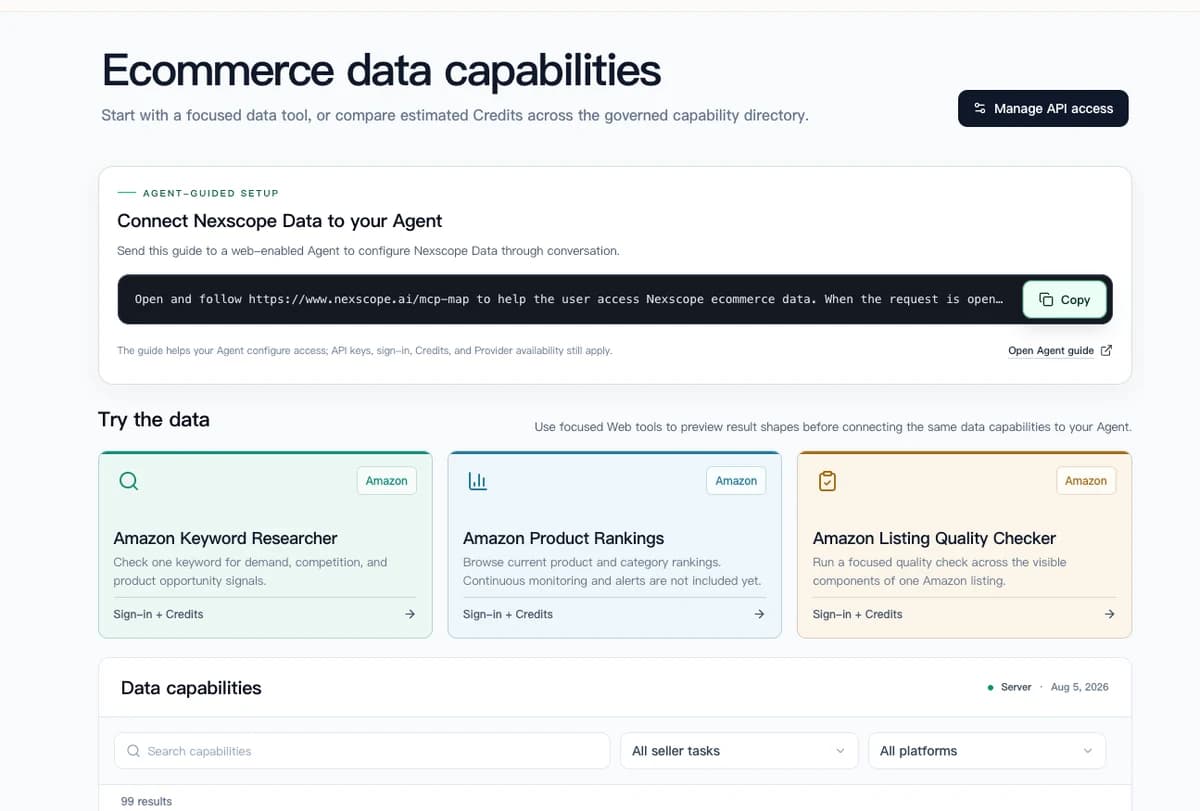
Connect Ecommerce Data to Your Agent
Use Nexscope through API, MCP, or Skills, or open a ready seller workflow.
Explore Ecommerce Data →1,000 free credits • API, MCP & Skills
FAQs
Is AI really necessary for a small Shopify store?
Not necessary, but increasingly advantageous. Stores using AI tools report 30-50% time savings on operational tasks. For solo entrepreneurs, this often means the difference between burnout and sustainability.
Which AI tool should I start with?
Start with ChatGPT or Claude for writing tasks — product descriptions, ad copy, customer service templates. These have the lowest learning curve and immediate applicability. For e-commerce sellers who want an all-in-one solution, Nexscope combines product research, competitor analysis, and AI automation specifically designed for Amazon and Shopify sellers — no need to juggle multiple platforms.
Will AI-generated content hurt my SEO?
No, if done correctly. Google evaluates content quality, not creation method. AI-assisted content that provides genuine value ranks well. AI-generated spam does not.
How much does an AI stack cost for a Shopify store?
A basic stack (ChatGPT + Shopify Magic + Canva) costs $0-20/month. A professional stack (Claude Pro + Tidio + Klaviyo) runs $50-100/month. ROI typically exceeds cost within 2-3 months through time savings alone.
Can AI write product descriptions that actually convert?
Yes, with proper training. Feed AI your brand voice guidelines, top-performing product descriptions, and customer language from reviews. The output matches your brand while scaling production.
Sources
- Shopify: AI Tools for E-commerce
- Google DeepMind: Nano Banana Pro
- Gorgias: AI Customer Service Benchmarks