

How to Get Your Product Recommended in ChatGPT Shopping

Learning how to get your product recommended in ChatGPT Shopping matters because AI shopping is becoming part of the buying decision. Shoppers can ask an AI assistant to compare products, explain trade-offs, narrow a long list, or choose the best option for a specific budget and use case. By the time they visit a product page, an AI-generated answer may already have influenced which brands make the shortlist.
The first move is measurement. A seller needs to know whether the product appears in AI shopping answers, where it ranks when mentioned, which buyer questions trigger it, which competitors win instead, and which sources support those recommendations. That baseline separates a discovery problem from weak recommendation strength, unclear product data, missing comparison content, or limited third-party authority.
This guide explains how ecommerce teams can measure current product AI visibility, improve the signals that help AI systems understand and evaluate a product, and retest the buying questions that matter. It also distinguishes page-level GEO readiness from observed product recommendations so each problem can be matched to the right fix.
How ChatGPT Shopping Influences Product Decisions
AI Shopping Compresses the Discovery Process
Traditional product discovery often requires several separate searches. A buyer might open marketplace listings, review sites, comparison pages, videos, and brand websites before deciding what belongs on the shortlist. An AI shopping conversation can compress those actions into a single request.
Examples include:
- "What is the best carry-on backpack for a week-long trip?"
- "Compare these three espresso machines for a small apartment."
- "Is this skincare device worth the price?"
- "Find a cheaper alternative with the same core features."
- "Which option is best for a beginner?"
These questions contain more context than a short product keyword. They combine category, use case, budget, audience, features, objections, and purchase intent. That context allows the answer to explain why one product fits the request better than another.
This shift expands the role of AI shopping in product discovery. Search rankings and marketplace visibility still matter because AI systems may use searchable web and commerce information. The recommendation layer adds another decision point. A product must be available as reliable information, fit the buyer's request, and provide enough evidence for a useful comparison.
Four Levels of Product AI Visibility
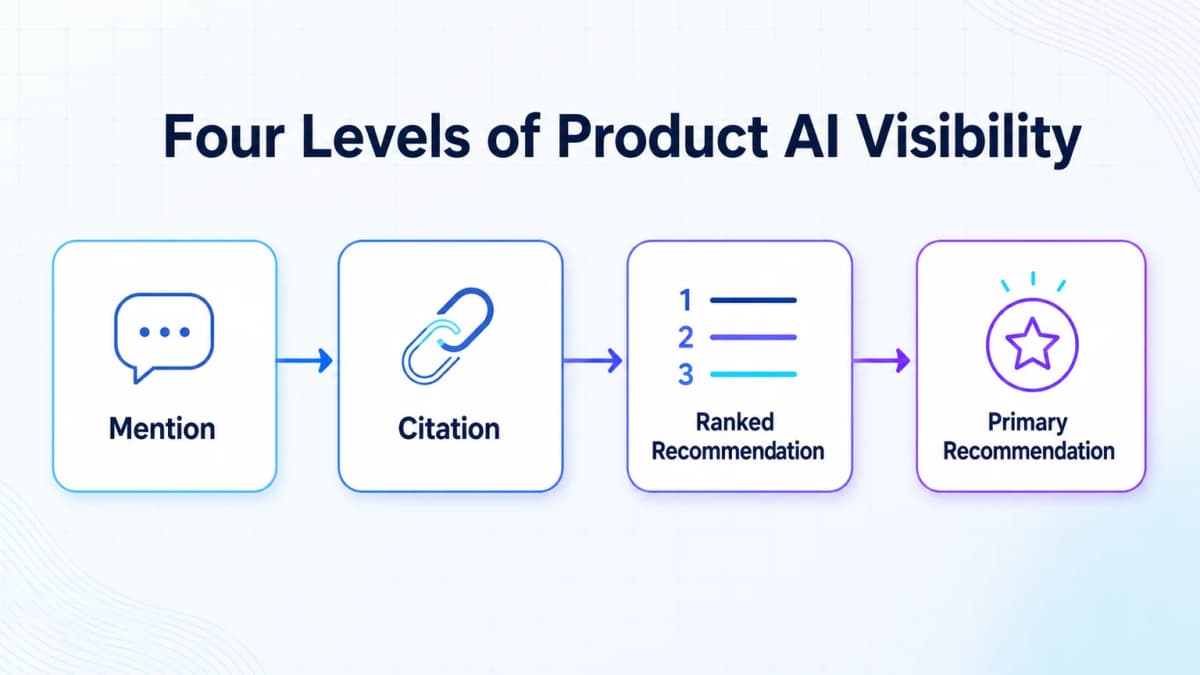
Product visibility should be evaluated as a funnel:
| Level | What it means | Business question |
|---|---|---|
| Mention | The product appears somewhere in the answer | Does AI know the product exists? |
| Citation | The answer links to or relies on a supporting source | Is the product supported by retrievable evidence? |
| Ranked recommendation | The product appears in a shortlist or ordered comparison | How strongly does it compete for the query? |
| Primary recommendation | The product becomes the first or main choice | Does AI treat it as the best fit? |
A high mention rate can coexist with a low primary recommendation rate. A well-known product may appear in most answers while losing the final verdict to a competitor with clearer use-case positioning, stronger comparison evidence, more consistent product information, or better source coverage.
The distinction changes the optimization strategy. A product with almost no mentions needs better discovery and entity signals. A product that appears frequently but rarely wins needs stronger differentiation and recommendation evidence. A product that performs well in branded questions but disappears from generic category questions needs broader buyer-intent coverage.
Measure Whether AI Already Recommends Your Product
Build a Repeatable Test Instead of Asking One Prompt
A single ChatGPT conversation cannot establish product visibility. AI answers can vary by query wording, model, location, language, available sources, and run time. A branded question such as "Is Product X good?" can also produce an inflated impression because the product is already named in the prompt.
A more useful benchmark includes several buying intents:
- Discovery: best products for a category, audience, budget, or use case
- Comparison: Product A vs Product B, or three-product comparisons
- Validation: reviews, pros and cons, quality, safety, or whether the product is worth it
- Alternatives: products similar to a market leader or lower-priced substitutes
- Feature-led: best products with a specific material, feature, size, compatibility, or performance requirement
- Purchase advice: which product should a buyer choose right now?
The test should keep the target country, language, product identity, and evaluation scope consistent. This makes later comparisons more meaningful.
Use Product-Level Visibility Metrics
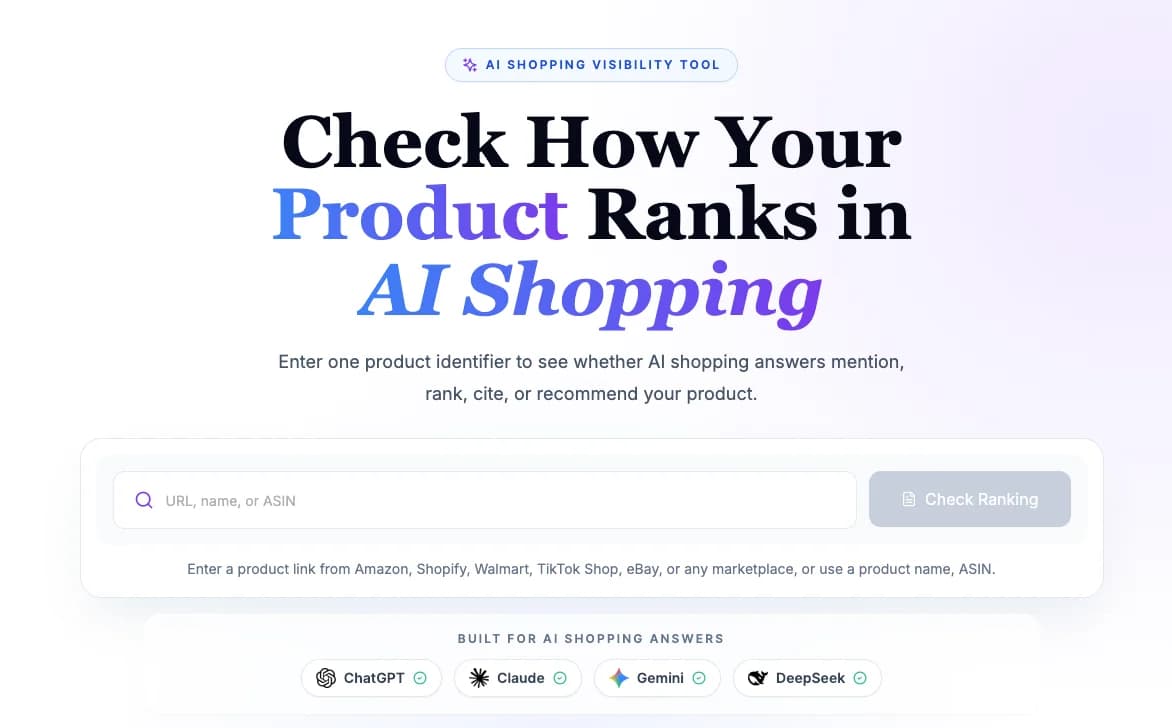
Nexscope provides an AI Product Visibility Tool for product-level checks. A seller can submit a product name, product URL, ASIN, or UPC/EAN identifier. The report evaluates product-specific shopping questions across ChatGPT, Claude, Gemini, and DeepSeek, then records how the product and its competitors appear.
The check is not limited to Shopify or DTC products. It can evaluate products sold through Amazon, TikTok Shop, Walmart, eBay, Shopify stores, DTC sites, and other ecommerce channels when a usable product name, URL, ASIN, or product identifier is available.
The report is organized around six connected dimensions:
- Visibility scorecard: mention rate, average recommended position, and primary recommendation rate
- Buyer-question coverage: performance across discovery, comparison, purchase-advice, alternatives, feature, and trust queries
- Query-level evidence: the outcome, rank, recommendation type, and misses for each tested question
- LLM and competitor benchmarks: performance by AI system and the products that repeatedly win the same prompts
- Citations and signal gaps: the domains, pages, prices, purchase links, comparison formats, and other signals found in the answers
- Prioritized action plan: the highest-impact content, technical, authority, and distribution gaps to address next
A sample AI Product Visibility Report shows how these dimensions work together. Its overview begins with mention rate, average position, and primary recommendation rate, then expands into buyer questions, competitor performance, LLM-by-LLM rankings, cited sources, shopping signals, and prioritized next steps.
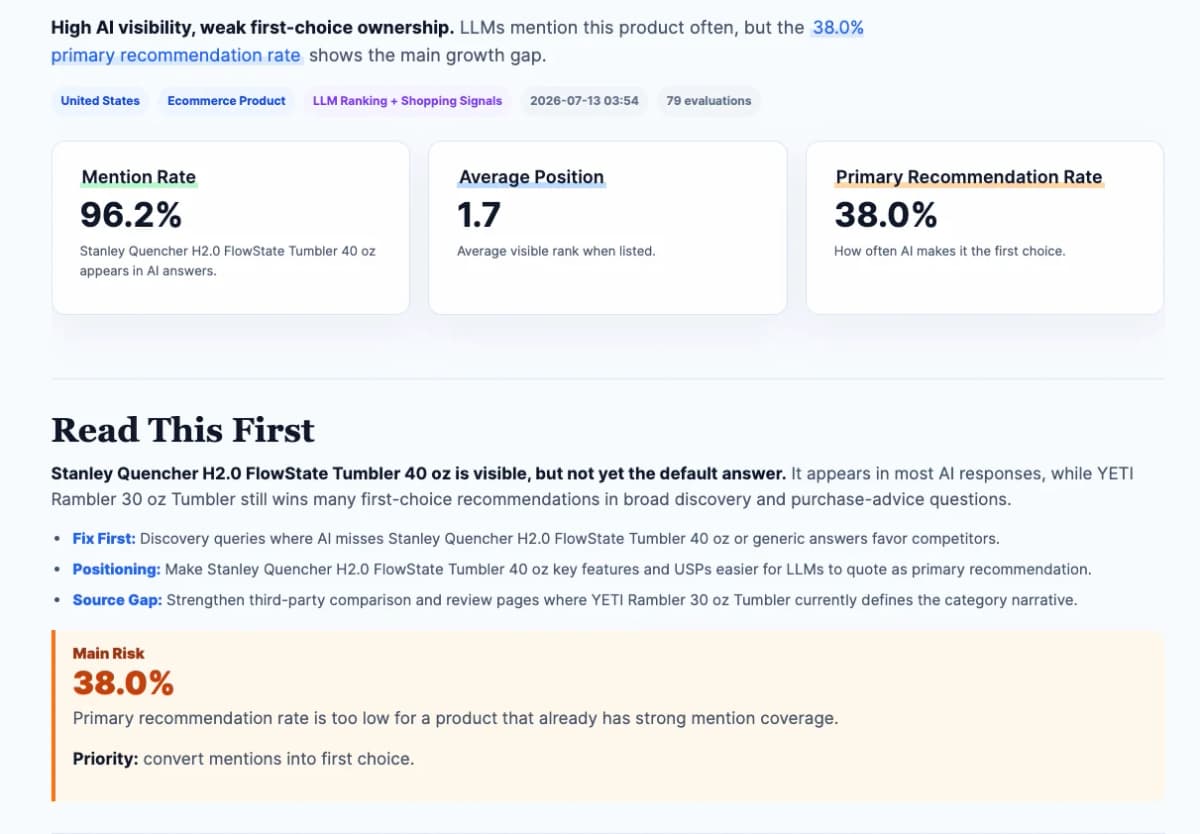
The report is a time-bound snapshot of the tested market, questions, and models. No visibility report can guarantee future AI recommendations or sales. Its value comes from showing where recommendation performance is weak and what evidence should be examined next.
Read the Metrics as a Funnel
The combination of metrics matters more than any single score.
| Pattern | Likely interpretation |
|---|---|
| Low mentions across most queries | The product has a discovery, entity, crawl, or source-coverage problem |
| High mentions with weak average rank | AI recognizes the product but sees stronger alternatives |
| High mentions and good rank with low primary rate | The product reaches the shortlist but lacks a decisive reason to win |
| Strong branded performance and weak generic performance | The product is known by name but poorly associated with broader category needs |
| One LLM performs much worse than others | Search, source access, indexing, or platform-specific retrieval may differ |
| Competitors receive more citations | Third-party sources may define the market more clearly than the brand's own content |
This diagnostic stage prevents random changes. It provides the outcome data needed to decide whether the next priority is product identity, page readability, buyer-intent content, comparisons, reviews, citations, or technical access.
7 Ways to Improve ChatGPT Recommendation Readiness
No single tactic controls ChatGPT product recommendations. Recommendation readiness grows when a product is easy to identify, easy to compare, supported by consistent commerce information, relevant to the buyer's request, and backed by retrievable evidence.
1. Keep Product Identity Consistent Everywhere
AI systems need to connect information from product pages, marketplaces, feeds, reviews, and third-party sources to the same product entity. Inconsistent naming and identifiers make that connection harder.
Check the following fields across every controlled channel:
- Brand name and official product name
- ASIN, GTIN, UPC/EAN, or MPN where applicable
- Product category and subcategory
- Model, size, color, material, and variant names
- Core specifications and compatibility
- Price, currency, availability, and offer details
- Canonical product URL
- Primary use cases and target audience
A Shopify page might call a product "Flow Brew Mini," while a marketplace listing uses "Portable Coffee Maker 2.0" and a review article uses "FlowBrew Travel Brewer." Those variations may be understandable to a person. They create unnecessary ambiguity for systems trying to merge product information.
Use one canonical product name and preserve the same identifiers and core specifications wherever the product appears. Marketing copy can vary by channel, but the underlying entity should remain stable.
Amazon sellers should also check whether the brand website, Brand Store, A+ Content, packaging references, and external reviews describe the same model consistently. Shopify and DTC teams should align the product page, product feed, structured data, collection pages, and retailer listings.
2. Make the Product Page Easier for AI to Understand
Product visibility testing measures the observed result. A page-level GEO audit examines whether the controlled page exposes the information that search and AI systems need to crawl, interpret, summarize, and cite.
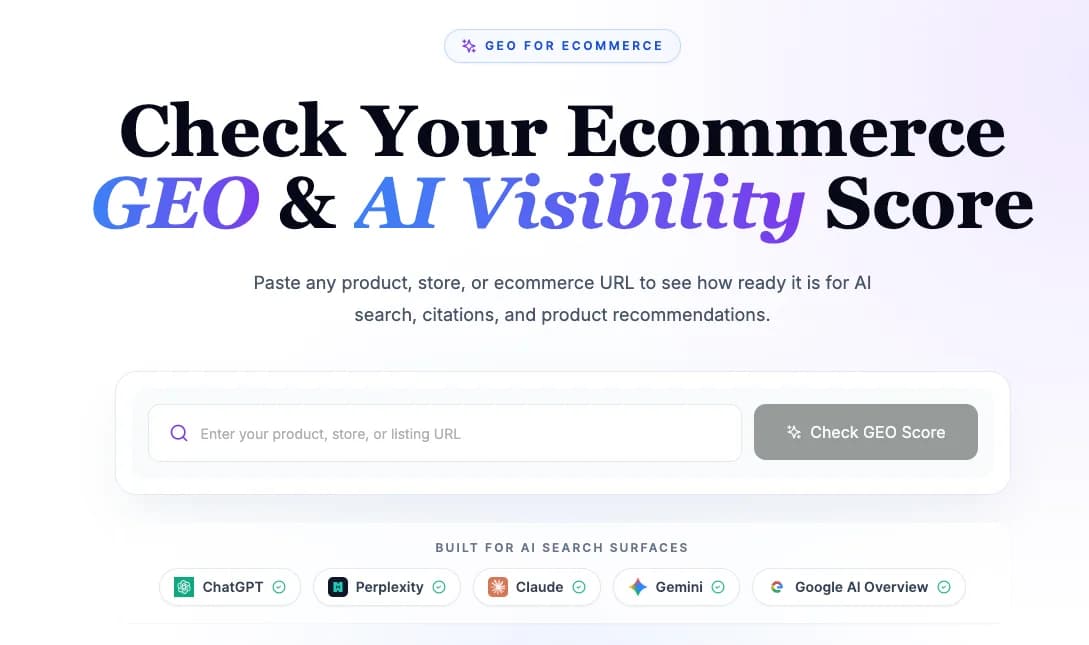
The free Nexscope GEO Score Checker accepts product, store, marketplace, category, and ecommerce homepage URLs. It evaluates page-level readiness across:
- SEO and crawl readiness
- Image SEO and product understanding
- Product, Offer, Review, Organization, Breadcrumb, and FAQ structured data where relevant
- Brand, product, category, material, color, use-case, and offer recognition
- Buyer-intent coverage
- Trust and conversion proof
- AI citation readiness
- Prioritized recommendations
The GEO score does not claim that a product currently ranks in ChatGPT. It evaluates whether the page provides accessible, structured, and citation-friendly product information. The AI Product Visibility Tool measures whether the product actually appears, ranks, or becomes the primary recommendation in tested shopping answers.
The summary report separates SEO score, GEO and AI visibility, technical health, and content authority. It then shows the full audit areas for crawl readiness, search intent, image SEO, structured data, trust signals, AI brand recognition, citation readiness, and prioritized fixes.
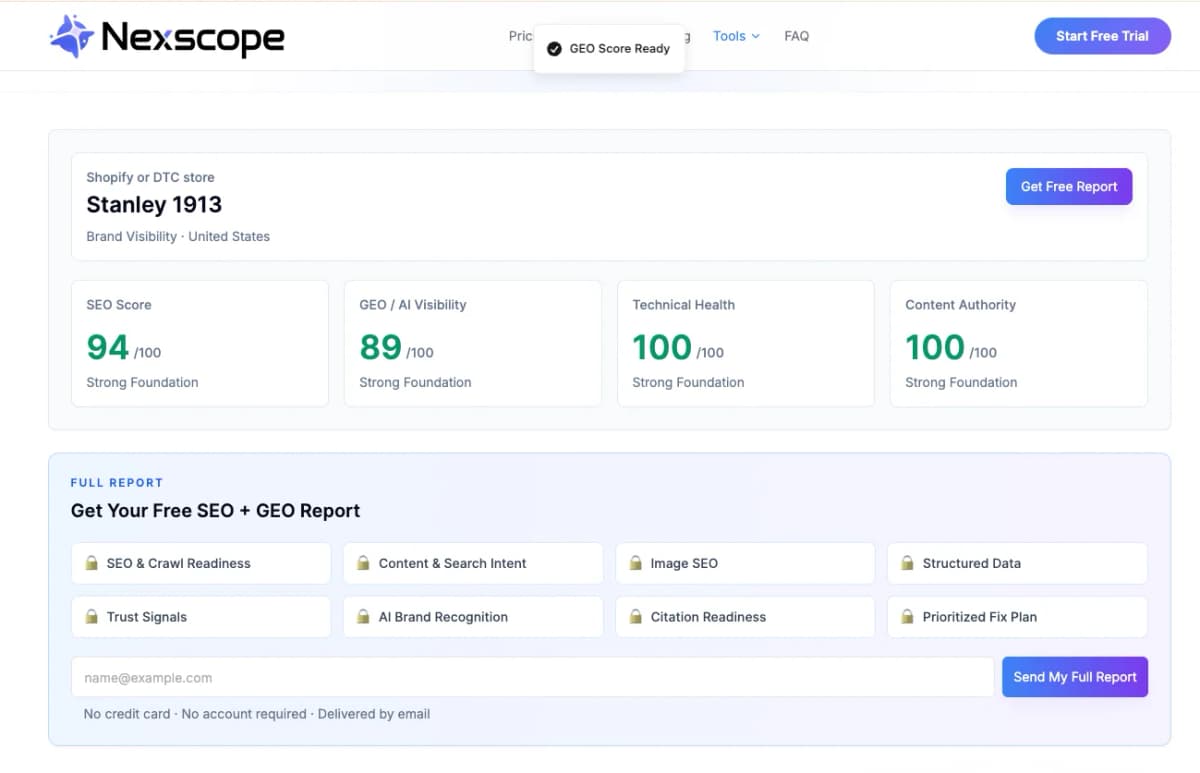
This distinction applies across ecommerce platforms. Amazon and other marketplace sellers can audit the listing evidence that is publicly accessible, while Shopify, DTC, TikTok Shop, Walmart, eBay, and other sellers can evaluate the product or store URLs they control. A weak GEO report can reveal missing structured data, thin use-case content, unclear policies, poor image metadata, or inaccessible product details. A detailed technical GEO workflow for Shopify stores can guide implementation when the seller controls the storefront templates and product data.
3. Make Product Data Complete and Machine-Readable
Structured product information helps search systems understand offers, variants, prices, availability, ratings, and identifiers. Google documents Product structured data and Merchant Center product attributes for this purpose. OpenAI also provides a merchant product discovery path where supported, making product data quality relevant beyond a single website.
For Shopify and DTC products, review:
- Product and Offer structured data
- GTIN, MPN, SKU, and brand fields
- Current price, currency, and availability
- Variant-level size, color, and material data
- Shipping cost and delivery information
- Return policy information
- Product images and descriptive alt text
- Merchant product feeds where available
For Amazon and marketplace products, focus on fields the seller can control:
- Accurate listing title and product type
- Complete bullets and specifications
- Correct variation relationships
- Clear A+ Content and comparison modules
- Consistent Brand Store information
- Stable identifiers and model names on external pages
Structured data improves clarity and eligibility for supported search features. Schema markup does not guarantee inclusion or recommendation in an AI answer. It reduces ambiguity and gives eligible systems a more reliable representation of the product.
4. Answer the Buyer Questions That Trigger Recommendations
Product pages often describe what an item is without explaining when it is the right choice. AI shopping questions are usually contextual, so recommendation-ready content should connect features to use cases and decision criteria.
Useful information includes:
- Who the product is designed for
- Which problems it solves
- When it performs better than common alternatives
- Important limitations or unsuitable scenarios
- Size, compatibility, material, and care requirements
- Budget position and total cost considerations
- What is included in the package
- Warranty, shipping, returns, and support
For example, "750 ml bottle with double-wall insulation" states a specification. "Keeps a full workday of water cold and fits standard vehicle cup holders" explains a use case. Both are useful. The second makes the feature easier to connect to a shopper's question.
This approach also supports making a Shopify store AI-ready because category, product, policy, and educational pages can answer different parts of the buying decision.
5. Publish Comparison and Decision-Stage Content
Comparison questions frequently appear in AI shopping conversations. A brand can help buyers and answer engines by publishing evidence-based content that explains meaningful differences.
Useful formats include:
- Product A vs Product B pages
- Best products for a specific use case
- Alternatives to a category leader
- Pros and cons pages
- Size, model, or feature comparisons
- Category buying guides
- Product FAQs based on pre-purchase objections
Strong comparison content includes a clear decision framework. It should compare the same criteria across every option, disclose meaningful limitations, and give different verdicts for different buyers. A single product does not need to win every scenario.
For instance, one travel backpack might be the best choice for laptop organization, while another fits airline personal-item limits more reliably. Clear scenario-based verdicts are easier to summarize than a page filled with general claims such as "premium," "innovative," or "best in class."
Include exact specifications, current pricing context, warranty differences, compatibility, and evidence supporting each verdict. Keep comparison pages updated when products, prices, or policies change.
6. Build Reviews, Citations, and Third-Party Evidence
Brand-owned pages explain the intended product position. Independent sources help validate whether the product performs as described. AI visibility reports can reveal which domains are repeatedly cited in category and comparison answers.
Useful evidence may come from:
- Verified marketplace and store reviews
- Independent product reviews
- Relevant category roundups
- Creator demonstrations with clear product details
- Retailer listings with accurate identifiers
- Specialist publications in the product category
- Customer case examples with specific use conditions
Quality matters more than volume. Generic directory submissions, copied press releases, or low-quality review pages add little decision value. Strong sources describe the exact product, discuss real criteria, and make claims that a buyer can verify.
Review mining can also uncover repeated strengths and objections. If buyers consistently praise easy cleaning but complain about lid durability, the product page and comparison content should address both points accurately. Transparent limitations can improve trust and help the right buyer select the product.
7. Keep Commercial Information Current
AI shopping answers become less useful when product information is stale. Maintain consistency across price, availability, shipping, return terms, variant status, and purchase URLs.
Important checks include:
- Remove discontinued variants from active feeds
- Update price changes across the site and marketplaces
- Keep availability synchronized where possible
- Use valid purchase URLs
- State regional shipping restrictions clearly
- Keep return windows and warranty terms current
- Update review and comparison pages after material product changes
A product should not appear available in one source and discontinued in another. Conflicting commerce data can weaken buyer confidence and create unreliable recommendation context.
How to Turn Visibility Findings Into Action
Prioritize the Gaps That Affect Recommendations
Once the baseline is clear, the next task is prioritization. Query-level visibility results show where a product disappears or loses to competitors. A page-readiness audit helps determine whether controlled product information is difficult to crawl, interpret, compare, or cite. The table below maps common patterns to the evidence worth reviewing and the next action to consider.
| Finding | What to review | Priority action |
|---|---|---|
| Product is absent from most AI answers | Query-level product visibility results | Check entity consistency, product discovery, crawl access, feeds, and external source coverage |
| Product appears but ranks below competitors | Competitor positions, comparisons, and cited sources | Study competitor positioning, comparisons, reviews, and source coverage |
| Product reaches the shortlist but rarely wins | Primary recommendation rate and losing queries | Clarify differentiators, buyer fit, proof, and scenario-based verdicts |
| Page has crawl or indexing weaknesses | Page accessibility and technical readiness | Fix status codes, canonicalization, robots rules, sitemaps, and accessible page content |
| Structured product information is incomplete | Product, offer, identifier, and policy fields | Add or repair eligible Product, Offer, review, policy, and organization data |
| Buyer-intent coverage is thin | Use cases, objections, comparisons, and FAQs | Add purchase-decision details for the queries the product loses |
| Citation readiness is weak | Claims, answer blocks, and supporting sources | Support claims and improve source-friendly page structure |
| One competitor dominates generic questions | Query results plus page and source evidence | Build category relevance, comparison evidence, and third-party authority around the losing intents |
Start with the highest-impact gap. A seller with almost no mentions should focus on product identity, accessibility, and source coverage before polishing minor copy details. A product with excellent mention coverage and weak primary recommendation performance needs a stronger reason to win.
The AI Product Visibility Tool can identify the queries, competitors, and citations behind the visibility gap. When the evidence points to the product page, listing, or store itself, the free GEO Score Checker can surface page-level readiness issues.
Prioritize by Platform and Control
Different sellers control different parts of the product footprint.
- Shopify and DTC brands can usually modify templates, structured data, product feeds, policy pages, comparison content, and technical access directly.
- Amazon sellers control listing content, A+ Content, Brand Stores, product details, and some external brand properties, while Amazon controls the marketplace template and crawl behavior.
- TikTok Shop sellers can improve product details, creator evidence, content demonstrations, and consistent external product information.
- Marketplace operators should focus on the fields and content they can change, then strengthen owned and third-party sources outside the marketplace.
The broader ecommerce AI search optimization workflow still supports store-level architecture. Product-level reporting adds the recommendation outcome needed to decide which items, queries, and competitors deserve attention first.
Retest Product Visibility After Optimization
Keep the Evaluation Scope Consistent
Retesting works best when the benchmark remains comparable. Use the same product identifier, target market, language, query set, and core model coverage when possible. Record the run date because AI answers and available web information change over time.
Compare:
- Mention rate
- Average recommended position
- Primary recommendation rate
- Discovery-query coverage
- Comparison-query wins
- Validation and purchase-advice performance
- Competitor mention and primary rates
- Cited domains and source gaps
- Differences between AI systems
Changes should be evaluated by query intent as well as the overall score. A product might improve in branded and comparison questions while remaining absent from generic discovery prompts. That result suggests better product understanding without enough category authority.
Retest after meaningful changes such as a product page rewrite, corrected structured data, a new merchant feed, major review growth, new editorial coverage, a pricing change, or a substantial comparison-content launch. Daily checks can create noise when the underlying product footprint has not changed.
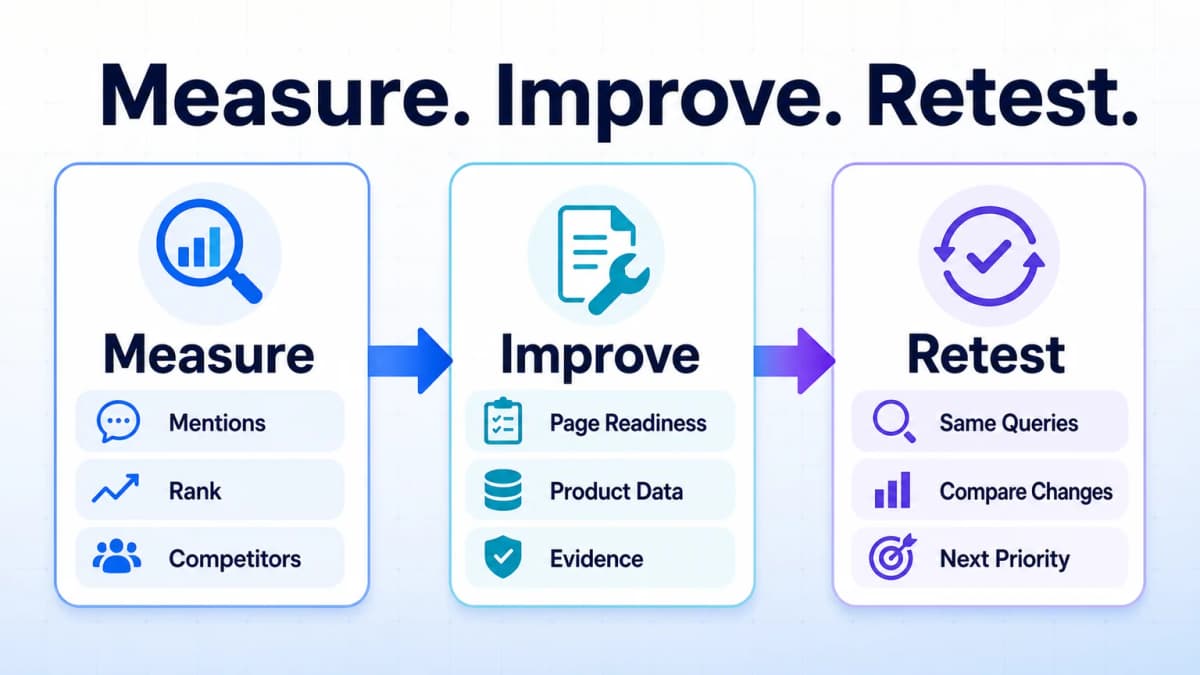
The goal is a repeatable improvement loop: measure, diagnose, improve, and verify. The report should guide the next decision rather than become a one-time score.
Common Mistakes to Avoid
Measurement Mistakes
- Testing only one branded prompt - A question that already includes the product name does not show generic discovery strength.
- Treating a mention as a recommendation - Presence in an answer says little about rank or first-choice ownership.
- Changing every variable between tests - New markets, languages, prompts, and models make before-and-after results difficult to compare.
- Ignoring query-level evidence - An overall score can hide important losses in discovery, comparison, or purchase-advice questions.
- Assuming every AI system behaves identically - Retrieval, source access, and answer composition can differ across platforms.
Optimization Mistakes
- Adding schema without fixing the underlying data - Structured markup should match visible product information and current commerce details.
- Publishing self-serving comparison pages - Unsupported claims and automatic first-place verdicts weaken credibility.
- Using different product identities across channels - Name and specification drift make entity resolution harder.
- Chasing low-quality mentions - Irrelevant directories and copied content rarely help buyers make a decision.
- Hiding limitations - Accurate suitability boundaries help the right shopper understand when the product fits.
- Making guarantee claims - No seller, agency, or tool can guarantee that ChatGPT will recommend a product.
Conclusion: See Where Your Product Ranks in AI Shopping
Getting a product recommended in ChatGPT Shopping starts with a clear baseline. Sellers need to know whether the product appears, where it ranks, which questions it wins, which competitors replace it, and which sources shape the answer. Page readability, structured commerce data, buyer-intent content, comparisons, reviews, and third-party evidence can then be improved in response to the actual gaps.
The free GEO Score Checker supports the page-level work by showing whether an ecommerce URL is easy to crawl, understand, summarize, and cite. The AI Product Visibility Tool measures the outcome that matters for this guide: whether the product is mentioned, ranked, cited, or selected as the primary recommendation across tested AI shopping questions.
Use the report as a snapshot and an action plan. Improve the signals that are under the seller's control, then retest the same buying intents to see what changed.
Check How Your Product Ranks in AI Shopping
Enter a product name, URL, or identifier to see whether AI shopping systems mention, rank, cite, or recommend it.
Check Your Product's AI Visibility →No coding required • Instant access
Frequently Asked Questions
How do I get my product recommended in ChatGPT Shopping?
Start by checking whether the product already appears in relevant AI shopping answers. Then review the questions it loses, the competitors that win, and the sources AI systems cite. Improve product identity, structured commerce data, buyer-intent content, comparisons, reviews, and page accessibility based on those gaps. Retest the same market and query set after meaningful changes. These actions can improve recommendation readiness, but no tactic guarantees a ChatGPT recommendation.
How can I check whether ChatGPT recommends my product?
Use a repeatable set of discovery, comparison, validation, alternatives, and purchase-advice questions. Track whether the product is mentioned, its average position, how often it becomes the primary recommendation, and which competitors appear instead. The Nexscope AI Product Visibility Tool automates this process across ChatGPT, Claude, Gemini, and DeepSeek and records query-level evidence, citations, and competitor performance.
What is the difference between a GEO score and AI product visibility?
A GEO score evaluates page readiness. It checks whether a product, store, listing, category, or homepage URL exposes accessible, structured, buyer-focused, and citation-friendly information. AI product visibility measures observed outcomes in tested AI answers, including mentions, recommended rank, primary recommendation rate, citations, and competitor appearances. The first helps diagnose page-level weaknesses. The second shows whether the product actually appears and competes in AI shopping responses.
Does Product schema make ChatGPT recommend a product?
Product structured data can make product attributes, offers, identifiers, prices, ratings, and availability easier for eligible systems to interpret. It does not guarantee inclusion or ranking in ChatGPT. Recommendation performance can also depend on query relevance, product-market fit, source availability, comparison evidence, reviews, commercial data, and the information available to the model at the time of the request.
Why does ChatGPT recommend a competitor instead of my product?
A competitor may match the buyer's use case more clearly, have stronger category associations, provide more consistent product data, receive better third-party coverage, or appear in sources that AI systems can retrieve and summarize. Use query-level results to identify which intents the competitor wins. Then compare product positioning, specifications, reviews, comparison content, citations, pricing context, and availability instead of assuming one missing keyword caused the loss.
Can Amazon products and Shopify products both be evaluated?
Yes. A product visibility check can start from a product name, URL, ASIN, or UPC/EAN identifier. Page-level GEO checks can also evaluate Shopify, DTC, marketplace, product, store, category, and homepage URLs when the page is accessible. Marketplace pages may expose less evidence to external crawlers, so the resulting page-readiness audit can be limited by what the marketplace makes available.
How often should a seller retest AI product visibility?
Retest after a meaningful change to the product's information footprint. Examples include a major product page rewrite, corrected structured data, updated merchant feeds, new comparison content, substantial review growth, new editorial coverage, or a pricing and availability change. Keep the target market, language, query set, and product identity consistent so the new report can be compared with the previous baseline.
Sources
- OpenAI. (2025). Introducing Shopping Research in ChatGPT. Retrieved from openai.com
- OpenAI. (2026). Power Product Discovery in ChatGPT. Retrieved from chatgpt.com
- Google Search Central. (2026). Intro to Product Structured Data on Google. Retrieved from developers.google.com
- Google Merchant Center. (2026). Product Data Specification. Retrieved from support.google.com
- Schema.org. (2026). Product. Retrieved from schema.org