

Is Temu a Scam Site? 7 Real Risks to Check Before Buying

Temu is cheap, aggressive, and everywhere. That is exactly why many shoppers search "is Temu a scam site" before placing an order. The short answer: Temu is not a fake website. It is a real online marketplace operated by Whaleco, part of the PDD Holdings commerce group. But a real marketplace can still create real buyer risk.
The better question is whether every product, seller, promotion, and refund experience on Temu deserves the same level of trust as a known retailer or a marketplace listing with strong seller history. This guide explains the main risks buyers should check and what ecommerce sellers can learn from Temu's rise.
Quick Answer: Is Temu a Scam Site?
Temu is not a scam site in the simple sense of being a fake storefront that takes money and disappears. It is a legitimate marketplace where many buyers receive products. Still, shoppers should treat it as a high-variance marketplace, not as a risk-free retailer.
The practical verdict:
- Temu is real.
- Some orders may be fine.
- Some products may disappoint.
- Certain categories deserve extra caution.
- Buyers should use stronger checks before ordering.
For ecommerce sellers, Temu is also a live case study in market pressure: low prices win attention, but trust problems can become a cost of growth.
Why People Think Temu Looks Like a Scam
Temu triggers suspicion because its shopping experience combines extreme discounts with heavy promotion. A product that looks like it should cost $30 may appear for $4, surrounded by coupons, countdowns, reward games, and app notifications.
That does not automatically mean fraud. Low prices can come from direct sourcing, thin margins, cross-border logistics, subsidies, simple packaging, or sellers competing for visibility. But shoppers are right to pause when pricing feels too good to be true, especially for products where quality, safety, or brand authenticity matters.
7 Real Risks Buyers Should Check Before Ordering
1. Product Quality Can Be Inconsistent
The biggest everyday risk is not that nothing arrives. It is that the item arrives and feels different from the photo. Materials, sizing, colors, stitching, packaging, or durability may not match the listing.
Before buying, look beyond the product image. Read recent reviews, filter for photos, check one-star complaints, and avoid products where all positive reviews sound generic.
2. Counterfeit or Lookalike Products May Appear
Temu is a marketplace, so buyers may encounter lookalike goods, copied designs, or listings that appear too close to known brands. In September 2025, the U.S. Federal Trade Commission announced a $2 million settlement with Whaleco, Inc., the operator of Temu, over alleged INFORM Consumers Act violations. The FTC said the case involved information and reporting tools intended to help consumers avoid and report stolen, counterfeit, or unsafe goods.
For buyers, the takeaway is simple: avoid anything that imitates a known brand at a suspiciously low price. For sellers, IP risk and brand protection are not abstract legal issues. They shape consumer trust and marketplace reputation.
This is also why sellers building a defensible ecommerce business should treat Amazon Brand Registry and IP monitoring as part of growth, not as paperwork to handle later.
3. Unsafe or Non-Compliant Products Are a Bigger Concern
Not all product categories carry the same risk. A cheap phone stand and a cheap baby toy are not the same kind of purchase.
On May 28, 2026, the European Commission said it fined Temu EUR200 million under the Digital Services Act. The Commission said Temu failed to properly assess and mitigate systemic risks related to illegal products on its platform, including the risk of consumers encountering illegal or non-compliant goods such as baby toys and small electronics.
That does not mean every product on Temu is unsafe. It means buyers should be more cautious with products where failure can harm people, damage property, or create health risks.
Be especially careful with:
- Baby products and children's toys
- Chargers, batteries, adapters, and electronics
- Cosmetics and skincare
- Food-contact items
- Protective gear
- Medical, wellness, or safety-related products
If a product should meet a safety standard, look for credible certifications, seller transparency, and reviews that mention real use.
4. Returns and Refunds Can Be Frictional
Temu publishes return and refund policies, and many buyers successfully return items. But a policy page is not the same as a smooth experience for every order.
Return outcomes can depend on item type, seller rules, packaging condition, timing, documentation, and support handling. To reduce friction, save screenshots of the product listing, delivery status, order page, and support messages. If the item is damaged or not as described, take photos before repackaging it.
5. Seller Information May Not Always Feel Transparent
Marketplace trust depends on knowing who is selling, what they are promising, and how to report a problem. When seller identity, contact information, or reporting options are hard to find, buyer confidence drops.
For ecommerce operators, this is one of the clearest Temu lessons. Transparency is not just compliance. It is a conversion asset. Strong seller pages, accurate descriptions, visible customer support, and consistent post-purchase handling all reduce hesitation.
6. Privacy and App Permission Concerns Are Part of the Trust Question
Some shoppers worry about Temu's app permissions, data practices, and tracking. A practical approach is better than panic: use the website if you do not want to install the app, limit app permissions, avoid saving unnecessary payment details, use payment methods with dispute protection, and turn off excessive notifications.
7. Fake Temu Giveaways and Phishing Scams Exist Outside Temu
Some "Temu scams" are not Temu listings at all. They are fake ads, phishing pages, giveaway messages, SMS links, or social media posts pretending to be Temu. Type the domain directly, use the official app store listing if downloading an app, and avoid logging in through links from suspicious messages.
How to Shop on Temu More Safely
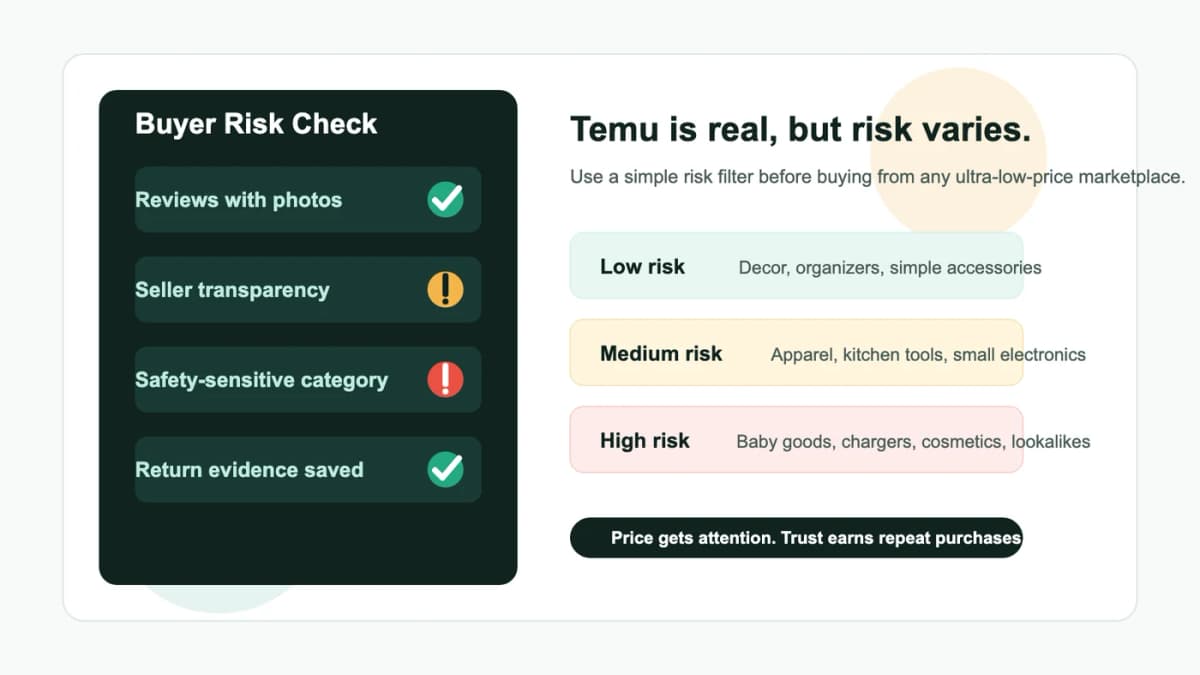
The safest way to use Temu is to match the purchase to the risk level. Low-risk items may include simple organizers, decorations, craft supplies, low-cost accessories, or novelty items. Medium-risk items include clothing, kitchen tools, and small electronics accessories. High-risk items include products for babies, charging, skin application, food contact, safety protection, health claims, or anything that appears to copy a protected brand.
Before buying, run five checks:
- Read recent negative reviews first.
- Look for customer photos, not only polished product images.
- Avoid obvious brand knockoffs.
- Use a payment method with dispute protection.
- Screenshot the listing if the product claim matters.
These checks will not remove every risk, but they reduce the chance of buying based only on price and polished images.
What Ecommerce Sellers Can Learn From Temu
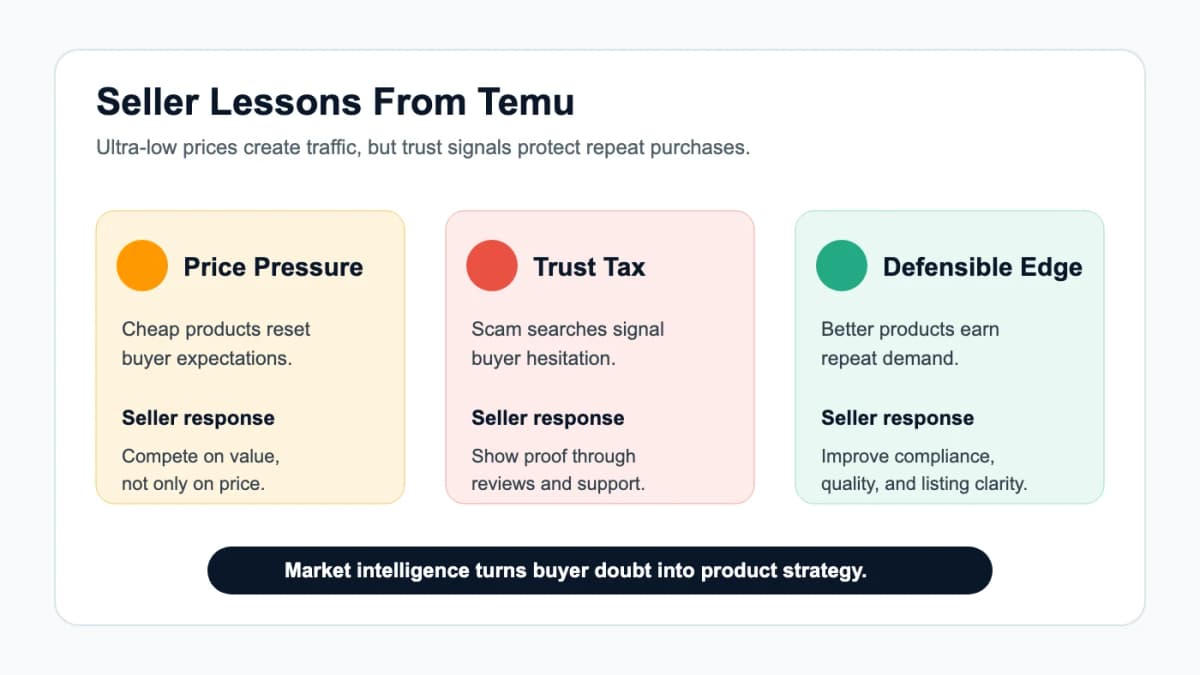
Temu's growth is not just a consumer story. It is a competitive signal for ecommerce sellers on Amazon, TikTok Shop, Shopify, Walmart, and other marketplaces.
The first lesson is obvious: price still matters. Buyers notice low prices immediately. The second lesson is more important: price does not eliminate the need for trust. If shoppers ask "is Temu a scam site," the platform has already paid a trust tax through hesitation, extra research, negative reviews, regulatory scrutiny, and lower confidence in certain categories.
Independent sellers should not try to win by becoming the cheapest version of Temu. A stronger strategy is to combine competitive pricing with clearer trust signals:
- Accurate product photos
- Real customer review mining
- Better product specifications
- Clear compliance claims
- Faster support
- Better packaging and instructions
- Clearer listing copy
This is where product research and review analysis matter. Sellers need to know which buyer complaints are price complaints, which are trust complaints, and which point to product gaps worth solving.
Temu also shows why AI tools for Amazon sellers are becoming more useful. When markets move quickly, sellers need faster ways to compare listings, extract review pain points, watch competitor claims, and validate whether a niche still has room for a better product.
Use Nexscope to Turn Marketplace Risk Into Product Research
Nexscope provides structured ecommerce data and focused seller workflows. Teams can use Nexscope's web tools directly or connect governed capabilities to their existing Agent through API, MCP, or Skills. Ready workflows include Keyword to Ads, Video Clone, and Buy Box Repricer.
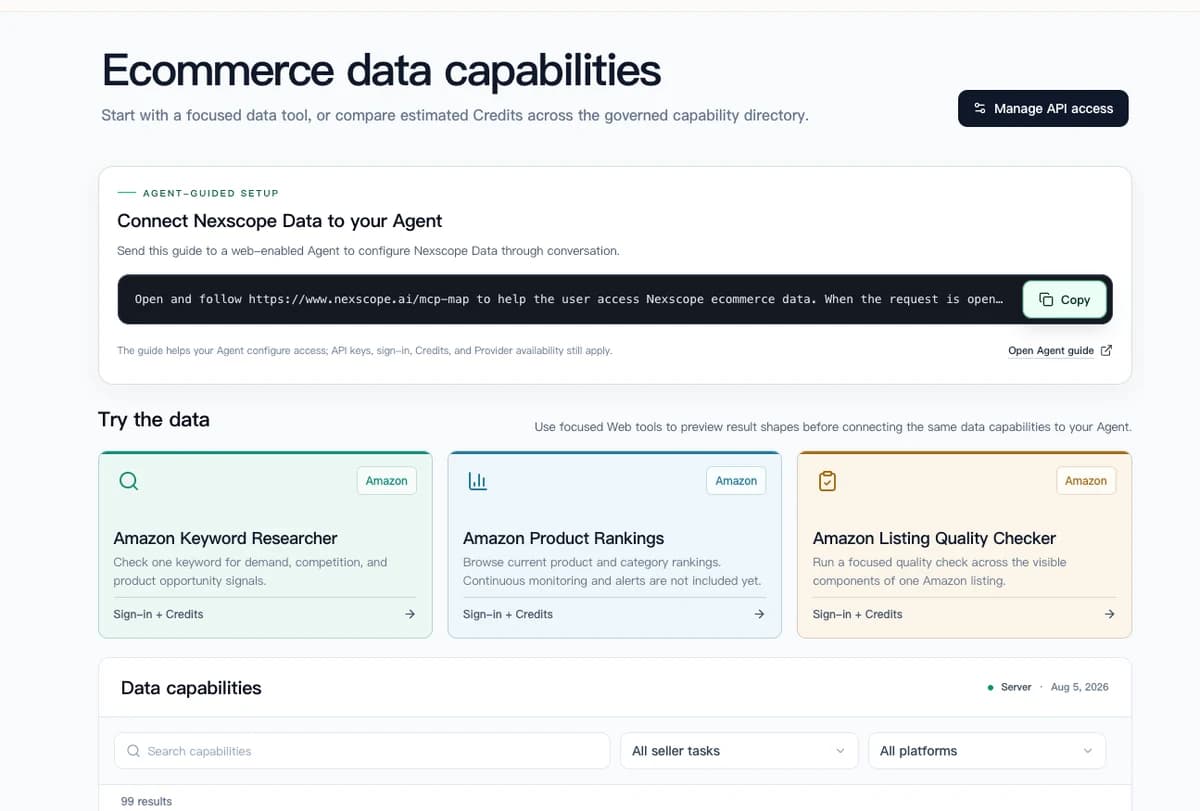
With Nexscope, ecommerce sellers can run plain-English workflows for Review Analysis, Product Research, Patent and IP Risk checks, Keyword Research, Market Research, Competitor Research, Product Sourcing, Pricing Analysis, Image Generation, and Video Generation.
For this topic, the most useful workflows are:
- Review Analysis to find buyer complaints that low-price products fail to solve
- Competitor Research to compare listing claims, pricing, reviews, and weak points
- Market Research to understand whether a niche is price-driven or trust-driven
- Patent and IP Risk checks before sourcing lookalike products
- Product Sourcing and Pricing Analysis to evaluate whether better quality can still leave margin
The opportunity is not to copy Temu's lowest-price strategy. It is to understand where buyers feel underserved, uncertain, or disappointed, then build products and listings that make the safer choice feel obvious.
Final Verdict: Temu Is Real, But Shop Carefully
So, is Temu a scam site? No, not in the basic sense. Temu is a real marketplace where many buyers receive real products. But it is also a marketplace with enough quality, safety, seller transparency, refund, privacy, and counterfeit concerns that shoppers should be selective.
For buyers, Temu is better suited to low-risk purchases than safety-sensitive products or branded goods that seem suspiciously cheap. For sellers, Temu is a reminder that low prices create attention, but trust creates durability. The brands that compete best against ultra-low-price platforms prove their value through clearer listings, better reviews, safer products, stronger compliance, and more reliable post-purchase experiences.
Connect Ecommerce Data to Your Agent
Use Nexscope through API, MCP, or Skills, or open a ready seller workflow.
Explore Ecommerce Data →1,000 free credits • API, MCP & Skills
Frequently Asked Questions
Is Temu a scam site?
Temu is not a fake scam site. It is a real online marketplace. However, buyers should still be cautious because product quality, seller reliability, safety compliance, and refund experiences can vary.
Is Temu safe to buy from?
Temu can be safe for some low-risk purchases, but buyers should use extra caution with children's products, electronics, cosmetics, food-contact items, branded lookalikes, and anything with safety implications.
Why is Temu so cheap?
Temu's low prices can come from direct sourcing, seller competition, lightweight packaging, marketplace subsidies, cross-border logistics, and thin margins. Low price does not always mean fraud, but it can mean trade-offs in quality, support, or consistency.
Can you get fake products on Temu?
Marketplace shoppers may encounter lookalike or potentially counterfeit products. Avoid obvious brand imitations, suspiciously cheap branded goods, and listings where the seller information or reviews look weak.
Does Temu have a real return policy?
Yes, Temu publishes return and refund policies. The actual experience may vary by product, timing, documentation, and support handling, so buyers should save screenshots, photos, and order records.
Is the Temu app safe for privacy?
Privacy concerns are part of Temu's trust debate. Buyers who are uncomfortable can use the website, limit app permissions, avoid saving unnecessary payment details, and turn off promotional notifications.
What should ecommerce sellers learn from Temu?
Sellers should learn that low prices win attention, but trust wins repeat purchases. Product quality, reviews, compliance, transparent listings, and reliable support can become competitive advantages against ultra-low-price marketplaces.
Sources
- Federal Trade Commission: Online Marketplace Temu to Pay $2 Million Penalty for Alleged INFORM Act Violations
- European Commission: Commission fines Temu EUR200 million for breaching the Digital Services Act
- Better Business Bureau: Temu.com complaints profile
- Temu: Return and Refund Policy
- PDD Holdings: Annual Reports