

AI Agents vs E-commerce Agencies: What Actually Works in 2026

E-commerce sellers face a familiar dilemma: hire an agency or figure it out yourself.
For years, the answer was straightforward—if you had the budget, agencies handled your PPC, listing optimization, and marketing. If you didn't, you learned the hard way.
But 2026 introduced a third option. AI agents now perform many tasks that agencies charge thousands for. They run 24/7, cost a fraction of agency retainers, and don't need onboarding calls.
Does that mean agencies are obsolete? Not exactly. This comparison breaks down what each option actually delivers—and when you might need both.
What Is an E-commerce Agency?
An e-commerce agency is an external team you hire to manage parts of your online business. They typically specialize in specific platforms (Amazon, Shopify, TikTok Shop) or services (PPC, SEO, creative).
Common Agency Services
PPC & Advertising Management
- Amazon Sponsored Products, Brands, Display
- Google Shopping and Performance Max
- Meta (Facebook/Instagram) ads
- TikTok Ads Manager campaigns
Listing & Content Optimization
- Product titles, bullet points, descriptions
- A+ Content / Enhanced Brand Content
- Keyword research and backend optimization
- Product photography direction
Strategy & Consulting
- Market analysis and competitive research
- Launch planning and promotions
- Account health and compliance
- Brand building and positioning
Operations Support
- Inventory planning recommendations
- Customer service playbooks
- Review management strategies
Typical Agency Pricing
| Service Type | Monthly Cost | Additional Fees |
|---|---|---|
| Full-service Amazon management | $3,000–$10,000 | 10–15% of ad spend |
| PPC-only management | $1,000–$5,000 | 10–20% of ad spend |
| Listing optimization (project) | $500–$2,000 | Per ASIN |
| SEO/Content marketing | $2,000–$7,000 | — |
| Social media management | $1,000–$7,000 | — |
Most agencies require 3–6 month minimum contracts. Some charge setup fees of $1,000–$5,000.
What Is an AI Agent?
An AI agent is software that performs tasks autonomously using artificial intelligence. Unlike simple automation tools that follow rigid rules, AI agents understand context, make decisions, and adapt to new situations.
How AI Agents Differ from Traditional Tools
| Traditional Tools | AI Agents | |
|---|---|---|
| Rules | Pre-programmed, fixed | Learns and adapts |
| Input | Structured data only | Natural language, images, documents |
| Decisions | If-then logic | Contextual reasoning |
| Edge cases | Breaks or escalates | Attempts to solve |
| Setup | Complex configuration | Conversational |
What AI Agents Can Do for E-commerce
Research & Analysis
- Product research across marketplaces
- Competitor monitoring and pricing analysis
- Keyword research and search volume trends
- Review analysis and sentiment tracking
Content Creation
- Product descriptions and bullet points
- A+ Content copywriting
- Social media posts and ad copy
- Email marketing sequences
Advertising Operations
- Campaign structure recommendations
- Bid adjustments based on performance
- Negative keyword identification
- Budget allocation suggestions
Customer Intelligence
- Review summarization and insights
- Common complaint identification
- Feature request tracking
- Competitor review analysis
Reporting & Monitoring
- Daily/weekly performance summaries
- Anomaly detection and alerts
- Cross-channel data aggregation
- Custom report generation
Typical AI Agent Pricing
| Tool Type | Monthly Cost | Notes |
|---|---|---|
| General AI assistants (ChatGPT, Claude) | $20–$200 | Per seat |
| E-commerce specific AI platforms | $50–$500 | Based on usage/features |
| Custom AI agent solutions | $200–$2,000 | Enterprise features |
No contracts required. Cancel anytime.
Side-by-Side Comparison
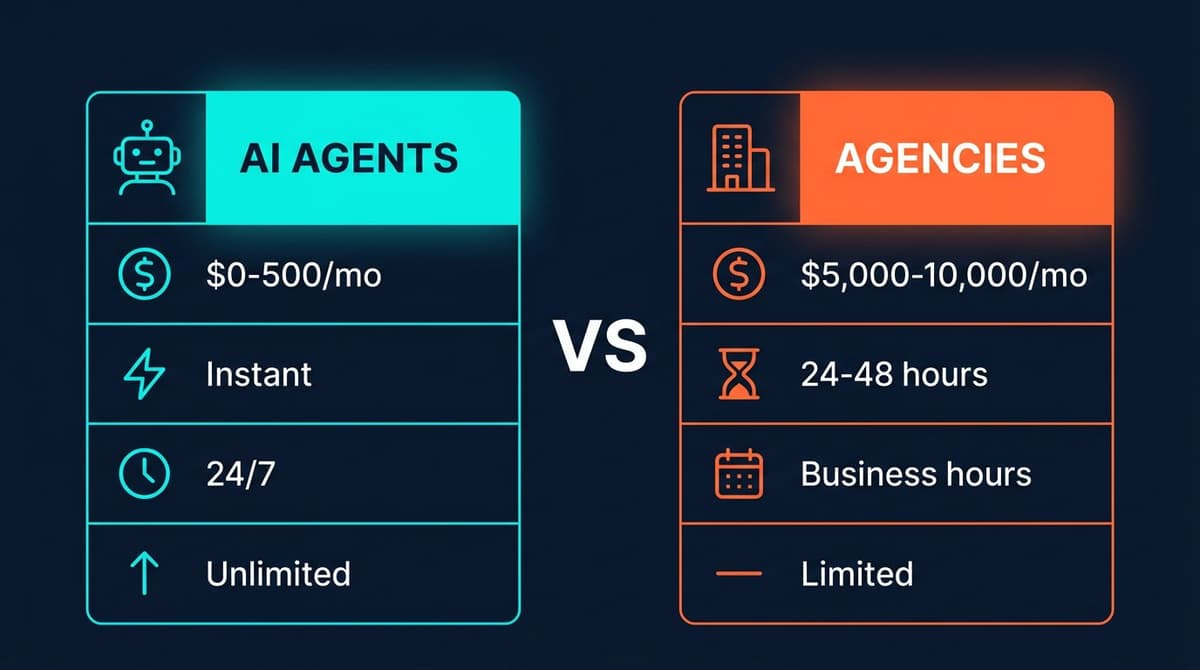
Cost
| Factor | Agency | AI Agent |
|---|---|---|
| Monthly minimum | $1,000–$10,000 | $20–$500 |
| Ad spend fees | 10–20% of spend | None |
| Setup/onboarding | $1,000–$5,000 | Usually free |
| Contract length | 3–6 months | Month-to-month |
| Annual cost (typical) | $24,000–$150,000 | $240–$6,000 |
Winner: AI Agents — 10–50x cheaper for comparable task coverage.
Speed & Availability
| Factor | Agency | AI Agent |
|---|---|---|
| Response time | 24–48 hours | Instant |
| Availability | Business hours | 24/7/365 |
| Turnaround (simple tasks) | 1–3 days | Minutes |
| Turnaround (complex projects) | 1–4 weeks | Hours to days |
Winner: AI Agents — No waiting for account managers to respond.
Expertise & Quality
| Factor | Agency | AI Agent |
|---|---|---|
| Platform-specific knowledge | Deep (usually specialized) | Broad but less deep |
| Strategic thinking | Human judgment, experience | Pattern-based recommendations |
| Creative direction | Original concepts | Variations on existing ideas |
| Industry relationships | Insider access (Amazon reps, etc.) | None |
| Adaptability to changes | Slower (meetings, approvals) | Faster (immediate updates) |
Winner: Agencies — Human expertise still matters for strategy and relationships.
Scalability
| Factor | Agency | AI Agent |
|---|---|---|
| Adding new products | More cost, more time | Same cost, minimal time |
| Adding new channels | Usually requires new agency | Same tool, new prompts |
| International expansion | Specialist agencies needed | Multi-language capable |
| Peak season handling | Capacity constraints | Unlimited capacity |
Winner: AI Agents — Scale without proportional cost increases.
Accountability
| Factor | Agency | AI Agent |
|---|---|---|
| Performance guarantees | Sometimes (with caveats) | None |
| Error responsibility | Shared/negotiated | You own it |
| Communication | Account managers | Self-directed |
| Course correction | Meetings, discussions | Immediate adjustments |
Winner: Agencies — Someone to call when things go wrong.
When to Choose an Agency
Agencies still make sense in specific situations:
1. You're Launching a New Brand
New brands need strategic positioning, not just task execution. Agencies bring experience from dozens of launches—they know what works and what doesn't.
2. You're Spending $50K+/Month on Ads
At high ad spend levels, a 10% improvement in ROAS from expert management easily covers agency fees. The math changes when real money is on the line.
3. You Need Platform Relationships
Top agencies have direct contacts at Amazon, Meta, and TikTok. When your account gets suspended or you need early access to new features, those relationships matter.
4. You Want Someone Accountable
If a campaign fails, you can have a conversation with your agency. AI agents don't attend performance reviews or explain what went wrong.
5. Creative Strategy Is Critical
AI can write variations, but it struggles with truly original creative direction. If your brand depends on standout creative, human strategists still lead.
When to Choose AI Agents
AI agents excel in different scenarios:
1. You're Budget-Constrained
If agency fees would consume your entire marketing budget, AI agents let you compete. A solo seller spending $100/month on AI tools can accomplish what previously required $3,000/month in agency fees.
2. You Need Speed
Waiting 48 hours for a keyword report kills momentum. AI agents deliver research, content drafts, and analysis in minutes—not days.
3. You're Managing Multiple Products
Agencies charge per ASIN or per project. AI agents handle 10 products or 10,000 products at the same cost. High-SKU catalogs benefit dramatically.
4. You Want Control
Some sellers prefer making their own decisions with better data rather than delegating to agencies. AI agents inform without taking over.
5. Your Tasks Are Repetitive
Competitor price monitoring, review tracking, keyword updates—these recurring tasks are perfect for AI automation. Agencies would charge hourly rates for the same work.
The Hybrid Approach
The smartest sellers in 2026 aren't choosing one or the other—they're combining both.
How the Hybrid Model Works
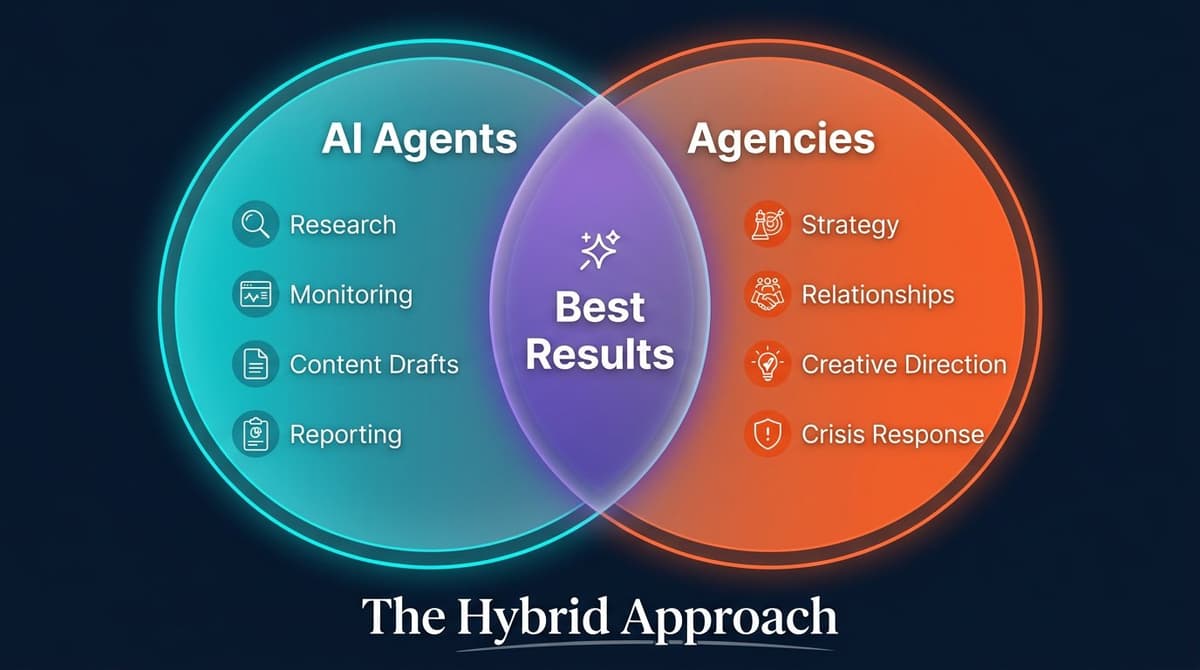
AI agents handle: - Daily monitoring and alerts - First-draft content creation - Research and data gathering - Routine optimizations - Reporting and analysis
Agencies handle: - Strategic planning and positioning - High-stakes campaign management - Platform relationship management - Creative direction - Crisis response
Example: A $500K/Year Amazon Seller
Before (Agency Only): - Full-service agency: $5,000/month - Ad spend fee (15% of $20K): $3,000/month - Total: $8,000/month ($96,000/year)
After (Hybrid): - AI tools for research, monitoring, content drafts: $200/month - PPC-focused agency (reduced scope): $2,000/month - Ad spend fee (10% of $20K): $2,000/month - Total: $4,200/month ($50,400/year)
Savings: $45,600/year — while maintaining expert oversight on what matters most.
Making the Decision
Start with AI Agents If:
- Your monthly revenue is under $50,000
- You're comfortable learning and iterating
- Speed matters more than hand-holding
- You have more time than money
Start with an Agency If:
- You're scaling past $100,000/month
- You've already tried DIY and hit a ceiling
- You need strategic guidance, not just execution
- You value accountability over cost savings
Consider Hybrid If:
- You're between $50K–$500K/month
- You want to reduce agency costs without losing expertise
- You're willing to manage multiple tools and relationships
- You want the best of both worlds
Conclusion
The "AI agents vs agencies" question has no universal answer. Both serve different needs, and the right choice depends on your business stage, budget, and goals.
What's clear: AI agents have permanently changed the equation. Tasks that once required agency intervention—research, content drafts, monitoring, reporting—can now happen instantly at a fraction of the cost.
Agencies aren't going away. But they're evolving from "do everything" partners to strategic specialists who handle what AI can't: relationships, judgment calls, and creative vision.
The sellers winning in 2026 aren't loyal to either option. They're pragmatic—using AI agents for speed and scale, and agencies for expertise that justifies the premium.
Want to See AI Agents in Action?
Nexscope provides structured ecommerce data that can be used in focused web tools or connected to an existing Agent through API, MCP, or Skills.
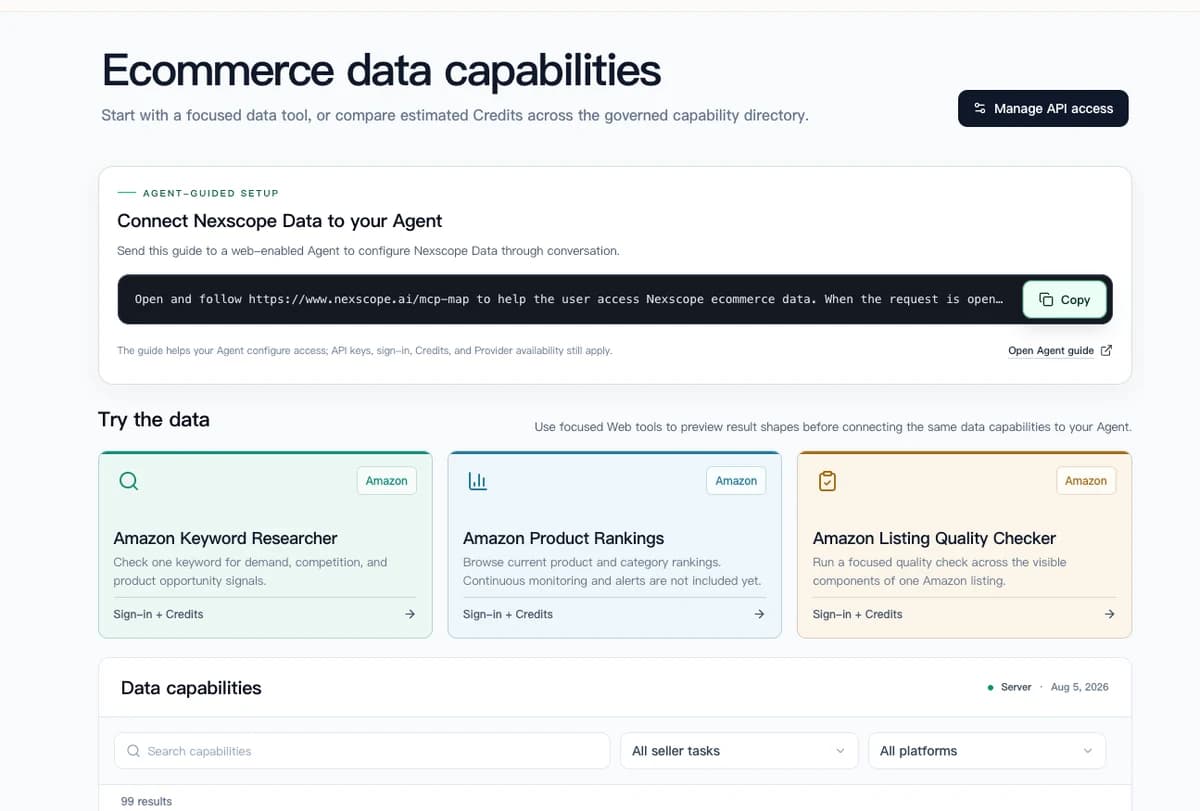
Connect Ecommerce Data to Your Agent
Use Nexscope through API, MCP, or Skills, or open a ready seller workflow.
Explore Ecommerce Data →1,000 free credits • API, MCP & Skills
FAQs
Can AI agents completely replace an e-commerce agency?
For some sellers, yes—especially those under $50K/month in revenue or with straightforward product lines. But AI agents struggle with strategic thinking, platform relationships, and truly original creative work. Most growing brands benefit from some human expertise, even if AI handles the bulk of daily tasks.
How much can I save by switching from an agency to AI agents?
Typical savings range from 50–90% on equivalent task coverage. A seller paying $5,000/month for agency services might accomplish similar outputs with $200–500/month in AI tools. However, the comparison isn't always apples-to-apples—agencies provide accountability and strategic guidance that AI currently can't match.
Are AI agents reliable enough for business-critical tasks?
AI agents are highly reliable for research, analysis, and content drafting. For execution tasks (actually running ads, changing listings), most sellers still prefer human oversight. Use AI agents to inform decisions and create first drafts, then review before implementing.
What's the learning curve for AI agents?
Most e-commerce AI tools are designed for non-technical users. If you can describe what you want in plain English, you can use AI agents effectively. Expect 1–2 weeks to get comfortable, compared to 1–3 months to fully onboard with an agency.
Should I fire my agency and switch to AI?
Not necessarily. Consider reducing agency scope first—let AI handle research and content while your agency focuses on high-value strategic work. This hybrid approach often delivers better results than going all-in on either option.
What tasks should I never delegate to AI agents?
Avoid using AI for final decisions on pricing strategy, brand positioning, and high-stakes negotiations. Also be cautious with customer-facing communication that requires empathy or nuance. AI excels at preparation and analysis; humans should handle judgment calls.
Sources
- WebFX: Ecommerce Marketing Pricing
- Stryde: How Much Does an Ecommerce Marketing Agency Cost?
- OpenStore: Marketing Agency Costs for E-commerce
- Alhena: AI Agents for Ecommerce Performance Analysis
- Commercetools: AI Trends Shaping Agentic Commerce in 2026