

10 Best Amazon Seller Forums and Communities to Join in 2026

Amazon seller forums can shorten the distance between a difficult question and a practical answer. Sellers use these communities to compare account-health experiences, understand FBA workflows, discuss advertising problems, and learn how other operators handle changes across Amazon.
The quality of that advice varies. Some groups are public and beginner-friendly. Others screen members by revenue, business ownership, or experience. Fast-moving chat groups are useful for current issues, while structured forums are easier to search months later. Sellers also need to separate peer experience from official Amazon policy before changing an account, listing, price, or campaign. That makes community selection part of responsible marketplace risk management.
This guide compares 10 active Amazon seller communities available in 2026. Each entry includes a verified community link, the audience it serves, its access model, and the situations where it is most useful. All links were checked on July 24, 2026, but private-group and invitation links can still change after publication.
What Are Amazon Seller Forums?
Amazon seller forums are online spaces where marketplace sellers share questions, operating experiences, and possible solutions. They range from Amazon's own Seller Forums to independent discussion boards, social media groups, Discord servers, Telegram groups, and paid communities for established founders.
The format affects how sellers use the information. A searchable forum is useful for recurring problems such as stranded inventory, variation policy, listing suppression, or FBA reimbursement. A chat group can surface a sudden issue quickly, but useful answers may disappear inside a busy conversation. A vetted paid community may offer more experienced peers, though access requirements and fees limit who can participate.
A seller forum is a peer resource, not a replacement for Seller Support, Account Health Support, legal advice, or Amazon's published policies. Amazon states that Seller Forums can crowdsource advice, while Selling Partner Support remains the primary contact for operational account issues.
Why Join Seller Communities?
Amazon sellers often face problems that are difficult to diagnose from a single dashboard notification. Community discussions can reveal whether an issue is isolated, related to a policy update, or affecting multiple sellers.
Useful reasons to join include:
- Operational problem solving: Compare experiences involving FBA shipments, reimbursements, listing errors, returns, or account health.
- Policy awareness: Notice emerging enforcement patterns, then confirm them against Amazon's official documentation.
- Advertising feedback: Discuss search terms, campaign structure, placement performance, and broader Amazon PPC strategy.
- Listing improvement: Learn how other sellers diagnose suppressed content, category requirements, and listing optimization problems.
- Peer support: Connect with operators who understand inventory risk, cash-flow pressure, seasonality, and marketplace uncertainty.
- Professional networking: Meet potential service providers, partners, hires, or other founders without relying on cold outreach.
Community participation works best when sellers arrive with a clear question, relevant evidence, and a willingness to contribute. Detailed questions usually attract better answers than broad requests for a complete business strategy.
10 Best Amazon Seller Forums
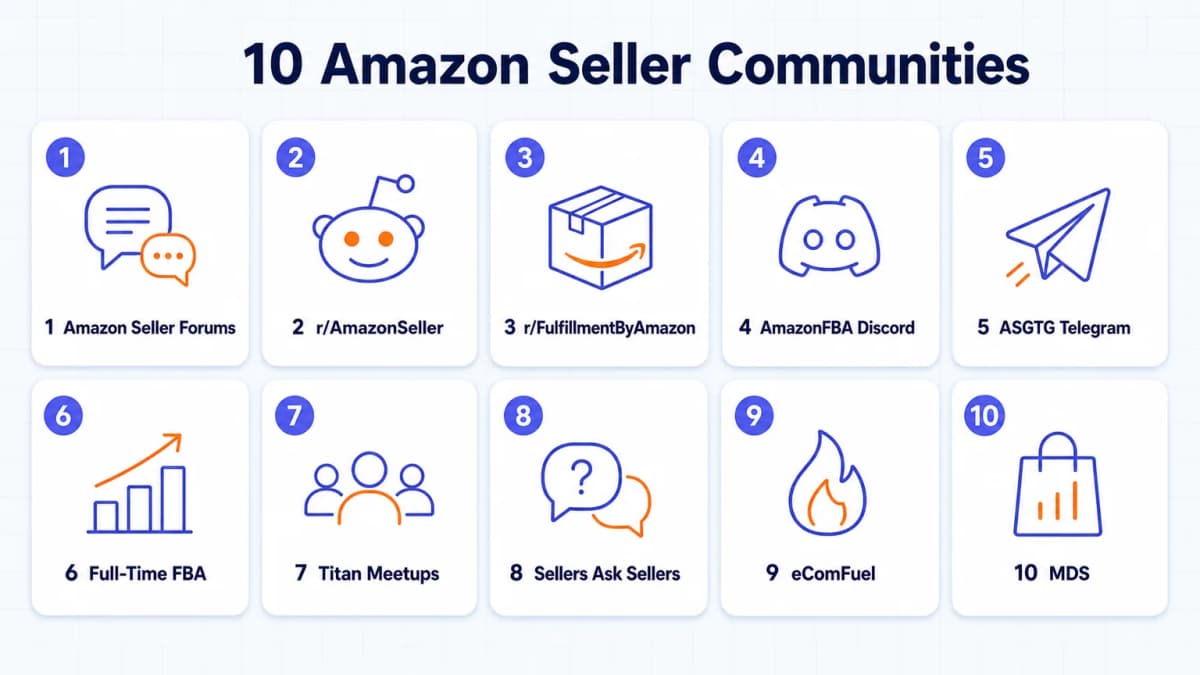
The list below favors communities with a working official page, a verifiable group destination, or recent public activity. It excludes generic WhatsApp groups and unverified invite links because ownership, moderation, and link safety could not be confirmed.
| Community | Access | Best For | Main Limitation |
|---|---|---|---|
| Amazon Seller Forums | Free; active Seller Central account required to post | Official context and account-related discussions | Peer answers are not binding policy |
| r/AmazonSeller | Free | General questions and mixed experience levels | Strict rules and uneven answer quality |
| r/FulfillmentByAmazon | Free | Intermediate and advanced FBA discussions | Basic questions may be removed |
| AmazonFBA Discord | Free invitation | Fast topic-based chat | Conversations are harder to search |
| ASGTG Telegram | Free invitation | Urgent notices and account-health discussion | High message volume |
| Full-Time FBA | Free Facebook group | Beginners, resellers, and peer encouragement | Facebook account required |
| Titan Meetups | Free | Local and in-person networking | Availability varies by location |
| Sellers Ask Sellers | Free | Independent, searchable marketplace help | Covers more than Amazon |
| eComFuel | Paid and vetted | Seven- and eight-figure store owners | High revenue and ownership requirements |
| MDS | Paid and vetted | Seven- to nine-figure ecommerce founders | High membership cost |
1. Amazon Seller Forums
Amazon Seller Forums is the strongest starting point for discussions tied directly to selling in Amazon's store. The forum includes categories for account setup, listings, FBA, inventory, product safety, Brand Registry, advertising, account health, returns, and Amazon announcements.
Amazon Community Managers moderate discussions and sometimes respond or connect sellers with the appropriate resources. Forum content is publicly readable, but only sellers with an active Seller Central account can create discussions or post replies.
Best for:
- Account-health and listing-policy discussions
- Reading responses from Amazon Community Managers
- Searching previous discussions before opening a support case
- New sellers learning the vocabulary of Seller Central
Limitation: A reply from another seller is still peer advice. Policy-sensitive actions should be checked against Seller Central documentation or confirmed through the appropriate Amazon support channel.
2. r/AmazonSeller
r/AmazonSeller is a broad Reddit community for people selling on Amazon. Discussions cover account setup, wholesale, private label, retail arbitrage, invoices, listing restrictions, returns, and common operational mistakes.
The community can be useful for seeing how other sellers interpret an issue, especially when a question affects several business models. Moderators enforce rules around spam, self-promotion, deceptive practices, and prohibited behavior. Sellers should read the subreddit rules before posting.
Best for:
- General Amazon selling questions
- Beginner and intermediate perspectives
- Candid discussion of mistakes and operational tradeoffs
- Searching historical threads without joining a private group
Limitation: Reddit answers vary in quality. Sensitive account information, supplier documents, case IDs, and customer data should never be posted publicly.
3. r/FulfillmentByAmazon
r/FulfillmentByAmazon focuses more narrowly on Amazon FBA. The community describes itself as a place for intermediate and advanced discussion, and its moderation favors detailed questions over basic topics that can be answered through documentation or a simple search.
Topics commonly include PPC, listing optimization, logistics, inventory, private label, supply chain, and advanced FBA operations. That focus can produce more useful discussions for experienced sellers, but new sellers may find the posting requirements stricter.
Best for:
- Intermediate and advanced FBA operations
- Private-label and logistics discussions
- Detailed troubleshooting with supporting context
- Sellers who already understand basic FBA costs
Limitation: Low-context posts and basic questions may be removed. Sellers should search the subreddit and prepare specific evidence before posting.
4. AmazonFBA Discord
The AmazonFBA Discord provides a faster chat format connected with the broader FBA community. Its verified invitation page showed more than 32,000 members when checked in July 2026.
Separate channels cover topics such as PPC, listing optimization, logistics, jobs, advanced FBA, and general discussion. The channel structure makes it easier to keep conversations focused compared with a single large group chat.
Best for:
- Fast questions and real-time conversation
- Topic-specific FBA channels
- Sellers who prefer chat over traditional forums
- Networking with sellers across time zones
Limitation: Chat messages move quickly and can be difficult to reference later. Important instructions should be saved and verified before implementation. Discord invitations can be changed or revoked by community administrators.
5. ASGTG Telegram
Amazon Sellers - ASGTG is the original general Amazon seller group operated by ASGTG. The verified Telegram destination identifies the group directly and includes discussions about general Amazon issues.
ASGTG also maintains an Amazon Sellers Important Info broadcast channel for urgent notices and weekly summaries. The discussion group is better for peer interaction, while the broadcast channel is better for scanning updates.
Best for:
- Fast-moving Amazon issue discussions
- Account-health and suspension-related awareness
- Urgent notices and operational updates
- Experienced sellers comfortable with high-volume chat
Limitation: Telegram groups can attract spam or unsolicited private messages. Sellers should confirm administrator identities and avoid sharing login credentials, one-time codes, bank information, or sensitive case documents.
6. Full-Time FBA
The Full-Time FBA Facebook group is a free community for sellers who want to grow an Amazon business with part-time working hours. The official link redirects to the group's Facebook destination.
The community includes sellers at different stages, from beginners and side-hustle operators to experienced resellers. Its public materials emphasize encouragement, practical questions, and participation rather than passive promotion.
Best for:
- Beginners learning FBA and resale workflows
- Retail and online arbitrage discussion
- Peer encouragement and accountability
- Sellers who prefer a moderated Facebook group
Limitation: Access requires a Facebook account and approval. Advice may lean toward the group's resale and part-time operating perspective, which may not fit every private-label or brand-owner model.
7. Titan Meetups
Amazon Seller Meetups powered by Titan Network combines an online community with free local networking events. The program is designed for sellers at different levels, including new operators and sellers running seven-figure businesses.
The official site lists meetup coverage across the United States, Canada, the United Kingdom, the United Arab Emirates, Australia, and New Zealand. Its value comes from live conversation and regional relationships rather than a large searchable archive.
Best for:
- Local Amazon seller networking
- In-person conversations with experienced operators
- Regional contacts and service-provider discovery
- Sellers who learn better through live discussion
Limitation: Meetup availability depends on location and scheduling. Sellers should confirm the latest event details on the official site before making travel plans.
8. Sellers Ask Sellers
Sellers Ask Sellers is a free, independent ecommerce forum run as a peer self-help community. It is not affiliated with Amazon, eBay, Walmart, or another marketplace.
The forum covers Amazon as well as other selling channels, which can help merchants compare marketplace policies and operational patterns. Discussions are organized in a searchable forum structure, and recent topics showed current activity when checked in July 2026.
Best for:
- Independent seller-to-seller discussion
- Searchable troubleshooting threads
- Multichannel merchants
- Sellers who want an alternative to platform-owned forums
Limitation: The wider marketplace scope means not every discussion is Amazon-specific. Any advice involving Amazon policy still requires confirmation through Amazon's official resources.
9. eComFuel
eComFuel is a private, paid community for owners of seven- and eight-figure ecommerce businesses. Its primary value is a vetted discussion forum, member directory, software and agency reviews, and operator events.
Current requirements include ownership of at least 25% of a qualifying ecommerce business. Amazon-only businesses must generate at least $2.5 million in annual revenue. Current membership pricing is $199 per month for seven-figure businesses and $299 per month for eight-figure businesses, billed quarterly after a $1 trial period.
Best for:
- Established ecommerce owners
- Vetted operator discussions
- Software, agency, hiring, and scaling decisions
- Founders seeking a searchable private knowledge base
Limitation: The revenue threshold, ownership requirement, vetting process, and membership fee exclude most new Amazon sellers.
10. Million Dollar Sellers
Million Dollar Sellers is a paid community for ecommerce founders and operators with at least $1 million in trailing twelve-month revenue. It covers Amazon-led brands, DTC businesses, TikTok Shop operators, retail, and omnichannel brands.
The official site describes a peer-vetting process, online groups, local chapters, weekly sessions, events, a private app, and a library of member-created resources. Current pricing is $1,995 per quarter or $7,497 per year, with a 60-day refund period.
Best for:
- Seven- to nine-figure ecommerce founders
- High-level operational and leadership discussions
- Local chapters, events, and peer networking
- Amazon brands expanding into multiple channels
Limitation: MDS is designed for established founders. The revenue requirement and annual cost make it unsuitable for most early-stage sellers.
Free vs. Paid Communities
Free and paid communities solve different problems. A free forum offers reach, varied perspectives, and a low barrier to entry. A paid group trades reach for screening, privacy, and a higher concentration of experienced operators.
Free Community Strengths
- Large archives of common seller questions
- Access for beginners and small businesses
- Multiple viewpoints across business models
- Low-risk way to evaluate community participation
Free Community Limits
- Inconsistent answer quality
- More spam and self-promotion
- Limited context about a contributor's experience
- Greater privacy risk on public platforms
Paid Community Strengths
- Vetted membership
- Higher concentration of experienced founders
- Private discussions about teams, finance, vendors, and scaling
- Structured events, directories, and curated resources
Paid Community Limits
- Membership fees
- Revenue or ownership requirements
- Smaller pools of perspectives
- Value depends on active participation
New sellers usually gain more from one or two well-moderated free communities than from paying for an advanced founder network too early. A paid group becomes more relevant when a business faces specialized problems involving team building, international expansion, capital allocation, acquisitions, or multichannel growth.
Common Seller Forum Topics
Seller communities repeatedly discuss the same operational areas:
- Account health: Policy warnings, deactivations, appeals, verification, and performance notifications
- FBA operations: Shipment creation, receiving delays, reimbursements, returns, storage, and removal orders
- Listings: Suppression, category approval, variations, images, keywords, and content compliance
- Advertising: Search terms, bids, placements, campaign structure, and wasted spend
- Inventory: Forecasting, stockouts, restock decisions, stranded inventory, and seasonal planning
- Product research: Demand, competition, reviews, pricing, differentiation, and sourcing risk
- Brand protection: Brand Registry, intellectual property complaints, counterfeit reports, and unauthorized sellers
- Business operations: Hiring, agencies, software, cash flow, taxes, and international expansion
These topics also appear in official documentation, specialized tools, and professional services. Community discussion is most valuable when it helps a seller frame the right question and identify evidence to collect.
Choosing the Right Community
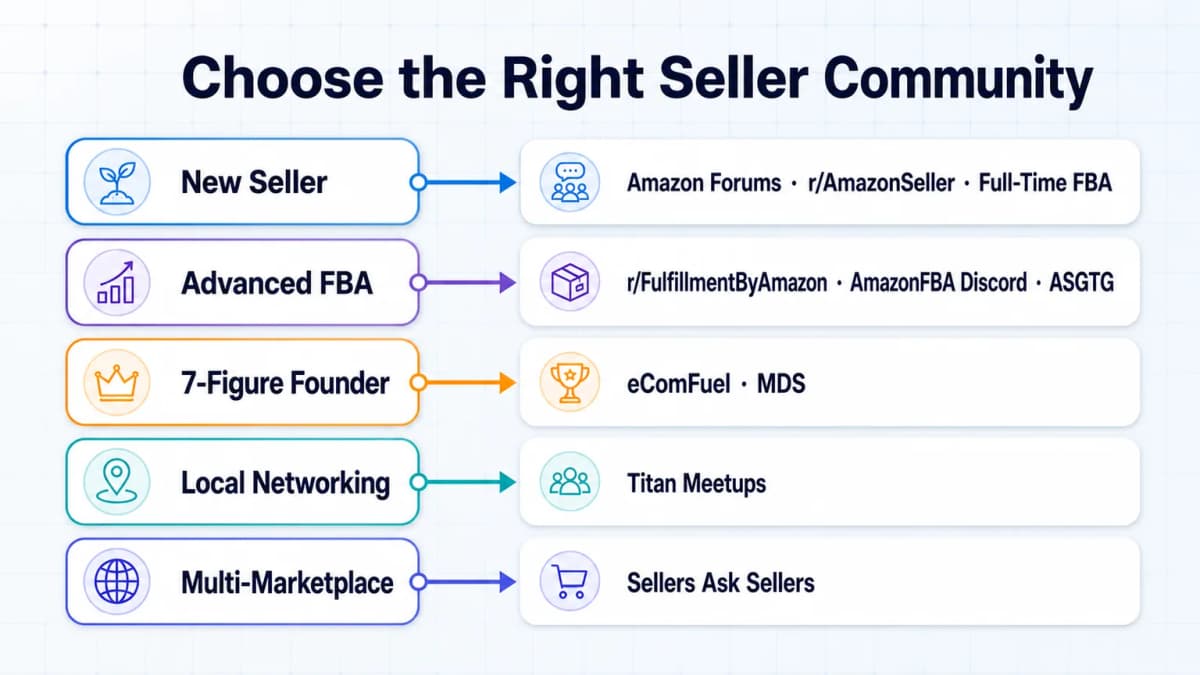
The largest group is rarely the best group for every seller. A useful community matches the seller's experience, business model, preferred format, and current problem.
Seller Experience
Beginners benefit from Amazon Seller Forums, r/AmazonSeller, and Full-Time FBA because common setup and operating questions appear frequently. Experienced FBA sellers may prefer r/FulfillmentByAmazon, AmazonFBA Discord, or ASGTG. Seven-figure founders can evaluate eComFuel or MDS if the screening requirements match.
Business Model
Private-label brands, resellers, wholesalers, agencies, and DTC founders face different problems. A retail-arbitrage discussion may offer little value to a brand evaluating international expansion. Sellers should review recent threads and community rules before joining.
Moderation and Activity
Healthy communities show recent activity, clear rules, visible moderation, and useful answers that do not immediately lead to a sales pitch. Repeated spam, copied responses, fake success stories, or pressure to move into private messages are warning signs.
Privacy and Scam Risk
Sellers should never post Seller Central passwords, two-factor codes, bank details, tax records, customer information, unredacted invoices, or complete case documents in a community. Account screenshots should be cropped or redacted before sharing.
Unsolicited messages promising reinstatement, guaranteed ranking, review manipulation, or privileged Amazon access deserve additional scrutiny. Legitimate help should not require unsafe account access or violations of Amazon policy.
Networking Format
Forums support search and long-term reference. Discord and Telegram support faster conversation. Facebook groups combine feeds, events, and member profiles. Meetups support deeper relationships. Private paid communities focus on curated access and advanced peer discussion.
Community Advice Verification
Peer experience can reveal patterns, but it does not automatically establish the correct action for another account. Sellers should verify advice through a simple process:
- Identify the exact issue. Record the marketplace, ASIN, shipment, campaign, case ID, notification, and relevant dates.
- Search official documentation. Compare the recommendation with Seller Central help pages, program policies, and account notifications.
- Check recency and marketplace. Advice for the United States may not apply to the United Kingdom, Europe, Canada, or another store.
- Look for independent agreement. Multiple detailed reports are stronger than one anonymous claim, though they still do not override policy.
- Use the proper support channel. Account-specific problems may require Seller Support, Account Health Support, Brand Registry Support, or qualified legal and tax professionals.
- Test low-risk changes first. Avoid large catalog, pricing, advertising, or inventory changes based only on one forum reply.
Advice involving reviews, ranking manipulation, coordinated pricing, counterfeit documents, account transfers, or policy evasion should be rejected. A community recommendation does not protect a seller from enforcement.
Conclusion: Turn Advice Into Action
The best Amazon seller forums help sellers find context, compare experiences, and ask better questions. Amazon Seller Forums is the strongest official starting point. Reddit, Discord, Telegram, Facebook, and independent forums offer wider peer perspectives. Titan Meetups supports local networking, while eComFuel and MDS serve established founders who meet their membership requirements.
Nexscope provides structured ecommerce data and focused seller workflows. Teams can use Nexscope's web tools directly or connect governed capabilities to their existing Agent through API, MCP, or Skills. Ready workflows include Keyword to Ads, Video Clone, and Buy Box Repricer.
Key capabilities include:
- Ecommerce research across products, keywords, competitors, reviews, markets, sourcing, and pricing
- Live ecommerce signals from Amazon, TikTok Shop, Keepa, Jungle Scout, Google Trends, and Amazon Brand Analytics
- Structured outputs that help teams compare evidence before acting
- Ecommerce image and video generation for listing and campaign workflows
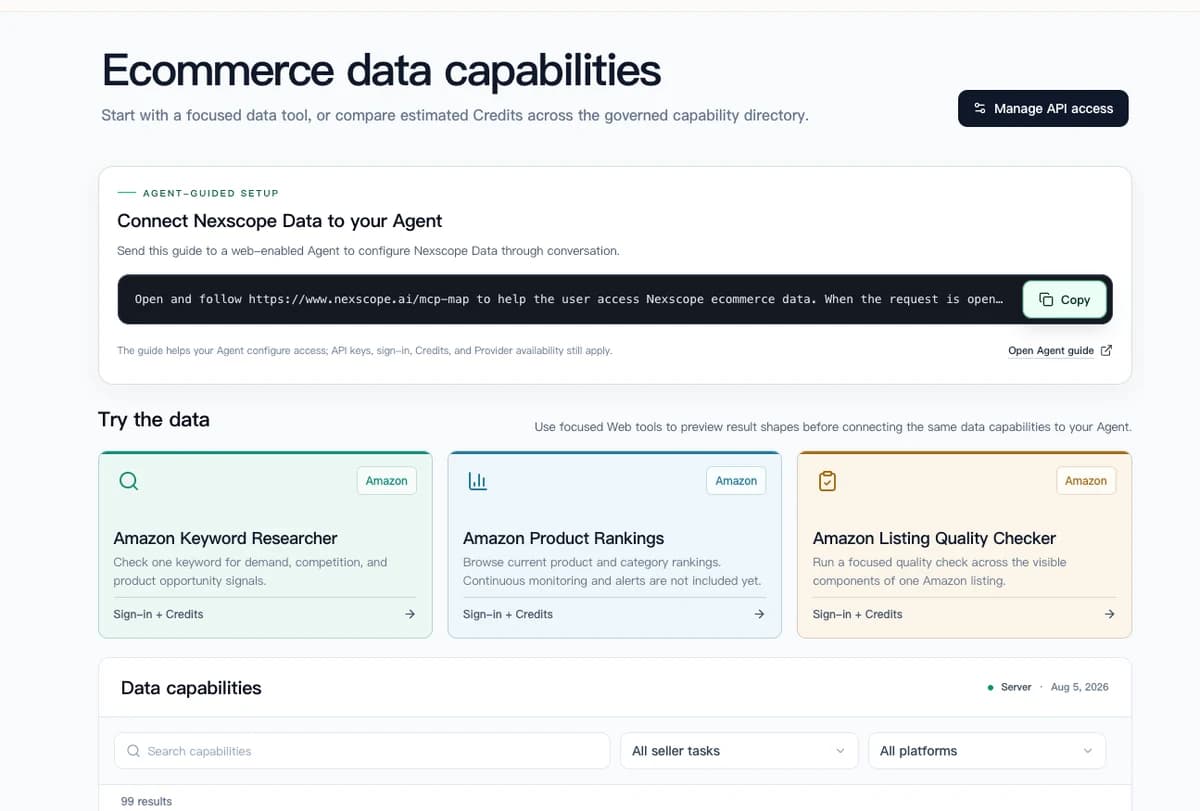
A forum can surface a useful idea. A structured workflow helps sellers validate that idea, document the evidence, and turn it into the next operational decision.
Turn Seller Insights Into a Custom Growth Plan
Nexscope's E-commerce Growth Services combine product research, competitor and review analysis, listing optimization, AI product creatives, marketplace PPC, and tailored launch or growth plans.
Talk to an Ecommerce Growth Expert →Amazon • TikTok Shop • Shopify • Walmart • Custom solutions
Connect Ecommerce Data to Your Agent
Use Nexscope through API, MCP, or Skills, or open a ready seller workflow.
Explore Ecommerce Data →1,000 free credits • API, MCP & Skills
Frequently Asked Questions
Are Amazon seller forums worth joining?
Yes. Amazon seller forums can help sellers understand common operational problems, compare peer experiences, and find questions they may need to raise with Amazon Support. Their value depends on moderation, contributor quality, and how carefully the seller verifies advice. Forums work best as a research and peer-support layer. They should not replace official Amazon policies, account-specific support, or qualified legal, tax, and compliance advice.
Which Amazon forums are best for beginners?
Amazon Seller Forums, r/AmazonSeller, and the Full-Time FBA Facebook group are accessible starting points. Amazon Seller Forums provides official categories and Community Manager participation. r/AmazonSeller offers broad peer discussion, while Full-Time FBA emphasizes beginner-friendly support and resale workflows. New sellers should also use Amazon Seller University and a structured guide to starting an Amazon business.
Which communities suit advanced sellers?
r/FulfillmentByAmazon, AmazonFBA Discord, ASGTG, eComFuel, and MDS serve progressively more experienced audiences. The Reddit and chat communities are available without a high revenue threshold. eComFuel and MDS screen applicants and focus on established operators. The best choice depends on whether the seller needs FBA tactics, account-health awareness, private founder discussion, local networking, or multichannel growth support.
Are paid Amazon seller communities worth the cost?
Paid communities can be valuable when a seller has complex decisions and can benefit from vetted peers, private discussions, events, directories, and specialized operating experience. The fee alone does not guarantee value. Sellers should compare membership requirements, participation levels, confidentiality rules, refund terms, and the relevance of current members to their business model. Early-stage sellers can usually learn more efficiently from established free communities first.
Are Amazon seller forums safe?
Most established communities are safe to browse when sellers follow basic privacy practices. Risks include spam, phishing, fake service providers, policy-violating advice, and unsolicited private messages. Sellers should redact screenshots, protect account credentials, avoid unknown downloads, and verify administrator identities. Any recommendation involving account access, review manipulation, falsified documents, or guaranteed reinstatement should be treated as a serious warning sign.
Can forum advice replace Amazon Support?
No. Community members can explain similar experiences and suggest questions to ask, but they cannot see the complete account record or issue binding decisions. Amazon identifies Selling Partner Support as the primary contact for operational seller issues. Account Health Support, Brand Registry Support, or another specialist channel may be appropriate depending on the problem. Forum research can improve a support request by helping a seller organize evidence and describe the issue precisely.
Sources
- Amazon. (2026). Seller Forums FAQs and Community Guidelines. Retrieved from sellercentral.amazon.com
- Full-Time FBA. (2026). Full-Time FBA Facebook Community Resources. Retrieved from fulltimefba.com
- Titan Network. (2026). Amazon Seller Meetups. Retrieved from titanmeetups.com
- eComFuel. (2026). Community Membership Frequently Asked Questions. Retrieved from ecommercefuel.com
- Million Dollar Sellers. (2026). Ecommerce Community Membership. Retrieved from mds.co