

9 Ecommerce Schema Markups Every Online Store Should Know

Ecommerce schema markup gives search engines a structured description of the products, offers, policies, and business details that shoppers can already see on an online store. Without it, a crawler must infer whether a number is a price, whether an item is in stock, which color belongs to which variant, and whether a policy applies to one product or the entire store.
Those distinctions matter as product discovery expands across standard search results, shopping experiences, image search, and AI-assisted research. Accurate structured data can make a store easier for machines to interpret and can make eligible pages available for richer search presentations. It does not guarantee rankings, rich results, citations, or AI recommendations.
This guide explains why ecommerce schema matters, where each type belongs, and which nine markups deserve priority. It also provides a complete JSON-LD example, a testing workflow, and a practical way to separate technical page readiness from actual AI product visibility.
What Is Ecommerce Schema Markup?
Ecommerce schema markup is structured data added to store pages to describe entities and relationships in a standardized, machine-readable format. The vocabulary usually comes from Schema.org, while search engines publish their own eligibility rules for the specific structured data features they support.
Three terms appear often in this topic:
- Schema markup refers to the vocabulary used to label entities such as a
Product,Offer,Organization, orReview. - Structured data is the machine-readable information created with that vocabulary.
- JSON-LD is the format Google recommends for implementing structured data. It normally appears inside a
<script type="application/ld+json">element in the page HTML.
The distinction between Schema.org validity and Google feature eligibility is important. Schema.org contains a broad vocabulary. Google supports selected types and properties for specific search experiences. A markup block can be valid according to Schema.org and still be ineligible for a Google rich result because it is missing a required property or does not match the page's purpose.
Why Ecommerce Schema Matters
Ecommerce pages contain fast-changing facts and closely related entities. A single product page may include a product name, brand, SKU, price, currency, availability, variants, reviews, shipping terms, and return rules. Clear ecommerce schema helps machines connect those facts to the correct product and offer.
Product Data Clarity
Text and visual layout give shoppers context, but machines benefit from explicit labels. priceCurrency identifies the currency attached to a price. availability identifies whether the item is in stock. sku, gtin, and mpn help distinguish one product from another. ProductGroup can connect size or color variants to a common parent product.
The structured data must match the current, visible page content. A stale price or stock status can create conflicting signals and make a technically valid implementation unreliable.
Richer Search Eligibility
Google states that product structured data can make product information eligible for enhanced presentations across Search, Google Images, and Google Lens. Depending on the page and available data, those presentations may include price, availability, ratings, shipping information, and returns.
Eligibility is the correct expectation. Google does not guarantee that valid structured data will appear as a rich result. Search appearance depends on the query, device, location, page quality, policies, and other systems.
Consistent Product Data
Schema implementation often exposes operational issues that already affect shoppers. A catalog may show one price in visible HTML, another in an app-generated JSON-LD block, and a third in a product feed. Auditing structured data forces the store to identify a reliable source for prices, inventory, identifiers, and policies.
That consistency supports Shopify SEO, product feed quality, crawlability, and site maintenance. The benefit reaches beyond the markup itself.
Machine Readability and AI Visibility Limits
Structured data gives machine systems explicit clues about products and policies. That can improve page readability for systems that parse HTML and structured markup. However, AI answers may also depend on crawl access, content quality, brand authority, third-party citations, marketplace data, product relevance, freshness, and the model's retrieval process.
Schema readiness and actual AI visibility require separate measurements. A clean JSON-LD block cannot prove that a product is mentioned, cited, ranked, or recommended in a live AI response.
Map Ecommerce Schema to Each Store Page
Different page templates serve different purposes. Adding the same large schema graph to every URL usually creates duplication and irrelevant entities. A better approach maps each page type to its main entity and adds supporting markup only when the visible content justifies it.
| Store page | Primary schema | Supporting schema | Main purpose |
|---|---|---|---|
| Homepage | OnlineStore or Organization |
WebSite, MerchantReturnPolicy, ShippingService |
Identify the business and global policies |
| Product detail page | Product |
Offer, AggregateRating, Review, OfferShippingDetails |
Describe one purchasable product and its offer |
| Variant product page | ProductGroup and Product |
Offer |
Connect variants and define variant-specific facts |
| Collection or category page | ItemList |
BreadcrumbList |
Describe an ordered set and the page hierarchy |
| Return policy page | MerchantReturnPolicy under Organization |
WebPage |
Define store-wide return terms |
| Shipping policy page | ShippingService |
DefinedRegion, ShippingConditions |
Define store-wide shipping terms |
| Blog or guide | Article |
VideoObject, BreadcrumbList |
Describe editorial content |
| Store location page | LocalBusiness |
PostalAddress, OpeningHoursSpecification |
Describe a physical location |
The map is a starting point. A store should add only the types and properties supported by the actual page content. Google recommends focusing product rich-result markup on pages about one product or multiple variants of the same product, rather than a general category page.
9 Ecommerce Schema Markups Online Stores Should Know
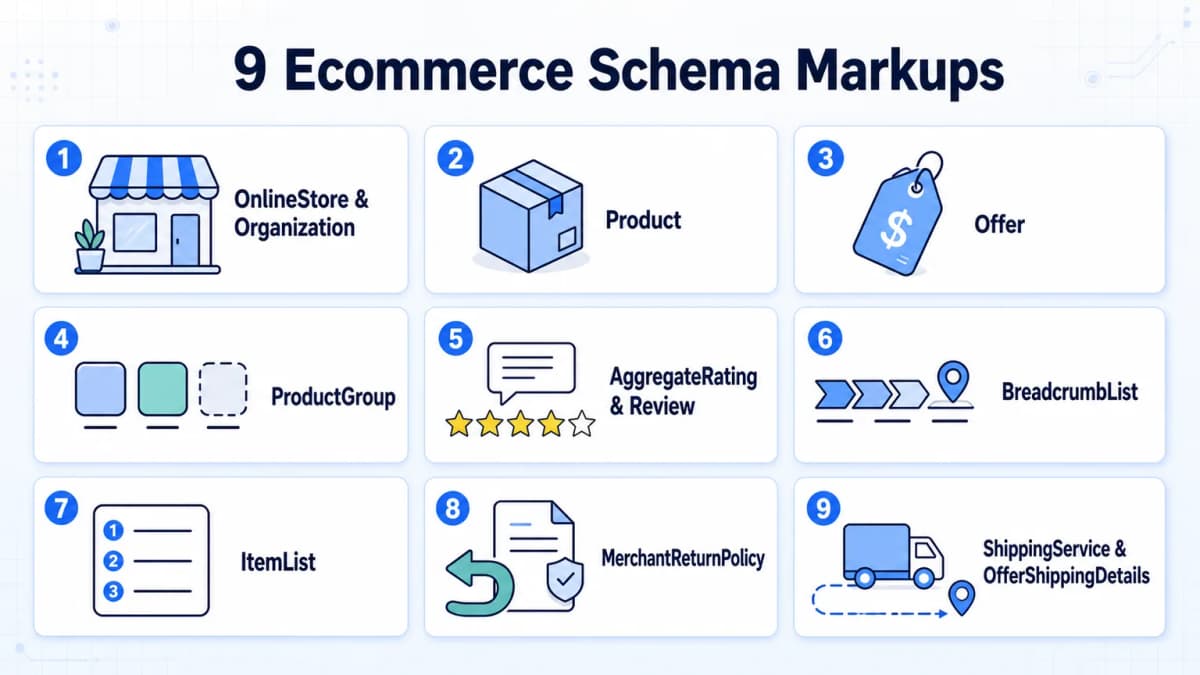
The following nine groups cover the most common ecommerce use cases. A store does not need every type on every page. Priority should follow page purpose, catalog structure, and the search features that matter to the business.
1. OnlineStore and Organization
OnlineStore is a Schema.org subtype for an ecommerce business. It can describe the store's name, URL, logo, contact details, identifiers, and relationships to policies or marketplaces. Organization is the broader type and is also the type Google documents for business details and organization-level return policies.
Use one stable entity ID, such as https://example.com/#organization, and reference it from other markup blocks. This helps avoid creating several disconnected versions of the same business.
Best placement: the homepage or a sitewide graph generated from a single source of truth.
2. Product
Product identifies the item described on a product detail page. Common properties include name, image, description, sku, gtin, mpn, brand, color, size, category, and offers.
For Google merchant listing eligibility, name, image, and a nested Offer are central requirements. Product identifiers should reflect real manufacturer or catalog data. A store should not invent a GTIN when one does not exist.
Best placement: a product detail page focused on one product or variants of that product.
3. Offer
Offer describes the commercial terms attached to a product. It is where price, currency, availability, condition, purchase URL, shipping details, and product-specific return rules usually belong.
At minimum, a purchasable product offer should keep price and priceCurrency synchronized with the visible page. Recommended details such as availability, url, and itemCondition reduce ambiguity. If a sale expiration date is supplied through priceValidUntil, it must be maintained because a date in the past can affect listing display.
Best placement: nested inside the corresponding Product.
4. ProductGroup
ProductGroup connects variants that belong to the same parent product. A shirt sold in four colors and five sizes may represent one product group with variant products linked through hasVariant or isVariantOf.
Use stable variant URLs and mark the distinguishing property with variesBy, such as color or size. Each variant should carry its own SKU, URL, image, price, and availability when those values differ.
Best placement: product families with selectable variations. Avoid treating unrelated products as variants merely because they share a category.
5. AggregateRating and Review
AggregateRating summarizes a genuine collection of ratings with values such as ratingValue and reviewCount. Review describes an individual review, including the author, review body, date, and rating.
Only mark up reviews displayed on the page and associated with the specific product. Self-created ratings, imported reviews without clear provenance, and hidden review content can violate structured data quality guidelines.
Best placement: product pages that visibly display eligible product reviews.
6. BreadcrumbList
BreadcrumbList describes the hierarchy that leads to the current page. A product path might be Home, Drinkware, Travel Mugs, and Aster Travel Mug. Each step is represented by a ListItem with a position, name, and URL.
Breadcrumb markup helps search engines understand site structure and may support a more meaningful breadcrumb trail in search results. The marked path should match the breadcrumb users can navigate on the page.
Best placement: product, collection, blog, and informational pages with visible breadcrumbs.
7. ItemList
ItemList describes an ordered or unordered group of items. On a collection page, it can identify the products shown and their positions. It should represent the visible list rather than a hidden or much larger inventory set.
ItemList does not turn a category page into a product rich-result page. Google recommends product rich-result markup for pages focused on a specific product or its variants. Collection markup is useful for describing page structure, while individual product URLs carry the detailed Product and Offer data.
Best placement: collection pages, category pages, comparison lists, and curated product roundups.
8. MerchantReturnPolicy
MerchantReturnPolicy communicates the countries covered, return window, return method, fees, and refund conditions. Google recommends defining a global policy under Organization when most products share the same terms. A product-level policy under Offer can override the global policy for an exception.
The schema should match the visible policy page and checkout experience. Country codes, return days, fees, and seasonal exceptions need ongoing maintenance.
Best placement: the organization graph for a global policy, with offer-level overrides only when necessary.
9. ShippingService and OfferShippingDetails
ShippingService can describe a store-wide shipping policy. OfferShippingDetails describes shipping attached to a specific offer, including destination, rate, handling time, and transit time. A store can use stable @id references to connect offers with a global shipping service.
Shipping markup becomes complex when rates vary by region, basket value, service level, or product. Each condition must reflect what shoppers can actually receive. Free shipping uses a numeric value of 0 with the correct currency, not a promotional phrase.
Best placement: ShippingService in the organization-level policy graph and OfferShippingDetails inside an offer when product-level detail is needed.
How to Implement Ecommerce Schema Safely
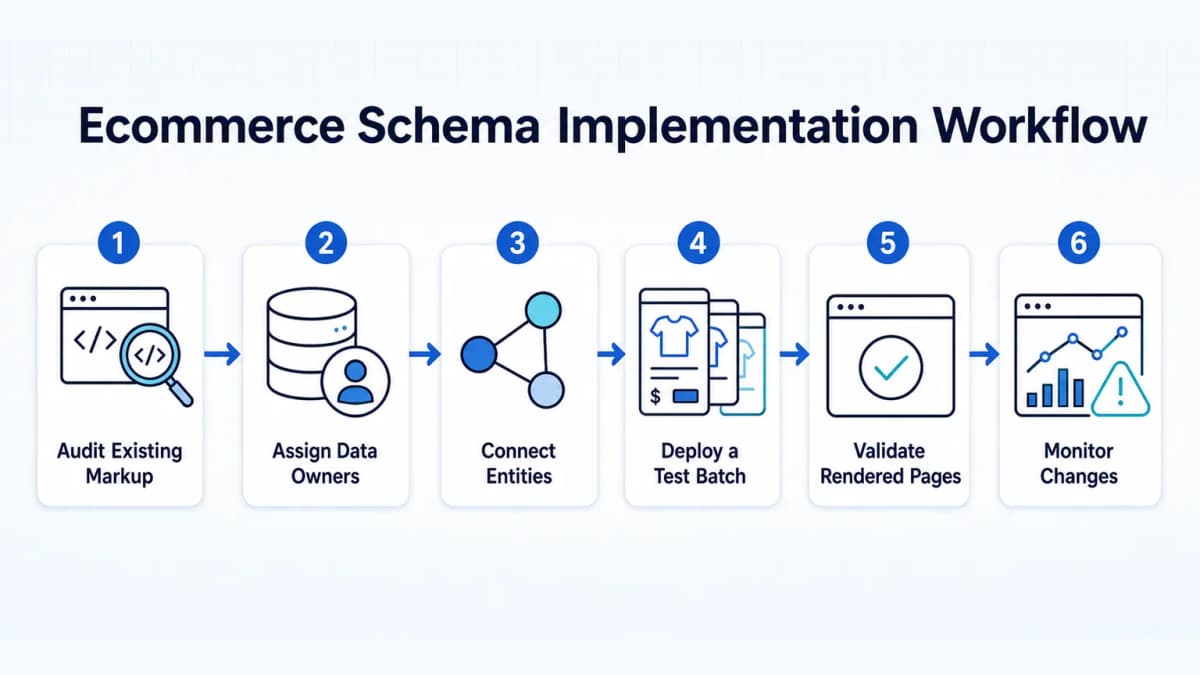
Structured data projects often fail because several systems write overlapping markup. A theme, review app, SEO plugin, feed app, and custom script may all generate their own Product entity. Implementation should begin with an inventory of what already exists.
1. Rendered Output Audit
Inspect representative pages from each template, including products with and without reviews, products with variants, sale items, out-of-stock items, collections, and policy pages. Record every JSON-LD block and the system that generated it.
2. Single Source of Truth
Price and inventory should normally come from the commerce platform. Review counts should come from the review system. Return and shipping terms should come from maintained policy data. Define ownership before changing the markup.
One field should not have conflicting values across visible HTML, structured data, and product feeds.
3. Stable Entity IDs
Use full URLs with fragments for @id values. Examples include:
https://example.com/#organizationhttps://example.com/products/aster-travel-mug#producthttps://example.com/products/aster-travel-mug#offerhttps://example.com/policies/returns#policy
Stable IDs let separate nodes refer to the same organization, product, offer, or policy without repeating conflicting copies.
4. Representative Batch Deployment
Release changes to a limited group of pages first. Test one standard product, one variant product, one sale item, one out-of-stock item, and the relevant policy pages. This makes template errors easier to isolate.
5. Maintenance Triggers
Schema should be retested after theme changes, app installations, catalog migrations, currency changes, review-provider changes, and shipping or return policy updates. The maintenance plan matters as much as the initial code.
Complete Ecommerce Product Schema Example
The following JSON-LD example describes a fictional product and one active offer. It includes product identity, brand, price, availability, aggregate rating, shipping details, and a product-level return policy. Store-wide shipping and return policies can instead live under the organization graph and be referenced by @id.
<script type="application/ld+json">
{
  "@context": "https://schema.org",
  "@type": "Product",
  "@id": "https://example.com/products/aster-travel-mug#product",
  "name": "Aster Insulated Travel Mug, 16 oz",
  "description": "A 16-ounce stainless steel travel mug with a leak-resistant lid.",
  "image": [
    "https://example.com/images/aster-mug-1x1.jpg",
    "https://example.com/images/aster-mug-4x3.jpg",
    "https://example.com/images/aster-mug-16x9.jpg"
  ],
  "sku": "ATM-16-NAVY",
  "gtin13": "0123456789012",
  "brand": {
    "@type": "Brand",
    "name": "Example Brand"
  },
  "color": "Navy",
  "offers": {
    "@type": "Offer",
    "@id": "https://example.com/products/aster-travel-mug#offer",
    "url": "https://example.com/products/aster-travel-mug",
    "price": 29.99,
    "priceCurrency": "USD",
    "availability": "https://schema.org/InStock",
    "itemCondition": "https://schema.org/NewCondition",
    "shippingDetails": {
      "@type": "OfferShippingDetails",
      "shippingDestination": {
        "@type": "DefinedRegion",
        "addressCountry": "US"
      },
      "shippingRate": {
        "@type": "MonetaryAmount",
        "value": 0,
        "currency": "USD"
      },
      "deliveryTime": {
        "@type": "ShippingDeliveryTime",
        "handlingTime": {
          "@type": "QuantitativeValue",
          "minValue": 0,
          "maxValue": 1,
          "unitCode": "DAY"
        },
        "transitTime": {
          "@type": "QuantitativeValue",
          "minValue": 2,
          "maxValue": 5,
          "unitCode": "DAY"
        }
      }
    },
    "hasMerchantReturnPolicy": {
      "@type": "MerchantReturnPolicy",
      "applicableCountry": "US",
      "returnPolicyCategory": "https://schema.org/MerchantReturnFiniteReturnWindow",
      "merchantReturnDays": 30,
      "returnMethod": "https://schema.org/ReturnByMail",
      "returnFees": "https://schema.org/FreeReturn"
    }
  },
  "aggregateRating": {
    "@type": "AggregateRating",
    "ratingValue": 4.7,
    "reviewCount": 128
  }
}
</script>
This example is a template, not copy-and-paste production data. The product name, images, identifiers, price, stock status, rating, shipping times, destinations, and return terms must match the page where the code appears.
For variants, a store can add a ProductGroup with variesBy and connect each variant through hasVariant. A single variant URL should identify the selected variant and its specific offer. Stores selling in multiple currencies should review Google's recommendation to use a distinct URL for each currency.
How to Test and Monitor Ecommerce Schema
Validation needs several tools because syntax, Schema.org vocabulary, Google eligibility, rendered output, and live search performance are separate questions.
Rich Result Eligibility
Use Google's Rich Results Test on code and live URLs. Fix critical errors first. Recommended-property warnings may identify useful enhancements, but they do not always block eligibility.
Full Schema.org Graph Validation
Use the Schema Markup Validator to inspect types and properties that Google's test may not evaluate. This is especially useful for OnlineStore, ItemList, and connected organization or policy nodes.
Rendered URL Inspection
Use URL Inspection in Google Search Console to confirm that Google can access the page and rendered markup. Check whether robots rules, noindex, login requirements, JavaScript errors, or server problems block the page.
Google notes that dynamically generated product markup can make shopping crawls less frequent and less reliable, especially for fast-changing prices and availability. Server-rendered or initial-HTML product data may reduce that risk.
Post-Deployment Monitoring
Track enhancement reports, merchant listing issues, product snippet issues, crawl changes, and manual actions in Search Console. Retest samples after catalog releases and policy changes. A valid result today does not prove that future template output will remain accurate.
Measure What Schema Alone Cannot Prove
A validator answers whether markup is readable or eligible for a supported feature. It does not answer whether a page is strong enough to be cited, whether a product appears in buyer-focused AI answers, or whether competitors receive more recommendations.
That distinction is central to generative engine optimization. Page readiness and observed visibility belong in separate measurement layers.
Page-Level SEO and GEO Readiness
The Nexscope GEO Score Checker evaluates page-level signals across SEO, GEO and AI visibility readiness, technical health, and content authority. Its checks cover areas such as crawl readiness, search intent, image SEO, structured data, trust signals, AI brand recognition, citation readiness, and prioritized fixes.
The resulting score measures whether a page is prepared for search and AI systems to access, understand, and potentially cite. It does not measure a product's live ranking or recommendation frequency inside an AI platform.
The sample report below illustrates how technical and content findings are separated into actionable checks.
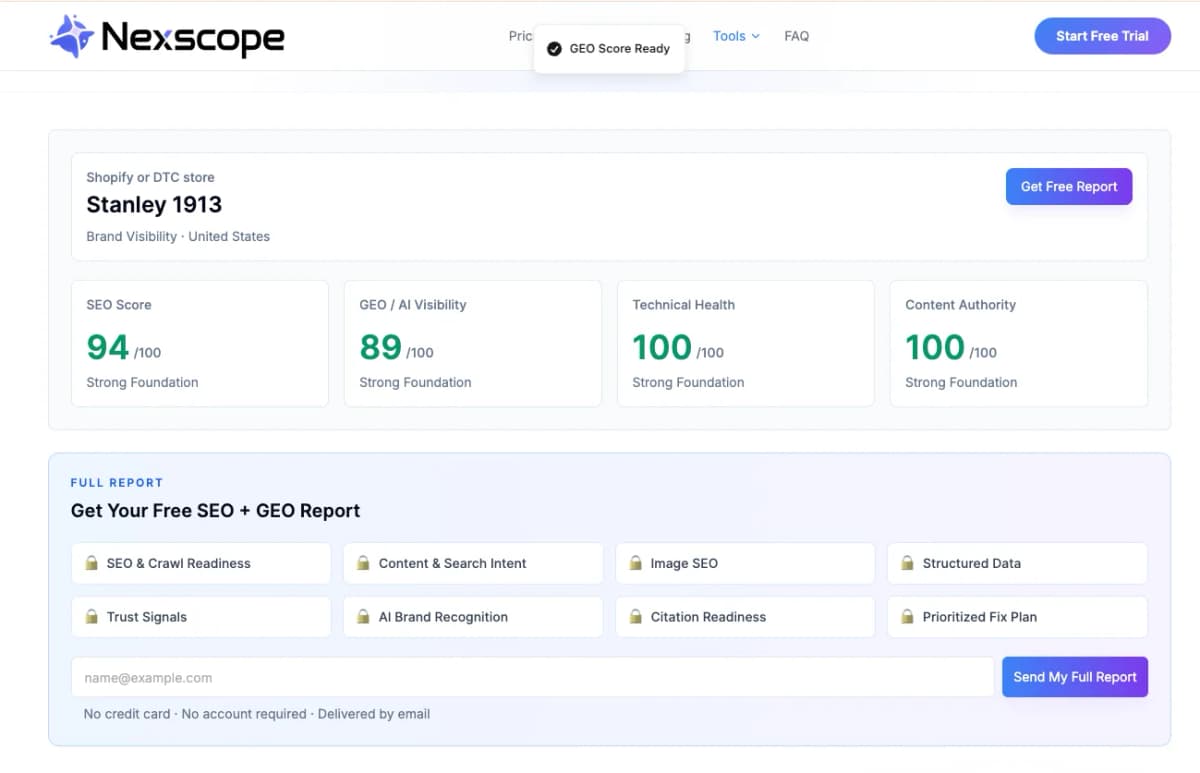
The checker applies to individual ecommerce, product, collection, article, and service URLs. Results should be interpreted within the crawler and platform scope shown in the report.
Check Your Ecommerce Page's GEO Readiness
Find structured data, crawl, content, authority, and AI citation gaps before deeper visibility monitoring.
Check Your Page's GEO Score Free →SEO score • GEO readiness • Prioritized fixes
AI Mentions and Product Recommendations
The AI Product Visibility Tool examines a different outcome: whether a product appears in relevant AI-assisted shopping responses. Its report includes a visibility scorecard, buyer-question coverage, query-level evidence, LLM and competitor benchmarks, citation and signal gaps, and a prioritized action plan.
An official sample AI visibility report shows how those dimensions are presented.
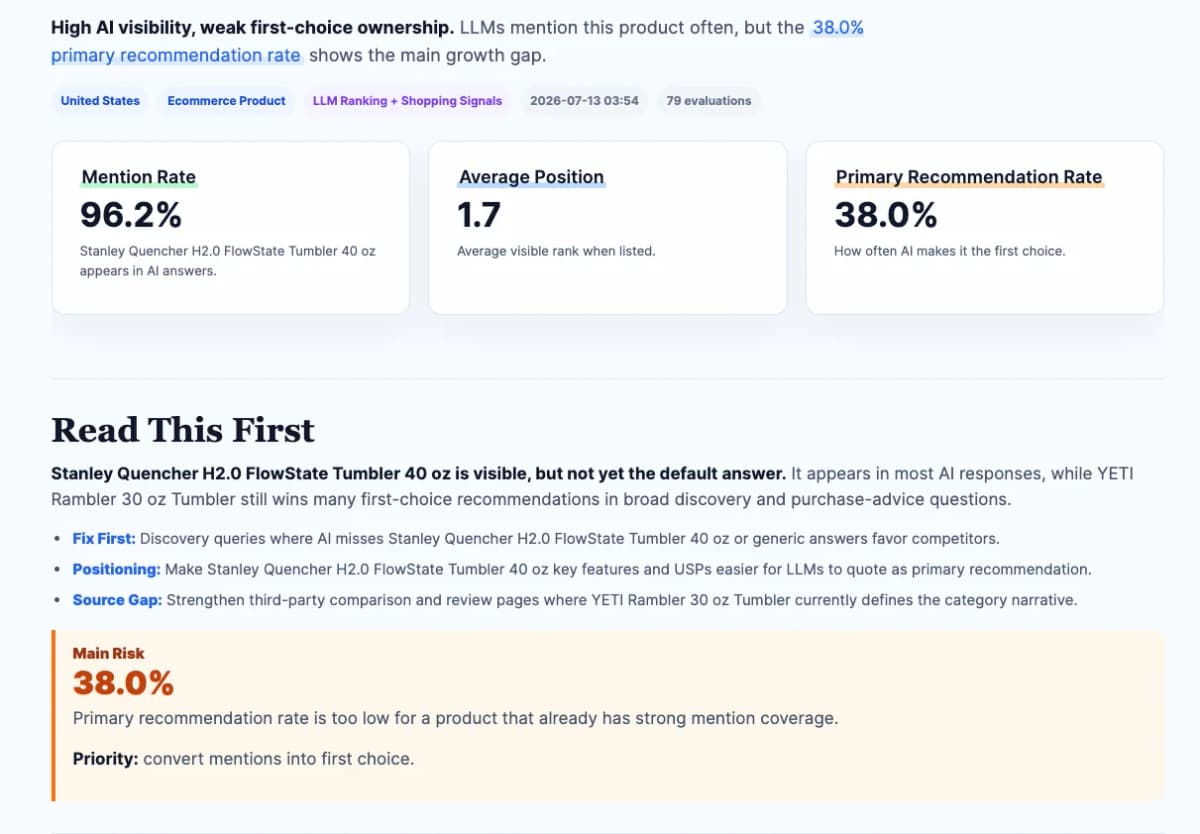
Observed results are query, model, location, language, and time dependent. They should be treated as a measured sample of platform behavior, not a permanent guarantee. This matters as AI shopping changes product discovery and buyer questions become more conversational.
See Whether AI Shopping Answers Recommend Your Product
Review product mentions, recommendation position, citations, competitors, and the visibility gaps to address next.
Check Your Product's AI Visibility →Product URL, name, or ASIN • Query-level evidence
Common Ecommerce Schema Mistakes
Most ecommerce schema problems come from conflicting systems, stale catalog facts, or markup that describes content users cannot see.
- Duplicate product entities: A theme and several apps generate separate
Productblocks with different values. - Stale price or availability: JSON-LD does not update when the visible product price or inventory changes.
- Missing currency, URL, or condition: An offer lacks context needed to interpret its commercial terms.
- Invented identifiers: A store creates a GTIN, MPN, or brand value instead of using real product data.
- Invalid review markup: Ratings are hidden, unrelated to the product, self-created, or inconsistent with the visible review count.
- Incorrect variant modeling: Every variant is treated as an unrelated product, or one parent offer is reused despite variant-specific prices and stock.
- Product markup on collection pages: A category page is marked as one product even though it lists unrelated items.
- Policy drift: Shipping destinations, fees, delivery times, or return windows no longer match the policy page or checkout.
- JavaScript rendering failures: The product schema is injected late, intermittently, or only after user interaction.
- Guarantee language: The implementation is presented as proof of ranking, rich results, citations, or AI recommendations.
When an audit uncovers issues across themes, apps, feeds, catalog data, content, and conversion paths, the fix may require more than a code edit. Nexscope E-commerce Growth Services can review store and product pages, identify SEO, GEO, content, and conversion gaps, recommend schema and page changes, and build a prioritized implementation plan.
Turn Schema Findings Into an Action Plan
Nexscope experts can review product pages, data sources, SEO, GEO, and conversion gaps, then prioritize the changes that matter.
Talk to an Ecommerce Growth Expert →Store audit • Listing optimization • Implementation plan
Conclusion: Turn Schema Findings Into a Growth Plan
Effective ecommerce schema starts with accurate product and policy data. Product and Offer deserve priority on purchasable product pages. ProductGroup supports variant relationships. OnlineStore, Organization, MerchantReturnPolicy, and ShippingService establish store-level identity and policies. BreadcrumbList and ItemList clarify page structure.
The implementation should then move through a controlled cycle: audit existing output, assign data ownership, connect entities, deploy representative pages, validate the rendered code, and monitor changes. Valid schema creates eligibility and clearer machine-readable context. It does not guarantee rankings, rich results, or AI recommendations.
The next step depends on the question. Use the GEO Score Checker to diagnose page readiness, the AI Product Visibility Tool to observe product mentions and recommendations, and E-commerce Growth Services when the findings require a coordinated store, product, content, or implementation plan.
Frequently Asked Questions
What is ecommerce schema markup?
Ecommerce schema markup is structured data that labels store information in a machine-readable format. It can describe products, offers, prices, inventory, reviews, variants, shipping, returns, breadcrumbs, and business identity. Schema.org supplies the vocabulary, while search engines such as Google define which types and properties qualify for specific search features. JSON-LD is Google's recommended implementation format.
Which ecommerce schema is most important?
Product with a nested Offer is usually the highest-priority markup for a store that sells through product detail pages. It identifies the product and its active commercial terms, including price and currency. The next priorities depend on the catalog: ProductGroup for variants, AggregateRating for visible eligible reviews, and organization-level shipping and return policies for store-wide terms.
Does ecommerce schema improve Google rankings?
Google does not describe valid structured data as a guaranteed ranking increase. Schema can improve Google's understanding of page content and can make a page eligible for supported rich-result or shopping presentations. A richer presentation may affect how a result appears and how shoppers interact with it. Ranking still depends on many technical, relevance, quality, and authority signals.
Can ecommerce schema help products appear in AI recommendations?
Schema may help machine systems interpret products, offers, and policies when they parse structured markup. It cannot guarantee an AI mention, citation, ranking, or recommendation. Those outcomes can also depend on crawl access, product relevance, content, brand authority, external sources, marketplace signals, query wording, model behavior, and freshness. Actual visibility should be measured through repeated buyer questions and recorded platform responses.
Do Shopify and WooCommerce add product schema automatically?
Many themes, platform features, and plugins generate some product structured data automatically, but coverage and quality vary. Automatic markup may omit variants, policies, identifiers, shipping details, or review data. Multiple apps can also create duplicates. Store operators should inspect rendered output on representative page templates and verify that visible prices, inventory, reviews, and policies match the JSON-LD.
How should an online store validate schema markup?
Use Google's Rich Results Test to check eligibility for supported search features and the Schema Markup Validator to inspect the broader graph. Then use URL Inspection in Google Search Console to confirm that Google can crawl and render the live page. Test standard products, variants, sale items, out-of-stock items, collections, and policy pages. Continue monitoring after theme, app, catalog, and policy changes.
Should every product variant have separate schema?
Each meaningful variant should have accurate variant-specific data, especially when its SKU, URL, image, price, availability, size, or color differs. ProductGroup can connect variants under a shared parent and identify the properties that vary. The URL and markup should reflect the selected variant. Stores should avoid publishing several identical variant entities that search engines cannot distinguish.
How can duplicate schema from ecommerce apps be fixed?
First identify every system that writes JSON-LD, including the theme, SEO app, review app, feed app, and custom scripts. Choose one owner for each entity and field. Remove or disable overlapping output where possible, then connect the remaining nodes with stable @id values. Validate rendered pages after deployment because app settings and theme updates can reintroduce duplicate markup.
Sources
- Google Search Central. (2025). Include Structured Data Relevant to Ecommerce. Retrieved from developers.google.com
- Google Search Central. (2025). Introduction to Product Structured Data. Retrieved from developers.google.com
- Google Search Central. (2025). Merchant Listing Structured Data. Retrieved from developers.google.com
- Google Search Central. (2025). General Structured Data Guidelines. Retrieved from developers.google.com
- Schema.org. (2026). OnlineStore. Retrieved from schema.org