

How to Build an Amazon Product Research Workflow With Codex

An Amazon product research workflow with Codex can reduce hours of repetitive data collection, spreadsheet cleanup, filtering, and reporting. The value does not come from asking Codex to name a few promising products. It comes from giving the system reliable inputs, explicit rejection rules, a transparent scoring model, and clear approval gates.
Consider a typical research session. An operator reviews hundreds of ASINs, switches between keyword tools and product pages, checks reviews, estimates FBA costs, searches for suppliers, and opens more tabs to investigate patents. Three hours later, the decision still sounds like this: “These products look promising.”
That answer exposes the real problem. The team collected data without building a repeatable decision process.
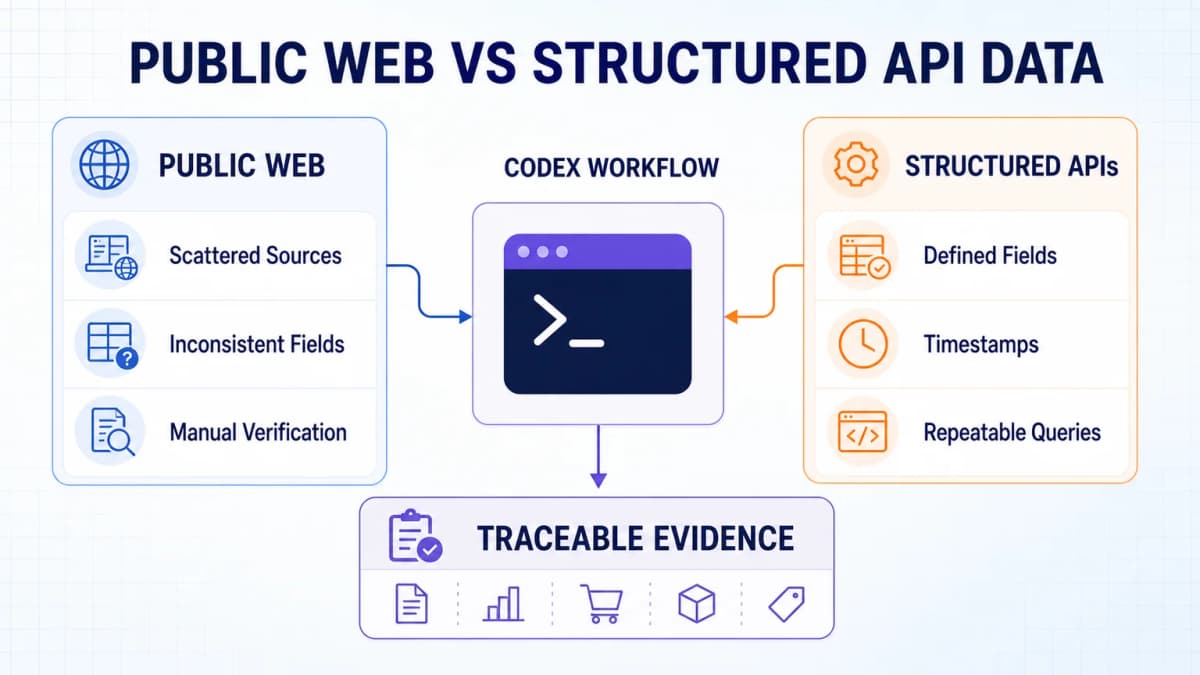
Codex can search public webpages, analyze files available in its environment, run code, and execute a documented workflow. It does not automatically have structured, current Amazon, wholesale supplier, or intellectual-property data. That is where data providers can improve the workflow: authorized interfaces return defined fields, timestamps, and responses that can be stored and checked again. Teams can connect Nexscope ecommerce data to Codex, Claude Code, OpenClaw, or another Agent through REST API or MCP.
The final sourcing and inventory decision still belongs to the seller. Codex can organize the evidence, expose missing information, and apply the same standards to every candidate. It cannot absorb the financial consequences of a bad purchase order.
What an Automated Amazon Product Research Workflow Actually Means
Full automation does not require removing people from every decision. It means the repeatable parts of research run according to the same documented process each time.
A practical workflow can:
- Retrieve market, keyword, product, supplier, and risk data from approved sources.
- Standardize field names, units, marketplaces, currencies, and date ranges.
- Reject candidates that fail non-negotiable requirements.
- Calculate contribution profit and estimate cash exposure.
- Score demand, competition, economics, supply fit, and risk.
- Analyze reviews for recurring customer problems.
- Flag missing fields instead of inventing values.
- Produce a shortlist with evidence and rejection reasons.
- Recheck important assumptions on a fixed schedule.
- Pause before sampling, legal approval, payment, or inventory commitments.
The basic sequence is:
Data Input → Data Cleaning → Hard Filters → Scoring → Risk Review → Shortlist → Human Decision
Public web research can contribute useful context, but webpages often use inconsistent periods, estimates, and definitions. A repeatable system needs a stable data layer. When a team does not want to build and maintain every marketplace collector itself, Nexscope Ecommerce Data APIs can feed structured product, keyword, sourcing, and compliance inputs into its own workflow through REST API or MCP.
The process can be automated. Responsibility cannot be delegated. A seller should still approve every action that creates financial, legal, or operational exposure.
How Codex Turns Disconnected Research Into a Repeatable System
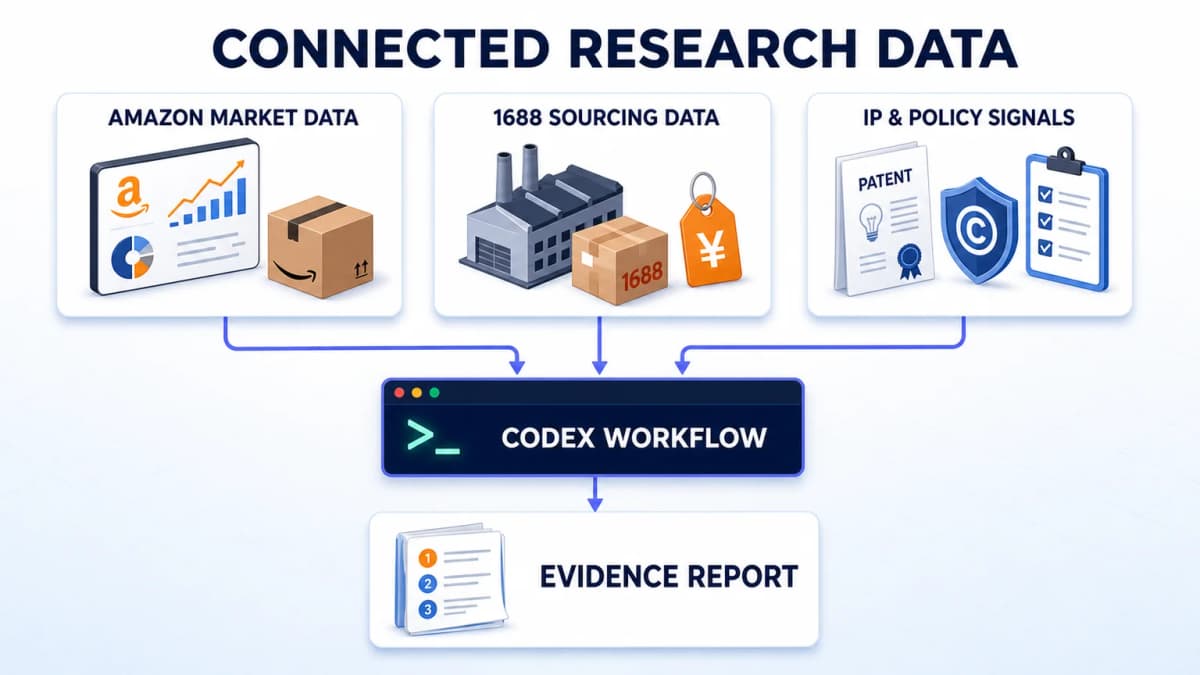
Codex acts as the orchestration and analysis layer. It receives the research brief, calls approved tools, processes files, applies business rules, and prepares evidence for review. The underlying data remains just as important as the instructions.
Data Orchestration
Codex can work with local spreadsheets, scripts, databases, web research, REST APIs, and MCP connections available in its environment. The team must configure those sources and grant only the permissions required for the task.
Before the first run, each connection should be turned into an explicit contract: what Codex may request, which fields it should retain, where the response will be stored, and how errors or empty values will be handled. For Nexscope inputs, those details can be mapped from the relevant endpoint reference instead of being guessed from a webpage.
Data Normalization
Research tools frequently describe similar metrics in different ways. Monthly sales may refer to a calendar month, a rolling 30-day estimate, or another modeled period. Product dimensions and packaged dimensions cannot be used interchangeably. List price, discounted price, and observed historical price represent different facts.
Codex can standardize these fields before analysis. Each normalized value should preserve its source, retrieval date, original unit, marketplace, and estimate status. If two values cannot be reconciled, the workflow should retain both and flag the conflict.
Rule-Based Analysis
Once the data is normalized, Codex can apply the same rules to hundreds of candidates. It should not lower a threshold because a product looks interesting or ignore a review barrier because an operator prefers the design.
At this stage, Codex needs a broad screen rather than a product recommendation. Connecting Nexscope's metric-based opportunity search lets the workflow narrow niches and keywords by market size, growth, competition, pricing, demographics, and reviews before applying the thresholds in the research brief.
Evidence-Backed Reporting
The final output can include:
- A ranked candidate list
- A product opportunity card for each surviving idea
- Market and keyword evidence
- Competitor comparisons
- Profit scenarios
- Supplier-validation requirements
- Review-derived product gaps
- Patent and compliance warnings
- Missing-data and manual-review queues
- Continue, reject, or verify recommendations
Every recommendation should link back to the source data, retrieval time, calculation, and rule that produced it. A polished report without traceable evidence is still a weak research system.
Other Agent Runtimes
The same architecture can work with Claude Code, OpenClaw, or another Agent runtime that can process files, run code, and call approved REST or MCP tools. The commands and configuration will differ, but the underlying research brief, data model, rejection rules, scoring method, and approval gates can remain consistent.
Five Data Inputs Every Amazon Product Research System Needs
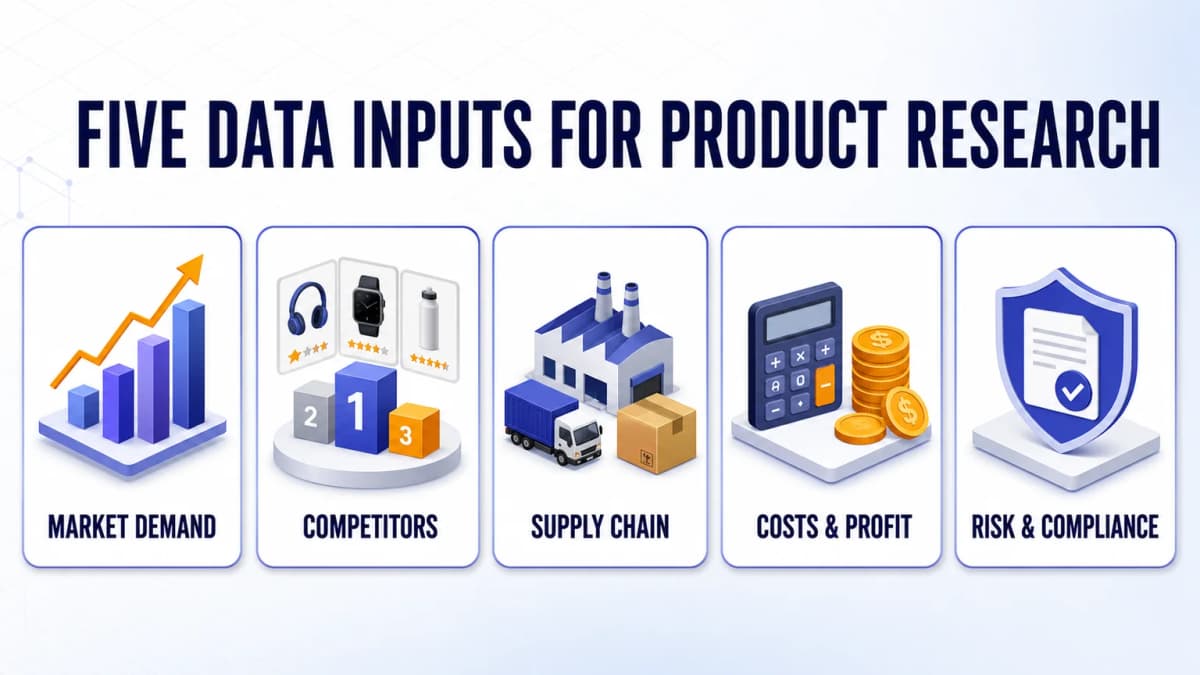
The quality of an automated workflow depends on the inputs it can verify. Five groups of data cover most of the evidence required before a candidate should reach human review.
Market Demand Data
Market demand data should cover more than one search-volume number. A useful dataset includes:
- Core and related keywords
- Search demand and demand history
- Seasonal patterns
- Market sales and revenue estimates
- Product and seller counts
- Brand and ASIN concentration
- New-product entry and success signals
- Typical price and rating ranges
To populate this layer without copying figures from multiple tabs, Codex can pull niche-level market size, competition, concentration, seller structure, new-product share, pricing, ratings, and margin ranges from Nexscope's Amazon market research endpoint. The workflow can then test that evidence against the team's own demand and risk thresholds.
No single demand threshold works for every seller. A mature brand with capital, content resources, and an established supplier base may accept a market that would be unsuitable for a smaller team.
Competitor Data
Competitor analysis should include both current position and direction of travel. Relevant fields include:
- ASIN and listing age
- Current and historical price
- Estimated sales and revenue
- BSR and BSR movement
- Ratings and review count
- Variant structure
- Seller and fulfillment model
- Dimensions and weight
- Organic and advertising visibility
Review count alone says little about whether a competitor is gaining or losing ground. A competitor lookup request can give Codex sales, BSR, price, rating, and growth signals for the same comparison set, making direction of travel part of the decision.
Competitive accessibility should also consider brand concentration, price pressure, new-product performance, listing quality, ad intensity, and the cost of creating a meaningful difference. A weak listing does not automatically represent an easy opportunity if the brand has strong distribution or a large advertising budget.
Supply Chain Data
Supplier evidence should enter the workflow before a product receives a confident profit score. Useful inputs include:
- Indicative purchase price
- Minimum order quantity
- Sample cost
- Product and package dimensions
- Product and package weight
- Supplier and trade information
- Production lead time
- Customization options
- Packaging requirements
- Quality-control requirements
Once an Amazon candidate survives the market screen, a team sourcing from China can pass its product image to Nexscope's 1688 image search. The returned price, MOQ, sales, supplier, and trade signals give Codex a structured starting point for supplier discovery rather than a final sourcing decision.
Supplier API data is preliminary sourcing evidence. The seller must still request a formal quotation, order samples, verify dimensions and materials, confirm lead times, inspect quality, and review contract terms. A catalog price is not an approved landed cost.
Cost and Profit Data
The workflow should calculate contribution profit at the unit level:
Contribution Profit = Selling Price − Product Cost − Freight − Referral Fee − FBA Fee − Storage − Promotions − Returns − Advertising
During early research, several inputs will be assumptions. The workflow should calculate conservative, baseline, and optimistic scenarios and label every assumed value.
Historical price stability matters because a profit model based on a temporary high price can overstate the opportunity. Instead of treating today's listing price as the baseline, Codex can pull an ASIN's price and market history, including BSR, rating, seller-count, and monthly-sales trends, and test whether the target selling price is supported by observed behavior.
Actual freight, duties, FBA charges, advertising, storage, returns, and labor should come from seller-owned data or a documented calculation. Teams evaluating Amazon FBA economics should keep gross margin separate from profit after advertising and returns.
Risk and Compliance Data
Risk data should cover:
- Patents and design similarity
- Text and graphic trademarks
- Copyrighted artwork
- Restricted claims
- Certification requirements
- Material and labeling rules
- Dangerous-goods exposure
- Children’s-product requirements
- Food-contact or skin-contact requirements
- Fragility and return risk
- Seasonal and supply continuity risk
Product images can reveal design-patent exposure that a simple keyword search misses. For products whose shape or appearance is part of the concept, Codex can send the image through a design-patent similarity search and add possible matches from multiple jurisdictions to the manual legal-review queue.
API screening does not prove that a product is safe to sell. A qualified attorney, testing organization, or compliance specialist should review material legal and regulatory questions. Codex should record unverified risks and block approval instead of producing a definitive legal conclusion.
Seven Steps for Building an Amazon Research Workflow in Codex
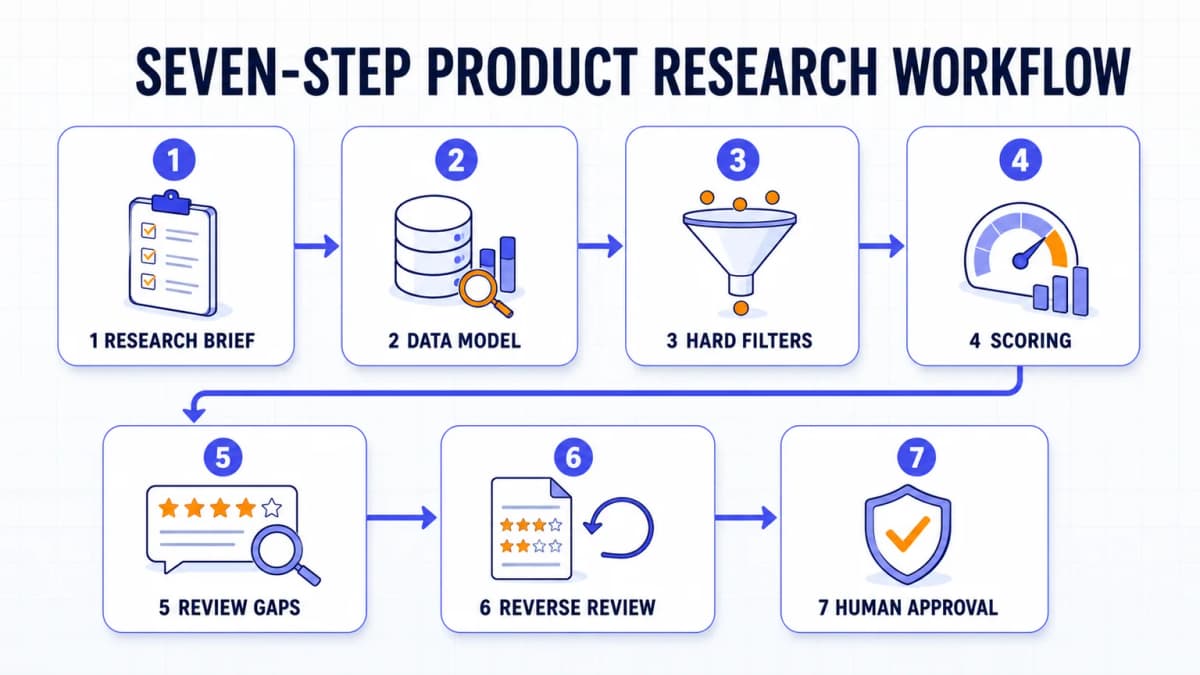
The workflow becomes easier to audit when it is divided into seven layers. Each layer has a clear input, transformation, output, and stopping condition.
1. Define the Research Brief
The first step is to describe the business that will operate the product. The brief should define:
- Target marketplace and category
- Price range
- Available launch budget
- Maximum acceptable loss
- Product size and weight limits
- Target contribution margin
- Supplier capabilities
- Existing design or manufacturing strengths
- Products the team will not enter
- Customer needs the team is equipped to solve
A useful brief is specific. For example, a small team with plastics and silicone sourcing experience might research standard-size, non-electrical Home & Kitchen products with stable demand and recurring review complaints that can be solved without complex certification.
If the brief is vague, automation only allows the team to process the wrong candidates faster.
2. Build a Unified Data Model
The workflow can begin with four core tables:
markets: keywords, niches, demand, competition, and concentrationproducts: ASINs, price, sales, BSR, reviews, dimensions, and variantscosts: supplier, freight, fulfillment, advertising, returns, and cash requirementsrisks: patents, trademarks, compliance, seasonality, returns, and supply continuity
Each field should store its source, retrieval date, marketplace, unit, estimate status, and missing-value rule. Raw responses should remain available for audit.
Instead of filling the products table by hand, Codex can seed it with a filtered Amazon product search across price, sales, keywords, BSR, reviews, dimensions, weight, and fulfillment. The raw response can remain attached while the selected fields are mapped into the common schema.
3. Apply Hard Rejection Rules
Hard filters should run before scoring. Common rejection conditions include:
- The product cannot meet the minimum contribution profit.
- Dimensions or weight exceed the team’s logistics limits.
- MOQ or initial cash exposure exceeds the approved budget.
- Required certification is outside the team’s capability.
- The sourcing timeline misses the seasonal demand window.
- Material patent or infringement risk remains unresolved.
- Critical data is missing and the economics cannot be calculated.
Category-level crowding can be tested before the workflow spends time on individual listings. Nexscope's market statistics endpoint gives Codex average price, rating, BSR, sales, seller-count, and new-product metrics to compare with the brief's rejection thresholds.
These thresholds belong to the seller. They should reflect capital, supply capability, brand strength, and operational tolerance rather than a universal “winning product” formula.
4. Score Viable Candidates
Products that pass the hard filters can move into a weighted score. One practical example is:
| Dimension | Weight | Evidence |
|---|---|---|
| Demand quality | 25 | Market size, trend, seasonality, keyword coverage |
| Competitive accessibility | 20 | Concentration, reviews, new-product entry, pricing |
| Profit and cash efficiency | 25 | Contribution profit, MOQ, lead time, cash exposure |
| Supply chain fit | 15 | Materials, customization, packaging, quality control |
| Risk control | 15 | IP, compliance, returns, seasonality, continuity |
Keyword-level evidence can fill several parts of the score without collapsing them into one opaque number. A Nexscope opportunity report can bring market potential, product traits, reviews, customer profiles, trends, and pricing into the same candidate record; Codex should still retain every component score and deduction.
Some risks should remain vetoes. A severe infringement concern should not disappear because a product has strong demand and attractive margins.
5. Mine Review Gaps
Market data can show that a category is active. Reviews help explain where current products disappoint buyers.
Rather than copying reviews one listing at a time, Codex can retrieve selected ASIN and star-rating bands through Nexscope's Amazon reviews endpoint. It can then classify recurring comments into functionality, material, fit, assembly, cleaning, packaging, instructions, durability, and expectation gaps.
The analysis should distinguish:
- Isolated complaints
- Problems repeated across several competitors
- Problems the team’s suppliers can realistically solve
- Improvements that would increase cost substantially
- Expectations that cannot be solved through product design
A common complaint is not automatically a profitable opportunity. If customers want a major material upgrade but refuse a higher price, the apparent gap may produce weak unit economics.
Review insights can also inform later Amazon listing optimization, but product changes should be validated before they become marketing claims.
6. Run a Reverse Review
Most research reports are designed to prove why a candidate should move forward. A stronger workflow also tries to disprove the recommendation.
Codex can receive a separate instruction:
Assume the team is preparing to invest in this product. Identify the five most likely reasons the launch could fail, show the supporting evidence, and list every risk that remains unresolved.
The reverse review should examine:
- Demand driven by a short-lived event
- Declining or highly volatile search interest
- Sales concentrated among a few brands
- New-product growth caused by deep discounts
- Profit dependent on unrealistic ad assumptions
- Return rates that could eliminate the margin
- Differentiation that suppliers can copy quickly
- Hidden testing or compliance costs
- Inventory turns that exceed cash-flow capacity
To challenge the demand case, Codex should look beyond the latest monthly total. Nexscope's seven-day keyword history can show whether exact-query demand across supported marketplaces is stable, seasonal, or already weakening.
A workflow that only recommends products has limited decision value. It must be able to reject every candidate when the evidence does not support investment.
7. Add Human Approval Gates
The following actions should not execute automatically:
- Contacting a supplier with binding commercial terms
- Paying for samples
- Accepting a patent or compliance conclusion
- Selecting the first purchase quantity
- Placing a purchase order
- Submitting certification documents
- Publishing major listing changes
- Sending confidential operating data outside the approved environment
At each gate, Codex should present confirmed facts, unconfirmed inputs, the current recommendation, the largest downside, and the exact action requiring approval.
Mature automation reduces the number of decisions that require attention. It does not remove accountable decision-makers.
A Reusable Codex Task Template for Amazon Product Research
The following structure can be adapted to a category, marketplace, budget, and supplier base. The values are examples, not Amazon rules.
Objective
Identify up to five product opportunities in different Home & Kitchen subcategories for Amazon US, ideally three evergreen products and two seasonal products. Return fewer than five when the available evidence does not support five qualified products. A seasonal candidate must have enough development and inbound-shipping time to reach FBA at least 60 days before expected peak demand.
Operating Targets
- Example total test budget: approximately $70,000.
- Example per-product budget: approximately $14,000.
- Example maximum loss per product: approximately $2,800.
- Initial inventory: no more than 300 units per listing across three to five variants.
- Stop replenishment when average daily sales remain below two units after the 90-day validation period.
- Six-month target: at least 300 monthly units and approximately $2,800 in monthly contribution profit.
- Mature advertising cost target: no more than 20% of revenue.
- Use conservative, baseline, and optimistic scenarios.
- Keep advertising, returns, storage, promotions, and labor separate from gross margin.
Product Constraints
- FBA eligible
- Standard-size preference
- Package weight within the team’s limit
- Non-fragile and non-electrical
- No complex assembly
- Package weight no more than 1 kg and longest packaged side no more than 50 cm
- Sample-to-first-delivery timeline no longer than 90 days
- Mature replenishment lead time of approximately 30 to 45 days
- No regulated health claims
- Testing documentation required for relevant materials or claims
- No unlicensed entertainment, celebrity, sports, or artwork IP
Market Thresholds
- Monthly niche sales between 3,000 and 50,000 units
- Monthly niche revenue of at least $200,000
- Stable or growing twelve-month demand
- Top-three product, brand, and seller concentration no higher than 40%
- Top-ten product, brand, and seller concentration no higher than 65%
- Amazon Retail sales share no higher than 20%
- At least three products launched within six months, including two that meet the team’s success definition
- Main selling-price range between $25 and $80
- Average return rate no higher than 8%
Keyword Thresholds
- Monthly search volume between 1,000 and 50,000
- Competing product count no higher than 1,000
- Average first-page organic review count no higher than 500
- At least three first-page products with 200 reviews or fewer
- Click concentration no higher than 50%, with conversion concentration reported separately
- Search trend
- Suggested exact-match bid preferably below 5% of average selling price
- Missing-data rejection rules
Representative ASINs can be used to test whether the keyword set reflects real traffic rather than brainstorming alone. By pulling reverse-ASIN keyword data, Codex can compare organic and advertising ranks, search volume, traffic share, conversion, and time-window metrics, then separate broad product-selection terms from narrower launch terms.
Scoring and Output
For each candidate, return:
- Product direction and niche
- Market sales, revenue, and trend
- Product, brand, and seller concentration
- New-product entry evidence
- Price and review barriers
- Core keywords and representative ASINs
- Unit economics and sensitivity scenarios
- Supplier assumptions and manual validation steps
- Differentiation options
- Patent, trademark, compliance, return, and supply risks
- Initial inventory logic
- Ninety-day validation metrics and exit conditions
Every result should receive one status:
- Qualified
- Data-qualified, operations pending
- Insufficient data
- Rejected
The same task structure can be translated into Claude Code instructions, an OpenClaw workflow, or an internal Agent specification. Tool names and permission settings may change, but the business rules should not.
How to Turn One Product Research Run Into an Ongoing System
A candidate does not remain attractive simply because it passed one review. Demand, competition, prices, supplier economics, patents, and marketplace policies change.
Codify the Research Rules
Teams that repeat the same process can store the workflow, scoring definitions, data dictionary, templates, and output contract in a reusable instruction package. Changes to a threshold should occur in one controlled location so operators do not run different versions of the research standard.
Store Project Boundaries
The project configuration should record:
- Where source files are stored
- Which APIs and scripts may be called
- Approved marketplaces and date ranges
- Field and unit definitions
- Files that must not be overwritten
- Actions requiring confirmation
- Required validation checks
- Report output location
Recheck Market Assumptions
At each review cycle, Codex can refresh product attributes and up to twelve months of ASIN sales history through Nexscope's product history endpoint. Comparing the new pull with the prior record exposes changes in price, sales, listing status, and variants without rebuilding the research process.
The monitoring workflow can flag:
- Search demand below the approved threshold
- New competitors entering the niche
- Falling prices
- Rising review barriers
- Sales or BSR reversals
- Supplier cost increases
- Margin falling below the minimum
- New IP or compliance questions
Automated monitoring still depends on a running environment, valid authorization, and an active schedule. A local session should not be assumed to continue after it closes.
How the Workflow Screens 300 Candidate Amazon ASINs
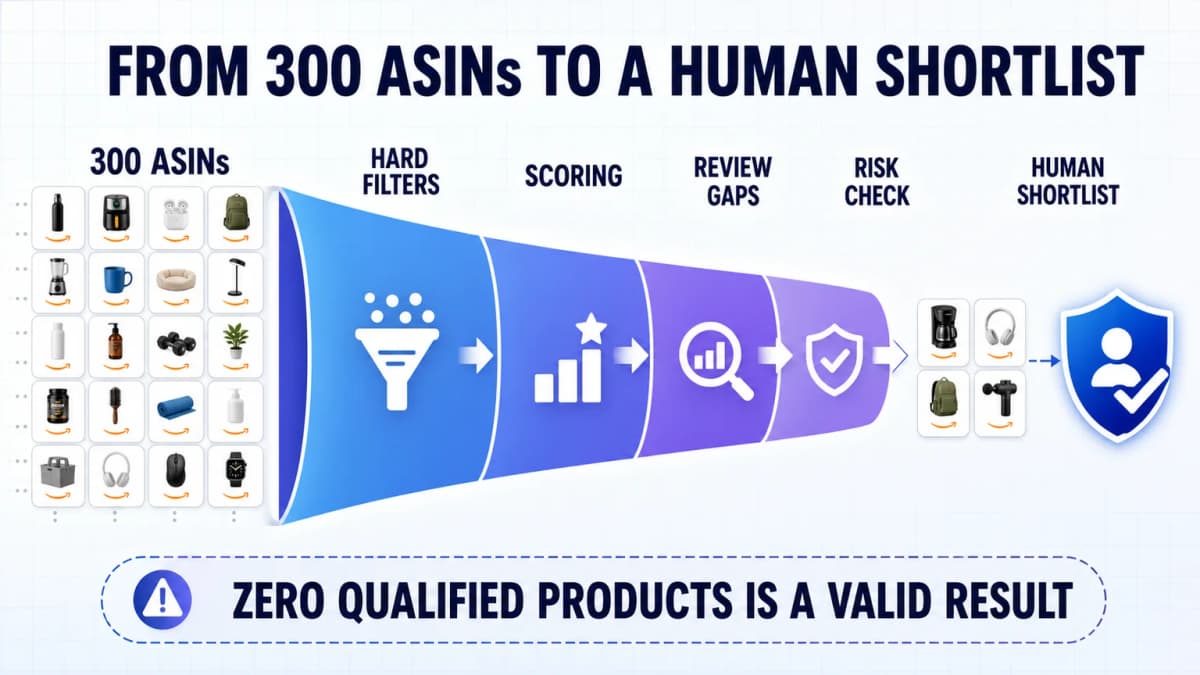
Assume the team imports 300 candidate ASINs from an approved source.
Round one: hard filters. Codex rejects products that exceed size, weight, certification, budget, MOQ, or contribution-profit limits. Candidates with critical missing data move into a verification queue rather than passing automatically.
Round two: demand and competition scoring. The remaining products receive scores for demand, competition, economics, supply fit, and risk. To keep that comparison on one date range, Codex can request daily estimated ASIN sales and the latest known price from the sales-estimate endpoint.
Round three: review analysis. Codex identifies repeated complaints across leading competitors and separates solvable product gaps from expensive or unrealistic customer expectations.
Round four: reverse review. High-scoring products are tested for seasonal dependence, price pressure, advertising reliance, return exposure, easy-to-copy differentiation, and supply-chain weakness.
The workflow may leave only a small group for supplier calls, samples, legal review, and financial approval. It may also leave none.
“No products met the current requirements” is a valid and useful result. Forcing the system to return ten “blue ocean” products weakens every rule established earlier.
Three Mistakes That Break Automated Amazon Product Research
Prompt-Only Research
A detailed prompt cannot create current sales, supplier quotes, or patent evidence. Without approved data sources, Codex can analyze public information and provided files, but the report will contain more assumptions and missing fields.
The solution is to separate instructions from evidence. The prompt defines the question and decision rules. Data connections provide the observations. The report must show which values are verified, estimated, assumed, or unavailable.
Scores Without Rejection Rules
A large market can still carry unacceptable infringement risk. A high projected margin can still require certification, inventory, or lead times the team cannot support.
Hard risks should remain hard risks. They should not be averaged into a score that allows unrelated strengths to cancel them out. Rejection logic must run first, and every veto should remain visible in the report.
Automation Without Approval
Product research affects cash, inventory, contracts, compliance, and brand reputation. A workflow that bypasses responsible approval increases operational risk.
Codex should stop before sampling, payment, legal acceptance, purchasing, or external distribution of confidential data. The purpose of automation is to prepare a better decision, with less repetitive work and stronger evidence.
Amazon Product Research Workflow Launch Checklist
Before the workflow runs against a large candidate pool, confirm the following:
- [ ] Marketplace, category, budget, and supply boundaries are defined.
- [ ] Each field records its source and retrieval date.
- [ ] Marketplaces, currencies, units, and periods are normalized.
- [ ] Estimates remain labeled as estimates.
- [ ] Empty values and failed requests are not converted to zero.
- [ ] Hard rejection rules run before scoring.
- [ ] Profit includes advertising, returns, storage, promotions, and inventory exposure.
- [ ] Supplier prices and MOQ values remain provisional until confirmed.
- [ ] Every candidate receives a reverse review.
- [ ] Patent, trademark, copyright, testing, and compliance issues have manual owners.
- [ ] Payments, purchase orders, and external sends require approval.
- [ ] Logs preserve inputs, calculations, scores, and rejection reasons.
- [ ] Monitoring includes warning thresholds and stop conditions.
Marketplace requirements also change. A scheduled policy-feed check can bring marketplace, regulation, and compliance updates into the same risk queue. Codex can flag the relevant changes, while the responsible team decides how each one affects the product.
Conclusion
An Amazon product research workflow with Codex should turn the team’s experience into a repeatable evidence process. Codex can gather approved inputs, normalize data, apply hard filters, calculate scores, analyze reviews, challenge recommendations, and prepare a clear decision package.
Claude Code, OpenClaw, and other capable Agent runtimes can use the same architecture. The durable asset is the combination of a documented research brief, structured data, explicit rejection rules, transparent scoring, and human approval gates.
Public web search remains useful for discovering context. Structured marketplace, keyword, product, review, sourcing, and risk data make repeated analysis easier to audit. Teams that want to replace manual collection with one authorized connection can bring supported Amazon data into their own Codex or other Agent workflow through the Nexscope Amazon Data API, using REST API or MCP.
Frequently Asked Questions
Can Codex fully automate Amazon product research?
Codex can automate data retrieval from approved sources, file processing, normalization, hard filtering, scoring, review classification, reporting, and scheduled checks. It should not independently approve patents, certify compliance, pay suppliers, place purchase orders, or decide how much inventory the business can risk. Those actions require accountable human review.
Can Claude Code run the same product research workflow?
The same research design can work in Claude Code or another Agent environment that can read files, run code, and call the required tools. Configuration, permissions, and command syntax may differ. The data dictionary, filtering rules, scoring model, risk checks, output format, and approval gates can remain the same.
Does Codex automatically have live Amazon data?
No. Codex can use the web, files, tools, and connections available in its environment. It does not automatically receive live Amazon sales, BSR, keyword, review, or seller data. A team must provide authorized APIs, MCP connections, database access, or exports and define how the workflow should handle missing and estimated values.
Can Nexscope data be connected through REST API or MCP?
Yes. Nexscope provides supported ecommerce data through REST API and MCP access. The Agent, model, prompts, permissions, and workflow remain under the user’s control. Available fields depend on the selected endpoint, marketplace, request parameters, and source coverage.
Can the workflow use 1688 supplier data?
Yes. Structured 1688 product and supplier signals can support initial sourcing research, including product discovery, indicative prices, MOQ, sales, supplier, and trade information where available. The seller should still request a formal quotation, inspect samples, verify materials, confirm production capacity, and calculate landed cost before approving a supplier.
Can patent APIs prove that a product has no infringement risk?
No. Patent and visual-similarity tools can identify records and risks that deserve further investigation. They cannot guarantee freedom to operate or replace a professional legal opinion. A responsible workflow records the search method, jurisdictions, date, results, and unresolved questions before sending the candidate to qualified counsel.
How often should Amazon product opportunities be reviewed?
The schedule should match the product’s volatility and the team’s decision cycle. Weekly reviews may be appropriate for price, sales, advertising, or fast-moving seasonal signals. Monthly reviews may be sufficient for slower niches. Policy, patent, supplier, and compliance changes should trigger additional reviews whenever material new evidence appears.
Sources
- OpenAI. (2026). Codex Documentation. Retrieved from learn.chatgpt.com
- Anthropic. (2026). Claude Code Overview. Retrieved from docs.anthropic.com
- Amazon. (2026). Amazon Seller Central Product Research and FBA Resources. Retrieved from sellercentral.amazon.com
- United States Patent and Trademark Office. (2026). Patent and Trademark Search Resources. Retrieved from uspto.gov