

TikTok Shop Black Friday 2026 Fashion Guide for Sellers
Black Friday 2026 falls on Friday, November 27, followed by Cyber Monday on Monday, November 30. For TikTok Shop sellers in the United States, the platform's published 2026 BFCM calendar lists the Black Friday and Cyber Monday promotion from November 11 through December 1. A separate U.S. Creator Community Challenge runs from November 1 through December 1, with creator sample selection scheduled for October 18-31. Because campaign calendars and eligibility can vary by market and shop, sellers should confirm the latest dates in Seller Center before committing inventory or promotional pricing.
Fashion sellers cannot wait until the official promotion begins. Product selection, first-round inventory, short-form video testing, and creator sampling all need lead time. TikTok Shop's cross-border fashion guidance points to seven broad opportunity groups and recommends a staged September-to-December plan that moves from assortment planning to content testing, then peak-season scaling and replenishment. The following timeline turns that guidance into a practical workflow for choosing seasonal products, validating demand, building shoppable content, and protecting fulfillment during the 2026 holiday peak.
Three-Stage Black Friday Timeline
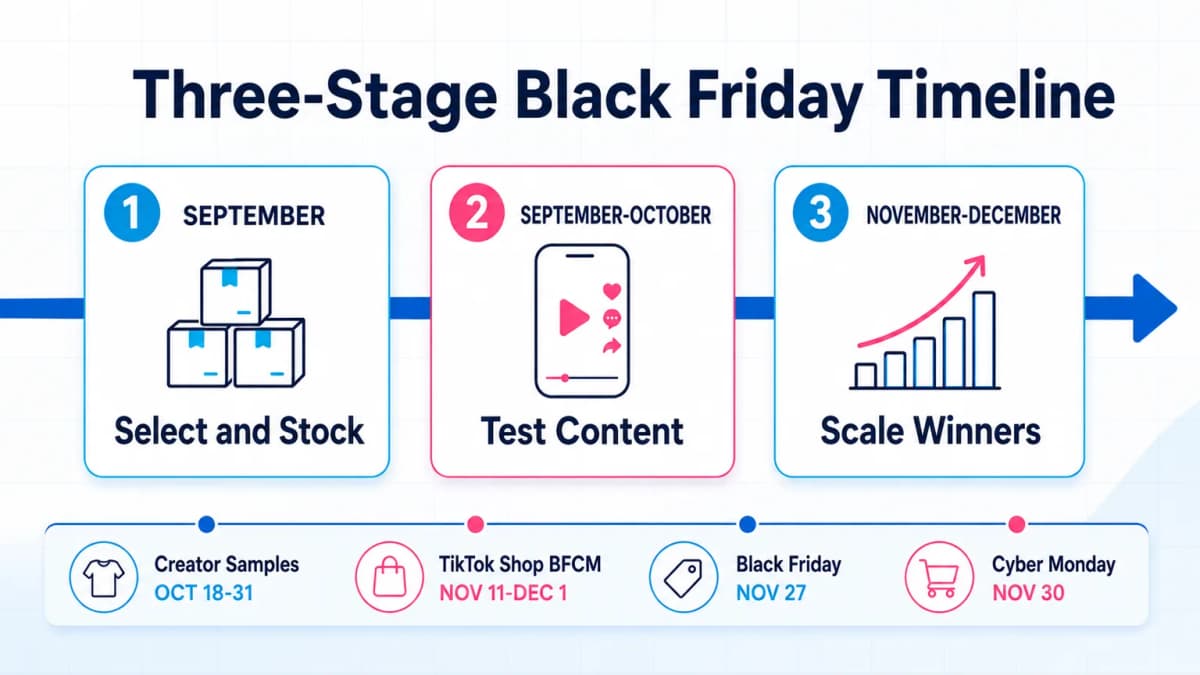
The official promotion window is the selling peak, while the work that determines performance starts weeks earlier. Fashion products need enough time for samples, fit checks, listing preparation, creator delivery, content testing, and replenishment. Sellers can use the following three-stage plan as the operating backbone for September through December.
September: Select and Stock
September is the month to lock the initial assortment. Choose a focused set of products that fit fall, winter, gifting, and event-led demand. For each candidate, check whether its margin can absorb platform discounts, creator commissions, returns, shipping, and paid promotion.
The first inventory order should support testing without tying up excessive cash. Fashion has additional risk from sizes, colors, materials, and fit. A product with healthy top-line demand can still perform poorly when the size curve is wrong or the supplier cannot repeat the same quality.
Complete the basic preparation during this stage:
- Define the hero assortment. Select the products most likely to earn content attention and repeat purchases.
- Build a size and color plan. Allocate inventory based on evidence instead of ordering every variation equally.
- Reserve production capacity. Confirm supplier lead times, quality-control steps, and replenishment minimums.
- Prepare creator samples. TikTok Shop's U.S. Creator Community Challenge lists October 18-31 as the sample-selection period, so eligible products and sample stock should be ready earlier.
September-October: Test Content
The second stage connects products with content. Publish short shoppable videos, image posts, and LIVE demonstrations before the main promotion begins. Test one clear variable at a time, such as the opening hook, product angle, on-body styling, feature demonstration, offer framing, or call to action.
Views alone do not identify a winning product. Track click-through rate, product-page visits, add-to-cart behavior, conversion, cancellations, and returns where those signals are available. A video with modest reach may still create stronger commercial intent than a high-view clip with weak product clicks.
Use October to remove products that repeatedly miss the mark, improve listings for products that attract interest, and expand the content library for the most promising items. Sellers that need a more detailed inventory, creator, pricing, and campaign checklist can use the existing TikTok Shop Black Friday readiness plan alongside this fashion-specific guide.
November-December: Scale Winners
Once the campaign window begins, concentrate attention on products that have already shown demand and content potential. Increase the frequency of proven formats, coordinate creator posts, maintain LIVE coverage, and move paid support toward assets that generate profitable product actions.
Scaling still requires daily controls. Monitor in-stock rate, size availability, discount depth, commission, fulfillment delays, cancellations, and return signals. Replenish products that continue to convert within an acceptable margin. Slow down products whose sales depend on unsustainable discounts or whose return risk is increasing.
After Cyber Monday, keep products with Christmas gifting, winter-use, or New Year relevance active. TikTok Shop's published U.S. BFCM window extends through December 1, but holiday demand can continue after that date. Campaign eligibility and traffic support should always be checked in the seller's own market.
Seven TikTok Shop Fashion Categories
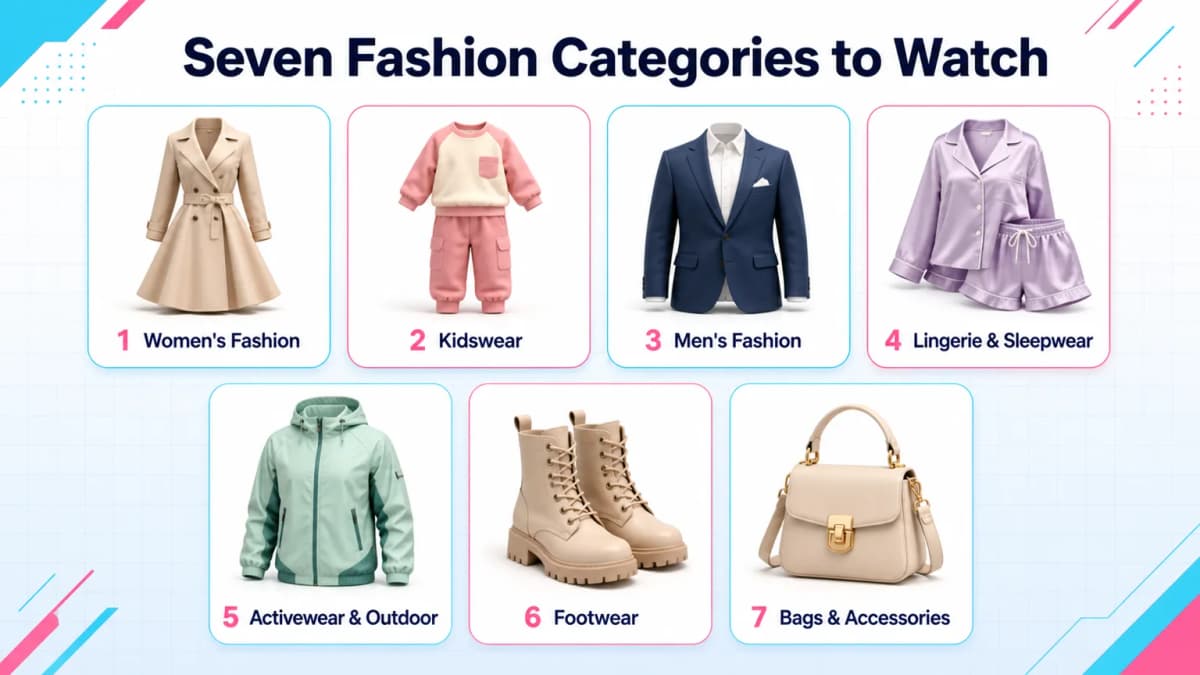
TikTok Shop's source guidance highlights seven broad fashion opportunity groups. These are the seven priority areas discussed in the source, not an exhaustive list of every fashion category available on TikTok Shop. Each group includes several product directions, and sellers still need to validate demand, price, supply, and content fit in their target market.
A repeatable TikTok Shop product research workflow should treat these categories as seeds for validation rather than a fixed shopping list.
1. Women's Fashion
Women's fashion offers the broadest range of seasonal silhouettes and visual hooks. The source highlights jackets, coats, knitwear, tops, and bottoms, with product differentiation coming from shape, material, or design detail.
- Jackets and coats: Faux leather, faux fur, fleece, and tweed support fall and winter styling. Long coats often use straight or A-line shapes, while shorter jackets lean toward relaxed proportions.
- Knitwear: Relaxed sweaters, soft sleeves, stripes, polka dots, natural-looking buttons, cable knits, and ribbed textures give creators visible details to demonstrate.
- Tops: Stripes, checks, leopard patterns, lace, bows, Henley necklines, half-zips, fleece, and corduroy can refresh otherwise basic silhouettes.
- Bottoms: Corduroy, faux leather, brushed linings, studs, embellishment, pleats, and better drape help seasonal products stand apart.
Fashion trends can move quickly, so sellers should treat these details as research directions. Supplier quality, fit consistency, available size ranges, and return history matter as much as the visual trend.
2. Kidswear
Kidswear in the source centers on color, tactile quality, special-occasion details, and flexible styling. Pastel palettes, lace patterns, large bows, layered skirts, and textured fabrics create strong visual moments for short-form video.
Products that work across several settings can offer a clearer value story. A dress that can be worn alone in mild weather and layered with a cardigan in cooler conditions may fit birthdays, family photos, holiday gatherings, performances, and everyday use.
Comfort and safety remain essential. Product pages should accurately describe fabric composition, closure type, care instructions, size guidance, and included accessories. Sellers should also review the applicable children's product rules in every destination market before scaling.
3. Men's Fashion
The men's fashion direction emphasizes cleaner proportions and comfortable layering. Sharper shoulders, longer trouser lines, shorter tailored jackets, and light layers can support both commuting and casual use.
Soft knitwear and lightly structured outerwear add a second opportunity. The strongest products communicate warmth, material texture, fit, and versatility without requiring elaborate styling. Video content can show the same piece in a work setting, at home, and in a casual weekend outfit.
Fit uncertainty can raise returns, especially when a style shifts away from familiar oversized silhouettes. Sellers should provide garment measurements, model measurements, close-up fabric shots, and side views instead of relying only on generic size labels.
4. Lingerie and Sleepwear
Sleepwear can connect comfort with the visual language of fall and winter. Button fronts, hoods, A-line shapes, ruffles, bows, and playful details give sellers multiple content angles. Fleece, flannel, coral fleece, and other plush materials require close-up demonstrations that show thickness, softness, and movement.
Holiday designs can use familiar seasonal symbols and colors. Halloween themes may feature pumpkins, ghosts, or orange-and-black palettes. Christmas products can use snowflakes, gingerbread figures, bows, or warm family-gathering scenes.
Product claims should stay specific. Terms such as "soft," "lightweight," or "warm" need support from material details and clear visuals. Avoid implying medical or therapeutic benefits unless the product and market rules support those claims.
5. Activewear and Outdoor
Activewear spans relaxed sets, recovery wear, sweatpants, outdoor trousers, hoodies, shells, insulated jackets, and functional footwear. The source points to wider silhouettes, heavyweight loopback cotton, fleece, retro athletic styling, water resistance, and garments that move between outdoor, commuting, and casual settings.
Function creates the strongest content proof. Demonstrate pockets, stretch, layering, zippers, hoods, water resistance, traction, insulation, and range of motion. Sellers should describe each function accurately and avoid showing a level of weather protection the product does not provide.
Small-batch testing is particularly useful for performance-oriented products. Start with core colors and a manageable size range, then add colors after sales and return data show which combinations deserve more inventory.
6. Footwear
The footwear directions include women's boots, ballet-inspired flats, comfortable slip-ons, platform shoes, men's boots, and casual styles that bridge commuting, light activity, and indoor wear.
Strong footwear content shows the product from several angles and addresses the questions that drive returns. Include sole grip, closure, toe shape, lining, flexibility, heel height, and a clear size comparison. If a product is described as waterproof, slip-resistant, or supportive, the listing and video should use evidence appropriate to that claim.
Footwear also benefits from seasonal color testing. Begin with reliable colors such as black, navy, brown, or neutral tones, then use creator and sales data to decide whether limited holiday colors deserve additional stock.
7. Bags and Accessories
The source highlights crossbody bags, totes, handbags, wallets, organizers, cosmetic bags, toiletry sets, passport holders, straps, charms, and men's gift sets.
Capacity is an effective entry point for bag content. Show exactly what fits inside, then demonstrate compartments, strap options, closures, lining, hardware, and how the bag looks when carried. Seasonal textures such as quilting, faux fur, checks, or animal prints can create a visual hook without replacing practical product proof.
Giftability adds another Black Friday angle. Wallet sets, card holders, bag-and-pouch combinations, and limited accessories can be presented as ready-to-give options when the packaging and included items are shown accurately.
Validate Fashion Demand With TikTok Data
The seven categories provide a research map, but category inclusion does not prove that every product will sell. Market, price, creator activity, commission, and current sales can vary across TikTok Shop regions.
Nexscope provides structured ecommerce data that teams can connect to their own Agent and workflows through REST API or MCP. In this workflow, the TikTok Product Search API can help compare product sales, creator-driven sales, pricing, and commission data across supported TikTok Shop markets.
Use those fields to narrow the source trends into testable product hypotheses:
- Choose one market and fashion category.
- Compare products within a consistent time window.
- Separate current sales from longer-term cumulative signals.
- Check whether high sales depend on unusually high commission or creator concentration.
- Shortlist products that also meet margin, lead-time, quality, and return-risk requirements.
API data can support prioritization, but some marketplace figures may be estimates or derived from third-party market signals. Keep first-party shop performance separate from external estimates and preserve missing values instead of turning them into zeros.
The same evidence boundary applies when TikTok Shop competitor signals are used to compare stores, products, creators, or content performance.
Validate Fashion Demand With TikTok Data
Compare product, sales, pricing, commission, creator, and content signals before committing peak-season inventory.
Explore TikTok Product Search API →Fashion Content Production
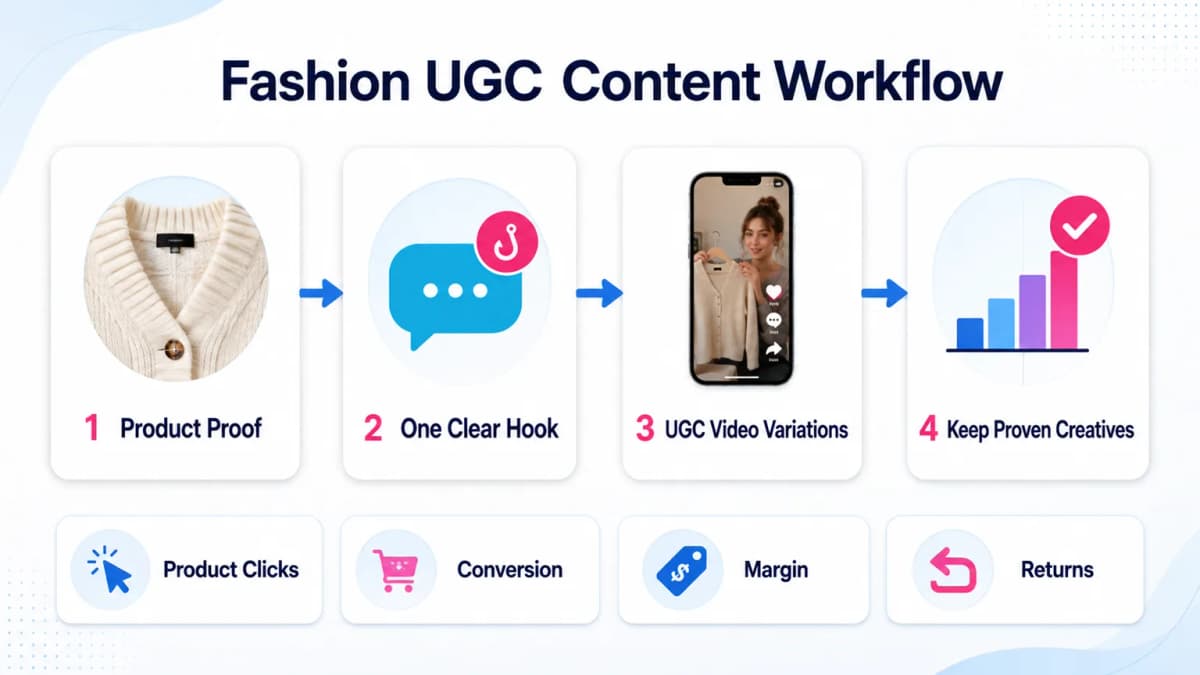
Fashion products need content that makes fit, texture, movement, and use visible. A single polished campaign video cannot answer every buying question. Sellers should build a library of short assets that test different product angles while keeping claims and product details consistent.
Content Angles
Useful fashion angles include:
- Fit and movement: Show the front, side, back, and how the garment moves while walking or sitting.
- Material proof: Use close-ups to show texture, thickness, lining, stretch, and stitching.
- Styling options: Demonstrate two or three realistic outfits without changing the product's actual color or construction.
- Problem and solution: Address a concrete buyer need such as layering, storage capacity, easy closure, or all-day comfort.
- Occasion framing: Connect the product to commuting, gifting, family gatherings, travel, parties, or outdoor use.
- Size guidance: Pair garment measurements with a clearly identified model size and fit preference.
Each video should have one main job. Combining every feature, every use case, and every promotional message into one clip weakens the hook and makes testing harder. A focused bank of TikTok product video ideas also makes it easier to assign one testable angle to each asset.
UGC Video Testing
Nexscope AI UGC Video Generator helps ecommerce sellers create UGC-style product videos from product images. For fashion and adjacent lifestyle campaigns, teams can test variations around product-detail close-ups, creator-led testimonials, real-use demonstrations, styling ideas, and direct-response hooks for TikTok Shop and paid social.
The three examples below represent different testing jobs: a tightly framed beauty detail, a creator-led product testimonial, and a lifestyle demonstration. All three start playing without sound. Each player has its own controls, so readers can enable or disable audio separately without changing the other videos.
Generated content still needs review. Confirm that color, garment shape, print, closure, included items, and product claims match the listing. Keep the strongest variations only after product clicks, conversion, margin, and return behavior support them.
Create More UGC Variations Before the Peak
Turn approved product images into creator-style video variations for controlled TikTok Shop content testing.
Create UGC Fashion Videos →Inventory and Fulfillment Readiness
Fashion assortment planning works only when inventory can reach customers on time. Build the fulfillment plan around the products that have evidence, then account for supplier lead time, receiving time, quality checks, warehouse availability, and peak-season carrier pressure.
Small-Batch Testing
Use small initial orders for products with limited sales history, complex sizing, new materials, or uncertain creator fit. A small batch gives the team time to detect quality, fit, and content problems before the campaign peak.
The purpose of a test order is to generate evidence. Define the sales, margin, return, and content thresholds that would justify a reorder before the inventory arrives. Without a decision rule, a small batch can create activity without improving the next purchase decision.
Reorder Thresholds
A reorder point should combine recent sales velocity with supplier and warehouse lead time. Add a buffer for the campaign peak, but avoid assuming that the highest daily sales rate will continue unchanged.
Monitor inventory at the variation level. A product can appear in stock while its most popular sizes or colors are unavailable. Content should avoid promoting a variation that cannot be replenished within the promised delivery window.
Shipping Capacity
Confirm packaging materials, labeling, pickup schedules, warehouse cutoffs, and exception handling before the event starts. Assign responsibility for urgent orders, cancellations, address issues, damaged units, and delayed inbound inventory.
The original source includes warehouse names, JIT handling, packaging labels, and fulfillment rules for a specific fully managed cross-border program. Those instructions should not be copied into another market. Sellers need to follow the current rules shown in their own TikTok Shop Seller Center and logistics agreement.
Common Black Friday Mistakes
- Treating all seven categories as guaranteed winners. The source identifies opportunity areas, while each product still needs market and margin validation.
- Ordering deeply before testing demand. Large early orders increase cash, return, and markdown risk when fit or content performance is uncertain.
- Starting content production too late. Samples, revisions, creator schedules, and paid-media learning require time before the November peak.
- Optimizing for views alone. Product clicks, conversion, margin, cancellations, and returns provide stronger commercial evidence.
- Ignoring variation-level inventory. Missing core sizes or colors can reduce conversion even when the parent product remains available.
- Copying another market's rules. Campaign dates, eligibility, fulfillment, and promotion mechanics can differ by region and shop.
- Cloning content without permission. Reference footage should be owned, licensed, or otherwise authorized for reuse.
Conclusion
TikTok Shop Black Friday 2026 gives fashion sellers a defined commercial window, but preparation begins before November. Select and stock a focused assortment in September. Test products, listings, creators, and content through September and October. Scale only the combinations that produce healthy commercial signals, then protect inventory and fulfillment through the BFCM and holiday peak.
The seven fashion categories in the source offer a useful starting map. Strong execution comes from validating the local market, showing product details clearly, and matching inventory depth to evidence. TikTok data, UGC-style video testing, and disciplined replenishment can turn broad trends into more defensible decisions.
Once a video structure has already shown that it can hold attention and drive product interest, Nexscope Video Clone can recreate the concept around approved product images, prompts, duration, aspect ratio, and resolution. Sellers can recreate a proven product-video structure only when they own or have permission to adapt the reference footage.

Clone Proven Product Video Concepts
Recreate an authorized reference structure with approved product assets, formats, and generation settings.
Clone a Proven Product Video →No coding required • Instant access
Frequently Asked Questions
When is Black Friday in 2026?
Black Friday falls on Friday, November 27, 2026. Cyber Monday follows on Monday, November 30. These are the calendar dates for the two shopping events. TikTok Shop can run a longer platform promotion around them, so sellers should plan for the full campaign window instead of treating Black Friday as a one-day event.
When is TikTok Shop's 2026 BFCM campaign?
TikTok Shop's published 2026 U.S. calendar lists its Black Friday and Cyber Monday promotion from November 11 through December 1. Its separate U.S. Creator Community Challenge runs from November 1 through December 1, with creator sample selection from October 18 through October 31. Dates and eligibility can differ by market and shop, so Seller Center remains the final source for participation.
Why does preparation start in September?
September gives sellers time to choose products, place initial inventory, check quality, prepare listings, ship creator samples, and begin content testing before the November promotion. Fashion products add complexity through sizes, colors, materials, and fit. Starting early makes it possible to remove weak products and replenish stronger ones before peak demand.
Are these the only seven TikTok Shop fashion categories?
No. The seven categories are the broad opportunity groups emphasized in the source article: women's fashion, kidswear, men's fashion, lingerie and sleepwear, activewear and outdoor, footwear, and bags and accessories. They do not represent TikTok Shop's complete fashion taxonomy, and their inclusion does not guarantee reliable demand in every market.
How can sellers validate a fashion category?
Start with one market, category, and consistent time window. Compare product sales, pricing, commission, creator activity, and content signals, then apply operational checks for margin, quality, supplier lead time, size availability, and return risk. Keep first-party shop results separate from external estimates and preserve every missing data point as missing.
What content should fashion sellers test?
Test short videos that show fit, movement, texture, size guidance, styling options, practical features, and realistic use occasions. Change one major variable at a time so the result can inform the next asset. Evaluate product clicks, conversion, margin, cancellations, and returns alongside views, engagement, variation-level inventory availability, and unexpected stockouts.
Can sellers clone a successful TikTok product video?
Sellers can adapt a proven video structure when they own the footage, have a license, or have clear permission to reuse it. The recreated version should use accurate product images and claims, and it should avoid copying a creator's identity, protected content, or brand assets without authorization. Treat video cloning as a production workflow with rights checks, not as permission to copy any public video.
Sources
- TikTok Shop Academy. (2026). The Loop: October Edition. Retrieved from seller-us.tiktok.com
- TikTok Shop Academy. (2026). TikTok Shop Creator Community: All In for BFCM. Retrieved from seller-us.tiktok.com
- Time and Date. (2026). Black Friday 2026 in the United States. Retrieved from timeanddate.com
- TikTok Shop Academy. (2026). Campaigns 101: Grow Visibility and Sales. Retrieved from seller-us.tiktok.com