

5 Ways to Stretch Your Amazon Ad Budget During Sales Events

An Amazon ad budget can disappear quickly during a sales event when expensive category searches absorb most of the spending. For a seller with limited funds, the immediate decision is where the next dollar has the best chance of producing an affordable order. Increasing every bid leaves less room to test smaller opportunities or keep proven campaigns available later in the day.
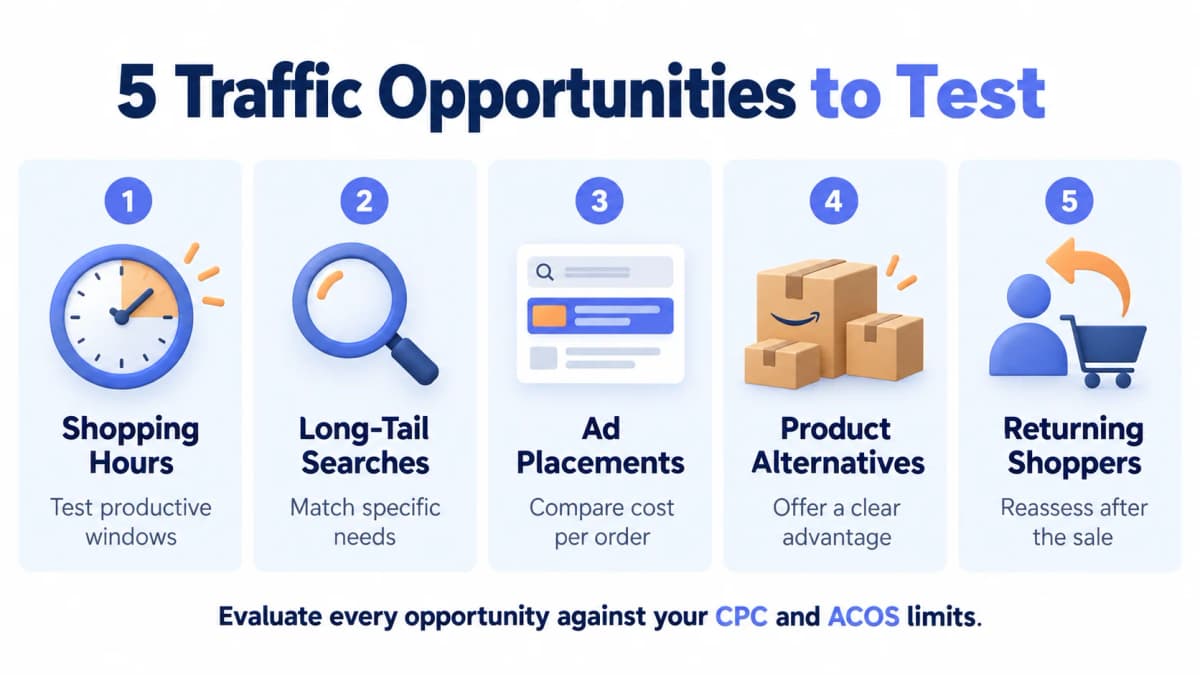
Start by protecting the targets that already earn their allocation. Then use a defined test allowance to evaluate specific shopping hours, relevant long-tail searches, alternative placements, competing products, and returning shoppers. Each opportunity needs a product-level CPC limit and a reason to receive money that could otherwise stay with a proven campaign. The five approaches below focus on that allocation decision. Use the actual promotional price, available inventory, and reporting maturity to decide which test deserves more budget, which needs more evidence, and which should stop. A lower CPC helps only when the resulting orders still meet the product's margin requirements.
Why Peak Sales Events Leave Traffic Gaps
During a promotion, sellers may concentrate spending on broad category terms, flagship products, and prominent placements. That concentration can leave other relevant searches and shopping periods less heavily contested. Whether those opportunities exist for a particular product has to be tested against actual campaign results.
Budget availability also changes throughout the day. Amazon explains that Sponsored Products budgets are not distributed evenly across each hour; strong demand can exhaust a small budget quickly. This makes continuous visibility uncertain for advertisers with limited daily allocations.
A competitor disappearing from a search result, however, does not reveal the reason. Eligibility, bids, relevance, targeting, and the auction itself can also affect visibility. Treat reduced competitive visibility as a research signal, then validate the opportunity using your own costs and conversions.
The objective is to identify purchase intent that your product can serve profitably. Low-cost clicks with poor conversion prospects still consume money that could support better targets.
Set a CPC Limit Before Moving Budget
Use the actual promotional price and contribution after variable costs to set the advertising allowance. An FBA profitability calculation establishes how much remains after product, marketplace, and fulfillment costs. Keep discounts and promotion charges in the calculation without counting them twice.
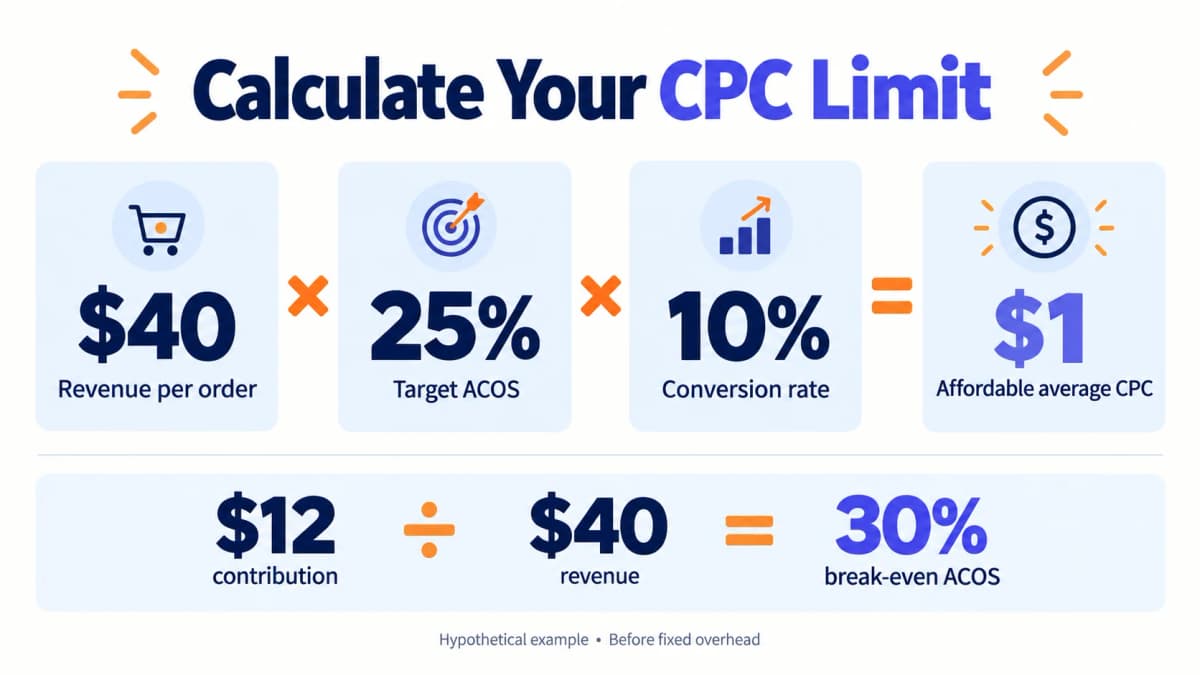
In a hypothetical one-unit order, a $40 selling price and $12 contribution before advertising produce a 30% break-even ACOS, before fixed overhead. A 25% target ACOS allows $10 of advertising per order. With a 10% expected click-to-order conversion rate:
Affordable average CPC = $40 × 25% × 10% = $1.
This is the limit to compare with each proposed traffic test. At $1 per click and 10% conversion, expected advertising cost is $10 per order, leaving $2 of contribution. If conversion falls to 5%, the same target supports only $0.50 per click.
Use expected average click cost to plan the test, and check bidding settings separately. A base bid alone does not enforce this economic limit when other bid adjustments apply.
Five Traffic Opportunities Worth Testing
1. Test Specific Shopping Hours
Review the last comparable promotion and recent performance for recurring periods when conversions remain healthy while CPC becomes more manageable. Use hourly reporting where available, with the account's reporting time zone kept consistent.
Look for a combination of affordable clicks, sufficient order volume, and budgets that remain available. A single inexpensive hour with one sale is weak evidence. Repeat observations across comparable days provide a better basis for testing.
Amazon's budget and bidding rules support scheduled increases for selected periods. Budget rules control spending availability; bid rules affect auction competitiveness. Choose the adjustment that addresses the constraint.
With a fixed event allowance, additional spending in one period must come from an uncommitted reserve or a weaker allocation elsewhere. Prioritize a window with repeated affordable orders before increasing bids simply because impressions are low. A scheduled increase should fit both the CPC limit and the remaining event budget.
Check all active rules and bid adjustments before enabling a new schedule. Record the effective settings and end dates so temporary changes do not continue after the event.
2. Isolate Relevant Long-Tail Searches
A broad query such as “air fryer” can represent many different needs. More specific searches reveal the conditions a shopper wants the product to satisfy:
- small air fryer for an apartment;
- dishwasher-safe air fryer basket;
- air fryer for two people;
- compact air fryer with a window;
- air fryer under 80 dollars.
These are illustrative search ideas, not verified high-volume keywords. Target only terms that accurately describe the product and its current offer.
Start with search term reports from the previous promotion and recent campaigns. Find relevant queries with attributed orders, acceptable ACOS, or promising engagement that deserves a controlled test. Use those findings to refine manual targets and apply negative targeting to exclude unwanted traffic.
Protect an allocation for relevant queries that have already produced affordable orders. Fund unproven variations from the test allowance. Routine search-term optimization supports this selection, but a tight event budget requires a short priority list. Avoid spreading the test allowance across more targets than it can meaningfully evaluate.
Long-tail wording alone does not establish profitability. Continue reviewing the actual queries, conversion performance, and relevance after launch.
3. Compare Search and Product Placements
Top-of-search placement can produce strong conversion rates and still exceed a product's advertising allowance. Evaluate it alongside rest of search and product-page performance using the placement reporting available for the campaign.
Amazon Business placements include search and product pages within the business shopping experience. Do not add Amazon Business figures to other placement totals without checking whether the reporting dimensions overlap.
The following is a hypothetical comparison at $40 revenue per order:
| Placement | Average CPC | Conversion rate | Cost per order | ACOS |
|---|---|---|---|---|
| Top of search | $1.80 | 12% | $15.00 | 37.5% |
| Rest of search | $0.90 | 9% | $10.00 | 25.0% |
| Product pages | $0.60 | 6% | $10.00 | 25.0% |
Cost per order equals CPC divided by conversion rate; ACOS equals that cost divided by revenue per order. In this example, the highest-converting placement exceeds the 30% break-even ACOS, while the other two meet the 25% target.
For a constrained budget, the table supports testing a smaller top-of-search adjustment and monitoring whether more affordable orders become available elsewhere. It does not prove those placements can absorb unlimited spending. Actual results can reverse this pattern. Use comparable reporting periods and sufficient data. Placement adjustments influence bidding; they should not be described as a guarantee that an ordinary Sponsored Products campaign will serve exclusively in one placement.
4. Target Credible Product Alternatives
A popular competitor may attract shoppers whose needs its offer does not fully meet. Those shoppers could prefer a different size, a lower price, a specific compatibility feature, or a more suitable pack quantity.
Sponsored Products supports manual targeting of products and categories. Build a shortlist around a specific reason someone would choose your product:
| Candidate type | Reason to test | What to verify |
|---|---|---|
| Higher-priced alternative | Your offer fits a smaller budget | Compare current prices and included quantities |
| Different feature set | Your product meets an unmet need | Confirm the feature in both listings |
| Less suitable available option | Your variation better fits the shopper | Check current variations and delivery promises |
Strong listing presentation helps shoppers understand the difference after the ad earns attention. Images, compatibility details, and package contents should support the targeting rationale.
Avoid assuming that a large competitor automatically supplies worthwhile traffic. A substantially better discount, stronger review profile, or clearer offer may make your product a weak alternative. Recheck changing prices and availability before increasing spend.
Product targeting also does not guarantee that every impression appears on the selected competitor's detail page. Evaluate the delivered traffic through campaign reporting.
5. Reserve Budget for Returning Shoppers
Some shoppers compare products during an event and purchase later. Reserve enough flexibility to keep proven searches and relevant follow-up campaigns running if the economics remain attractive after the sale.
Amazon display ads offer views remarketing to re-engage eligible audiences who viewed the advertised or similar products without purchasing. Purchases remarketing serves a different purpose, such as reaching previous buyers or shoppers for complementary products. Availability and audience settings depend on the campaign and account.
Set aside a follow-up allowance before the event begins, then release it only if the restored offer can still convert at an acceptable cost. The wider Prime Day advertising plan covers preparation and event phases; this decision concerns how much of a limited budget remains worth spending afterward.
A reserve is permission to evaluate later demand, not a requirement to spend it. If the product becomes less competitive after the discount ends, leave the money unspent or retain it for a better-supported campaign. Avoid imposing a fixed percentage across products with different seasonality, inventory, and purchase cycles.
Recalculate the CPC allowance after the promotion ends. Returning shoppers may still be interested, but their willingness to buy at the restored price has to be measured.
Choose Where the Next Dollar Goes
Use the existing PPC campaign structure to track three spending priorities: proven targets, controlled tests, and any conditional follow-up reserve. Each priority needs a defined allowance within the event total.
When a test requests more money, compare it with the campaign that would lose that allocation:
| Decision | Evidence to review | Budget action |
|---|---|---|
| Keep proven traffic funded | Repeated affordable orders and sufficient inventory | Protect its allocation while the economics hold |
| Extend a promising test | Relevant traffic, credible conversion evidence, and CPC within its limit | Reallocate a limited amount and set the next review point |
| Investigate expensive traffic | Mature results above the allowance or a changed offer | Reduce exposure while diagnosing the cause |
| Hold the reserve | Weak post-event economics or incomplete evidence | Leave funds available until a stronger use is identified |
Moving budget changes the spending plan; raising a bid changes auction competitiveness. Apply the action that addresses the observed constraint. Keep the total event allowance fixed unless the business explicitly approves an increase.
Know When to Pause a Test
Four conditions deserve a prompt review:
- Clicks accumulate without orders. At a historical 10% conversion rate, 20–30 clicks without a sale can trigger an investigation. Treat that as an operational checkpoint, not statistical proof or an Amazon cutoff. Consider spend, reporting delay, relevance, and listing condition together.
- ACOS remains above break-even. Once enough attribution has accumulated, continued overspending requires a specific business justification. Rank improvement alone does not demonstrate that the campaign will recover its losses.
- The offer changes materially. Check Featured Offer eligibility, the promoted variation, pricing, discount display, delivery promises, and review issues. Investigate an offer problem before paying for more visits.
- Inventory becomes a constraint. Estimate stock coverage against expected demand and replenishment timing. Reduce acquisition spending when additional orders would create an avoidable shortage.
A pause creates time to diagnose a problem. Restart only after the reason for the weak result has been addressed or a revised test has a clear budget and purpose.
Avoid Decisions Based on Incomplete Attribution
Conversions can take up to 12 hours to appear in reports. Attribution metrics for a reporting date can continue changing until the applicable lookback window ends. Twelve hours is not a universal point at which sales attribution becomes final.
During the event, monitor spend pace, remaining budget, unexpected CPC changes, inventory, Featured Offer status, and whether the advertised promotion is active. These checks can reveal problems that justify immediate action.
Use more mature data to judge sales efficiency. A same-day ACOS spike may reflect delayed conversions, while an early order can make a very small sample look stronger than it is.
Log each adjustment with its time and reason. Changing the bid, budget, targeting, and product offer together makes it difficult to determine what affected performance. Where practical, change one major input at a time and compare periods with similar reporting maturity.
Your Before, During, and After Checklist
Keep one short allocation record for each product or campaign group:
| Timing | Budget decision | Record |
|---|---|---|
| Before the event | Protect proven demand and define test allowances | Event total, promotional margin, CPC limit, test list, and reserve |
| During the event | Move money only when the evidence justifies the trade-off | Spending pace, attributed results, reporting maturity, offer status, and reason for each change |
| After the event | Release or retain the remaining reserve | Current price, revised conversion expectations, stock coverage, and temporary rules to remove |
Maintain the same reporting time zone and comparable periods. Preserve the evidence behind a successful allocation so the next event starts with more than a list of targets and bids.
Conclusion
Stretching an Amazon ad budget starts with protecting the orders it can already acquire affordably. Evaluate the five traffic opportunities with a defined test allowance, then reallocate only when the evidence supports the trade-off. Keep money available when no additional traffic meets the product's limits.
Competitor selection also benefits from a current view of the offers shoppers are comparing. Teams can use Nexscope to bring structured Amazon product, pricing, and review data into their own research workflows through REST API or MCP. Comparing those inputs with the advertised product helps explain why a particular ASIN belongs in a targeting test.
Keep field coverage, source freshness, and missing values visible. Use Amazon Ads reporting to judge campaign spend and attributed results; public competitor data cannot establish a rival's remaining advertising budget.
Research Competing Products Before You Bid
Compare Amazon product, pricing, and review data through REST API or MCP to build a better-supported targeting shortlist.
 Explore Amazon Data API →
Frequently Asked Questions
Which Targets Deserve a Limited Budget?
Prioritize targets with repeated orders at an acceptable advertising cost, provided the current offer and inventory remain suitable. Allocate a separate, limited amount to new traffic hypotheses. Compare the evidence for a test with the campaign that would give up the money. A promising click-through rate alone is insufficient reason to remove funding from a consistently productive target.
Should Every Event Campaign Get More Budget?
Increase an allocation only when the campaign has a credible use for additional spending. A profitable campaign running out of budget may justify a transfer from weaker activity. A campaign with expensive, poorly converting traffic needs diagnosis first. Within a fixed event total, record where the extra money comes from and how the change affects the remaining days.
Can Cheaper Clicks Stretch the Budget?
Cheaper clicks help when their conversion rate supports an acceptable cost per order. In the article's example, a $0.60 CPC at 6% conversion and a $0.90 CPC at 9% conversion both produce a $10 expected advertising cost per order. Compare that cost with the product's allowance before deciding which placement or target deserves additional money.
When Should a Small Test Stop?
Define a spending review point before launching the test, based on the product's advertising allowance and the uncertainty the business can afford. Investigate missing orders alongside reporting delay, relevance, and offer conditions. Pause when the evidence no longer supports further spending, or when a changed price, eligibility problem, or stock constraint makes the original test invalid.
Must the Post-Event Reserve Be Spent?
A reserve preserves the option to reach returning shoppers; it creates no obligation to keep advertising. Check the restored price, conversion expectations, and remaining inventory before releasing it. Continue only where the likely order economics justify the cost. Leaving money unspent is reasonable when the available opportunities do not meet the product's limits.
Sources
- Amazon Ads. (n.d.). Budgets—the basics and best practices for Sponsored Products. Retrieved from advertising.amazon.com
- Amazon Ads. (n.d.). An introduction to budget and bidding rules. Retrieved from advertising.amazon.com
- Amazon Ads. (n.d.). A simple guide to effective targeting with Sponsored Products. Retrieved from advertising.amazon.com
- Amazon Ads. (n.d.). Everything you need to know about display ads. Retrieved from advertising.amazon.com