

15 AI Tools for E-commerce: From Product Research to Ads

How much time does an e-commerce team spend on repetitive tasks each day? Writing product descriptions, answering customer messages, monitoring inventory, adjusting prices, creating ad creatives, analyzing competitor data—a three-person cross-border team can easily fill an entire day with just these tasks alone.
The real strategic work—product selection, brand positioning, market analysis—gets pushed to late nights or weekends.
The problem isn't effort. The problem is that too many tasks that should be handled by machines are still being done manually.
AI in e-commerce goes far beyond "using ChatGPT to write copy." From frontend shopping experiences to backend inventory and fraud prevention to advertising optimization, almost every workflow has dedicated tools ready to deploy.
This guide breaks down 15 AI tools across 4 categories. Each tool solves a specific problem. By the end, sellers will know which ones to prioritize.
Product Research & All-in-One Platforms
Product research is the foundation of any successful e-commerce business. These tools use AI to analyze market trends, competition, and demand—turning weeks of manual research into hours of focused analysis.
1. Nexscope
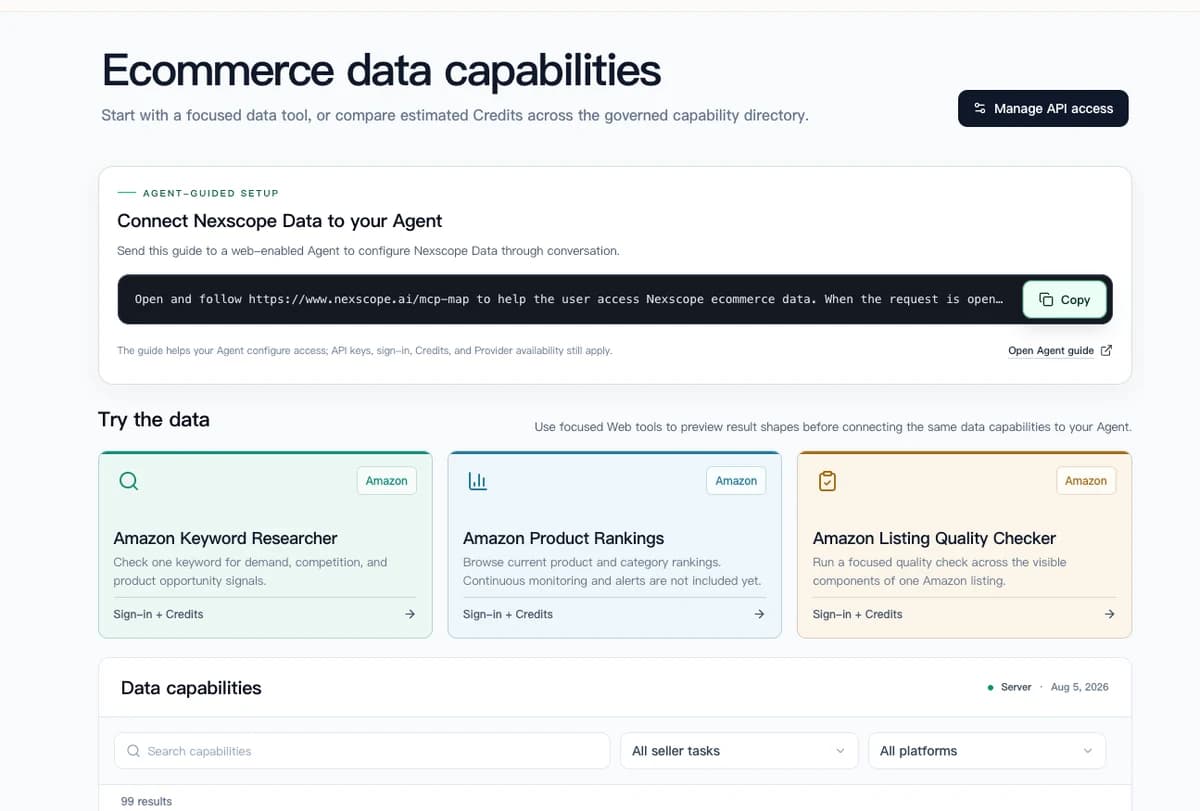
Nexscope provides structured ecommerce data that sellers can use in focused web tools or connect to an existing Agent through API, MCP, or Skills.
What It Does
- Ecommerce keyword, product, ranking, listing, review, and market data
- Focused web tools for previewing result formats
- Agent connections through API, MCP, or Skills
- Ready workflows for Keyword to Ads, Video Clone, and Buy Box repricing
Why It Stands Out
The same governed data layer can support quick browser-based research, internal tools, or the Agent environment a team already uses.
Sellers can start with a focused data tool, connect the required capability to their Agent, or open a ready workflow when the task needs execution.
Key Features
- Ecommerce Data: Structured capabilities for seller research and operating decisions
- Agent Access: Connect through API, MCP, or Skills
- Focused Web Tools: Preview result shapes before connecting the same capability
- Ready Workflows: Keyword to Ads, Video Clone, and Buy Box Repricer
Pricing
New users receive 1,000 free credits.
2. Jungle Scout
Jungle Scout remains the industry standard for Amazon product research. Its database covers millions of products with real sales data, making it essential for data-driven product selection.
What It Does
- BSR trend analysis and sales estimation
- Keyword research with search volume data
- Competitor tracking and monitoring
- Review analysis and sentiment detection
- Supplier database for sourcing
Key Features
- Opportunity Finder: Identifies high-demand, low-competition niches
- Product Tracker: Monitors competitor sales and inventory in real-time
- Keyword Scout: AI-powered keyword research with historical trends
- Review Analysis: Extracts customer pain points from thousands of reviews
Pricing (2026)
| Plan | Monthly | Best For |
|---|---|---|
| Starter | $49 | New sellers |
| Growth Accelerator | $79 | Growing brands |
| Brand Owner + CI | $399 | Established brands |
Best For
Amazon sellers who need comprehensive market data and are comfortable with dashboard-based tools.
Customer Experience Tools
A store's conversion rate depends heavily on how smooth the shopping experience feels. Customers who can't find what they want, get no response to questions, or see irrelevant recommendations will leave. AI tools in this category turn passive browsing into personalized service.
3. Chatfuel
Chatfuel is an AI chatbot platform focused on WhatsApp and Facebook Messenger. For brands whose traffic comes through social channels, it handles customer service without requiring 24/7 human staff.
What It Does
- Automates responses to common questions
- Handles cart abandonment recovery
- Processes payment and shipping inquiries
- Collects customer feedback automatically
Why It Matters
One of the most common reasons for lost sales: a customer has a question during checkout and no one responds. Time zone differences make this worse—European or American customers asking questions at night may wait 12+ hours for a reply. By then, they've already bought elsewhere.
Pricing
Free tier available; paid plans from $14.99/month.
4. Klevu
Klevu is a personalization engine that predicts what customers want based on their behavior. Instead of showing the same products to everyone, it tailors recommendations to individual intent.
What It Does
- Analyzes browsing behavior to predict purchase intent
- Delivers personalized product recommendations
- Supports multi-language natural language processing
- Optimizes search results based on user context
Why It Matters
A store with 500 SKUs presents a discovery problem. Customers who don't immediately find what they want leave within seconds. Klevu solves this by surfacing relevant products before customers even search.
For cross-border sellers targeting multiple countries, Klevu's multi-language NLP ensures German, French, and Japanese customers all receive accurate recommendations—not machine-translated guesses.
Pricing
Custom pricing based on traffic and features.
5. Vue.ai
Vue.ai goes beyond product recommendations to deliver full personalization across the shopping journey. It covers emails, notifications, inventory sorting, and cross-device experiences.
What It Does
- Extracts and enriches product data automatically
- Creates personalized email and notification content
- Enables virtual try-on for fashion products
- Applies intelligent tagging to product attributes
Key Features
- Auto-tagging System: Tags not just products but individual attributes (neckline, fabric, pattern)
- Virtual Fitting Room: Lets customers visualize how clothing looks on them
Best For
Fashion and apparel sellers who need deep personalization and virtual try-on capabilities.
6. Algolia
Algolia fixes the most underrated conversion killer in e-commerce: bad site search. Most store search functions return empty results or irrelevant products when customers use slightly non-standard terms.
What It Does
- Understands natural language queries with typos and variations
- Returns highly relevant results even for imprecise searches
- Provides instant search-as-you-type functionality
- Supports faceted filtering and merchandising rules
Why It Matters
Customers don't blame themselves when search fails. They assume the store doesn't have what they need. Algolia's neural hash technology interprets human expression patterns, returning relevant results even when queries are messy.
Pricing
Free tier up to 10K requests/month; paid plans from $1/1K requests.
7. Syte
Syte enables visual search—customers upload an image and find similar products in the store. This solves a common problem: customers know what they want but don't know what to call it.
What It Does
- Matches uploaded images to similar products in inventory
- Allows customers to click on specific details within an image
- Supports camera search from mobile devices
- Integrates with product recommendation engines
Why It Matters
"That top with the slightly square neckline and puffy sleeves that might be linen"—no text search can handle descriptions like this. Syte lets customers point at exactly what they mean.
Best For
Fashion, home decor, and lifestyle brands where visual discovery drives purchases.
8. Pixelcut
Pixelcut is an AI image editing tool that brings product photos to professional quality without requiring design skills or expensive photographers.
What It Does
- Removes and replaces backgrounds with one click
- Erases unwanted elements from images
- Upscales image resolution
- Generates consistent product photo styles
Why It Matters
Product image quality is the first conversion gate. Professional photography costs thousands per shoot. For new sellers or high-SKU catalogs, that's not feasible. Pixelcut compresses hours of Photoshop work into seconds.
Pricing
Free tier available; Pro from $9.99/month.
Backend Operations Tools
Great frontend experience means nothing if backend operations fall apart. Inventory mistakes cause stockouts or cash flow problems. Payment fraud eats into margins. Manual content creation can't keep pace with catalog growth. These tools automate the operational foundation.
9. Monocle
Monocle is an AI-powered inventory management tool that automates purchasing decisions and tracks products across the entire supply chain.
What It Does
- Predicts demand and automates reorder timing
- Calculates optimal order quantities
- Tracks inventory from manufacturer to customer
- Integrates with multiple warehouses and suppliers
Why It Matters
Inventory is where cross-border sellers lose the most money. Over-order and cash gets tied up. Under-order and bestsellers go out of stock. Monocle uses sales patterns and trends to time purchases automatically.
Best For
Sellers managing multiple SKUs across multiple warehouses.
10. Jasper
Jasper is one of the most mature AI content generation platforms. It handles product descriptions, blog posts, email templates, and ad copy at scale.
What It Does
- Generates product descriptions from specifications
- Creates blog content and marketing copy
- Produces Google and Facebook ad variations
- Maintains brand voice consistency across outputs
Why It Matters
A store with 500 SKUs needs 500 product descriptions. At 15 minutes each, that's 125 hours of writing. Jasper compresses "writing from scratch" into "editing drafts"—a 10x efficiency gain.
Pricing
Creator plan from $49/month; Pro from $69/month.
💡 Pro Tip: For e-commerce-specific content generation, the Amazon Listing Optimization Skill on SkillHub provides pre-built prompts optimized for marketplace listings.
11. Shield
Shield is an AI fraud detection platform that analyzes transaction patterns to identify and block fraudulent payments before they cost money.
What It Does
- Analyzes device, user, and account behavior patterns
- Assigns risk scores to each transaction
- Automatically approves or flags based on thresholds
- Reduces false positives that block legitimate customers
Why It Matters
Cross-border fraud rates are significantly higher than domestic. Credit card theft, fake accounts, and chargeback abuse destroy margins if not controlled. Shield catches high-risk transactions without blocking real customers.
12. Minderest
Minderest monitors competitor pricing in real-time and helps sellers find optimal price points that maximize profit.
What It Does
- Tracks competitor prices across online and offline channels
- Monitors supplier pricing, promotions, and stock levels
- Identifies profit-maximizing price points
- Automates price adjustments based on rules
Why It Matters
Cross-border markets move fast. Competitors may adjust prices multiple times per day. Manual price monitoring always lags. Minderest provides the data foundation for dynamic pricing strategies.
Advertising Tools
Advertising is the most direct path to new customers—and the easiest way to burn money. Poor creatives, imprecise targeting, and misallocated budgets waste ad spend. AI tools in this category optimize every stage of the advertising funnel.
13. AdCreative.ai
AdCreative.ai solves a common bottleneck: creative production can't keep pace with testing velocity. Teams want to test 10 ad variations but designers can only produce 2 per day.
What It Does
- Generates ad headlines, CTAs, and social copy
- Creates visual assets that match brand guidelines
- Produces multiple variations for A/B testing
- Tracks performance data for each creative
Why It Matters
More creative variations means faster identification of winning ads. AdCreative.ai removes the production bottleneck, letting teams test at the speed of ideas rather than the speed of design.
Pricing
Starter from $29/month; Professional from $59/month.
14. Adline
Adline is a cross-channel advertising platform that unifies campaign management across Google, Facebook, Instagram, and other networks.
What It Does
- Manages campaigns across multiple ad platforms in one dashboard
- Analyzes customer touchpoints and conversion paths
- Generates ad copy using natural language processing
- Optimizes budget allocation based on performance
Why It Matters
Every ad platform claims strong performance. But budgets are limited. Adline provides visibility into where each dollar goes and what it produces—across all channels, not just one.
15. Lookalike Audiences
Lookalike audience targeting is a capability built into platforms like Facebook and Google Ads. It finds new customers who share characteristics with existing buyers.
What It Does
- Analyzes behavior patterns of current customers
- Identifies similar users across the platform's network
- Targets ads to high-probability prospects
- Improves over time as more data accumulates
Why It Matters
The best prospects often look like existing customers. Instead of casting a wide net, lookalike targeting focuses spend on users most likely to convert. Acquisition costs drop because ads reach pre-qualified audiences.
Most major ad platforms include this feature natively. Third-party tools like Madgicx can extend these capabilities across platforms.
Tool Comparison by Category
| Category | Tool | Starting Price | Best For |
|---|---|---|---|
| Ecommerce Data | Nexscope | 1,000 free credits | Focused tools and Agent integrations |
| Product Research | Jungle Scout | $49/month | Amazon data and research |
| Customer Service | Chatfuel | $14.99/month | Social channel support |
| Personalization | Klevu | Custom | Multi-language recommendations |
| Personalization | Vue.ai | Custom | Fashion virtual try-on |
| Site Search | Algolia | Free-$1/1K | Natural language search |
| Visual Search | Syte | Custom | Image-based discovery |
| Image Editing | Pixelcut | $9.99/month | Product photo optimization |
| Inventory | Monocle | Custom | Multi-warehouse management |
| Content | Jasper | $49/month | Scaled content generation |
| Fraud | Shield | Custom | Payment risk scoring |
| Pricing | Minderest | Custom | Competitive price monitoring |
| Ad Creative | AdCreative.ai | $29/month | Rapid creative testing |
| Ad Management | Adline | Custom | Cross-channel optimization |
| Targeting | Lookalike | Platform-native | High-intent prospecting |
Conclusion
15 tools across 4 categories. Not every tool applies to every business.
The right starting point depends on where the biggest bottleneck is. Which workflow consumes the most time? Which process produces the most errors? Which task slows down everything else?
That answer points to the first tool worth testing.
For sellers who want to simplify the stack, Nexscope adds ecommerce data to the tools and Agent environments they already use, with ready workflows for Keyword to Ads, Video Clone, and Buy Box repricing.
Connect Ecommerce Data to Your Agent
Use Nexscope through API, MCP, or Skills, or open a ready seller workflow.
Explore Ecommerce Data →1,000 free credits • API, MCP & Skills
FAQs
Which AI tool should an e-commerce seller start with?
Start with the tool that addresses the biggest time sink. For most sellers, that's either product research (Jungle Scout or Nexscope) or content generation (Jasper). These two areas consume the most manual hours.
Are these AI tools worth the subscription costs?
The math is straightforward: if a tool saves 10 hours per month and costs $50, it's worth it if those hours are worth more than $5 each. For most e-commerce operators, time is worth far more than that.
Can AI tools replace human judgment in e-commerce?
No. AI excels at processing data, generating content, and automating repetitive tasks. Strategic decisions—which markets to enter, how to position a brand, which suppliers to trust—still require human judgment. AI is a force multiplier, not a replacement.
How do these tools handle multiple marketplaces?
Most tools in this guide support multiple marketplaces (Amazon US, EU, UK, Japan). Jungle Scout and Algolia have marketplace-specific features. Nexscope exposes ecommerce data capabilities through focused web tools, API, MCP, and Skills.
Is there a free way to test these AI tools?
Yes. Chatfuel, Algolia, and Pixelcut all offer free tiers. ChatGPT has a free version for content generation. Start with free tiers to understand workflows before committing to paid subscriptions.
Sources
- Jungle Scout pricing page (April 2026)
- Jasper pricing page (April 2026)
- Chatfuel pricing page (April 2026)
- AdCreative.ai pricing page (April 2026)
- Algolia pricing page (April 2026)
- Pixelcut pricing page (April 2026)