

7-Step Amazon Keyword Ranking Strategy for Profitable Growth

An Amazon keyword ranking strategy becomes difficult to manage when a team has hundreds of search terms but no clear order for testing them. Some keywords spend every day without producing orders. Others convert through ads but show little organic movement. A few reach a visible position yet have so little demand that the ranking adds limited commercial value.
The practical answer is a repeatable keyword growth system. Sellers can group search terms by buyer intent, make sure the listing supports each group, use PPC to collect conversion evidence, and promote keywords from high-intent long tails to mid-tail opportunities and finally to broad core terms. This approach keeps relevance, conversion, budget, and profit connected.
This guide explains how to organize a large keyword portfolio into manageable clusters, build a seven-step operating process, calculate spending limits, and measure whether paid activity is creating profitable demand. The goal is not to force every related phrase onto page one. The goal is to identify which keywords deserve investment and build a larger set of terms that can generate qualified traffic, orders, and durable organic visibility.
Amazon Ranking Boundaries
Amazon gives sellers several ways to research and evaluate search behavior. Its keyword research guidance covers short-tail and long-tail terms, listing placement, backend search terms, and performance monitoring. Brand Registry sellers can also use Brand Analytics dashboards such as Search Query Performance, Top Search Terms, and Search Catalog Performance.
These resources help sellers examine query volume, impressions, clicks, cart adds, purchases, and conversion. Amazon Ads also recommends using the Search Term Report to identify search queries that perform well and promote them into more focused targeting.
Amazon does not publish a universal formula that guarantees page-one organic placement. No public rule states that a fixed number of orders, a certain number of advertising days, or a particular bid will move an ASIN to a specific organic position.
A useful strategy therefore separates three ideas:
- Indexing: whether an ASIN is eligible to appear for a query.
- Sponsored placement: where an ad appears when the seller wins an auction.
- Organic keyword rank: where the ASIN appears without a sponsored label for that particular query.
The distinction matters because a keyword can generate sponsored orders while its organic position remains nearly unchanged. Sellers who need a deeper baseline can separate these measurements through Amazon keyword ranking fundamentals before scaling a large portfolio.
Why Large Keyword Lists Fail
Mixed Buyer Intent
Keywords can describe the same product category while representing different buyers and product requirements. Consider these queries:
- water bottle
- 32 oz water bottle
- water bottle for hiking
- leakproof water bottle for kids
All four relate to water bottles, but they do not express the same need. A 32-ounce insulated bottle designed for adult commuters may fit the first three searches to different degrees and still be unsuitable for children. Buying traffic for the fourth query can create clicks without dependable conversion.
Keyword relevance is not enough when the underlying purchase intent does not match the product. A large portfolio should contain only terms the product can satisfy truthfully.
Weak Listing Support
Advertising can place a product in front of shoppers, but the listing still has to answer their questions. A shopper searching for a leakproof bottle expects visible evidence in the main image, secondary images, bullet points, specifications, and reviews.
If the query emphasizes leak resistance and the listing never demonstrates the seal, higher bids can amplify the conversion problem. The same principle applies to size, materials, compatibility, intended users, and use cases. Effective listing optimization gives each priority keyword a clear and truthful conversion reason.
Uncontrolled Campaign Structure
Placing hundreds of keywords in one campaign makes budget allocation difficult. A few broad, high-volume terms may consume most of the daily budget before smaller, higher-intent terms receive enough traffic to produce useful evidence.
The team then loses the ability to answer basic operating questions:
- Which keyword cluster needs more budget?
- Which term is spending without conversion?
- Which search query should move into exact match?
- Which term needs a listing change rather than a bid increase?
- Which keyword should be paused before it creates a larger loss?
Campaign structure should make these decisions easier to isolate, measure, and reverse.
Paid and Organic Confusion
Paid orders do not automatically prove organic progress. A keyword review should compare organic position, sponsored performance, total orders, estimated organic orders, total advertising cost of sales, and contribution profit.
If paid orders increase while total orders remain flat and TACoS rises, the campaign may be replacing organic demand or buying traffic that never develops into a stronger natural position. That does not make the keyword useless, but it changes the decision from "keep pushing" to "diagnose relevance, offer quality, and profitability."
The Keyword Cluster Method
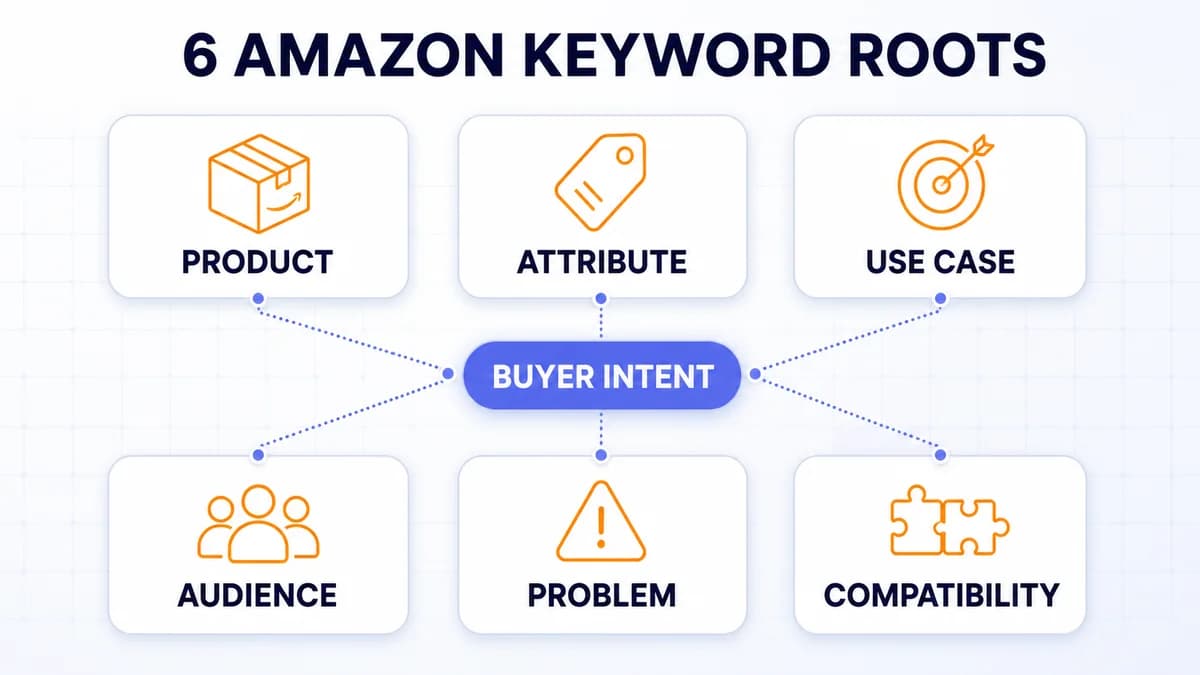
A scalable keyword system starts with roots. These roots describe the product, the buyer, or the condition behind the search. Six useful categories cover most ecommerce queries:
- Product: what the item is.
- Attribute: size, material, color, capacity, or function.
- Use case: office, travel, kitchen, car, outdoor, or another environment.
- Audience: children, older adults, pet owners, professionals, or another buyer group.
- Problem: leakage, noise, cleaning difficulty, limited space, or another pain point.
- Compatibility: a device, model, size standard, accessory, or operating condition.
Teams can combine these roots into groups of terms that share the same purchase intent. An insulated bottle, for example, might have separate clusters for large capacity, leak resistance, straw drinking, commuting, outdoor use, and easy cleaning.
Every cluster should map to the same set of product facts and conversion reasons. If the product team cannot explain why the item satisfies a cluster, that cluster should remain outside the primary ranking plan regardless of its reported search volume.
This structure also makes long-tail expansion more disciplined. A term such as "32 oz leakproof water bottle for hiking" can connect the product root to capacity, problem, and use-case roots. It belongs in the portfolio only when all three claims are accurate and visible on the detail page.
Four Keyword Priority Tiers
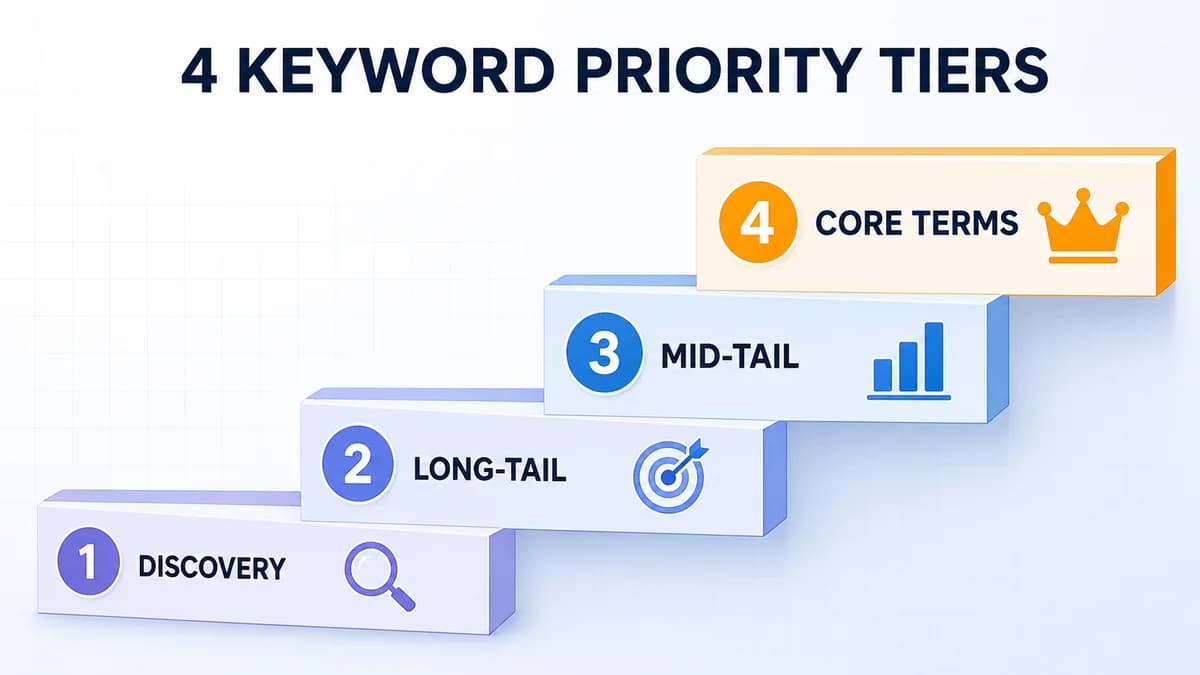
Core Category Terms
Core terms represent the category's broadest commercial demand. A typical product may have five to ten of them. They usually combine substantial traffic with expensive clicks, strong competitors, and less specific buyer intent.
These terms deserve long-term attention, but a new or weak listing should not receive most of its budget from them. Broad traffic can expose weaknesses in click-through rate, conversion, reviews, price, delivery, or product-market fit at a high cost.
Mid-Tail Growth Terms
Mid-tail terms usually express a more specific attribute, audience, or use case. A portfolio might contain 20 to 50 of these opportunities. They often balance meaningful demand with clearer intent and can become the main source of scalable growth after long-tail validation.
High-Intent Long Tails
Long-tail keywords combine the product with specific attributes, problems, audiences, or use cases. Individual search volume may be modest, but the intent is easier for a matching listing to support.
Amazon's own keyword guidance notes that long-tail queries tend to be more specific and may have lower search volume with higher relevance. A group of closely matched long tails can therefore provide the first stable layer of paid and organic demand for a newer ASIN.
Discovery Keywords
Discovery terms appear relevant but lack enough click or conversion evidence. They belong in controlled broad, phrase, or automatic targeting rather than the main ranking budget.
A discovery keyword should eventually move in one of two directions. Strong queries graduate into focused campaigns and listing review. Weak or irrelevant queries receive lower bids, negative targeting, or removal.
7-Step Ranking System
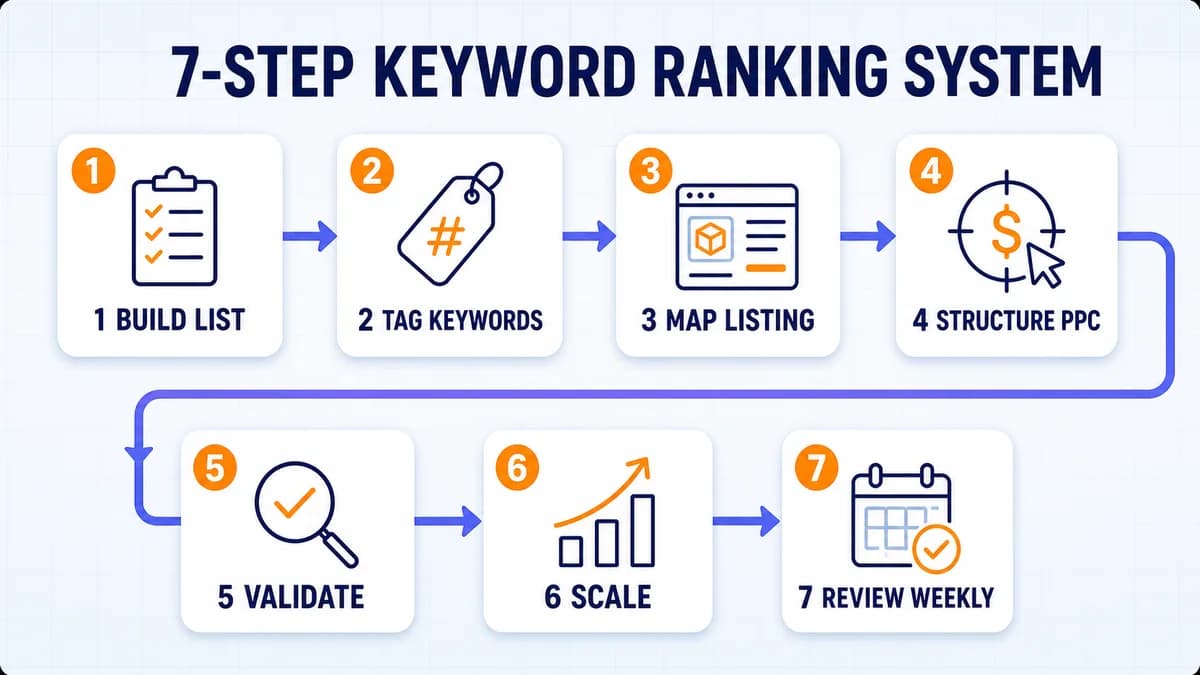
1. Build the Master List
Create one source of truth for every potential keyword. Useful inputs include:
- Amazon Brand Analytics
- Search Query Performance
- Amazon Ads search term reports
- Amazon autocomplete suggestions
- Competitor listings
- Category-leading detail pages
- Customer reviews and questions
- Third-party keyword research data
- Product attributes and use cases
Clean the list before making campaign decisions. Normalize capitalization and spacing, separate meaningful singular and plural forms when performance differs, remove duplicates, exclude competitor trademarks that cannot be used, and delete terms the product does not satisfy.
The list should represent distinct buyer intent. It should not become larger because the same phrase appears in dozens of cosmetic variations.
2. Tag Every Keyword
Each term needs enough context to support a decision. At minimum, record:
- Search demand
- Product relevance
- Purchase intent
- Current organic position
- Current conversion evidence
When available, add suggested bid, cost per click, advertising conversion rate, organic rank trend, competitive concentration, listing coverage, and assigned cluster.
A keyword repository becomes operational only when every term has a role, evidence state, and next action. Without those fields, it is only a collection of search phrases.
3. Map Keywords to Listings
Different listing elements perform different jobs:
| Listing Element | Primary Role | Keyword Use |
|---|---|---|
| Title | Identify the product clearly | Most accurate core product and decisive attributes |
| Bullet points | Explain functions and boundaries | Attribute, problem, audience, and use-case terms |
| Images and video | Demonstrate product facts | Visual proof for the intent behind priority clusters |
| A+ Content and description | Expand buying reasons | Comparisons, specifications, care, and detailed use cases |
| Generic Keyword field | Add relevant hidden vocabulary | Synonyms, abbreviations, and alternate names |
| Category and attributes | Supply structured facts | Size, material, compatibility, quantity, and variation data |
Do not repeat the same phrase everywhere. Amazon advises sellers to place keywords naturally and avoid keyword stuffing. Relevant vocabulary that would make visible copy repetitive can be assigned to backend search terms.
4. Structure PPC by Cluster
Avoid placing the entire keyword portfolio in one undifferentiated campaign. Split targeting by intent and operational task:
- Proven converters in exact match
- Strategic terms with separate budgets
- Mid-tail terms grouped by shared intent
- Long-tail terms in small exact or phrase groups
- Discovery terms in controlled broad, phrase, or automatic campaigns
- Competitor product targeting in separate campaigns
- Branded terms in defensive campaigns
The purpose is budget control. A disciplined keyword harvesting process moves proven search terms from discovery into focused targeting while keeping spend, bids, conversion, and stop-loss decisions visible at the level where the team can act.
5. Validate Before Promotion
A discovery term should not enter the primary budget only because it has high search demand. Promotion requires evidence. The team should be able to answer:
- Does the query match the product closely?
- Is the click-through rate acceptable for the current listing?
- Has the query produced conversions?
- Is customer acquisition cost financially sustainable?
- Has organic visibility improved across a meaningful review period?
- Did total orders increase rather than only paid orders?
- Does the opportunity justify continued budget?
Small samples require patience. At the same time, repeated spend without conversion needs a defined limit. High volume does not justify unlimited testing.
6. Scale by Keyword Tier
New products and weak listings usually have a more efficient path through highly relevant long tails. These queries express clearer intent, create a better match with specific listing evidence, and face narrower competition than broad category terms.
Once several long tails in the same cluster produce stable conversions, the team can test adjacent mid-tail terms. Core terms receive more budget only after the cluster's listing support, click behavior, conversion rate, order volume, and inventory are strong enough to absorb broader traffic.
The long-tail to mid-tail to core sequence is an operating strategy, not an Amazon ranking rule. It is designed to improve evidence quality and budget efficiency.
7. Run Weekly Promotions
Keyword portfolios need both additions and removals. A weekly review should:
- Promote stable converting search terms into exact match.
- Reduce bids or pause high-spend, low-conversion terms.
- Move keywords with improving organic positions into profit monitoring.
- Reassess terms that remain dependent on advertising.
- Check whether listing, price, review, or inventory changes affected results.
The repeating cycle is straightforward: discover, validate, promote, measure organic contribution, and control advertising dependence.
Keyword Profit Limits
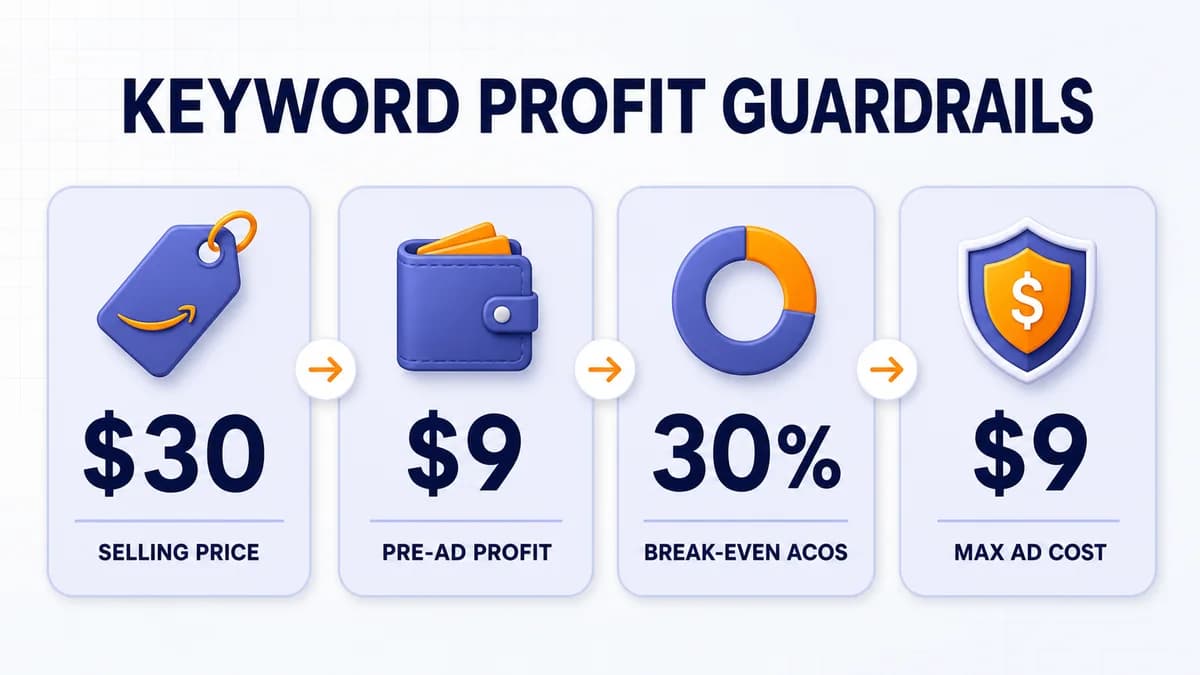
Large keyword programs can lose money quietly because each term appears to spend only a small amount. The combined portfolio still needs a profit boundary.
Assume a product sells for $30. After product cost, inbound shipping, referral fees, FBA fees, storage, promotions, and expected return losses, its contribution profit before advertising is $9.
The basic limits are:
- Break-even ACoS: $9 divided by $30, or 30%.
- Break-even acquisition cost: $9 per advertising order.
Without considering future organic value or repeat purchases, the product can absorb about $9 of advertising cost for each order before the transaction reaches break-even contribution.
Strategic keywords may temporarily exceed that boundary, but the exception needs a written rule:
- Maximum allowed overspend
- Test duration
- Required change in organic position or total orders
- Minimum conversion evidence
- Stop condition
The objective "reach page one" does not remove the need for a loss limit. Sellers should also recalculate contribution profit when FBA fees, discounts, returns, or landed cost change. A keyword that looked acceptable under an older margin may no longer support the same bid.
Ranking Progress Metrics
Consistent measurement matters more than a single page-one screenshot. A practical Amazon keyword rank tracker should distinguish organic and sponsored positions, preserve historical movement, and help teams connect changes with listing edits, PPC activity, price, promotions, and inventory events.
Impressions and Eligibility
First determine whether the ASIN receives consistent impressions for the query. Limited visibility can indicate an indexing issue, weak relevance, insufficient bid, constrained budget, poor offer eligibility, or intense competition.
Before increasing spend, confirm that the product is active, in stock, accurately categorized, and relevant to the target query.
Click-Through Performance
When impressions rise but clicks remain weak, review the search result as a shopper would. The main image, title, price, coupon, rating, review count, delivery promise, and visible variation all influence the click decision.
A higher bid can buy more impressions, but it cannot make a weak search result more convincing. Change one important variable at a time so the team can connect performance changes to a dated action.
Conversion Performance
Clicks without orders indicate a gap between query intent, product fit, listing evidence, and offer quality. Review whether the product delivers the promised function, whether important limits are clear, and whether price and delivery remain competitive.
Amazon Brand Analytics gives eligible sellers funnel-level views across impressions, clicks, cart adds, and purchases. This helps locate where demand is being lost instead of treating every ranking problem as a keyword-placement problem.
Organic Contribution
The last layer asks whether the keyword is creating durable value. Track:
| Metric | Decision Question |
|---|---|
| Organic position | Is unpaid visibility improving over time? |
| Sponsored orders | How much demand is still purchased? |
| Total orders | Did the keyword create incremental volume? |
| Estimated organic orders | Is paid dependence declining? |
| TACoS | Is total advertising becoming more efficient? |
| Contribution profit | Does the keyword create profit after all major costs? |
A page-one screenshot is incomplete evidence. A low-volume page-one term may contribute less value than a position-20 keyword that converts profitably and has enough demand to justify continued work.
80-Keyword Scaling Example
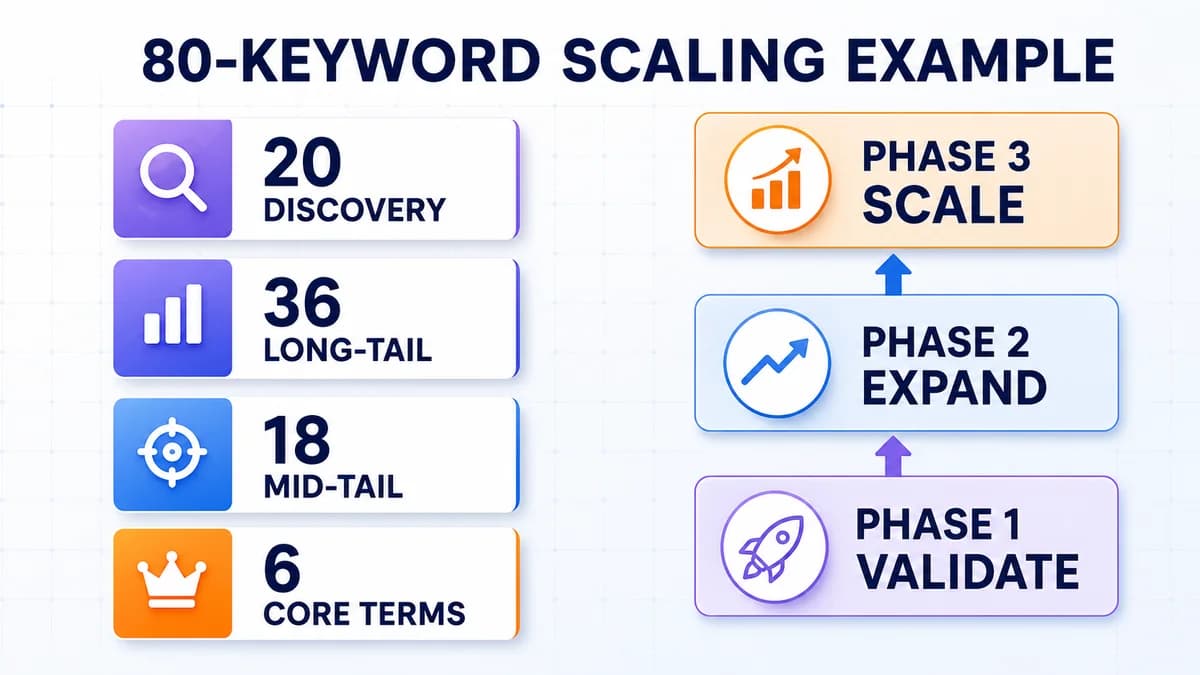
Assume a product has 80 valid keywords after duplicates, irrelevant phrases, and trademark risks are removed. The team divides them into six intent clusters and four operating tiers:
- 6 core category terms
- 18 mid-tail growth terms
- 36 high-intent long tails
- 20 discovery terms
Phase One: Long-Tail Validation
The first phase does not attempt to rank all 80 terms. It identifies long-tail queries with close product fit and stable conversion. Discovery campaigns supply search-term evidence, while exact and phrase groups protect enough budget for promising clusters.
Phase Two: Mid-Tail Expansion
When several long tails in one cluster perform consistently, the team expands to mid-tail terms that express the same buyer intent. The listing already contains the relevant product facts, so the test focuses on whether broader demand remains profitable.
Phase Three: Core-Term Scaling
Core terms receive more budget after the cluster has stable orders, acceptable conversion, stronger organic visibility, and enough inventory. The team continues to monitor whether higher spend increases total demand or simply purchases a larger share of existing orders.
Some terms may reach page one. Others may stabilize on page two or leave the portfolio. That is a normal outcome. The system succeeds when it concentrates resources on keywords that create commercially useful traffic.
Common Ranking Mistakes
- Keyword stuffing: Adding unrelated or repetitive terms reduces readability and attracts poorly matched traffic.
- Manipulated orders or reviews: Search-find-buy schemes, rebates tied to orders, and review manipulation create serious compliance risk.
- Simultaneous changes: Editing the listing, price, coupon, and advertising at the same time makes performance changes difficult to interpret.
- Sponsored-rank confusion: Buying a top-of-search ad does not mean the product holds the same organic position.
- Inventory neglect: A stockout can interrupt momentum after the team has paid to build demand.
- Unlimited strategic spending: A ranking goal without a financial stop condition can turn a useful test into an uncontrolled loss.
- Daily overreaction: One-day movement is weaker evidence than a consistent trend connected to dated operational changes.
Weekly Execution Checklist
Complete Today
- Build the master keyword list.
- Remove irrelevant and trademark-risk terms.
- Classify product, attribute, use-case, audience, problem, and compatibility roots.
- Calculate break-even ACoS and acquisition cost.
- Record organic position and advertising baselines.
Complete This Week
- Create five to eight intent clusters.
- Map priority terms to listing evidence.
- Separate campaigns by cluster and task.
- Assign different budgets to discovery, proven, and strategic terms.
- Define promotion and stop-loss conditions.
Review Continuously
- Promote stable converters.
- Reduce high-spend, low-conversion terms.
- Compare organic position with total orders.
- Monitor TACoS and contribution profit.
- Confirm inventory can support increased demand.
- Remove terms that no longer deserve budget.
Conclusion
Scale Keywords With Evidence
A profitable Amazon keyword ranking strategy organizes search terms by intent, connects each cluster to truthful listing evidence, uses PPC to validate demand, and scales from long-tail queries toward broader terms only when the data supports the move. Ranking, advertising, total orders, and profit should remain separate measurements throughout the process.
Teams that need structured Amazon product, keyword, sales, pricing, review, and market inputs can start with the Nexscope Ecommerce Data APIs and connect the selected data to their own workflows through REST API or MCP.
For Amazon keyword research and ranking workflows, popular Nexscope APIs include:
- Amazon Keyword Expansion expands a seed term into related keywords with search volume, trends, PPC bids, and ranking difficulty.
- Amazon ASIN Keywords reverse-lookups an ASIN's keywords with organic rank, ad rank, search volume, and traffic share.
- Amazon Traffic Keywords lists an ASIN's traffic keywords with traffic source, conversion type, organic rank, and ad rank.
- Amazon Keyword Overview evaluates search demand, product supply, and competitive conditions for a target keyword.
- Amazon Keyword Search History tracks exact keyword search-volume trends in seven-day periods across supported marketplaces.
- Amazon Keyword Share of Voice measures brand visibility across organic and sponsored Amazon search results.
The selected fields should support a specific decision, such as screening keyword clusters, comparing market signals, reverse-looking up competitor traffic, or monitoring rank and share-of-voice changes. Data access does not guarantee organic ranking, and estimates, freshness, sources, marketplace coverage, and missing values still need to remain visible in the workflow.
Connect Amazon Keyword Data to Your Workflow
Browse Nexscope Ecommerce Data APIs to compare keyword demand, competition, traffic sources, rank history, and share-of-voice signals through REST API or MCP.
 Browse Ecommerce Data APIs →
Frequently Asked Questions
How long does it take to rank Amazon keywords?
Amazon does not publish a guaranteed timeline for organic keyword ranking. A highly relevant long-tail query may show progress sooner than a broad category term, but the result depends on indexing, competition, click-through rate, conversion, price, reviews, inventory, and offer quality. Sellers should establish a baseline, record every listing and campaign change, and evaluate a meaningful trend rather than one daily snapshot. The test should also have a financial limit so a slow-moving term does not consume an open-ended budget.
Does Amazon PPC improve organic rankings?
Amazon PPC can create sponsored visibility, clicks, orders, and search-term evidence. Amazon has not published a rule stating that advertising spend directly raises organic position. Sellers should therefore track sponsored placement and organic rank separately. If paid orders increase while organic position and total orders remain flat, the team should review query relevance, listing support, conversion, offer quality, and competition before increasing the bid. PPC is most useful as a controlled discovery and validation channel.
How many keywords should one listing target?
There is no universal number that fits every product. A listing should prioritize terms that accurately describe the product and match buyer intent. Large exports can remain in a research database, while a smaller set receives visible placement, backend coverage, or PPC testing. The operational limit depends on how many terms the team can group, fund, measure, and review without losing decision clarity. Quality, product fit, and evidence matter more than the raw number of phrases.
Should sellers start with long-tail keywords?
New or weak listings often benefit from starting with highly relevant long-tail queries because those searches express clearer needs and usually face narrower competition. The product still has to satisfy the exact intent. A long phrase that describes the wrong audience, material, size, or use case is not a good target. Once related long tails convert consistently, the seller can test mid-tail and core terms within the same intent cluster.
How should Amazon keywords be grouped?
Keywords can be grouped by shared buyer intent using product, attribute, use-case, audience, problem, and compatibility roots. Each cluster should connect to the same product facts and conversion reasons. For example, leakproof terms should map to visible evidence about the seal and usage conditions. Campaigns can then separate discovery, proven, and strategic terms within each cluster. This structure makes budgets, bids, listing changes, and stop-loss decisions easier to manage.
When should a keyword be paused?
A keyword should be reduced or paused when it repeatedly spends beyond its approved limit without producing the required evidence. The exact threshold depends on contribution profit, expected conversion rate, sample size, and strategic importance. Teams should define the rule before testing. A high-volume keyword does not deserve unlimited spend. Pausing is also appropriate when the query does not match the product, creates compliance risk, or depends on a product claim the listing cannot support.
Which metrics matter besides keyword rank?
Keyword rank should be reviewed with impressions, click-through rate, cart adds, conversion rate, sponsored orders, total orders, estimated organic orders, TACoS, contribution profit, price, reviews, and inventory. These metrics reveal where the funnel is failing and whether paid activity is creating incremental demand. A page-one position can still be commercially weak when search demand is low, conversion is poor, or advertising cost absorbs the product's contribution margin.
Sources
- Amazon. (2024). Improve Product Visibility Through Effective Amazon Keyword Research. Retrieved from sell.amazon.com
- Amazon. (2026). Amazon Brand Analytics. Retrieved from sell.amazon.com
- Amazon Ads. (n.d.). 3 Steps to Help Start or Improve Your Keyword Strategy. Retrieved from advertising.amazon.com
- Amazon Ads. (2026). Search Term Report for Sponsored Products. Retrieved from advertising.amazon.com