

8 Best AI Tools for TikTok Shop Sellers and Brands in 2026

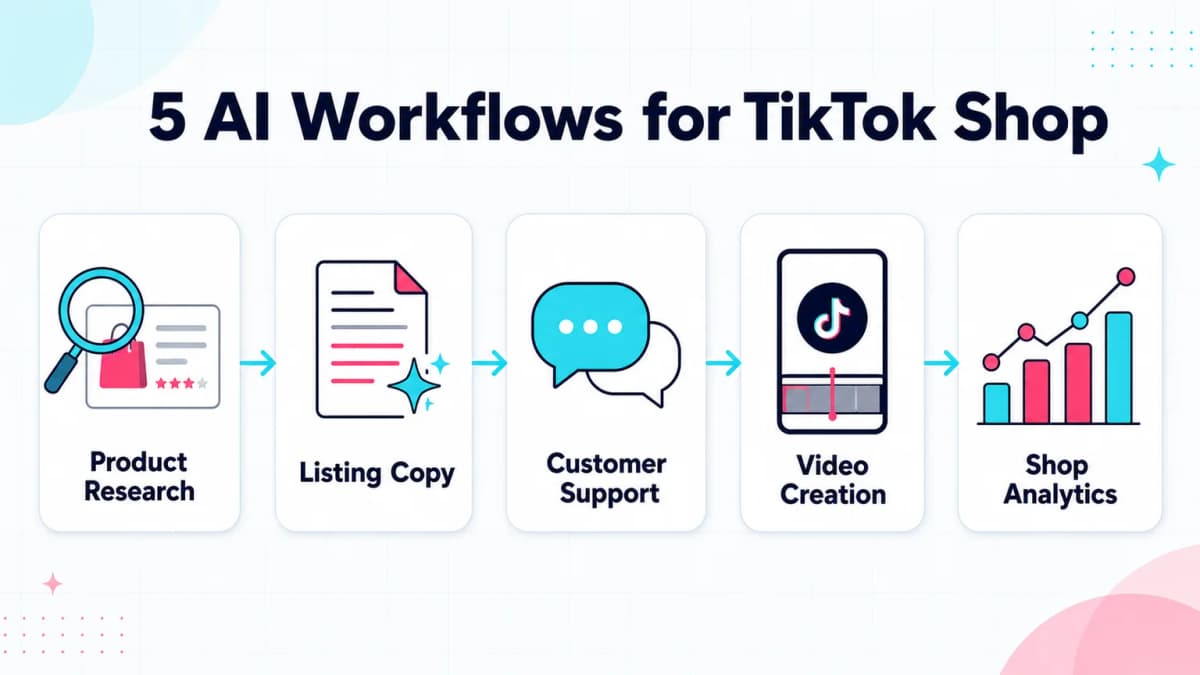
AI tools for TikTok Shop can reduce repetitive work across product research, listing drafts, customer support, video production, and performance analysis. The useful question is not whether a tool uses AI. It is whether the tool fits a specific shop task, accepts reliable inputs, and produces an output that a seller can review before publishing or acting on it.
This guide compares eight tools that fit five practical workflows. It removes broad creator utilities that belong in a general TikTok tools guide, and it avoids income promises that no software can guarantee. Pricing, feature access, and marketplace coverage can change by plan and region, so current official product pages should be checked before purchase.
The strongest stack usually combines first-party TikTok Shop analytics with one focused tool per bottleneck. Sellers can start with research and content, measure the result in Seller Center, then add support or automation only after volume creates a clear need.
Quick Comparison
| Tool | Primary workflow | Best fit | Pricing approach |
|---|---|---|---|
| Kalodata | TikTok Shop product and creator research | Sellers validating products, shops, creators, videos, and livestream signals | Paid subscription; coverage varies by market |
| Nexscope | Structured ecommerce research data | Teams that want data in Nexscope or connected to their own Agent through REST API or MCP | 1,000 free credits; paid plans start at $9 per month with 3,000 monthly credits |
| ChatGPT | Listing and campaign drafts | Sellers who need flexible first drafts from approved product facts | Free plan available; Plus is $20 per month |
| Jasper | Brand-controlled marketing copy | Brands managing repeatable voice and campaign assets | Paid plans; verify current limits |
| Zendesk AI | Multichannel support operations | Larger teams already using Zendesk | Paid support plans and AI usage pricing |
| Tidio | Website chat and AI support | Smaller stores with a connected site or Shopify operation | Free and paid tiers; limits vary |
| CapCut | Short-form video editing | Sellers producing product demonstrations and shoppable videos | Free and premium features; regional pricing varies |
| HeyGen | Avatar and translated video | Brands testing presenter-led or multilingual video formats | Credit-based plans and API usage |
The eight tools do not all connect directly to TikTok Shop. Some support adjacent work such as a connected storefront, brand content, or research. TikTok Shop Seller Center remains the source of truth for shop performance, order, traffic, refund, and content-attribution metrics.
Product Research Tools
Product research for TikTok Shop should combine market signals with operating reality. A rising product still needs acceptable margin, available inventory, compliant claims, a clear content angle, and enough evidence that demand is more than a short spike.
1. Kalodata
Kalodata is designed around TikTok Shop analytics. Its public product materials describe research across products, shops, creators, videos, livestreams, categories, and competitive signals. That makes it more relevant to TikTok Shop product discovery than Amazon-first suites.
Useful workflows:
- Compare product momentum across a selected market and period
- Review creator and video activity around a category
- Inspect shops and livestream formats connected to product demand
- Build a shortlist for deeper margin, compliance, and supply checks
Limitation: sales and GMV figures from third-party analytics can be modeled estimates. Sellers should treat them as directional evidence and confirm performance with first-party data wherever possible.
2. Nexscope
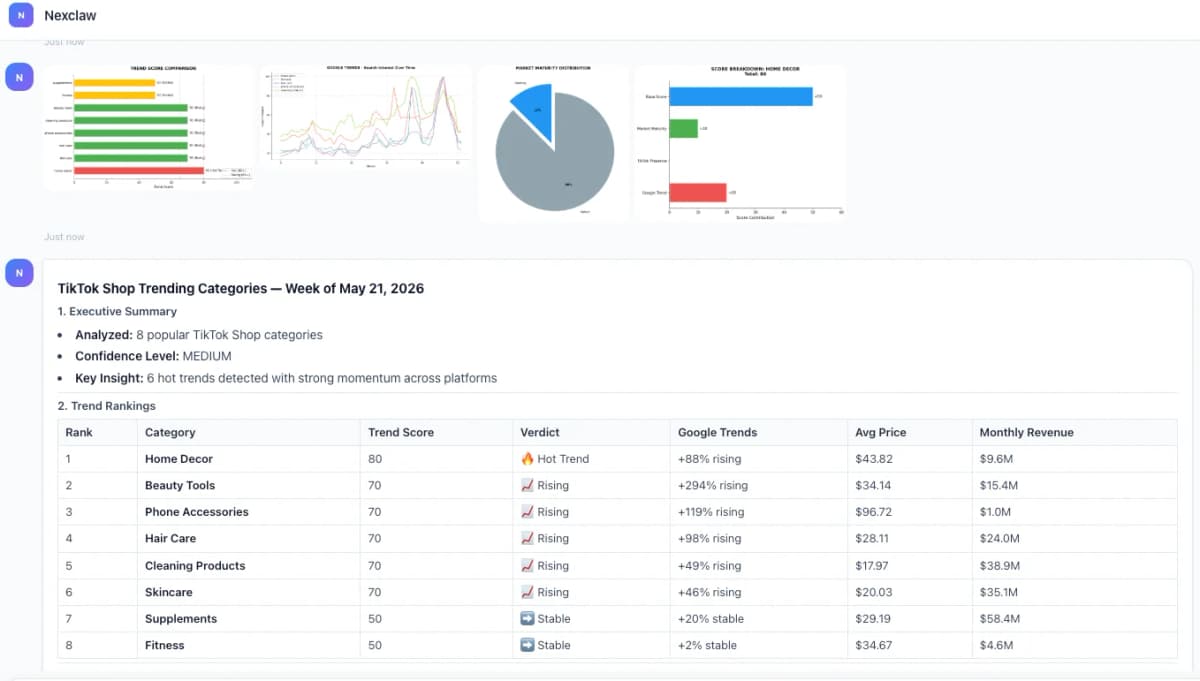
Nexscope is an ecommerce data source and data platform. It provides structured product, market, keyword, review, competitor, pricing, sales, and trend data. Teams can use supported capabilities in Nexscope's web product or connect them to their own Agent through REST API or MCP.
This model fits teams that want research data to remain reusable across internal workflows. A seller can compare product and category signals, inspect review gaps, and pass structured results into an existing decision process without treating an AI answer as final proof.
Useful workflows:
- Compare supported product and trend signals across research tasks
- Organize competitor and review evidence before product selection
- Use the same data in Nexscope or a seller's own Agent workflow
- Preserve source, freshness, estimate, and missing-data boundaries
New users receive 1,000 free credits. The lowest paid plan is $9 per month with 3,000 monthly credits.
Listing Optimization Tools
AI can accelerate listing drafts, but the input needs verified product facts, approved claims, target keywords, dimensions, materials, shipping information, and market-specific policy constraints. Generated copy should be checked against the physical product before publication.
3. ChatGPT
ChatGPT is useful for flexible drafting and revision. A seller can provide a product fact sheet, audience, tone, prohibited claims, and target keywords, then request multiple title, description, FAQ, or video-hook versions.
Useful workflows:
- Turn an approved product fact sheet into listing drafts
- Generate alternative hooks for different customer problems
- Shorten copy to fit channel and field limits
- Review copy for unsupported claims or missing product details
The free plan can support initial testing. ChatGPT Plus is currently $20 per month, while API usage is billed separately.
4. Jasper
Jasper is oriented toward marketing content and brand consistency. It can be useful when a team manages multiple products, campaigns, or contributors and needs a controlled brand voice across listing copy, ads, emails, and supporting content.
Useful workflows:
- Apply an approved brand voice to product copy
- Reuse campaign briefs across formats
- Create variations for review by a content team
- Keep repeated language consistent across a catalog
Limitation: brand consistency does not validate product facts. Teams still need a separate fact sheet and approval step.
Customer Support Tools
Customer support tools are most valuable after inquiry volume becomes repetitive. They should be trained on current shipping, return, warranty, product, and escalation policies. TikTok Shop messages and order issues should remain inside approved platform workflows where required.
5. Zendesk AI
Zendesk AI fits established teams that already manage support across email, web, social, and help-center channels. It can classify requests, suggest responses, route tickets, and use approved knowledge-base content.
Useful workflows:
- Route product, order, return, and account questions
- Suggest replies grounded in approved support content
- Escalate high-risk or unusual cases to a person
- Analyze recurring contact reasons for product or policy fixes
Limitation: Zendesk is usually an adjacent support layer, not a replacement for TikTok Shop Seller Center. Integration and channel eligibility should be confirmed before planning a workflow.
6. Tidio
Tidio combines live chat, helpdesk features, and the Lyro AI Agent for websites and connected ecommerce operations. It is a more accessible option for smaller teams that also operate a Shopify or direct-to-consumer storefront.
Useful workflows:
- Answer common pre-purchase questions on a connected website
- Route unresolved conversations to a person
- Use approved FAQ and policy content as the response base
- Capture repeated objections that may improve listing copy
Limitation: a website chatbot does not automatically handle every TikTok Shop communication channel. Sellers should keep platform-specific conversations in approved tools.
Video Creation Tools
TikTok Shop content needs a clear product demonstration, accurate claims, readable captions, and a strong first few seconds. AI can speed up editing and localization, but sellers remain responsible for rights, disclosures, claims, and the accuracy of what is shown.
7. CapCut
CapCut supports short-form editing, captions, templates, text-to-speech, background tools, and other AI-assisted production features. It is a practical choice for turning product footage into multiple testable cuts.
Useful workflows:
- Edit vertical product demonstrations
- Add captions and on-screen feature callouts
- Create several hook and pacing variations
- Adapt approved footage for different placements
Sellers should use original or properly licensed footage, music, templates, and brand assets. Premium feature availability and pricing vary by region and platform.
8. HeyGen
HeyGen supports avatar-led video, voice, translation, and API-based generation. It can help brands test presenter formats or localize an approved script when filming every version is impractical.
Useful workflows:
- Turn an approved product script into a presenter-led video
- Test multilingual versions of the same factual message
- Produce explainers for products that need more context
- Create draft variations before investing in a full shoot
Limitation: synthetic presenters and translated voices need disclosure and policy review where applicable. Product demonstrations should not imply a result that the physical product cannot deliver.
Shop Analytics
TikTok Shop Seller Center should measure whether the stack works. Current Shop Analytics separates performance across livestreams, videos, product cards, Shop Tab, search, and other operating areas. Product-level traffic, conversion, orders, GMV, refunds, and post-purchase signals help sellers distinguish content activity from commercial performance.
A useful review loop is:
- Record the product, listing, creator, and video change being tested.
- Use a consistent comparison period in Seller Center.
- Review impressions, product-page visits, conversion, orders, and return signals together.
- Keep the change only when the business result improves without creating support or refund problems.
Third-party tools can add discovery context. First-party Seller Center data should decide whether a change remains in the workflow.
Choosing an AI Stack
The smallest useful stack is usually better than a large collection of subscriptions.
| Seller need | Starting stack | Add only when needed |
|---|---|---|
| Product validation | Seller Center + Kalodata or Nexscope | Additional competitor or review analysis |
| Listing production | ChatGPT or Jasper + approved fact sheet | Brand workflow and approval automation |
| Customer support | Seller Center messages and documented policies | Zendesk AI or Tidio after volume is consistent |
| Short-form content | CapCut + original product footage | HeyGen for approved presenter or localization use cases |
| Performance review | Seller Center Analytics | External dashboards for cross-channel reporting |
Before adding a tool, define the task, owner, input, output, review step, and success metric. If those six elements are unclear, adding automation usually creates more output without improving the decision.
Automation Limits
AI tools should not make final decisions about product safety, prohibited claims, intellectual property, refunds, customer disputes, or regulatory compliance. They can organize evidence and draft work, while a responsible person approves the result.
Required review boundaries include:
- Verify product facts against samples and supplier documentation
- Check listing and video claims against TikTok Shop policy
- Keep personal and order data inside approved systems
- Review translations for meaning, claims, and cultural fit
- Confirm licenses for footage, music, avatars, and brand assets
- Separate modeled estimates from first-party performance data
The strongest workflow makes uncertainty visible. It does not turn an estimate or generated sentence into a verified fact.
Conclusion
The best AI tools for TikTok Shop solve a defined operating problem. Kalodata and Nexscope support research. ChatGPT and Jasper accelerate listing drafts. Zendesk AI and Tidio help organize support. CapCut and HeyGen support short-form and localized video production. TikTok Shop Seller Center measures the commercial result.
Teams that need reusable ecommerce evidence can use Nexscope Data inside Nexscope or connect supported data to their own Agent through REST API or MCP. The next step is to choose one bottleneck, document the review boundary, and measure the result before expanding the stack.
Scale your TikTok Shop
AI-powered product research and trend analysis for social commerce
Get Started Free →No coding required • Instant access
Frequently Asked Questions
What is the best AI tool for TikTok Shop sellers?
The best tool depends on the bottleneck. Kalodata or Nexscope can support product research, ChatGPT or Jasper can speed up listing drafts, CapCut can improve short-form editing, and Zendesk AI or Tidio can help when support volume becomes repetitive. TikTok Shop Seller Center should remain the measurement layer. A seller should start with one tool tied to one measurable task instead of buying an entire stack at once.
Can AI find winning TikTok Shop products?
AI and analytics tools can surface product, creator, video, shop, trend, review, and competitor signals. They cannot guarantee that a product will win. Sellers still need to confirm margin, supply, compliance, differentiation, content fit, and first-party conversion data. Third-party sales estimates should be treated as directional evidence, especially when the methodology or data freshness is not fully visible.
Can AI write a TikTok Shop listing automatically?
AI can produce a strong first draft when it receives verified product facts, target keywords, field limits, audience context, and prohibited-claim rules. A person should still check materials, dimensions, compatibility, shipping details, warranties, and performance claims against the real product. Generated copy should never invent certifications, results, ingredients, or features that are absent from approved documentation.
Which AI video tool is best for TikTok Shop?
CapCut is a practical choice for editing original product footage, captions, hooks, and short-form variations. HeyGen fits presenter-led or multilingual versions of an approved script. The better choice depends on whether the seller needs authentic demonstration footage or scalable explanation and localization. Both require human review for claims, rights, disclosure, and the accuracy of what viewers see.
What should remain under human review?
Humans should approve product selection, safety and compliance claims, intellectual property decisions, customer escalations, refund exceptions, translations, and final creative. They should also decide how much confidence to place in estimated market data. AI can summarize, classify, draft, and compare. Responsibility for the published listing, customer outcome, and business decision remains with the seller or brand.
Sources
- TikTok Shop Academy. (2026). Shop Analytics and Seller Center Guidance. Retrieved from seller-us.tiktok.com
- Kalodata. (2026). TikTok Shop Analytics and Insights. Retrieved from kalodata.com
- OpenAI. (2026). ChatGPT Pricing and Product Plans. Retrieved from openai.com
- Tidio. (2026). Lyro AI Agent and Pricing. Retrieved from tidio.com
- HeyGen. (2026). Credit-Based Plans and API Pricing. Retrieved from heygen.com