

Amazon Featured Offer Changes and 8 Essential Seller Actions

Amazon Featured Offer changes in 2026 affect what many sellers still call the Buy Box. Featured Offer is Amazon's current term for the highlighted offer sellers historically called the Buy Box, shown with the primary Add to Cart and Buy Now purchase options. The update removes a seller-level eligibility step that determined which sellers could enter the selection process. It started in July and is scheduled to reach every Amazon store by year-end. It creates opportunities for some sellers, but does not guarantee placement or make seller performance irrelevant.
Amazon also introduced new 75-character listing title rules for most non-media categories, so sellers are managing changes to product content and offer competition. The final Featured Offer selection still considers competitive pricing, delivery speed, and performance. More offers may receive consideration, increasing pressure on established sellers and giving newer sellers a clearer path to compete. The practical response is to monitor each ASIN, protect contribution margin, and connect pricing decisions with delivery, account health, inventory, and advertising data. This guide explains the official change and provides an eight-action response plan without uncontrolled price cuts.
2026 Amazon Buy Box (Featured Offer) Changes
EU and UK Timeline
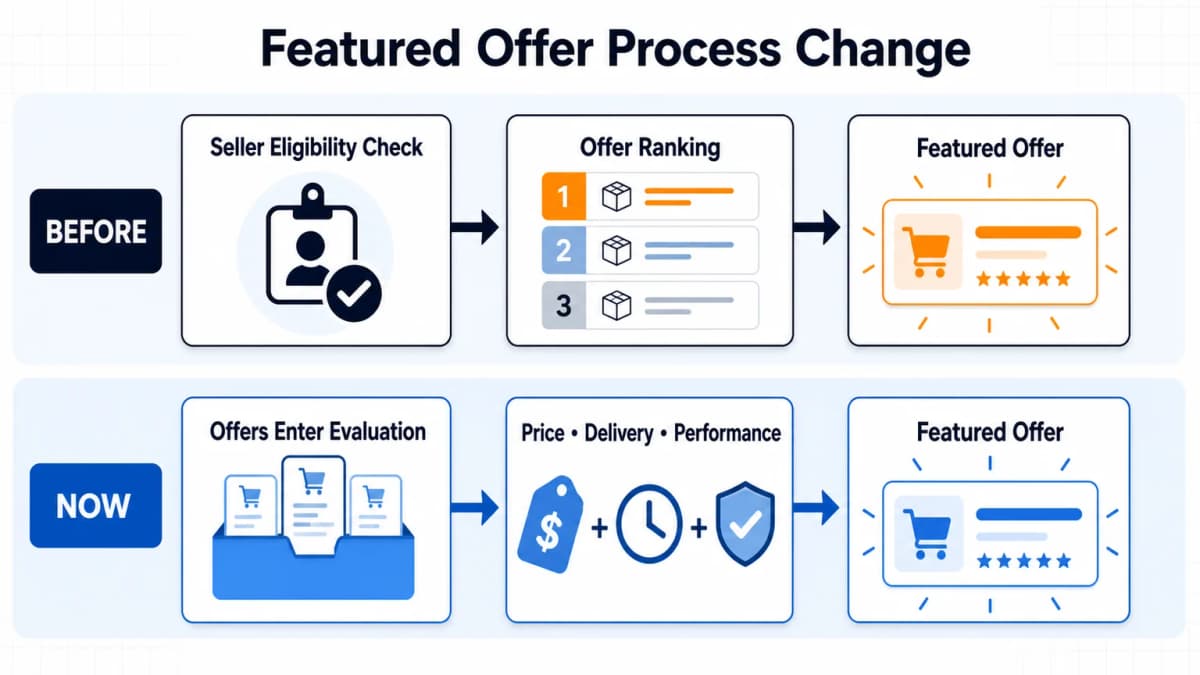
Amazon announced that it would remove seller eligibility requirements for the Featured Offer in the European Union and the United Kingdom on July 20, 2026. The announcement says sellers do not need to take action for existing offers to receive the update.
Before the change, Amazon first assessed whether a seller met its seller-level eligibility criteria. Amazon then ranked offers from eligible sellers for a product and selected the Featured Offer from that group. The update removes that first seller eligibility step. It does not remove the offer evaluation that determines which offer, if any, receives the placement.
Global Rollout
Amazon's global announcement uses a broader schedule. The change began rolling out across Amazon stores in July 2026 and is expected to finish by the end of 2026. Sellers should avoid treating the EU and UK implementation date as a confirmed completion date for the United States or every other marketplace.
Marketplace timing matters for multi-country catalogs. A seller operating in the United Kingdom, Germany, and the United States may see different eligibility behavior during the rollout. Each marketplace should be monitored separately by ASIN and offer.
No Seller Action Required
Amazon says existing offers are included automatically as the change reaches each store. Sellers do not need to submit an application or manually re-enroll products.
Automatic inclusion does not mean automatic Featured Offer placement. The update changes the seller-level screening process. The offer still needs to perform well under Amazon's selection criteria, and Amazon may decide that no offer should be featured for a particular product and customer context.
What Stays the Same
Selection Factors
Amazon states that it is not changing how the Featured Offer is selected. Its announcement names competitive pricing, delivery speed, and performance as examples of criteria that remain important to customers.
The official notice does not publish weights for those criteria. Claims that price, delivery, or performance represents a fixed percentage of the algorithm should be treated as speculation unless Amazon provides supporting documentation. Sellers need to work with observable outcomes instead: offer status, landed price, fulfillment method, delivery promise, account health, and changes over time.
Consideration Versus Winning
Amazon also states that being considered does not guarantee that an offer will be featured. Three operational states should remain separate:
- Winning means the seller's offer is the current Featured Offer for the relevant ASIN, marketplace, and customer context.
- Not winning means a Featured Offer exists, but another seller currently holds it.
- No Featured Offer means Amazon is not displaying one for that context. It should not be treated as a loss to a specific competitor or assigned an invented price gap.
Eligibility only means an offer can receive consideration under the applicable rules. It does not guarantee a win, a fixed share of placements, or continuous Featured Offer availability.
Seller Performance
Seller performance remains part of the final selection process. Amazon's notice removes performance-based seller screening as a separate first step while continuing to name performance as a selection factor.
Sellers should therefore continue monitoring account health, order defect rate, pre-fulfillment cancellations, late shipments, valid tracking, claims, and customer-service issues. Amazon does not state that each metric has a direct or fixed weight in the Featured Offer algorithm, but declining operational performance can weaken the customer experience that the selection process is designed to protect.
Why Competition May Increase
New Seller Access
Some new or smaller sellers previously faced unstable seller-level eligibility because their accounts had limited history or fewer performance observations. Removing the preliminary step may allow more of their offers to enter the final evaluation sooner.
That access helps only when the offer remains competitive. A new seller with a higher landed price, a slower delivery promise, weak fulfillment reliability, or insufficient stock may still fail to secure the Featured Offer. Sellers learning how to start selling on Amazon should treat the policy as one operational change, not a substitute for a viable product and reliable fulfillment.
Incumbent Pressure
Established sellers may face more eligible competing offers on ASINs where other sellers were previously excluded during the first screening step. The effect is likely to be most visible on shared listings with authorized distributors, wholesalers, resellers, or multiple fulfillment methods.
Historical stability is no longer enough evidence for a pricing plan. A seller that held a high Featured Offer share for months should establish a new post-change baseline and identify whether changes come from new competition, price movement, delivery differences, or account-level issues.
Price-War Risk
More participating offers can create faster price reactions. Sellers may respond to a lost placement by lowering prices repeatedly without checking whether the competitor has limited inventory, a different fulfillment model, or a temporary promotion.
Featured Offer share is an input to a pricing decision, not the entire profit objective. A price cut that wins placement while pushing contribution below the seller's minimum acceptable level can increase revenue and still reduce business value. Every repricing rule needs a floor based on product cost, Amazon fees, fulfillment expense, advertising cost, returns, and the seller's required contribution.
Seller Impact by Business Model
New Sellers
New sellers may receive consideration earlier, which can remove one uncertainty during launch. If an offer enters the selection process but still does not win, the seller can focus diagnosis on observable issues such as landed price, delivery promise, inventory availability, account health, and conversion quality.
The change does not solve weak demand or a confusing detail page. Amazon listing optimization still matters because a Featured Offer can generate visibility, but the page must convert that opportunity into a purchase.
Established Sellers
Established sellers should expect more variation on shared ASINs. Stable historical performance remains valuable, but it may compete against a larger set of offers. The correct first response is observation, followed by controlled tests. Immediate portfolio-wide price cuts can destroy useful baseline data and expose profitable SKUs to unnecessary margin loss.
Brands and Resellers
Brand owners with exclusive distribution may see limited change when no other seller offers the product. Brands with distributors, secondary channels, or unauthorized resellers need closer monitoring because a new competing offer may now receive consideration.
Channel reviews should compare seller identity, price, fulfillment method, stock position, and authorization status. Legitimate channel conflicts require commercial policy and distributor management. Suspected infringement or unauthorized activity requires evidence and the appropriate Amazon brand-protection process. Pricing automation should not replace channel governance.
FBA and FBM Sellers
FBA can support competitive delivery, but it does not guarantee the Featured Offer. FBM sellers can compete when their price and delivery promise remain attractive and their fulfillment performance is reliable.
Sellers using both methods should analyze FBA and FBM offers separately. A lower FBM price may still produce a less competitive customer outcome if delivery is materially slower. A higher FBA price may still lose when the landed-price gap becomes too wide. Each SKU needs its own evidence.
Advertising and Conversion Effects
Sponsored Products Eligibility
Amazon Ads currently states that products advertised through Sponsored Products must be eligible for the Featured Offer. The 2026 announcement discusses removing a seller-level eligibility step, while the advertising page still describes a product-level advertising requirement.
The policy announcement does not promise that previously inactive ads will begin serving. Sellers should monitor campaign delivery instead of assuming a direct result. If impressions change during the rollout, check Featured Offer status, product availability, campaign eligibility, bids, budgets, and search demand before assigning the cause.
Traffic Diagnosis
Featured Offer changes can affect ad delivery and conversion, but advertising is not the only variable. Sellers should compare:
- Featured Offer status and share
- Sponsored Products impressions and clicks
- Conversion rate and unit session percentage
- Landed price and active promotions
- Delivery promise and Prime status
- Listing suppression or content changes
- Inventory availability
A structured Amazon PPC strategy separates offer problems from bid, targeting, and budget problems. If an ASIN loses advertising visibility at the same time as the Featured Offer, the offer status deserves immediate review. If the Featured Offer remains stable, the campaign may require a different diagnosis.
Common Featured Offer Myths
Every Seller Wins
Removing seller eligibility requirements does not give every seller the Featured Offer. It allows more offers to receive consideration. Amazon still selects a single highlighted offer for a given product and customer context, and it may show no Featured Offer.
Performance No Longer Matters
Performance remains part of the selection criteria named by Amazon. The change removes a separate preliminary seller screening step. It does not remove the operational signals that support reliable customer outcomes.
Lowest Price Always Wins
Competitive pricing matters, but Amazon also names delivery speed and performance. The relevant comparison is broader than the item price alone. Shipping cost, delivery promise, fulfillment reliability, and customer experience can change the attractiveness of an offer.
Brands Are Unaffected
Exclusive brand listings may experience little direct competition. Brands with distributors, multiple seller accounts, wholesale partners, or unauthorized resellers can see meaningful changes. Every shared ASIN should be reviewed rather than assuming that brand ownership prevents offer competition.
Rollout Happened Everywhere
The confirmed July 20 date applies to the EU and UK announcement. Amazon's global notice describes a gradual rollout starting in July and completing by the end of 2026. Sellers should validate the current behavior in each marketplace.
Only Resellers Need Action
Resellers face direct offer competition, but the change also matters to new sellers, established brands, wholesalers, FBA operators, FBM operators, and advertisers. Any seller whose sales depend on the Featured Offer should establish a monitoring process.
Eight Seller Actions
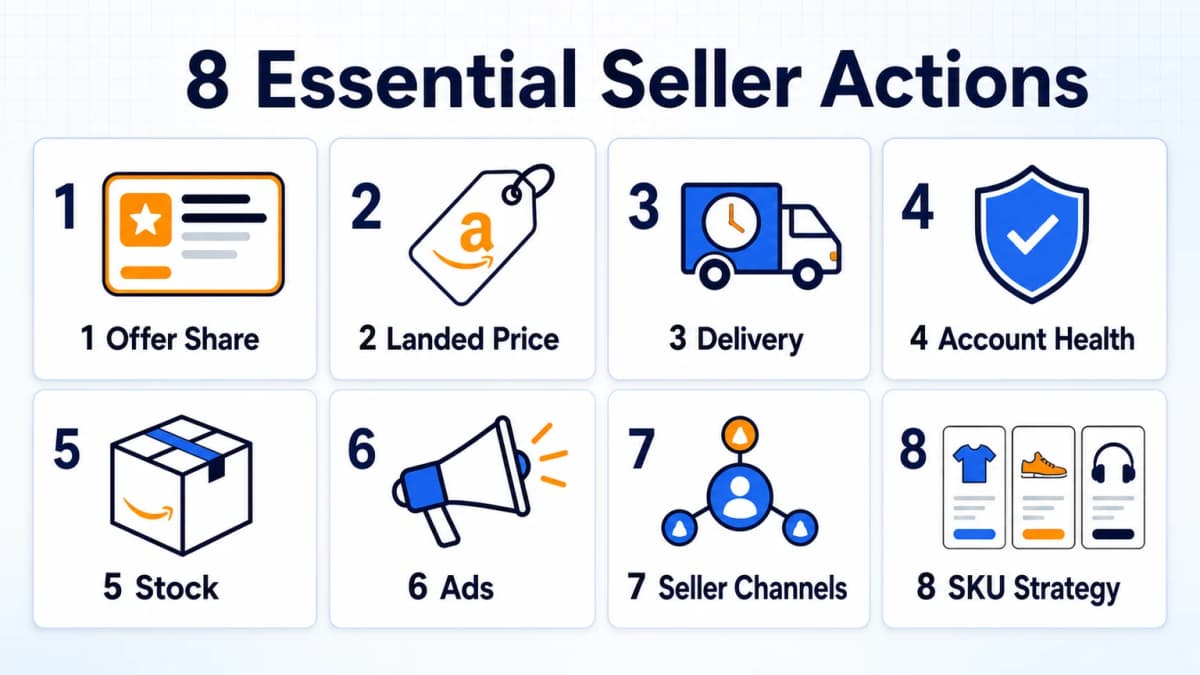
1. Track Offer Share
Create a baseline for each priority ASIN using the Featured Offer information available in Seller Central and seller reporting. Compare the period before and after the rollout reaches the marketplace.
Track at least:
- ASIN and marketplace
- Seller's current offer price
- Featured Offer status or share
- Current Featured Offer landed price
- Fulfillment method and delivery promise
- Number of visible competing offers
- Sponsored Products impressions and sales
- Estimated contribution margin
Daily observations are useful during a policy rollout. Weekly summaries help separate sustained changes from temporary movement.
2. Recalculate Landed Price
Compare the customer-facing total, including shipping, instead of evaluating item price in isolation. Record the lowest visible FBA and FBM landed prices, Prime availability, coupons, and meaningful delivery differences.
Set a minimum acceptable price before reacting. An Amazon FBA calculator can help organize referral fees, fulfillment fees, storage assumptions, and product costs, but the seller still needs to add advertising, return, promotion, and overhead assumptions that apply to the business.
3. Improve Delivery
Delivery speed remains one of the factors Amazon explicitly names. FBA sellers should verify that inventory is available in the relevant marketplace and that stranded or inbound stock is not being treated as sellable inventory. FBM sellers should review handling time, shipping templates, carrier performance, tracking validity, and late-shipment exposure.
Avoid promising a delivery speed that operations cannot support. Short-term competitiveness can create longer-term performance problems if fulfillment fails.
4. Protect Account Health
Continue monitoring account health and customer-service indicators. Pay particular attention to order defects, cancellations, late shipments, tracking, claims, and recurring buyer complaints.
The goal is not to reverse-engineer an undisclosed algorithm. The goal is to prevent operational problems that reduce customer trust and may weaken offer competitiveness.
5. Prevent Stockouts
Featured Offer opportunities can increase sales velocity. Before lowering a price or raising ad spend, confirm that available inventory can support the expected demand.
Use separate thresholds for high-margin products, traffic-driving products, tests, and low-priority products. A seller may choose to protect margin on constrained inventory rather than accelerating a stockout through aggressive repricing.
6. Align Ads and Offers
Review Featured Offer status alongside Sponsored Products delivery. When impressions or conversion change, compare the timestamps with offer-status changes, price changes, promotions, and stock events.
Do not increase bids automatically when the underlying offer is not competitive or the product is ineligible to advertise. Fix the offer or eligibility issue first, then reassess the campaign.
7. Monitor Seller Channels
Brands should maintain a current list of authorized sellers and compare it with visible offers. Review distributor pricing, marketplace promotions, cross-channel price differences, and suspected unauthorized activity.
Commercial pricing conflicts and intellectual-property issues require different responses. Document the seller, offer, price, fulfillment method, and timing before choosing an enforcement or channel-management action.
8. Segment SKU Strategy
Every SKU should not pursue the same Featured Offer objective. A practical segmentation model includes:
- Profit SKUs with strong contribution and stable demand. Protect margin and availability.
- Traffic SKUs that support discovery or cross-selling. Allow controlled flexibility without unlimited discounting.
- Test SKUs where the policy change may create new access. Use limited budgets and bounded price tests.
- Exit SKUs with persistent price wars, weak contribution, or channel problems. Avoid spending resources on an unattractive placement.
Define the objective, price floor, maximum move, monitoring interval, and stop condition for each group.
Practical Seller Scenarios
Established UK Seller
Consider a hypothetical UK accessories seller that uses FBA and historically held the Featured Offer without offering the lowest item price. Several newer sellers list the same ASIN but previously received little placement.
After the eligibility change, those offers may receive consideration. The established seller should avoid an immediate price match. A better sequence is to record the change in Featured Offer share, compare the competing landed prices and delivery promises, estimate each competitor's persistence, and confirm the seller's own contribution floor. A short-lived low-price offer with shallow stock may not justify a permanent reduction.
If the new competitor maintains a lower landed price, reliable delivery, and adequate stock, the seller can test a bounded response on that ASIN. The result should be evaluated using Featured Offer status, units, contribution, and advertising performance rather than sales volume alone.
New EU Seller
Consider a hypothetical new FBA seller in Germany with a competitive product and available stock. Before the update, the offer did not pass the preliminary seller eligibility step consistently.
Once the marketplace update reaches the account, the offer may enter the selection process more consistently. The seller should confirm the actual status, keep the price above the contribution floor, use a limited advertising test, and compare offer share with impressions and conversion.
If the offer receives consideration but conversion remains weak, the seller can investigate the detail page, reviews, images, value proposition, and advertising relevance. The policy change helps isolate the seller-level eligibility variable. It does not solve weaknesses elsewhere in the product or listing.
Safer Featured Offer Repricing
Repeated manual checks become difficult when a catalog contains dozens or hundreds of active ASINs. A useful repricing workflow should combine market context with seller-defined limits and keep the reason for every recommendation visible.
Nexscope Buy Box Repricer is designed around that approach. It uses real-time and historical Amazon data to support pricing decisions, Featured Offer context, alerts, and guarded automation. It keeps Winning, Not winning, No Featured Offer, and Out of stock as separate states and does not present Featured Offer data as an official numeric Buy Box rank.
Key workflow elements include:
- A 30-day view of observed Featured Offer price movement
- Visible offer, price-gap, fulfillment, and eligibility context when seller data is connected
- Estimated profit and movement checks before a candidate price advances
- Alerts Only mode for recommendations without automatic price writes
- Guarded Automation designed around explicit SKU enablement, a bounded first test, and saved safety limits
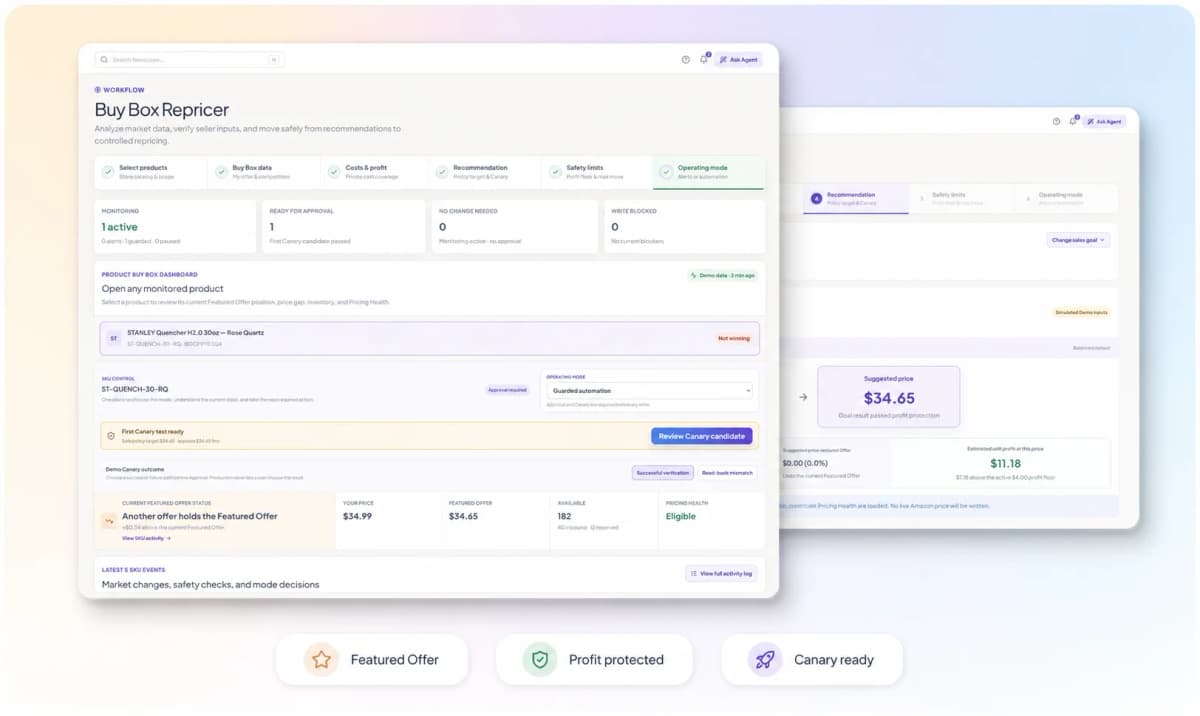
Sellers can currently review a preliminary ASIN market view with historical observations. The page states that seller-specific fees, eligibility, inventory, and price writes remain unavailable until Amazon connection launches. Sellers can use the current preview to begin an ASIN review, while treating connected monitoring and automation as a later stage that requires live availability, account permission, verified costs, and approved safety limits.
Analyze Your First ASIN
Review 30 days of observed Featured Offer pricing and market context before connecting your Amazon store.
Analyze Your First ASIN →Historical market preview • Start before connecting
One-Week Monitoring Plan
The first week should establish evidence before broad repricing changes are made.
| Day | Primary Action | Required Output |
|---|---|---|
| Day 1 | Record priority ASINs and current Featured Offer status | Marketplace baseline |
| Day 2 | Capture competing landed prices, fulfillment, and delivery | Offer comparison table |
| Day 3 | Review account health and fulfillment performance | Operational risk list |
| Day 4 | Calculate contribution-safe price floors | Approved SKU boundaries |
| Day 5 | Check available stock and inbound uncertainty | Inventory risk flags |
| Day 6 | Compare Sponsored Products delivery with offer status | Advertising diagnosis |
| Day 7 | Segment SKUs and define test rules | Monitoring and action plan |
Continue the observation for at least another week when possible. A 14-day window provides more evidence than a single daily snapshot, especially when competitor stock, promotions, delivery promises, and advertising budgets change.
For each test, record the starting price, target price, reason, expected contribution, maximum permitted move, timestamp, result, and rollback condition. If the offer changes without a price move, investigate competition and delivery before changing the rule.
Conclusion
Amazon's 2026 update removes a seller-level eligibility step for the Featured Offer. It does not remove the final selection process, guarantee placement, or make performance irrelevant. The EU and UK change took effect on July 20, while the global rollout is scheduled to continue through the end of 2026.
The practical response is disciplined monitoring. Sellers should track Featured Offer share, compare landed prices, protect delivery and account health, maintain stock, connect advertising with offer status, manage seller channels, and assign different objectives to different SKUs.
Controlled repricing starts with accurate costs and explicit limits. Every automated action should wait for verified account access, current marketplace data, contribution-safe boundaries, and a tested rollback process.
Make Your Next Price Decision With Guardrails
Start with an ASIN, review the market, and keep margin and movement limits in the decision.
Analyze Your First ASIN →Historical Featured Offer context • Profit-first workflow
Frequently Asked Questions
What changed in Amazon Featured Offer eligibility?
Amazon began removing a preliminary seller eligibility step in July 2026. Before the change, Amazon first determined whether a seller met seller-level eligibility criteria and then ranked offers from eligible sellers. The update removes that first step as it rolls out across marketplaces. Amazon still evaluates individual offers and selects the Featured Offer using customer-focused criteria such as competitive pricing, delivery speed, and performance. Existing offers are included automatically when the update reaches the relevant store.
Did Amazon remove the Buy Box algorithm?
No. Amazon states that it is not changing how the Featured Offer is selected. The update removes a seller-level screening step, while the final evaluation of offers continues. Amazon does not publish the complete algorithm or fixed weights for price, delivery, and performance. Sellers should avoid treating unverified weighting claims as facts and should monitor observable offer outcomes, landed prices, delivery promises, fulfillment performance, and account health instead.
Does every seller now qualify?
The announcement says seller eligibility requirements are being removed, but it does not guarantee that every offer will become the Featured Offer. Product, category, offer, availability, and marketplace conditions can still matter. Amazon explicitly says that consideration does not guarantee placement. A seller may be considered and lose to another offer, or Amazon may display no Featured Offer for the relevant product and customer context.
Is seller performance still important?
Yes. Amazon continues to name performance as a factor in Featured Offer selection. The removed step used seller performance criteria as a preliminary eligibility screen, but performance remains relevant inside the final evaluation. Sellers should continue monitoring order defects, cancellations, late shipments, tracking, claims, and customer-service quality. Amazon has not disclosed a fixed algorithmic weight for each metric, so these indicators should be managed as operational risk and customer-experience signals.
Will the change affect Sponsored Products?
It may affect some sellers, but Amazon has not promised a specific advertising outcome. Amazon Ads currently states that Sponsored Products must be eligible for the Featured Offer. The 2026 policy announcement focuses on removing a seller-level eligibility step, which is not the same as guaranteeing product-level ad eligibility or ad delivery. Sellers should monitor campaign impressions, offer status, inventory, bids, budgets, and listing eligibility together before attributing a change to the policy.
How should repricing rules change?
Repricing rules should use explicit contribution-safe floors, bounded price moves, monitoring intervals, and stop conditions. Sellers should compare landed price, delivery, fulfillment, offer status, competitor behavior, and inventory before changing a price. Begin with recommendations or alerts, test a small set of lower-risk SKUs, record the result, and preserve a rollback path. No repricing system can guarantee Featured Offer placement, margin, conversion, or sales.
Sources
- Amazon Seller Forums. (2026). Updates to Featured Offer eligibility requirements for EU and UK. Retrieved from sellercentral-europe.amazon.com
- Amazon Seller Forums. (2026). Updates to Featured Offer eligibility requirements across global stores. Retrieved from sellercentral.amazon.com
- Amazon Ads. (2026). Sponsored Products. Retrieved from advertising.amazon.com