

How to Audit Amazon AI Product Summaries

Table of Contents
Amazon AI product summaries can give shoppers a quick explanation of a product before they read its full details. For sellers, those short statements create another place to check whether the page sets the right expectations.
An effective audit compares the displayed summary with the selected variant, verified specifications, and the claims elsewhere on the listing. It then separates content gaps that the seller can fix from summary errors that need evidence and follow-up with Amazon.
Start with one important ASIN. Record what the customer sees, verify each claim, and track what changes after a correction. The objective is a product page that helps shoppers understand what they will receive and whether it fits their needs.
What Are Amazon AI Product Summaries?
Amazon AI product summaries condense product information into short highlights. The module discussed here carries the label “Summarized from product information.” A seller-uploaded example on Amazon Seller Forums shows three checkmarked statements beneath the variant selector.
This differs from the “Customers say” review summary. Amazon explains that review highlights synthesize shared opinions from verified-purchase reviews. They highlight customer feedback rather than listing specifications.
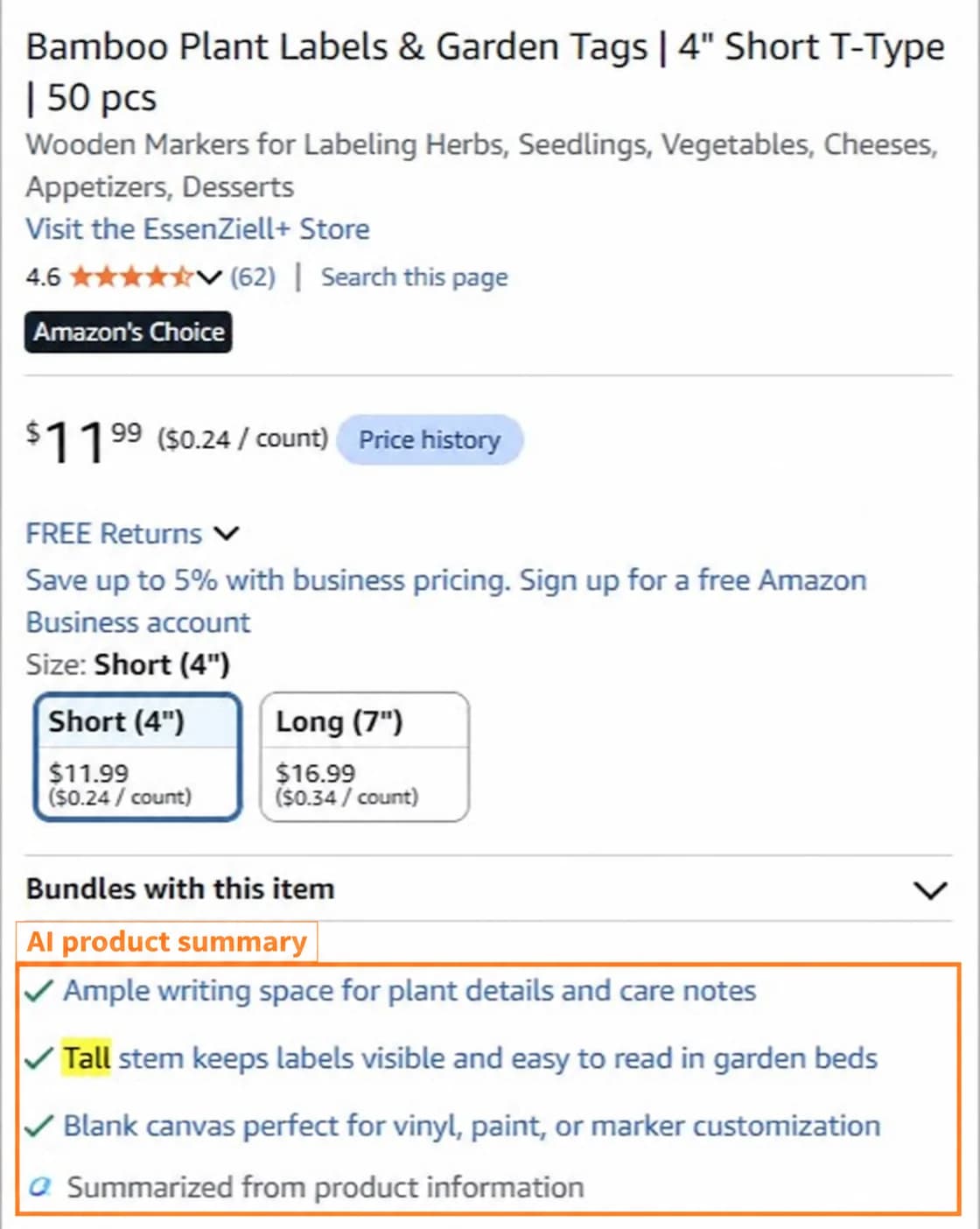
Source: seller screenshot on Amazon Seller Forums, ASIN B0D8K63CGH. Orange outline marks the AI summary beneath the selected Short (4-inch) variant.
How to Audit Your Product Summary
Use the same sequence for each ASIN: capture the selected variant, verify the summary’s claims, check limitations, and compare the main buying reasons. Keep the evidence in a simple audit sheet so another team member can reproduce the check.
Record the Selected Variant
Open the retail page and confirm the selected size, color, pack quantity, or model. Save the marketplace, child ASIN, page URL, access date, device type, and a screenshot showing both the selection and the summary.
A statement that fits the largest variant may mislead someone viewing the smallest. Record the child ASIN rather than only the family name.
If no summary appears, continue checking the underlying product information and revisit the page during the next audit.
Verify Each Product Claim
Break each summary line into claims that can be checked separately. A sentence about a lightweight, waterproof bag that holds a laptop contains at least three different assertions. Check weight, the evidence for water protection, and internal dimensions independently.
Use approved specifications, packaging records, measurements, and relevant test results as the factual baseline. Repetition across a listing does not make an unsupported claim true.
For larger catalogs, retrieve product titles, bullet points, and descriptions by ASIN to organize the source-content comparison. Keep the marketplace consistent, inspect missing fields, and compare the returned information with approved specifications. A marketplace data response is evidence of listing content, not independent product testing.
Check Compatibility and Limitations
Look closely at words such as “all,” “any,” “universal,” and “always.” They can turn a limited specification into a broader promise.
Consider an adjustable bedside table. Its height range alone does not establish compatibility with every bed. Base clearance, leg placement, tabletop reach, and the user’s intended position can all affect fit. A useful listing explains the relevant dimensions and restrictions rather than relying on a general compatibility claim.
Apply the same reasoning to accessories. A connector type, device generation, or required adapter may determine whether an otherwise accurate feature is useful to a particular buyer. Put essential conditions next to the benefit they qualify.
Compare the Main Buying Reasons
Check whether the summary conveys the product’s meaningful differences. If easy assembly is important, does the listing explain the actual assembly process? If a compact base is the advantage, are its dimensions visible?
A missing benefit does not automatically require a rewrite. First determine whether the source information is specific, supported, and consistent. Improve it when the buyer would otherwise struggle to understand the difference.
Do not treat summary wording as a keyword-indexing report. Whether a feature appears in a short summary and whether an ASIN is discoverable for a search query are separate questions that require separate checks.
Fix Listing Gaps and Escalate Summary Errors
Choose the response based on the evidence. An accurate summary, an omitted distinction, and a wrong specification call for different actions.
Accurate and Clear
If the summary matches the selected variant and communicates useful buying information, preserve the record. Avoid repeatedly changing accurate copy simply to obtain different AI wording.
Assign someone to recheck the page after a material product or content change.
Accurate but Missing a Distinction
Make the difference easier to understand in the source content. Replace vague phrases with supported specifications, explain the practical benefit, and keep attributes, bullets, images, and A+ consistent.
For variation families, identify which statements apply to every child and which belong only to one. Keep shared content accurate for all products it covers. After updating the listing, check how the summary presents those differences.
Incorrect or Mixed Across Variants
The forum example above shows a short bamboo plant label described using “Tall stem.” An Amazon representative acknowledged that the seller’s variant setup was accurate and recommended clearer differentiation plus follow-up. This illustrates why an error in the displayed summary should not automatically be blamed on the seller’s copy.
For your own case, collect the affected child ASIN, screenshot, exact disputed claim, correct specification, and supporting evidence. Record any source-content correction and the support case reference. If the source is already accurate, explain that distinction clearly.
Recheck the same variant after changes and continue the case if the mismatch remains.
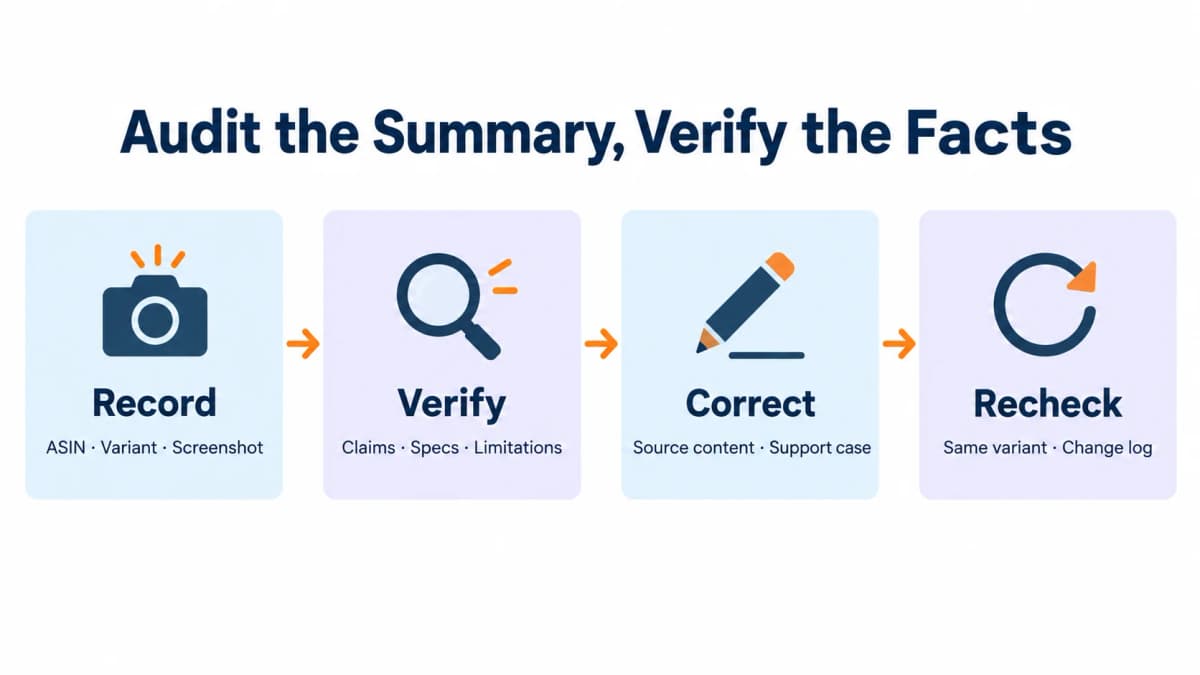
An Eight-Point Summary Audit Checklist
Give each unresolved item an owner and a next action.
| Check | What to verify | Evidence to retain |
|---|---|---|
| Selected variant | Summary matches the chosen child ASIN | Screenshot with variant selector |
| Basic specifications | Dimensions, material, and quantity are correct | Approved specification sheet |
| Package contents | Mentioned accessories are actually included | Packing list or packaging record |
| Functional claims | Performance statements have support | Relevant test or product record |
| Usage limitations | Compatibility claims include necessary conditions | Measurements and compatibility notes |
| Key differences | Useful distinctions are clearly explained | Source copy and supporting facts |
| Page consistency | Title, bullets, attributes, images, and A+ agree | Content comparison record |
| Follow-up | Corrections and unresolved issues are traceable | Owner, case reference, and recheck date |
Conclusion
An AI summary audit should end with a clear decision: keep accurate content, improve a documented information gap, or escalate a specific error. Begin with one important ASIN and expand the process once the team can reliably capture and resolve issues.
Build a Repeatable Listing Audit
Nexscope is an ecommerce data platform that teams can connect to their own workflows or Agents through REST API or MCP. Use these four APIs to collect evidence for your listing audit and follow-up checks:
- Amazon Product Detail API: Retrieve titles, bullet points, and descriptions by ASIN to compare listing content with verified specifications and the summary’s claims.
- Amazon Reviews List API: Collect customer reviews to identify recurring confusion about fit, variants, or included items and prioritize details that need clearer wording.
- Amazon Search API: Search by keyword and marketplace to inspect returned products and select relevant listings for a comparison of buying reasons.
- Amazon Traffic Keywords API: Find terms bringing traffic to an ASIN and compare organic and advertising rankings as a separate search-visibility check.
Keep returned data and customer observations alongside verified product records. Data APIs use pay-as-you-go Data Credits without a required Data API subscription.
Build Your Amazon AI Summary Audit
Bring product details, customer reviews, search results, and traffic keywords into your Amazon listing audit workflow.
Explore Amazon Data APIs →Frequently Asked Questions
Are AI product summaries the same as review summaries?
No. Product-information summaries present selected product details. Review summaries, often headed “Customers say,” synthesize customer feedback. Identify the module by its label and context before applying guidance about its source or behavior.
Can sellers directly edit an Amazon AI product summary?
The cited seller reported no direct editing control. Amazon’s forum response recommended clearer source-content differentiation and follow-up. Correct your own inaccurate information and ask Amazon to investigate specific summary errors.
Does a missing feature mean Amazon has not indexed it?
No such conclusion follows from the summary alone. A short selection of product highlights does not disclose search-index coverage. Check search discoverability separately instead of using omitted summary wording as proof of an indexing problem.
What should sellers do when a summary describes the wrong variant?
Capture the selected variant and the incorrect statement together. Compare them with verified specifications and current source content, correct any genuine inconsistencies, and provide the evidence to Amazon support. Retain the case reference and inspect the same variant again when following up.
Sources
- Amazon Seller Forums. 2026. Incorrect 'Summarized from product information'. Seller report, uploaded product screenshots, and Amazon representative response. sellercentral.amazon.co.uk.
- Ivy Levine, Amazon. Accessed 2026. Here's how Amazon's AI-generated review highlights help you make better shopping decisions. aboutamazon.com.
- Nexscope. Accessed 2026. Amazon Product Detail, Amazon Reviews List, Amazon Search, and Amazon Traffic Keywords API documentation. nexscope.ai.