

How to Go Viral on TikTok (For Ecommerce Brands and Sellers)

Learning how to go viral on TikTok starts with a hard truth: no script, editing style, AI model, or posting schedule can guarantee reach. Ecommerce brands can improve their odds, however, by building videos around immediate attention, recognizable products, and a repeatable testing process. That approach produces clearer lessons than spending days polishing one clip and hoping it takes off.
The most useful TikTok product videos combine entertainment with a commercial purpose. The opening creates curiosity. The middle makes the product necessary to the action. The ending leaves viewers with a product, benefit, or next step they can remember. For sellers, the commercial test is simple: did the viewer understand what the product was, why it mattered, and what to do next? Reach without product recognition may create an audience moment, but it does not automatically build demand. Tools such as Nexscope can speed up adaptation and testing, but the creative logic still comes first. This guide explains six practical rules for producing that kind of content, then shows how to turn an authorized reference video into original product-led variations without copying another creator's identity, claims, or protected assets.
TikTok Virality Fundamentals
TikTok distributes content through a recommendation system, but a brand cannot control distribution directly. It can control the creative inputs that affect whether people stop, understand the video, continue watching, and take action. For ecommerce content, three inputs deserve priority: the opening, the product's role, and the testing process.
Early Attention
TikTok's own creative guidance emphasizes the first few seconds. The opening should establish a clear reason to keep watching through a visual change, a question, a surprising result, a conflict, or an unresolved action. A slow introduction consumes the limited window in which a viewer decides whether to stay.
The hook should connect to the product or the problem it addresses. A shocking opening that has no relationship to the product may increase curiosity while weakening product recall. The viewer remembers the scene and forgets what was being sold.
Useful TikTok hooks for ecommerce include:
- A familiar problem shown before any explanation.
- A result placed before the process that created it.
- A product used in an unexpected but truthful setting.
- A strong contrast between two choices.
- A question that the demonstration will answer.
Product Relevance
Product-led storytelling gives the item a functional role in the video. The product can reveal information, resolve a practical problem, trigger the next event, or create the final payoff. If the product disappears without changing the story, the concept is probably entertainment with a late advertisement attached.
This principle also helps teams choose among different TikTok product video ideas. A talking-head pitch, unboxing, challenge, comparison, or short comedy scene can all work. The best format is the one that gives the product a visible and credible job.
Creative Testing
One polished video gives a brand one result. A controlled set of variations can show which hook, scene, product entry, or call to action changes performance. TikTok recommends testing distinct creative versions while changing one variable at a time. That makes the result easier to interpret.
Virality is an outcome, not a production setting. A useful workflow creates hypotheses, publishes controlled variations, measures the correct signals, and applies what the audience reveals.
6 Product-Led Video Rules
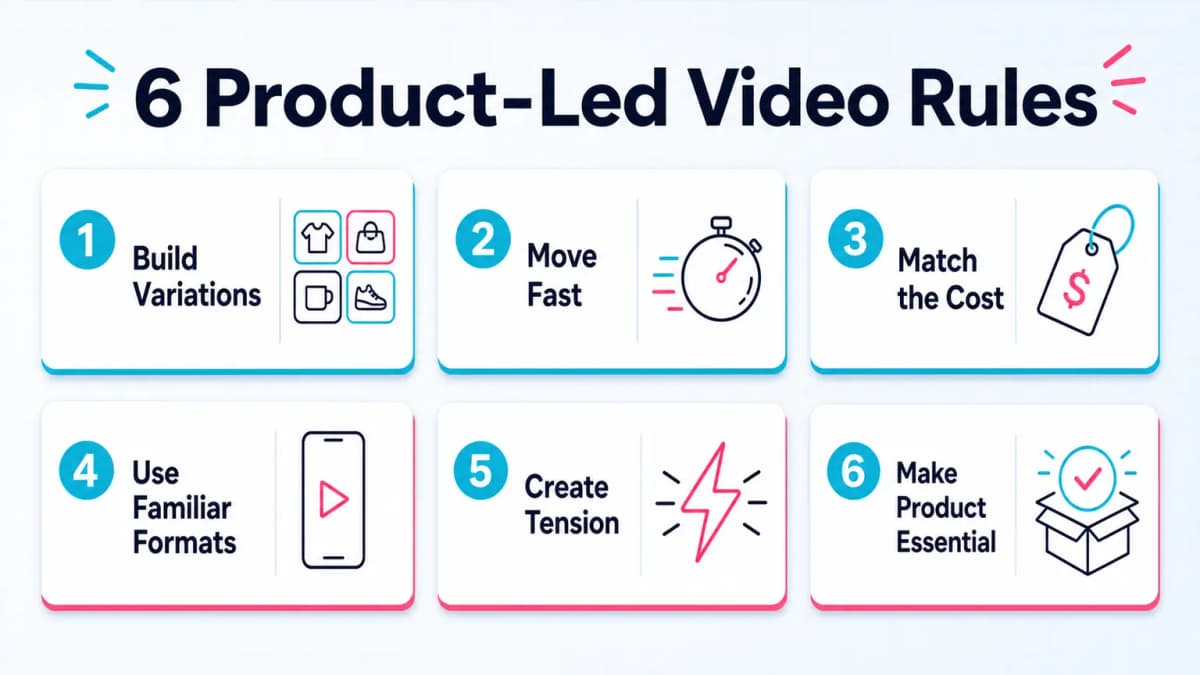
The following six rules turn short-form production into a repeatable operating system. They prioritize output and learning while protecting product accuracy and brand recognition.
1. Build Variations, Not Copies
High output does not require dozens of unrelated concepts. It requires a reusable structure with clearly defined parts. A team can break one promising concept into five elements:
- Opening hook
- Conflict or buyer problem
- Product entry
- Demonstration or turning point
- Closing result or call to action
The structure can remain stable while the person, room, country, first line, product benefit, or final action changes. These variations create a coherent test set. They also reduce the risk of recreating another creator's video too closely.
A reference should inform pacing and structure, not authorize copying. Brands should use videos they own, license, or have permission to adapt. Third-party faces, voices, logos, music, scripts, and distinctive scenes should not be carried into a new generation without the required rights.
2. Move From Trend to Test
Short-form trends move quickly. A brand that discovers a relevant format on Monday and starts production the following week may miss the useful testing window. Speed matters because it shortens the gap between observation and evidence.
That does not mean publishing unchecked output. A practical same-day workflow can still include a creative brief, a rights check, product-claim review, generation, visual inspection, captioning, and final approval. The goal is to remove unnecessary polishing before the concept has shown any audience signal.
Teams can use current ad and commerce evidence to find TikTok ads that drive sales, then separate repeatable creative patterns from isolated high-view clips. A strong pattern should appear across several examples or fit a clear buyer behavior before it enters production.
3. Match Cost to Scene Complexity
The cheapest generation is not always the lowest-cost production choice. A simple product beauty shot, package reveal, or single-person explanation may work with a lower-cost model or a short generation. Product handling, several people, complex hand movements, dialogue, and continuity across scenes usually require stronger controls.
Cost should be evaluated per approved asset, not per generation. If a low-cost model requires ten failed attempts to preserve the product while a stronger option produces an acceptable result in two, the stronger option may be more efficient.
Before generating, classify the scene:
| Scene Type | Main Risk | Production Priority |
|---|---|---|
| Product beauty shot | Label or shape drift | Product consistency |
| Simple presentation | Script and lip sync | Natural delivery |
| Hands-on demo | Contact and movement errors | Physical continuity |
| Two-person story | Identity and blocking changes | Subject consistency |
| Fast dramatic sequence | Lost product visibility | Story and product timing |
4. Keep the Format Familiar
Viewers recognize common TikTok formats quickly. Unboxings, problem-solution stories, reactions, comparisons, tutorials, challenges, and creator-style demonstrations give the audience a familiar viewing pattern. The newness can come from the product, person, setting, opening line, or outcome.
Familiarity should not become imitation. The goal is to use the grammar of the format while developing an original execution. A skincare brand can use a before-and-after structure without duplicating another creator's shots. A kitchen product can use a challenge format without copying the same dialogue, music, or visual sequence.
Brands that need format options can review a broader set of TikTok tools and production approaches, then keep the stack limited to the research, creation, editing, and measurement tools that support a defined job.
5. Front-Load Tension and Surprise
Tension creates an unanswered question. It can come from a visible mistake, a result that appears before its cause, a disagreement between two choices, a deadline, or a product used in an unusual situation. The first scene should make the viewer want the next piece of information.
High tension does not require offensive, dangerous, or deceptive material. Ecommerce brands can create safe tension through everyday problems:
- A suitcase will not close before a trip.
- A pet refuses the usual routine.
- Two organizers compete to fix the same messy drawer.
- A creator chooses between a complicated process and a simpler tool.
- A product test begins with an unexpected but realistic result.
The tension must be resolved by a truthful product action. False emergencies, fabricated reviews, unrealistic results, and misleading before-and-after effects create policy and trust risks.
6. Make the Product Drive the Plot
The final rule separates a memorable product video from a short story with a product shot at the end. The item should cause the next action or make the ending possible. Removing it should create a clear hole in the sequence.
For example, a travel organizer can reveal why the suitcase finally closes. A stain remover can drive a timed demonstration. A portable light can make a late-night repair possible. A pet puzzle can change the animal's behavior within a realistic, observable activity. The product remains visible because it performs the central action.
This also improves creative evaluation. The team can ask:
- Does the product appear early enough to be remembered?
- Is its use understandable without a long explanation?
- Does the story demonstrate a verified feature?
- Would the ending still work if the product were removed?
- Can the viewer identify the item at the final frame?
Winning Reference Breakdown
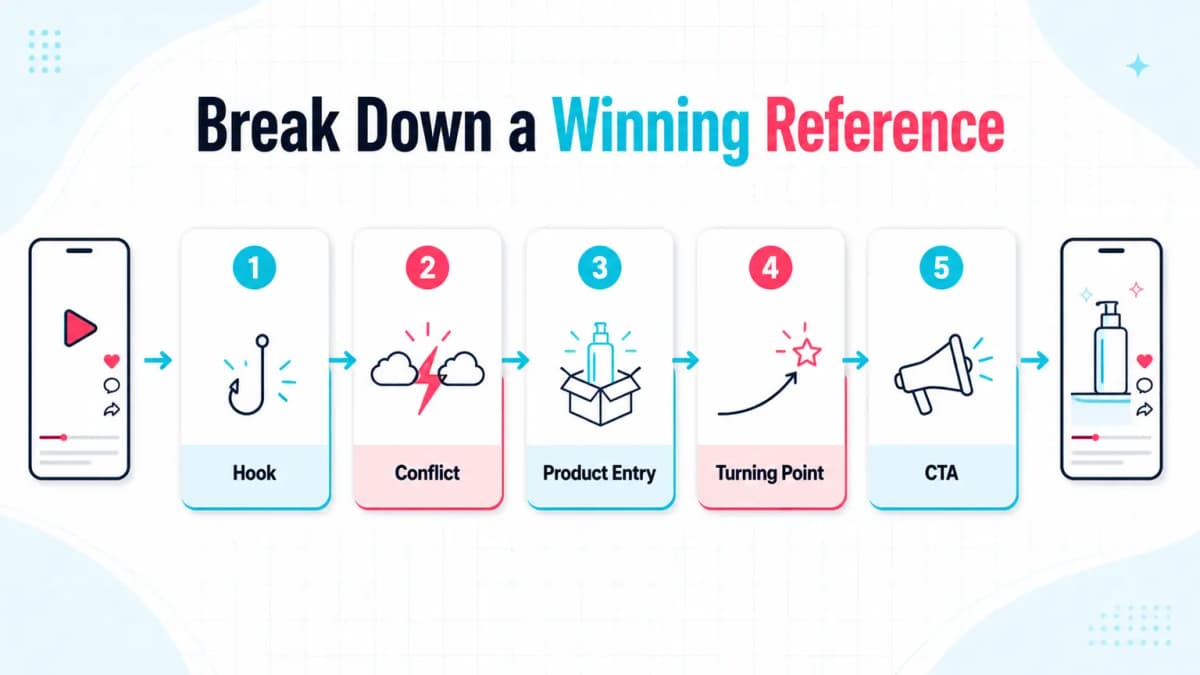
A useful reference video provides a structural pattern. The team should analyze it before generating anything, then write the new concept in terms of functions rather than copied scenes.
Hook and Conflict
Start by recording what happens during the first three seconds. Note the camera distance, visible action, sound cue, spoken line, on-screen text, and unanswered question. Then identify the conflict. It may be a physical problem, a choice, an emotional reaction, or an incomplete process.
The new version should reproduce the function, not the expression. If the reference opens with a bottle falling from a cluttered shelf, the transferable function may be "show a familiar storage failure immediately." A new video can express that idea through a different object, location, camera angle, and sequence.
Product Entry and Turn
Record the exact moment the product enters and what changes afterward. A weak product entry pauses the story for a sales message. A strong entry advances the action.
The turning point may be a demonstration, reveal, comparison, or reaction. It should remain grounded in verified product information. Packaging, color, size, included accessories, physical functions, and approved benefits must match the actual product and product detail page.
Ending and CTA
The final seconds should complete the story and leave one clear memory. That memory may be the product result, a recognizable package, a buying reason, or a next action. Too many closing messages compete with one another.
A good teardown can fit in one table:
| Segment | Reference Function | New Creative Decision |
|---|---|---|
| 0-3 seconds | Stop the scroll | Original hook using the same problem type |
| 3-7 seconds | Establish conflict | New person, place, and action |
| 7-12 seconds | Introduce product | Approved product image and feature |
| 12-18 seconds | Resolve tension | Truthful demonstration or result |
| Final frame | Create recall | Product, benefit, and one CTA |
Recreate a Winning Competitor Video
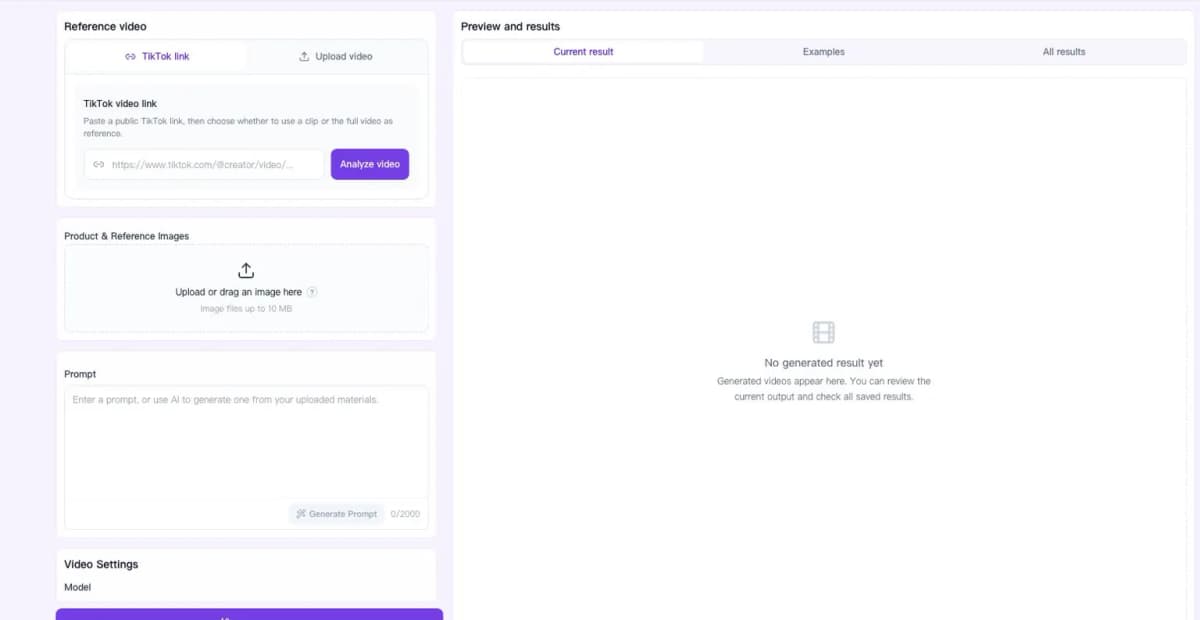
If a competitor's TikTok product video looks worth testing but the filming plan is difficult to recreate, Nexscope Video Clone provides a much simpler starting point. The team does not need to plan every shot from scratch. It can paste the TikTok link or upload the reference video, add its own product images, let the AI model write the prompt, and generate a new product-specific version.
Paste the Link or Video
Start with either a public TikTok link or an uploaded reference video. Choose a video with a useful hook, pace, or scene order. The reference should be content the brand owns, licenses, or has permission to adapt, especially when it includes recognizable people, music, logos, or distinctive creative elements.
Upload Product Images
Add one or more clear product images. Front, side, packaging, label, and important detail views help the model understand what should appear in the new video. One image may work for a simple scene, while several consistent views can improve product clarity.
Generate the Prompt
Click Generate Prompt. Nexscope's AI model analyzes the reference and uploaded product images, then writes the generation prompt automatically. The team can review the prompt and make any necessary adjustment, but it does not need to describe every camera movement or scene from scratch.
See the Recreated Result
The example below starts with one uploaded product image, then places the original reference video beside the version recreated with Nexscope. The recreated video keeps the same fast product-demo format while replacing the featured product with the uploaded Nexscope hair mask.

Click Generate
Choose the video model, duration, resolution, and 9:16 TikTok format, then click Generate. Video Clone uses the reference structure and the brand's product assets to create the new version. Before publishing, review:
- Product shape, color, package, label, and accessories
- Faces, hands, movement, and object contact
- Spoken and visible product claims
- Third-party logos, music, people, and protected assets
- AI-generated-content disclosure requirements
- Platform-specific aspect ratio, captions, and safe zones
The output remains a production draft until those checks pass. TikTok Shop requires AI-generated product content to remain truthful and accurate, disclose significant AI use, avoid impersonation, and preserve the real product rather than fabricating features or results.
Turn the Reference Into Your Product Video
Upload a TikTok link or reference video, add your product image, and let Nexscope prepare the prompt and generate a product-specific version.
Try Video Clone →Simple Creative Test Loop
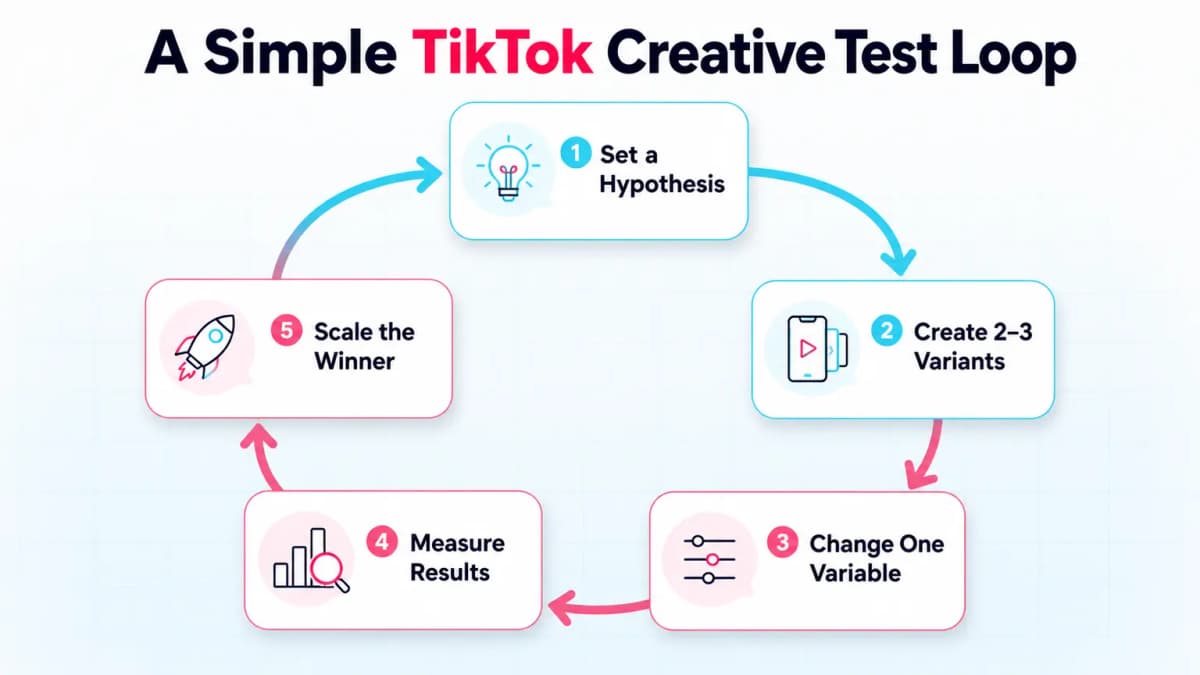
Fast production creates value only when every release teaches the team something. A simple test loop keeps the audience, offer, and product stable while one creative variable changes.
Change One Variable
Choose one hypothesis per test. Examples include:
- A result-first hook will improve the three-second view rate.
- A product appearance before second three will improve recall.
- A conflict-led opening will hold attention longer than a direct pitch.
- A demonstration will produce more product clicks than a lifestyle scene.
- A shorter CTA will improve completed views without reducing conversions.
Changing the hook, person, duration, music, script, product benefit, and CTA at the same time makes the result difficult to explain. Two or three distinct variations are usually easier to fund and interpret than a large uncontrolled batch.
Measure Attention and Action
Metrics should match the video's job. A clip intended to stop the scroll needs early-view and retention signals. A product-demonstration ad also needs click and conversion evidence.
| Creative Question | Useful Signals |
|---|---|
| Did the hook stop viewers? | 2-second and 3-second views |
| Did the story hold attention? | Average watch time and completion rate |
| Did viewers recognize interest? | Shares, saves, comments, profile visits |
| Did the product create action? | Product clicks, add-to-cart rate, conversion rate |
| Did paid distribution work? | CPC, CPA, conversion value, ROAS |
Views alone cannot show whether the product was remembered or purchased. A high-view entertainment clip may be commercially weaker than a smaller video with stronger product clicks and conversions.
Scale the Winner
Once a variation produces a stable improvement, preserve the winning variable and test the next one. A successful hook can move into several settings. A strong product entry can support different creators. A useful story structure can become localized versions for other markets.
The same approved reference system can also support longer or more controlled Seedance 2.5 ecommerce video workflows when a concept needs multiple scenes, richer references, or additional channel versions.
Common Mistakes to Avoid
- Copying instead of adapting: Reproducing a creator's identity, script, music, branded elements, or distinctive scenes creates legal and platform risk. Extract the function and build an original execution.
- Revealing the product too late: A dramatic story can earn attention while producing no product memory. Let the product enter early enough to influence the action.
- Generating without source assets: A vague product reference increases the risk of incorrect shape, packaging, labels, and features.
- Testing several variables together: When everything changes, the team cannot identify what improved or weakened performance.
- Optimizing only for views: Watch time matters, but ecommerce decisions also need product clicks, conversion signals, and revenue outcomes.
- Publishing unsupported claims: Scripts, captions, generated demonstrations, and before-and-after scenes must match verified product information.
- Skipping AI disclosure: Significant AI generation or alteration may require a platform label or creator disclosure.
- Overspending before validation: Expensive scenes and repeated rerenders should follow evidence that the underlying hook and product story deserve further investment.
Conclusion
Ecommerce brands improve their chance of going viral on TikTok by producing more useful experiments, not by chasing a guaranteed formula. Strong videos establish attention early, use a familiar format, create safe tension, and make the product necessary to the outcome. Fast variation then turns one promising structure into a set of controlled tests.
The operating sequence is straightforward: identify an authorized reference, break it into functions, replace protected and brand-specific expression, add accurate product assets, generate a distinct version, review the result, and change one variable in the next test. The audience decides which version deserves to scale.
Create the Next TikTok Video
Found a competitor TikTok video worth recreating? A seller can paste the public link or upload the reference video, add product images, click Generate Prompt, and let Nexscope prepare the prompt automatically. After a quick review, one click on Generate creates a product-specific version ready for final accuracy and rights checks.
Create Your Next TikTok Product Video
Bring an authorized reference and your own product image, then use Nexscope to create a version ready for review and testing.
Try Video Clone →Frequently Asked Questions
How can an ecommerce brand go viral on TikTok?
An ecommerce brand can improve its odds by opening with a product-relevant hook, making the product necessary to the story, and testing controlled variations instead of relying on one polished video. No method guarantees virality. The practical goal is to learn which openings, demonstrations, creators, and calls to action improve attention and commercial results. Early-view metrics, watch time, product clicks, conversion rate, and revenue should be evaluated together.
What makes a strong TikTok hook?
A strong TikTok hook creates an immediate reason to keep watching. It can show a problem, result, contrast, question, surprise, or incomplete action during the first few seconds. For ecommerce content, the hook should connect to the product or the buyer problem it addresses. An unrelated shock may attract views but leave weak product recall. The next scene should deliver on the expectation created by the opening.
How many TikTok video variations should a brand test?
Two or three controlled variations are a practical starting point for many ecommerce teams. Each version should change one meaningful variable, such as the opening line, first visual, product-entry timing, creator style, or CTA. The audience, product, offer, and other major conditions should remain stable. Larger test sets can work when the brand has enough budget and traffic, but uncontrolled batches make the results harder to interpret.
What is a product-led TikTok video?
A product-led TikTok video gives the product a necessary role in the action. The item may solve the visible problem, trigger a reveal, support a demonstration, or make the final outcome possible. If the product can be removed without changing the story, viewers may remember the entertainment and forget the offer. Product-led does not require a constant sales pitch. It requires a clear connection between the story and the product's verified function.
Can a brand clone another TikTok video?
A brand should only adapt a video it owns, licenses, or has permission to use. A reference can inform general structure, pacing, product timing, or camera rhythm, but it does not authorize copying a creator's face, voice, script, music, logos, claims, or distinctive creative expression. The new version should use original scenes and the brand's own approved product assets. Rights and platform-policy checks remain necessary before publication.
Does TikTok allow AI-generated product videos?
TikTok Shop allows responsible AI-generated content when it is truthful, accurate, properly disclosed, and consistent with platform policies. AI must not impersonate people without permission, fabricate product features, create misleading results, or change the product so it no longer matches what buyers receive. Creators should use the platform's AI-generated-content disclosure when required and review all product claims, visuals, audio, and third-party assets before posting.
Which metrics matter for TikTok product videos?
The right metrics depend on the video's objective. Early-view rates and watch time show whether the hook and story hold attention. Shares, saves, comments, and profile visits indicate deeper interest. Ecommerce videos also need product clicks, add-to-cart rate, conversion rate, cost per acquisition, conversion value, or ROAS. A high view count alone does not prove that viewers recognized the product or completed a purchase.
Sources
- TikTok for Business. (2026). Ad Testing Guide: Optimize Campaigns and Maximize ROI
- TikTok for Business. (2022). The Power of Creative Elements in TikTok Ads
- TikTok Shop Academy. (2026). AI-Generated Content Restrictions and Requirements
- TikTok Shop Academy. (2026). How to Avoid Misleading Content