

How to Make Money on Amazon: 12 Proven Methods for 2026

Making money on Amazon goes far beyond selling physical products. The platform offers at least a dozen distinct income streams, from building a full-time FBA business to earning passive commissions through affiliate links. Some methods require significant upfront investment; others can start with zero capital.
This guide covers 12 proven ways to make money on Amazon, organized by investment level and income potential. Each method includes realistic expectations for startup costs, time commitment, and earning potential. If you're wondering what FBA means or how fulfillment works, start there first.
Quick Overview: 12 Ways to Make Money on Amazon
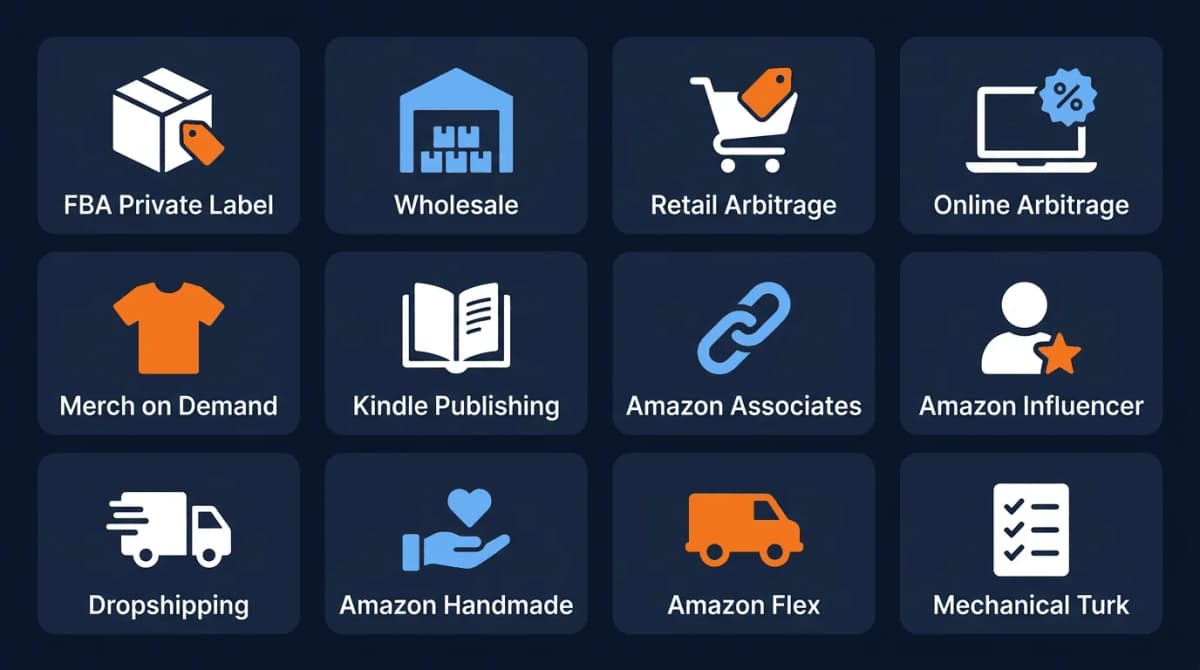
| Method | Startup Cost | Time to First Income | Income Potential |
|---|---|---|---|
| FBA Private Label | $2,000–$10,000 | 3–6 months | $1,000–$50,000+/month |
| Wholesale | $1,000–$5,000 | 1–3 months | $500–$20,000/month |
| Retail Arbitrage | $100–$500 | 1–2 weeks | $500–$5,000/month |
| Online Arbitrage | $200–$1,000 | 2–4 weeks | $500–$10,000/month |
| Merch on Demand | $0 | 1–3 months | $100–$5,000/month |
| Kindle Direct Publishing | $0–$500 | 1–6 months | $100–$10,000/month |
| Amazon Associates | $0 | 1–3 months | $100–$10,000/month |
| Amazon Influencer | $0 | 2–6 months | $500–$20,000/month |
| Dropshipping | $500–$2,000 | 1–2 months | $500–$10,000/month |
| Amazon Handmade | $100–$1,000 | 1–2 months | $500–$10,000/month |
| Amazon Flex | $0 | Immediate | $18–$25/hour |
| Amazon Mechanical Turk | $0 | Immediate | $3–$15/hour |
Selling Physical Products
1. FBA Private Label
Private label is the most popular path to building a serious Amazon business. The model involves finding products from manufacturers, adding your own branding, and selling them under your brand name.
How it works:
- Research product opportunities using tools like Jungle Scout or Helium 10
- Source products from manufacturers (often through Alibaba)
- Create your brand and packaging
- Ship inventory to Amazon's fulfillment centers
- Amazon handles storage, shipping, and customer service (learn more about FBA fees)
Startup costs: $2,000–$10,000 for initial inventory, samples, and listing optimization
Pros:
- Highest profit margins (typically 25–40%) — use an FBA calculator to estimate
- Build a sellable asset
- Full control over branding and pricing
Cons:
- Requires significant upfront investment
- Takes months to see returns
- Competition is fierce in popular categories
Realistic income: Successful private label sellers typically earn $3,000–$10,000/month after the first year. Top sellers exceed $50,000/month.
2. Wholesale
Wholesale selling involves purchasing products in bulk from established brands at discounted prices, then reselling them on Amazon.
How it works:
- Open wholesale accounts with brands and distributors
- Purchase inventory at 40–60% below retail
- List products on existing Amazon listings
- Compete for the Buy Box
Startup costs: $1,000–$5,000 for initial inventory orders
Pros:
- Faster startup than private label
- No need to build brand awareness
- Established demand exists
Cons:
- Lower margins than private label (15–25%)
- Must compete with other sellers on same listings
- Requires building supplier relationships
Realistic income: $500–$5,000/month is common for part-time wholesalers. Full-time operations can reach $10,000–$20,000/month.
3. Retail Arbitrage
Retail arbitrage means buying discounted products from retail stores and reselling them on Amazon for profit.
How it works:
- Use the Amazon Seller app to scan products in stores
- Look for clearance items, seasonal deals, and pricing errors
- Ship products to Amazon FBA or fulfill orders yourself
- Profit from the price difference
Startup costs: $100–$500 to start
Pros:
- Lowest barrier to entry
- See profits quickly
- Learn Amazon selling basics
Cons:
- Time-intensive (requires store visits)
- Inconsistent inventory supply
- Some brands restrict reselling
Realistic income: Most arbitrage sellers earn $500–$2,000/month part-time. Dedicated full-time arbitrageurs can reach $5,000+/month.
4. Online Arbitrage
Online arbitrage follows the same concept as retail arbitrage, but sourcing happens entirely online.
How it works:
- Find deals on websites like Walmart, Target, and discount retailers
- Use tools like Keepa and Tactical Arbitrage to identify profitable products
- Purchase online and have items shipped to your location or directly to Amazon
Startup costs: $200–$1,000
Pros:
- Scale without leaving home
- Software tools automate deal-finding
- Access to more inventory than retail arbitrage
Cons:
- More competition than retail arbitrage
- Requires learning multiple sourcing platforms
- Deal quality varies significantly
Realistic income: $500–$3,000/month part-time, with potential to scale higher.
5. Amazon Handmade
For artisans and crafters, Amazon Handmade provides a marketplace specifically for handcrafted goods.
How it works:
- Apply to join Amazon Handmade (approval required)
- List handcrafted products in categories like jewelry, home décor, and clothing
- Fulfill orders yourself or use FBA
Key benefit: Handmade sellers pay no monthly Professional seller fee ($39.99/month waived).
Startup costs: $100–$1,000 depending on materials and production
Realistic income: Varies widely based on product type and marketing—$500–$10,000/month for active sellers.
Print-on-Demand and Publishing
6. Merch on Demand
Amazon's print-on-demand service allows creators to upload designs for T-shirts, hoodies, and other apparel without holding inventory.
How it works:
- Apply for a Merch on Demand account (invitation-based)
- Upload original designs
- Set your price and royalty
- Amazon prints and ships when customers order
Startup costs: $0 (though design tools may cost money)
Pros:
- Zero inventory risk
- Completely passive after uploading designs
- No fulfillment work required
Cons:
- Highly competitive
- Low royalties per sale ($2–$5 typically)
- Account tier limits how many designs you can upload
Realistic income: Most sellers earn $100–$500/month. Top creators with hundreds of designs can reach $5,000+/month.
7. Kindle Direct Publishing (KDP)
Self-publish ebooks, paperbacks, and hardcovers through Amazon's KDP platform.
How it works:
- Write or commission a book
- Format for Kindle and/or print
- Upload to KDP with cover and description
- Earn royalties (up to 70% on ebooks)
Startup costs: $0 if writing yourself; $500–$2,000 for professional editing and cover design
Pros:
- True passive income after publishing
- High royalty rates
- Global distribution
Cons:
- Extremely competitive in popular genres
- Marketing is essential for visibility
- Quality content requires significant effort
Realistic income: Most authors earn under $500/month. Successful niche authors can earn $1,000–$10,000/month.
Affiliate and Influencer Programs
8. Amazon Associates (Affiliate Marketing)
Earn commissions by recommending Amazon products through blogs, websites, or social media.
How it works:
- Sign up for Amazon Associates (free)
- Create content (blog posts, videos, social posts)
- Include affiliate links to Amazon products
- Earn 1–10% commission on qualifying purchases
Commission rates vary by category:
- Amazon Games: 20%
- Luxury Beauty: 10%
- Furniture, Lawn & Garden: 8%
- Electronics: 4%
Startup costs: $0 (though building a website may cost $100–$500/year)
Pros:
- No inventory or customer service
- Works with existing content platforms
- Earn on entire cart, not just linked products
Cons:
- Low commission rates
- 24-hour cookie window
- Must disclose affiliate relationship
Realistic income: Beginners earn $50–$500/month. Established sites can reach $5,000–$10,000+/month.
9. Amazon Influencer Program
A step up from Associates, the Influencer Program offers a custom storefront and additional earning opportunities.
Requirements:
- Active social media presence (YouTube, Instagram, TikTok, or Facebook)
- Must apply and be accepted
How it works:
- Create a custom Amazon storefront
- Curate product recommendations
- Share your storefront link across platforms
- Earn commissions on purchases
Additional opportunity: Create shoppable videos for product pages and earn commissions when viewers buy.
Startup costs: $0
Realistic income: $500–$5,000/month for active influencers, with top performers earning $20,000+/month.
Other Income Methods
10. Dropshipping
Dropshipping lets you sell products on Amazon without holding inventory by having suppliers ship directly to customers.
Important: Amazon allows dropshipping only if you are the seller of record, responsible for returns, and products ship without third-party branding.
How it works:
- Find reliable suppliers (not other retailers)
- List products on Amazon
- When orders come in, suppliers ship directly to customers
Startup costs: $500–$2,000 for inventory testing and supplier setup
Pros:
- Low inventory risk
- Wide product selection
Cons:
- Low margins (10–15%)
- Quality control challenges
- Strict Amazon policy compliance required
Realistic income: $500–$3,000/month for compliant dropshipping operations.
11. Amazon Flex
Deliver Amazon packages using your own vehicle through the Amazon Flex program.
Requirements:
- Valid driver's license
- Reliable vehicle
- Smartphone with the Flex app
- Pass a background check
How it works:
- Sign up for delivery blocks (shifts)
- Pick up packages from delivery stations
- Deliver to customers' addresses
Earnings: $18–$25/hour, with potential tips on some deliveries.
Pros:
- Immediate income
- Flexible scheduling
- No selling required
Cons:
- Uses your own vehicle (wear, gas, maintenance)
- Income depends on available blocks
- Physical work
12. Amazon Mechanical Turk
Complete microtasks (HITs) for small payments through Amazon's crowdsourcing platform.
Task types:
- Data validation
- Survey participation
- Content moderation
- Transcription
Earnings: $3–$15/hour depending on task efficiency and qualification
Startup costs: $0
Pros:
- Work from anywhere
- Flexible hours
- No skills required for basic tasks
Cons:
- Very low pay for most tasks
- Not scalable
- Best as supplementary income only
Choosing the Right Method
For Beginners with Limited Capital
Start with:
- Retail Arbitrage to learn Amazon selling basics
- Amazon Associates if you have existing web traffic
- Merch on Demand if you have design skills
For Serious Business Builders
Consider:
- FBA Private Label for highest long-term potential
- Wholesale for faster cash flow
- KDP if you can produce quality content
For Passive Income Seekers
Focus on:
- Amazon Associates with evergreen content
- KDP with a backlist of books
- Merch on Demand with a large design catalog
Common Mistakes to Avoid
- Starting too big — Test with small orders before committing thousands
- Ignoring Amazon's rules — Account suspensions happen; know the policies
- Underestimating fees — FBA fees, referral fees, and storage costs add up
- Copying competitors — Differentiation matters in crowded categories
- Expecting overnight success — Most methods take 3–6 months to generate meaningful income
Conclusion
Amazon offers genuine opportunities to build income streams ranging from side hustle to full-time business. The best method depends on your available capital, time commitment, and skills.
For most people, starting with a lower-risk option like retail arbitrage or affiliate marketing makes sense. Learn how Amazon works, understand customer behavior, and build capital for larger investments like private label.
Whatever path you choose, success requires treating Amazon as a real business—not a get-rich-quick scheme.
Nexscope provides structured ecommerce data that teams can use in focused web tools or connect to their existing Agent through API, MCP, or Skills. Ready workflows include Keyword to Ads, Video Clone, and Buy Box Repricer.
Connect Ecommerce Data to Your Agent
Use Nexscope through API, MCP, or Skills, or open a ready seller workflow.
Explore Ecommerce Data →1,000 free credits • API, MCP & Skills
Frequently Asked Questions
How much money can you realistically make on Amazon?
Income varies dramatically by method and effort. Part-time sellers using arbitrage typically earn $500–$2,000/month. Serious private label businesses often generate $3,000–$10,000/month after the first year, with top sellers exceeding $50,000/month.
What is the easiest way to make money on Amazon?
Retail arbitrage and Amazon Mechanical Turk have the lowest barriers to entry. Arbitrage requires only a smartphone and small budget to start. However, "easy" doesn't mean "most profitable"—these methods also have the lowest income ceilings.
Can you make money on Amazon without selling products?
Yes. Amazon Associates (affiliate marketing), Amazon Influencer Program, Amazon Flex (delivery), and Mechanical Turk all generate income without inventory. Affiliate marketing and influencing offer the highest income potential among non-selling methods.
How much does it cost to start selling on Amazon?
Costs range from $0 (Merch on Demand, KDP) to $10,000+ (private label). Retail arbitrage can start with $100–$500. Most new FBA private label sellers should budget $2,000–$5,000 for initial inventory, samples, and listing optimization.
Is selling on Amazon still profitable in 2026?
Yes, but competition has increased. Success requires more sophistication than in earlier years—better product research, stronger branding, and more efficient operations. Sellers who treat Amazon as a real business still find profitable opportunities.
How long does it take to make money on Amazon?
Amazon Flex and Mechanical Turk pay within days. Retail arbitrage can generate profits within 2–4 weeks. Private label typically takes 3–6 months before seeing meaningful returns. Passive income methods like KDP and Merch may take 6–12 months to build momentum.
Sources
- Amazon. (2026). Sell on Amazon - Make Money on Amazon. Retrieved from sell.amazon.com
- Jungle Scout. (2026). State of the Amazon Seller Report. Retrieved from junglescout.com
- Amazon. (2026). FBA Revenue Calculator. Retrieved from sellercentral.amazon.com