

How to Sell on Amazon Without Inventory: 5 Proven Methods

You want to sell on Amazon, but you don't want a garage full of products. No inventory to manage, no upfront investment in stock, no risk of unsold items collecting dust.
Good news: it's possible. Several legitimate business models let you sell on Amazon without ever touching inventory. Whether you're exploring what to sell on Amazon or looking for low-risk ways to start, these methods can get you selling without a warehouse.
This guide covers the five main ways to sell on Amazon without holding stock, how each one works, and which model fits your situation best.
Quick Comparison: 5 Ways to Sell Without Inventory
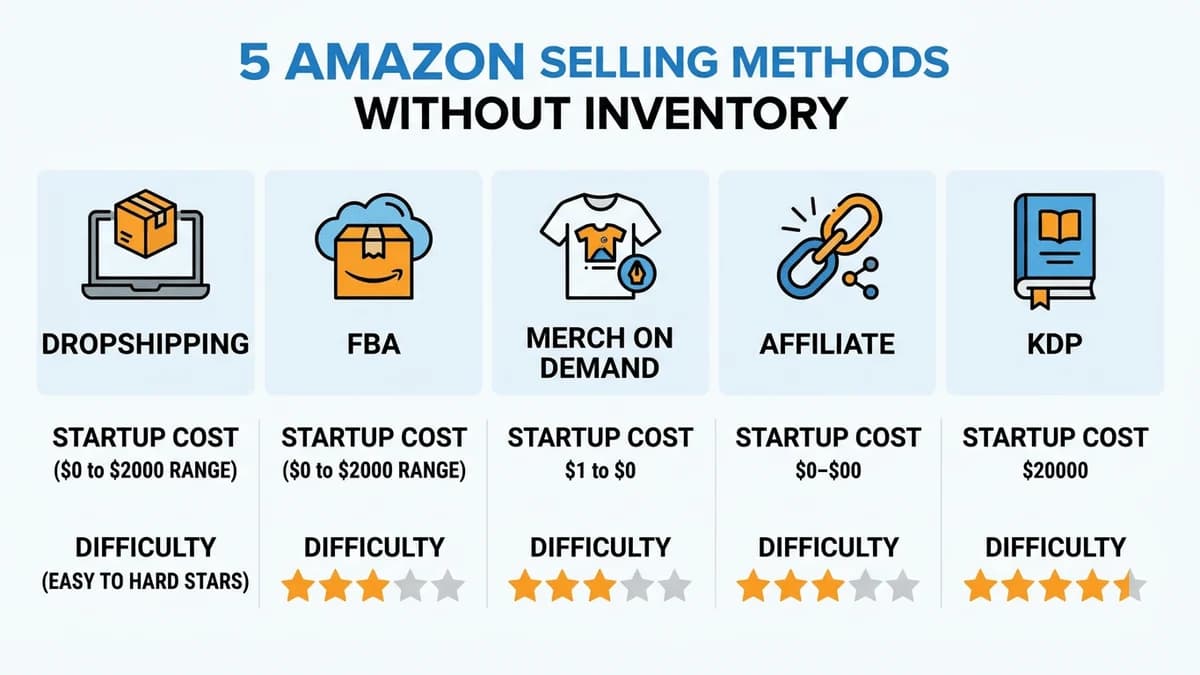
Before diving into details, here's how these models compare:
Dropshipping
- You sell: Physical products
- Startup cost: $0-500
- Profit margins: 10-30%
- Time to first sale: 1-2 weeks
- Difficulty: Medium
Fulfillment by Amazon (FBA)
- You sell: Physical products
- Startup cost: $500-2,000
- Profit margins: 15-40%
- Time to first sale: 2-4 weeks
- Difficulty: Medium
Merch on Demand (Print on Demand)
- You sell: Custom apparel/accessories
- Startup cost: $0
- Profit margins: 10-25% royalty
- Time to first sale: Weeks to months
- Difficulty: Easy
Amazon Affiliate (Associates)
- You sell: Nothing (referral commissions)
- Startup cost: $0-100
- Profit margins: 1-10% commission
- Time to first sale: Varies widely
- Difficulty: Medium-Hard
Kindle Direct Publishing (KDP)
- You sell: Ebooks, paperbacks, audiobooks
- Startup cost: $0-500
- Profit margins: 35-70% royalty
- Time to first sale: Days to weeks
- Difficulty: Easy-Medium
Now let's break down each method.
Method 1: Dropshipping
Dropshipping means listing products on Amazon that you don't physically own. When a customer orders, you forward that order to a supplier who ships directly to the customer.
You're the middleman. You never see or touch the product.
How It Works
- You find a supplier willing to dropship
- You list their products on Amazon at a markup
- Customer buys from your listing
- You order from the supplier with customer's shipping address
- Supplier ships directly to customer
- You keep the difference between selling price and supplier cost
Amazon's Dropshipping Rules
Amazon allows dropshipping, but with strict conditions:
- You must be the seller of record — Your business name on packing slip, not the supplier's
- No retail arbitrage dropshipping — Can't buy from Walmart/Target and ship to customers
- No third-party branding — Customer shouldn't know about your supplier
- You handle returns and customer service — Not the supplier
Violate these rules and your account gets suspended. This is why most "easy dropshipping" courses fail — they teach methods that break Amazon's policies.
Pros
- No upfront inventory investment
- Test products without financial risk
- Wide product selection possible
Cons
- Low margins (10-30%)
- Supplier reliability is critical
- Account suspension risk if done wrong
- Slower shipping than FBA competitors
Best For
Sellers who want to test product ideas before committing to inventory, and those willing to build relationships with legitimate wholesale suppliers. If this model interests you, check out our complete guide on how to start Amazon dropshipping.
Method 2: Fulfillment by Amazon (FBA)
Wait — doesn't FBA require inventory? Technically yes, but here's the key: you don't store it yourself.
With FBA, you send products to Amazon's warehouses. Amazon stores them, ships orders, handles returns, and provides customer service. You never touch inventory after the initial shipment.
How It Works
- You source products (wholesale, arbitrage, private label)
- You ship products to Amazon's fulfillment centers
- Amazon stores your inventory
- Customer orders, Amazon picks, packs, and ships
- Amazon handles returns and customer service
- You get paid (minus fees)
Why FBA Feels Like "No Inventory"
- No storage space needed at home
- No packing orders every day
- No trips to the post office
- Products get Prime badge (faster sales)
- Amazon handles customer complaints
For many sellers, FBA is "inventory-light" rather than "no inventory." You buy products once, send them to Amazon, and forget about fulfillment logistics. Use the Amazon FBA Calculator to estimate fees before committing to any product.
Combining FBA with Arbitrage
Many sellers use retail arbitrage or online arbitrage with FBA:
- Find discounted products at stores or online retailers
- Send them to FBA
- Let Amazon handle everything else
You're not manufacturing or storing long-term — you're flipping deals through Amazon's infrastructure.
Pros
- Prime badge = faster sales
- Amazon handles customer service
- Scalable without warehousing
- Higher trust from buyers
Cons
- Requires upfront inventory purchase
- FBA fees eat into margins
- Storage fees for slow-moving products
- Less control over fulfillment
Best For
Sellers ready to invest in inventory but want hands-off fulfillment. Great for scaling without building your own logistics. New to FBA? Start with our guide on what Amazon FBA means and how it works.
Method 3: Merch on Demand (Print on Demand)
Amazon Merch on Demand is Amazon's print-on-demand service. You upload designs, Amazon prints products when customers order, and you earn royalties.
Zero inventory. Zero fulfillment. Just creative work.
How It Works
- Apply for Amazon Merch (approval required)
- Upload your designs to the platform
- Set prices and write product listings
- Customer orders a product with your design
- Amazon prints and ships the item
- You receive a royalty (typically $2-8 per sale)
Products Available
- T-shirts (most popular)
- Hoodies and sweatshirts
- Long sleeve shirts
- PopSockets
- Phone cases
- Tote bags
- Throw pillows
The Tier System
Amazon Merch uses tiers that limit how many designs you can have live:
- Tier 10 — Starting point, 10 designs max
- Tier 25, 100, 500 — Unlock by selling products
- Tier 1000+ — Experienced sellers with proven sales
You climb tiers by actually selling products, not just uploading designs.
Pros
- Truly zero inventory and zero cost
- Amazon handles everything after design upload
- Passive income potential once designs rank
- No customer service needed
Cons
- Highly competitive (millions of designs)
- Low royalties per sale
- Approval required (not everyone gets in)
- Tier system limits early growth
Best For
Designers, artists, and creative people who can produce original designs. Also good for those testing niche ideas with zero financial risk. See our detailed breakdown of Amazon Merch on Demand for tips on getting approved and climbing tiers.
Method 4: Amazon Affiliate Program (Associates)
Amazon Associates isn't selling on Amazon — it's earning commissions by sending buyers to Amazon.
You create content (blog, YouTube, social media) that recommends products. When readers click your affiliate links and buy, you earn a commission. We have a detailed guide on how to become an Amazon affiliate if you want to explore this path.
How It Works
- Apply for Amazon Associates (free)
- Get approved (need existing content/traffic)
- Create content that naturally recommends products
- Include affiliate links in your content
- Readers click links and buy on Amazon
- You earn 1-10% commission on purchases
Commission Rates (2026)
Commission rates vary by category:
- Amazon Games: 20%
- Luxury Beauty: 10%
- Digital Music, Videos: 5%
- Physical Books, Kitchen: 4.5%
- Electronics, Computers: 4%
- Most other categories: 3-4%
Content That Works
- Product reviews and comparisons
- "Best of" lists (best coffee makers under $100)
- How-to guides that recommend tools
- Unboxing and demo videos
Pros
- Zero inventory, zero fulfillment, zero cost
- Works with any Amazon product
- Passive income from evergreen content
- Combine with other income streams
Cons
- Need existing audience or traffic
- Low commission rates (1-10%)
- Cookie duration only 24 hours
- Amazon can change commission rates anytime
Best For
Content creators, bloggers, YouTubers, and social media influencers who already have (or can build) an audience interested in products.
Method 5: Kindle Direct Publishing (KDP)
KDP lets you publish ebooks, paperbacks, and audiobooks on Amazon without upfront costs. You write (or hire writers), upload to KDP, and earn royalties on every sale.
No inventory. Books are printed on demand for paperbacks, and ebooks have zero production cost.
How It Works
- Create your book (write, design cover, format)
- Upload to KDP (free)
- Set pricing and royalty option
- Book appears on Amazon within 24-72 hours
- Customers buy, you earn royalties
Royalty Options
Ebooks: - 70% royalty on $2.99-9.99 books - 35% royalty on books outside that range
Paperbacks: - Royalty = List price - printing cost - Amazon's cut - Typically $2-5 per sale on standard paperbacks
Types of Books That Sell
- Non-fiction (how-to guides, self-help)
- Low-content books (journals, planners, notebooks)
- Fiction (romance, thriller, fantasy)
- Children's books
Low-content books (like lined journals or puzzle books) require minimal writing and can be created quickly with templates.
Pros
- Zero upfront cost
- High royalties (up to 70%)
- Truly passive after publication
- Global reach through Amazon
Cons
- Requires writing/creative skills (or budget for ghostwriters)
- Highly competitive in popular categories
- Marketing required for visibility
- Reviews are critical for sales
Best For
Writers, subject matter experts, or entrepreneurs willing to invest in content creation. Also viable for those creating simple low-content books.
Which Method Should You Choose?
Choose Dropshipping If:
- You want to test physical products without inventory risk
- You're willing to find legitimate wholesale suppliers
- You understand Amazon's strict dropshipping policies
- You accept lower margins for lower risk
Choose FBA If:
- You're ready to invest some capital in inventory
- You want the Prime badge advantage
- You prefer hands-off fulfillment
- You're willing to learn sourcing (arbitrage, wholesale)
Choose Merch on Demand If:
- You have design skills or ideas
- You want zero financial risk
- You're patient (tier system takes time)
- You enjoy creative work
Choose Amazon Affiliate If:
- You have or can build an audience
- You're good at creating content
- You're okay with low commissions
- You want to combine with other income streams
Choose KDP If:
- You can write or hire writers
- You have expertise worth sharing
- You want high royalties and passive income
- You're patient with book marketing
Can You Combine Multiple Methods?
Absolutely. Many successful Amazon sellers use multiple models:
- Start with Merch or KDP (zero cost) while learning the platform
- Add affiliate marketing to your content about Amazon products
- Graduate to FBA once you have capital from other methods
- Test with dropshipping before committing to FBA inventory
Diversification reduces risk. If one model slows down, others can carry you.
Start Selling Without Inventory Today
You don't need a warehouse to sell on Amazon. Each of these five methods lets you tap into Amazon's massive customer base without traditional inventory burdens. Once you pick a model, focus on optimizing your Amazon listings to maximize conversions.
For zero-cost start: Try Merch on Demand or Amazon Affiliate
For physical products without storage: Use Dropshipping or FBA
For content creators: KDP or Affiliate marketing
Pick one method, learn it well, and scale from there. Many successful Amazon sellers started with one model and expanded as they gained experience.
Tools to Help You Succeed
Whichever model you choose, research is critical. Understanding your Amazon competition and using tools like free sales estimators can help you make smarter decisions before committing time or money.
Connect Ecommerce Data to Your Agent
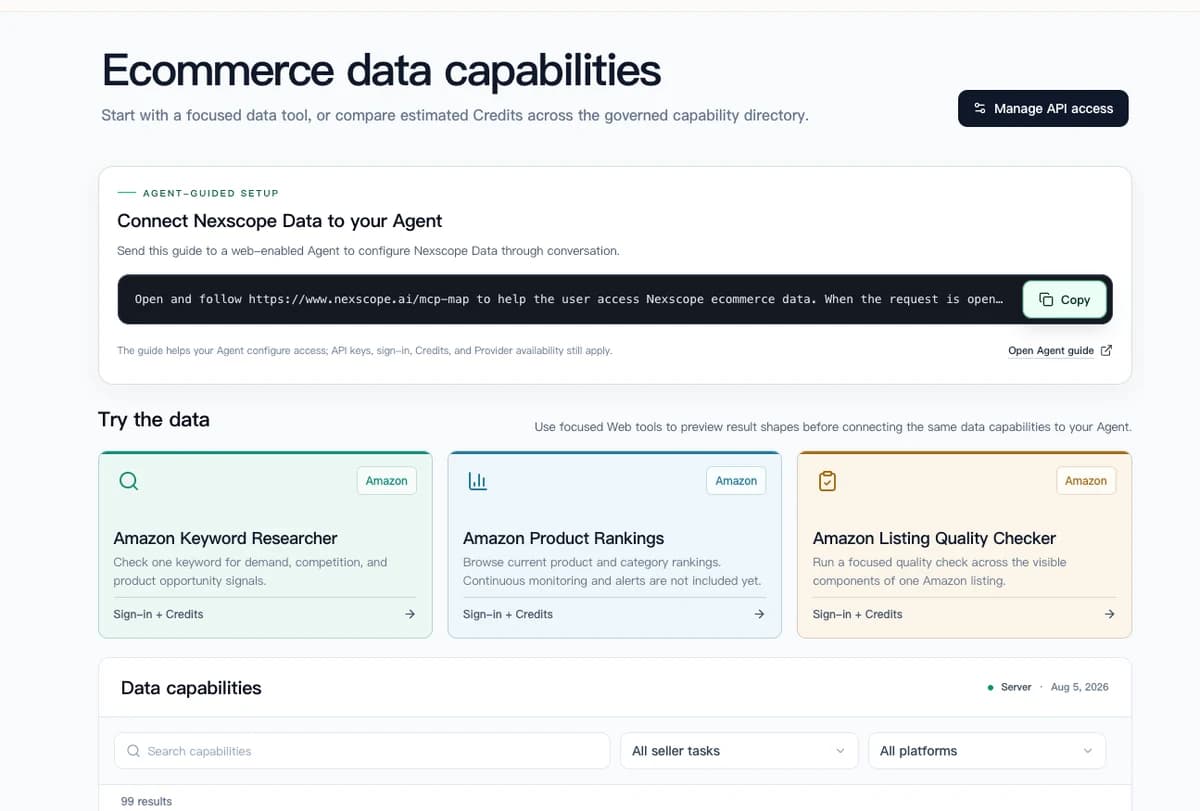
Nexscope provides structured ecommerce data and focused seller workflows. Teams can use Nexscope's web tools directly or connect governed capabilities to their existing Agent through API, MCP, or Skills. Ready workflows include Keyword to Ads, Video Clone, and Buy Box Repricer.
Key Features
- Agent-ready access — Connect ecommerce capabilities through API, MCP, or Skills
- Live data — real-time pulls from Amazon, TikTok Shop, Jungle Scout, Keepa, eBay, Walmart, Google Trends
- Image generation — create product visuals without leaving the workflow
- Ready seller workflows — Keyword to Ads, Video Clone, and Buy Box Repricer
- Context memory — remembers your niche, margin targets, and past research
Whether you choose dropshipping, FBA, or Merch on Demand, Nexscope helps you research smarter and move faster.
Connect Ecommerce Data to Your Agent
Use Nexscope through API, MCP, or Skills, or open a ready seller workflow.
Explore Ecommerce Data →1,000 free credits • API, MCP & Skills
FAQ
Can you sell on Amazon without buying inventory first?
Yes. Dropshipping, Merch on Demand, Amazon Affiliate, and KDP all let you sell without purchasing inventory upfront. FBA requires buying inventory, but Amazon stores and fulfills it for you.
Is Amazon dropshipping still allowed in 2026?
Yes, Amazon allows dropshipping with strict rules: you must be the seller of record, use wholesale suppliers (not retail stores), and ensure no third-party branding reaches customers. Violating these rules risks account suspension.
What is the easiest way to sell on Amazon without inventory?
Amazon Merch on Demand (if you can design) or Amazon Affiliate (if you have traffic) are the easiest because they require zero upfront cost. KDP is also easy if you can create content.
Is selling on Amazon without inventory profitable?
Yes, but profitability varies by method. Dropshipping and affiliate typically have lower margins (10-30%). FBA and KDP can be highly profitable with the right products or books. Merch on Demand scales with design volume.
How much can you make selling on Amazon without inventory?
Income varies widely. Part-time dropshippers might make $500-2,000/month. Successful Merch sellers with hundreds of designs can earn $1,000-10,000/month. KDP authors range from $100 to $10,000+/month depending on catalog size and marketing.
How long until I make my first sale?
It depends on the method: Dropshipping takes 1-2 weeks after listing. FBA takes 2-4 weeks after inventory arrives. Merch can take weeks to months depending on niche competition. Affiliate income varies with your traffic. KDP books can sell within days to weeks after publishing.
Do I need a business license to sell on Amazon without inventory?
Amazon doesn't require a business license to open a seller account, but local laws may require registration depending on your location and sales volume. Consult a local accountant for your specific situation.