
Meta Launches Muse Wonder, Its Most Powerful AI Models Yet

Table of Contents
Meta has launched Muse Wonder and Muse Wonder Full, calling them its most capable AI models so far. Announced on October 12, 2026, the release puts the company's latest work on memory, sustained task execution, and coding into developers' hands.
There is a meaningful distinction between the two. Muse Wonder is available through the Meta Model API and Muse Code. The higher-capability Wonder Full is available through selected Muse Code subscriptions. A team building an application and a developer choosing a coding assistant therefore face different access and cost decisions.
The benchmark results show a substantial improvement over Muse Spark 1.3, with some strong results against competing models. They also show why “best model” needs a more precise definition: performance changes with the task, reasoning setting, and software used to run the model.
What Are Muse Wonder and Wonder Full?
Muse Wonder and Wonder Full are Meta's new models for reasoning, coding, and agents that carry out tasks across multiple steps. Both accept text, images, video, and audio, produce text, and support a one-million-token inference context window.
Wonder Full is a separate model variant. Increasing Muse Wonder's reasoning effort to max does not turn it into Full. Meta's model documentation identifies Wonder as the option for API applications and reserves Full for Muse Code's Power Usage and Maximum Usage plans.
The models also differ from Meta Muse, Meta's personal AI agent that carries out tasks across connected services. Meta says Wonder will roll out to Muse subscribers first.
That distinction matters when evaluating a demo. A result produced by Full in Muse Code does not establish that the same workflow is available through a Wonder API call.
Muse Wonder Key Features
The release emphasizes continuity: retaining useful context, working through obstacles, and keeping a complex project moving.
Active Memory
Active Memory is Meta's term for carrying relevant context across conversations and retrieving it when needed. A useful assistant should recognize when a requirement has changed, rather than repeatedly relying on an earlier instruction.
For a business workflow, that could mean retaining an updated target market or product constraint. Teams should still keep critical requirements in an explicit brief that a reviewer can inspect.
Active Focus
Active Focus describes persistence during a difficult task: trying another approach after a blocker, checking progress, and adapting to new information. Meta illustrates this with tasks such as planning a run and arranging a wedding seating chart.
For developers, the useful question is whether that persistence produces a finished, tested change. More tool calls or a longer working session are valuable only when they improve the result.
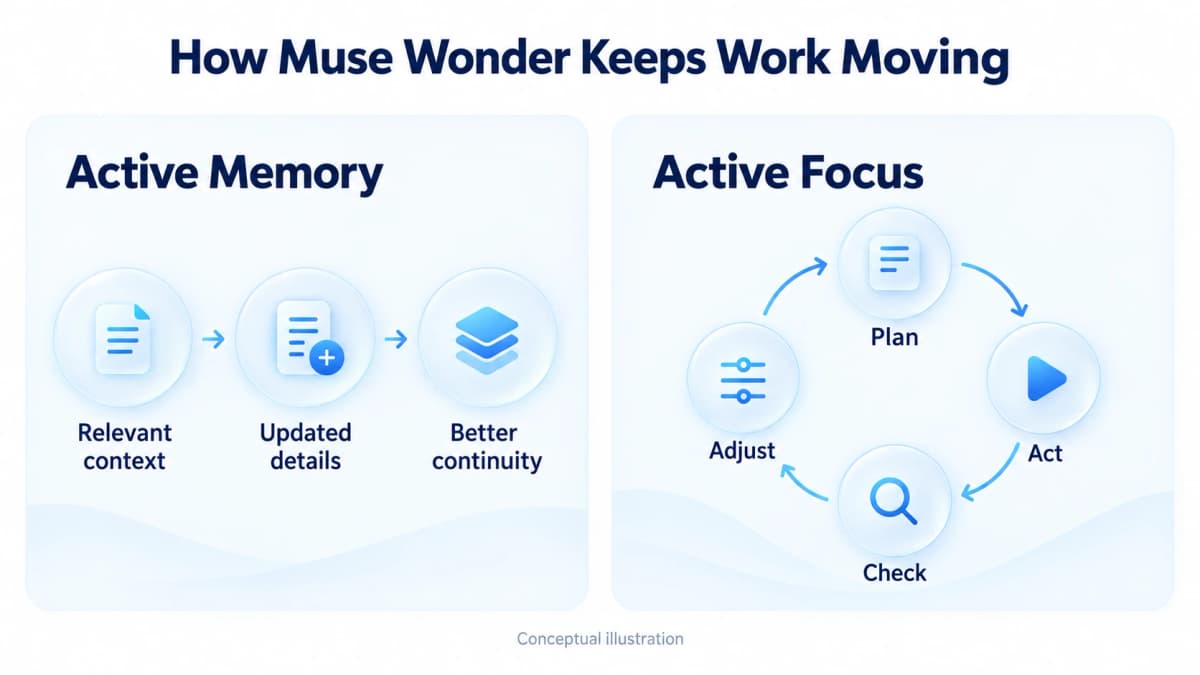
Conceptual illustration of Meta's two feature descriptions, not a product interface.
Multimodal Context
A large context window can accommodate extensive project material, while multimodal input allows a task to include visual or audio evidence. Text output remains the documented output modality; image input support does not make Wonder an image-generation model.
A practical evaluation might combine a product brief, a page screenshot, and a structured data export. The test should check whether the answer uses each source correctly, rather than merely checking whether the input fits.
Coding and Benchmark Results
Muse Wonder Full performs strongly on extended software tasks, but the published comparisons do not show a clean sweep across coding benchmarks.
Selected Coding Results
Meta's launch comparison reports the following results. These are published evaluation figures, not a Nexscope hands-on test.
| Benchmark | Muse Wonder | Wonder Full | GPT-6 Astra | Claude Opus 5.5 |
|---|---|---|---|---|
| SWE-Marathon | 53.1% | 57.5% | 42.5% | 46.3% |
| DeepSWE v1.1 | 78.8% | 79.0% | 74.1% | 74.2% |
| ProgramBench | 50.0% | 59.0% | 52.5% | 70.5% |
| Terminal-Bench 4.0 | 52.0% | 57.1% | 59.1% | 59.6% |
Full leads these two competitors on SWE-Marathon and DeepSWE. Opus leads on ProgramBench, while both Opus and Astra score above Full on Terminal-Bench.
Meta's model card adds an important qualification: SWE-Marathon uses results from different agent products and is not a controlled comparison with identical surrounding software. It also identifies Full's SWE-Marathon setting as xhigh. The table is useful evidence for choosing what to test, rather than proof that one underlying model wins every coding task.
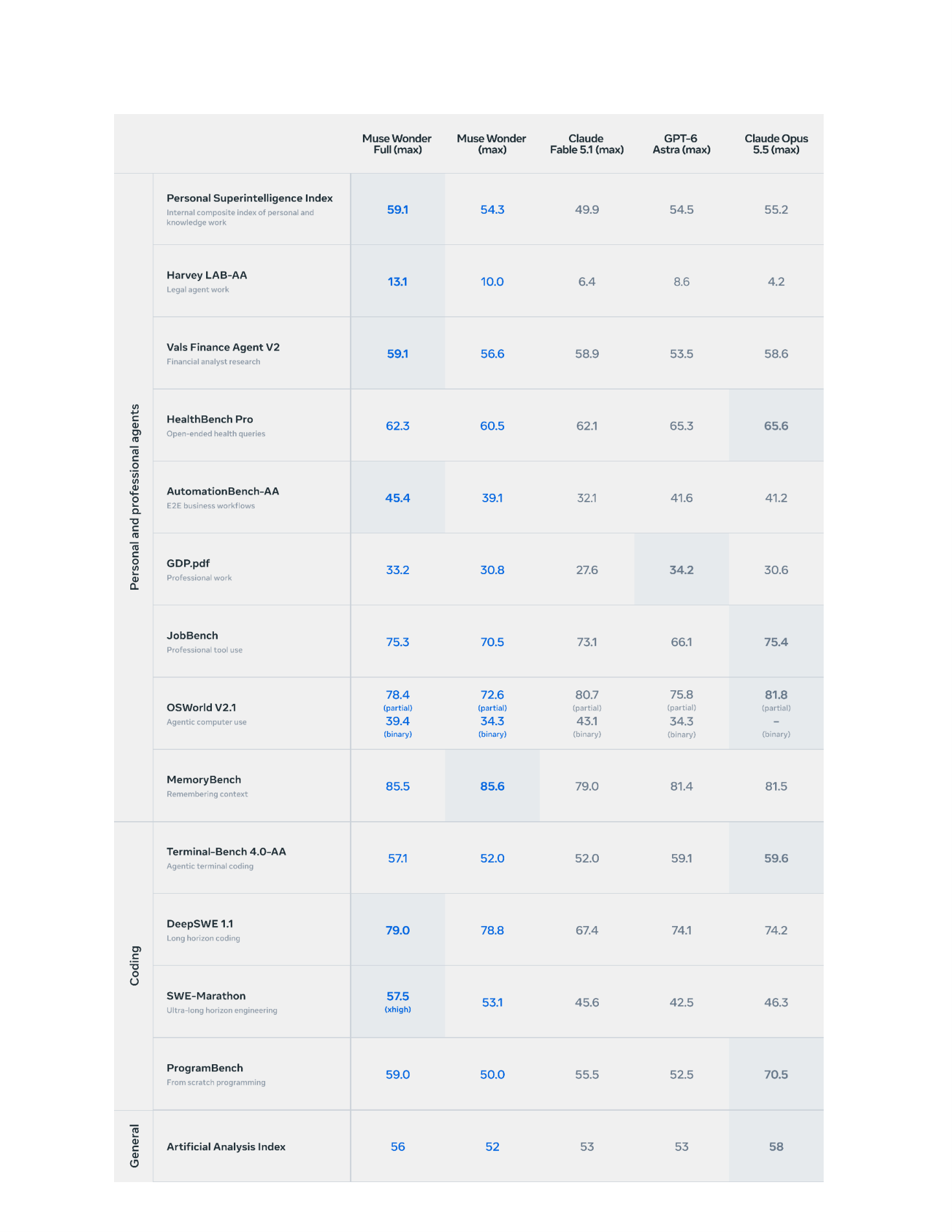
Meta's official launch scorecard, reproduced from the Muse Wonder Model Card, page 3. Click to enlarge. Evaluation settings and sources vary by benchmark; the SWE-Marathon caveat above applies.
Independent Intelligence Scores
Artificial Analysis reports Intelligence Index v4.3 scores of 52 for Muse Wonder and 56 for Wonder Full, both at maximum reasoning effort. Muse Spark 1.3 scores 48 under the same stated setting.
Full improves over Spark 1.3 across all ten evaluations in that index. Its strong results include scientific reasoning and work with professional documents. However, Artificial Analysis notes that some leading scores are close to competitors, with overlapping confidence intervals in its professional-work evaluation.
For an ecommerce engineering team, a useful follow-up test would be a real connector change: modify request handling, preserve existing behavior, pass regression tests, and produce an understandable review. Record completion quality, total cost, and reviewer time together.
Pricing and Availability
Muse Wonder uses token billing through the API. Wonder Full uses subscription access through Muse Code. The prices below are in USD and were checked on October 13, 2026.
Muse Wonder API Pricing
| Usage type | Price per million tokens |
|---|---|
| Input | $4.00 |
| Cached input | $0.20 |
| Output | $20.00 |
The model ID is muse-wonder-1.0. Meta lists no long-context surcharge. Web search grounding is an additional $2.50 per 1,000 search queries.
For example, one million uncached input tokens plus 100,000 output tokens costs $6 in token charges: $4 for input and $2 for output. That calculation excludes search and other separately billed services. Repeated attempts increase the total, so a per-request estimate should be checked against the cost of a completed task.
Wonder Full Subscription Plans
| Muse Code plan | Monthly price | Stated usage relative to Everyday |
|---|---|---|
| Power Usage | $50 | 20× |
| Maximum Usage | $200 | 80× |
Both plans include Wonder Full. These are usage-limited subscriptions, not unlimited API packages. Meta's subscription documentation states that additional API keys are billed separately on a pay-as-you-go basis. Benefits and availability can vary by region.
Muse Code subscriptions default to Contributor mode, which allows Meta to use submitted content for model training in exchange for more usage. Users can disable that setting; future content then receives the corresponding Standard-mode treatment. This distinction deserves attention before a team supplies proprietary code or internal business documents.
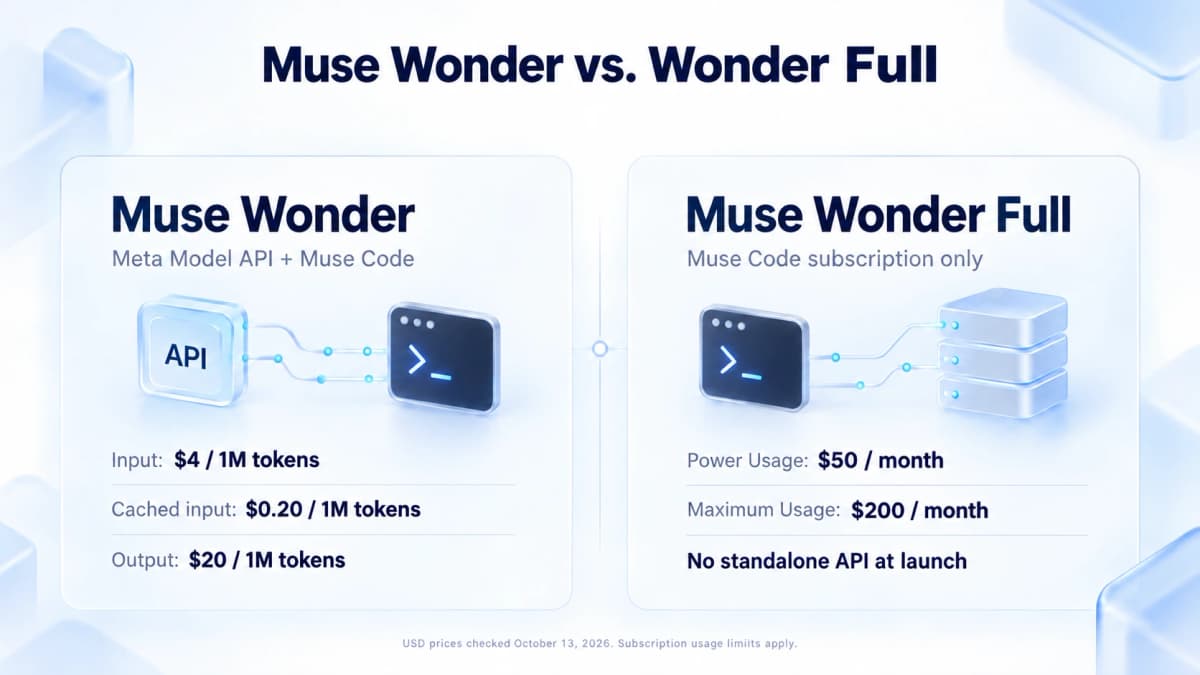
API token rates and Muse Code subscription prices use different billing units; they are not a cost-per-task comparison.
What This Means for Ecommerce Teams
The most relevant opportunity is testing whether better task continuity reduces the work required to turn scattered evidence into a reviewable decision. The examples below are proposed applications, not demonstrated Muse Wonder integrations or measured business outcomes.
Product Research Briefs
A research agent could carry a product shortlist through several rounds of investigation while preserving the team's exclusions and target market. Before it draws conclusions, supply actual listing evidence. For example, retrieve Amazon product details by ASIN to compare supported product attributes, prices, and ratings.
Ask the agent to separate observed facts from assumptions and identify missing information. A plausible explanation for why a product sells is still a hypothesis without supporting evidence.
Demand and Seasonality Checks
A trend investigation needs a defined market and time range. Compare search interest across keywords, then ask the agent to explain recurring peaks and differences between terms. Relative search interest should not be presented as unit sales or absolute search volume.
Keeping the research brief consistent across follow-up questions could make this work easier to review. Data freshness and the choice of comparison terms remain separate responsibilities.
Internal Tool Development
Wonder Full's coding results make it a candidate for evaluating internal reporting tools and API connectors. Start with a bounded change, such as adding a field to a research report. Define the expected output and tests before the agent begins, then measure whether it completes the change without breaking existing behavior.
Conclusion
Muse Wonder gives developers another model to evaluate for applications that require reasoning and tool use. Wonder Full offers a higher-capability option inside Muse Code. The launch results justify testing both in their available environments, with particular attention to completed work, cost, and review effort.
Build Research Workflows With Nexscope
Useful ecommerce analysis also depends on the information supplied to the model. Nexscope is an ecommerce data platform that provides structured product, market, keyword, and competitor information through REST API and supported MCP integrations.
You can ask your Meta Muse to connect to Nexscope through MCP using a custom connector. Give Muse the Nexscope connection details, complete authentication when prompted, and ask it to list the available tools and run a small product query. Once connected, you can request product comparisons and demand research directly in Muse, with Nexscope supplying the underlying ecommerce data.
The two APIs above support complementary steps: checking candidate products and examining search-interest patterns. Muse handles the task, while Nexscope provides the data it can call. Complete and test the connector setup in your account before relying on its results.
Nexscope Data APIs use pay-as-you-go Data Credits without a Data API subscription. New users receive 1,000 trial credits valid for three days, with no credit card required. Model-provider charges are separate.
Give Your Ecommerce Agent Better Data
Connect product facts and demand signals to your own research workflow through Nexscope's documented Data APIs.
Explore Nexscope APIs →Frequently Asked Questions
Is Muse Wonder Meta's most powerful model?
Meta describes the Wonder family as its most capable release so far, with Wonder Full as the higher-capability variant. That claim concerns Meta's lineup; the published results vary across tests against other providers.
Can I use Wonder Full through an API?
At launch, Full is available through Muse Code's Power Usage and Maximum Usage subscriptions. The standalone Meta Model API offers Muse Wonder. Selecting maximum reasoning effort on Wonder does not select Full.
How much does Muse Wonder cost?
Standard API rates are $4 per million input tokens, $0.20 per million cached-input tokens, and $20 per million output tokens. Search grounding is billed separately. Full is included in the $50 and $200 monthly Muse Code plans.
Can Muse Wonder generate images or videos?
The model card lists text, image, video, and audio inputs, with text output. Understanding an uploaded image or video is different from generating one.
Does Nexscope provide Muse Wonder access?
Nexscope supplies ecommerce data; Muse Wonder model access comes from Meta. To use Nexscope data inside Meta Muse, ask Muse to create a custom connector using Nexscope’s MCP connection details, finish authentication, and test a query. This connects data tools to Muse rather than providing a Muse Wonder model subscription.
Sources
- Meta. (2026). Muse Wonder: A Frontier Model For Personal & Professional AI Agents; Muse Wonder Model Card. Retrieved from research.meta.ai
- Meta. (2026). Muse Wonder; Put Your Ideas to Work With Muse Wonder and Muse Wonder Full; Models. Retrieved from dev.meta.ai
- Meta. (2026). Pricing and Rate Limits. Retrieved from dev.meta.ai
- Meta. (2026). Muse Code; Subscriptions. Retrieved from dev.meta.ai
- Meta. (2026). How Muse Works With Connectors. Retrieved from meta.com
- Artificial Analysis. (2026). Muse Wonder and Muse Wonder Full: A Material Jump in Intelligence Over Previous Meta Models. Retrieved from artificialanalysis.ai