

Amazon Black Friday Preparation Checklist for 2026

Table of Contents
Amazon Black Friday preparation starts with a practical question: how much can each product earn after discounts, advertising, fulfillment fees, storage, and returns? A busy sales weekend can leave a seller with less cash if the offer is too expensive to fulfill or the replenishment plan leaves excess inventory behind. The strongest preparation connects the promotion to the stock available to sell and the margin available to spend.
For US sellers preparing in late October 2026, the immediate priorities are checking inbound shipments, reviewing the extended deal submission window, and recalculating costs at holiday rates. Then comes a product-level plan for pricing, ad spend, backup stock, and customer issues. The checklist below follows that sequence so each decision has a clear input: an arrival estimate, a cost, a sellable quantity, or a conversion signal. It also separates the dates that have passed from the actions still available before the holiday shopping weekend.
Key Amazon Holiday Deadlines for 2026
Keep the US inbound calendar separate from the promotion calendar. Amazon's inventory dates are arrival cutoffs at its facilities, so dispatching a shipment on the cutoff date leaves the receiving requirement unmet.
| Date | Milestone | Action for a late-October review |
|---|---|---|
| October 14 | AWD inventory arrival cutoff | Review the status of stock already sent. |
| October 21 | FBA arrival cutoff for minimal shipment splits | Confirm received and available quantities. |
| October 28 | FBA arrival cutoff for Amazon-optimized shipment splits | Check appointments, receiving status, and shipment exceptions. |
| November 13 | Extended Black Friday and Cyber Monday deal submission deadline | Review eligible ASINs and submit available offers. |
| November 27 | Black Friday | Monitor availability, offer health, and contribution margin. |
| November 30 | Cyber Monday | Adjust spend to remaining stock and profitable demand. |
Amazon extended deal sourcing from the original October 20 deadline to November 13. That extension creates more time to submit promotions; it does not extend the inbound inventory dates. Check the event shown in the account's Deals dashboard when scheduling an offer.
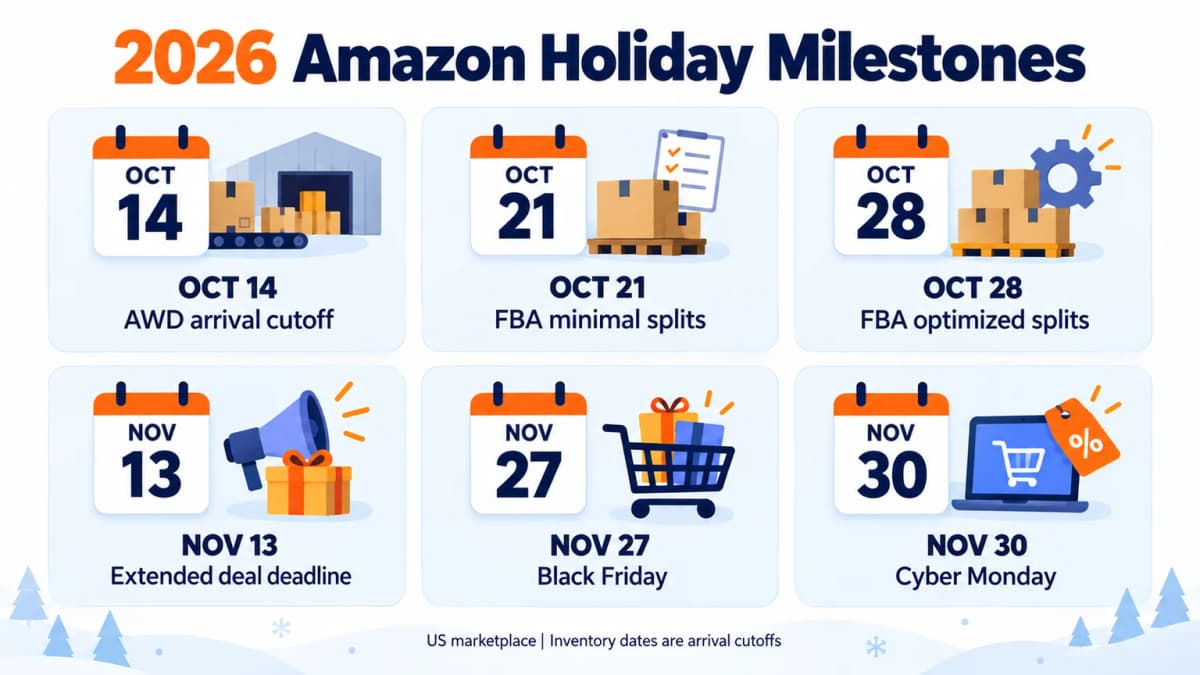
US marketplace milestones. Inventory dates refer to arrival at Amazon facilities.
As of October 26, the October 14 and October 21 cutoffs have passed. Prioritize shipment exceptions and usable inventory before committing more units to a promotion. For any late shipment, plan around the actual delivery promise and available quantity shown for the offer.
Teams also running a TikTok Shop Black Friday campaign need a separate calendar and stock allocation for that channel. Reserve each channel's planned units before promising the same inventory to two promotions.
Calculate Your Margin Before Discounting
Set a minimum contribution per order before selecting the discount. Use the promotional selling price and subtract product cost, referral fees, fulfillment, inbound costs, expected storage, promotion fees, advertising, and a returns allowance. Keep fixed overhead separate so the team can see what each extra sale contributes.
Separate the fee windows
For standard-size, non-dangerous-goods FBA inventory, Amazon's published base monthly storage rates are $0.78 per cubic foot from January through September and $2.40 from October through December. Billing uses daily average stored volume. Inventory age and storage utilization can add further charges.
Holiday peak fulfillment fees run from October 15, 2026, through January 14, 2027. Calculate the relevant size-and-weight charge for each SKU rather than applying a single surcharge across the catalog. A January order can still fall inside the peak fulfillment window after the October-to-December storage period has ended.
Model the promotion economics
Consider this illustrative offer. These figures are planning assumptions, not an Amazon fee quote:
| Per-order item | Assumed amount |
|---|---|
| Promotional selling price | $30.00 |
| Landed product cost | $9.00 |
| Referral fee | $4.50 |
| Fulfillment and allocated inbound cost | $5.20 |
| Storage and returns allowance | $1.30 |
| Allocated promotion cost | $0.80 |
| Contribution available before advertising | $9.20 |
If the required contribution after advertising is $3.00, the offer can support $6.20 of advertising cost per order. At a $30 selling price, that equals approximately 20.7% advertising cost of sales. Break-even ad spend would consume the entire $9.20 and leave nothing toward fixed overhead.
Run the calculation again at a lower conversion rate and a higher return allowance. If the downside case turns negative, reduce the discount, improve the offer economics, or leave that SKU out. A larger forecast alone does not repair weak unit economics.
Plan Inventory Across FBA, AWD, and Backup Storage
Build a forecast for each product and variant. Separate normal daily demand from expected promotional demand, then compare both with sellable stock and replenishment timing. A single account-wide coverage target can hide a fast-selling size beside a slow-selling color.
Forecast from available stock
A simple starting calculation is:
Days of cover = sellable units ÷ forecast daily unit sales.
An illustrative SKU with 360 sellable units and forecast demand of 18 units per day has 20 days of cover. If demand reaches 30 units per day during the promotion, cover falls to 12 days. Use both scenarios when deciding how much stock to reserve for the event.
Keep inbound units separate until their availability is sufficiently clear. A carrier delivery estimate, a receiving status, and units ready for customer orders represent different stages. Build the replenishment schedule around the date the units can support sales.
Give each location a purpose
| Inventory location | Planning role | Cost or timing to assess |
|---|---|---|
| FBA | Stock supporting near-term customer demand | Storage, fulfillment, receiving, and sell-through |
| AWD | Reserve inventory feeding FBA | Regional storage, processing, transport, and replenishment |
| Third-party warehouse | Backup stock or products needing separate handling | Minimum charges, transfers, appointments, and processing |
| Supplier or origin warehouse | Stock held before the next shipment | Production readiness, transit, and working capital |
AWD supports automatic replenishment to FBA. Its 2026 base storage rate is $0.57 per cubic foot per month in the West Coast region and $0.48 in the East Coast, South East, and South Central regions. Discounted storage tiers have eligibility conditions. Include processing and transportation charges when comparing the complete route with direct FBA storage.
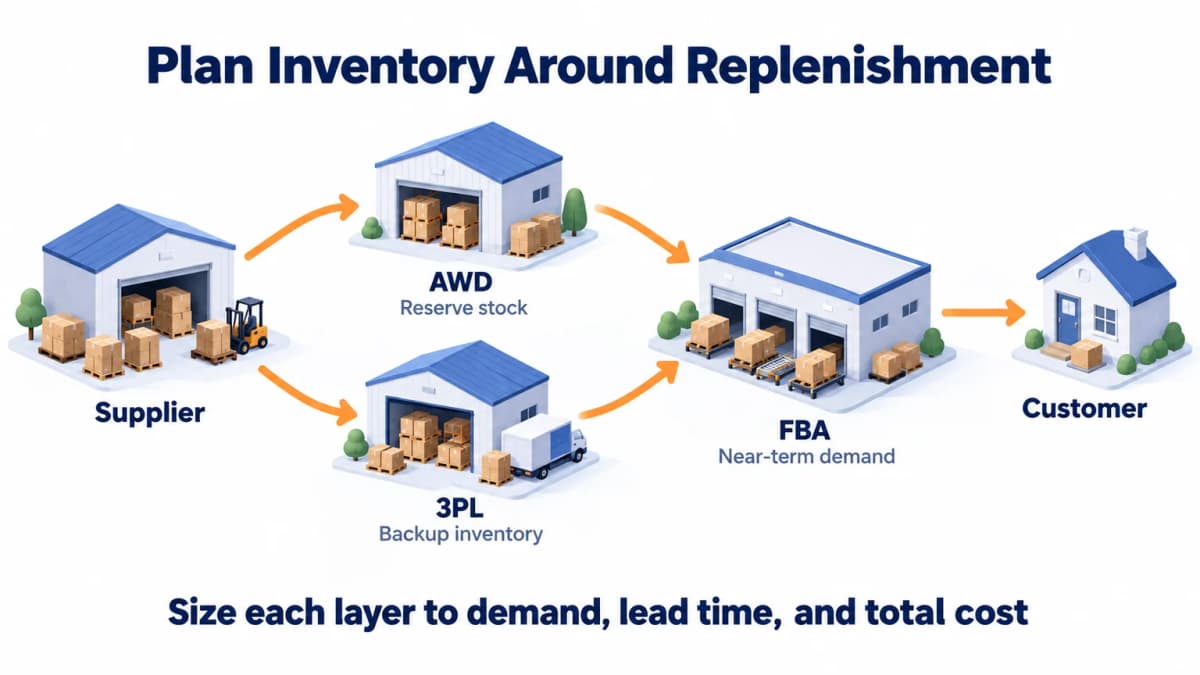
Illustrative replenishment paths. Batch sizes depend on demand, lead time, and total cost.
Schedule smaller replenishment decisions
Review the next shipment at a regular interval using stock remaining, updated sales pace, and the next usable arrival date. Smaller batches can reduce excess inventory exposure when handling and transit costs support the approach. Avoid creating so many shipments that transfer fees or receiving complexity consume the savings.
For slow movers, compare a controlled markdown with the cost of holding, removing, or relocating units. Make that decision before authorizing another purchase order. Existing inventory age belongs in the same review as the holiday sales forecast.
Check Deal Eligibility and Promotion Conflicts
Start with the ASINs available in the Deals dashboard. For each candidate, review the event's required price, reference-price status, rating and account requirements, inventory commitment, and displayed fee. Save the approved offer details so a later price change does not undermine the plan.
Amazon's 2026 holiday announcement lists a $100 upfront promotion fee plus 1.5% of promotional sales, with the variable component capped at $5,000. Allocate the displayed fee across a realistic unit forecast before deciding whether the event is worthwhile.
Prime Big Deal Days promotional prices are excluded from the 30-day and 60-day lookback windows used for the maximum Black Friday Week and Cyber Monday deal price. Keep that event-specific exclusion separate from other discounts and ordinary price changes.
Resolve eligibility issues in order
Use a consistent review sequence when an offer is suppressed or unavailable:
- Check the reason displayed for the ASIN.
- Review the validated reference price and required event price.
- Confirm the listing is active and the intended units are available.
- Check account health and unresolved product restrictions.
- Review every coupon, business discount, and other promotion affecting checkout.
- Recalculate contribution at the final customer price.
Treat a submission as a task that still needs monitoring. Recheck the offer after edits and before the scheduled start. Where multiple discounts can combine, calculate the resulting customer price and fee exposure before leaving both enabled.
Adjust Pricing and Ads Around Replenishment
Tie advertising to stock that can support customer demand. Start with the expected replenishment gap, then decide how much traffic and conversion the remaining units can sustain. Keep a record of the change, its purpose, and the next review time.
Use a replenishment decision table
The following is a planning framework, not a set of Amazon ranking rules:
| Replenishment situation | Pricing decision | Advertising decision |
|---|---|---|
| Usable stock expected before current cover runs out | Maintain a profitable, competitive offer | Fund campaigns within the SKU's contribution target. |
| A short stockout looks likely | Review whether the promotion remains serviceable | Reduce inefficient traffic and monitor cover daily. |
| A gap of several weeks is expected | Reassess discounts and the value of remaining units | Limit spend to what stock and margin can support. |
| Availability is uncertain | Rebuild the forecast before making another commitment | Redirect suitable spend to stocked products. |
Change one variable at a time
If stock is constrained, begin with search terms or targets producing poor contribution. Reduce spend there before broadly cutting a profitable campaign. When changing price, observe conversion and margin together; when changing bids, observe traffic cost and order quality.
For example, a SKU selling 20 units per day with 100 units left has about five days of cover at that pace. If replenishment is expected in nine days, the team needs a plan for the gap. The answer depends on the confidence of the arrival estimate, the offer's margin, and whether another stocked product can serve the demand.
Do not plan on closing a listing to preserve its search position. Maintain the existing catalog record through replenishment, and use legitimate variations only for products that meet Amazon's variation requirements. Creating duplicate or misleading catalog relationships adds avoidable account risk.
Prepare for Returns and Compliance Checks
Assign an owner to customer issues before promotional volume increases. Keep a short daily review covering inventory availability, listing suppression, ad spend, returns reasons, and account notifications. An issue should have a named next action and a review date.
Review the listing promises
Compare titles, bullets, images, and packaging with what the product actually delivers. Check measurements, compatibility, included accessories, materials, and care instructions. Route health, antimicrobial, or other regulated claims through the relevant product-compliance review before using them.
Use recent customer feedback to identify avoidable confusion. If shoppers repeatedly misunderstand the package contents, explain the contents clearly in the listing and imagery. If a return reason indicates a product defect, investigate the batch and stock affected before buying more traffic.
Track the full selling period
Track returns against the orders that generated them, including returns arriving after the shopping event. Include a realistic allowance in the original margin plan, then replace assumptions with observed costs as the period develops.
After the promotion, review remaining units, contribution after advertising, customer issues, and the next replenishment requirement. Keep effective campaigns funded where stock and margin support them. Investigate weak conversion before increasing bids, and review excess stock before placing another large order.
Conclusion
An effective Amazon Black Friday preparation checklist connects the calendar with product-level decisions. Confirm usable stock, calculate the offer's contribution, resolve promotion issues, and adjust traffic around replenishment. Continue the same review through Cyber Monday and the returns period so sales growth translates into a healthier inventory and cash position.
Support Holiday Decisions With Nexscope
Seller reports show the account's own inventory and results. External market evidence can help explain whether a pricing change, competitor offer, or customer concern deserves attention during the event.
Nexscope provides structured ecommerce data that teams can connect to their own agents and workflows through REST API or MCP. Relevant Amazon capabilities include:
- Product and competitor data to compare competing offers and product attributes.
- Price history and ranking signals, where supported, to put current changes in context.
- Keyword and review data to identify demand signals and recurring product questions.
Combine those inputs with the business's own stock, cost, advertising, and returns records. Keep the observation time and any estimates with the data so the team can distinguish a market signal from a confirmed account result.
Support Your Holiday Planning With Amazon Data
Connect Amazon market evidence to your own agents and workflows through REST API or MCP.
Explore Amazon Data APIs →Frequently Asked Questions
What is the Amazon Black Friday deal deadline for 2026?
Amazon extended the Black Friday and Cyber Monday deal sourcing deadline to November 13, 2026, from the earlier October 20 date. Review the event and ASIN availability in the account's Deals dashboard before submitting. Keep promotion submission separate from inbound planning: additional time to schedule a deal does not change the inventory arrival cutoffs.
Is October 28 an FBA shipping or arrival deadline?
October 28, 2026, is the US FBA inventory arrival cutoff for Amazon-optimized shipment splits in Amazon's holiday announcement. October 21 applies to minimal shipment splits, and October 14 applies to AWD arrivals. Plan transit, delivery appointments, and receiving before the relevant date. Then monitor the quantity available to fulfill orders when sizing promotions and advertising.
How much inventory should a seller prepare for Black Friday?
Calculate coverage by product and variant using sellable units divided by forecast daily demand. Test a normal-demand case and a stronger promotional case, then compare the resulting cover with replenishment lead time. Keep pending inbound units visible as a separate quantity. Choose the inventory commitment using margin, arrival confidence, and the cost of leftover stock after the event.
Is AWD cheaper than FBA during the holiday season?
AWD's storage rate can make reserve stock less expensive to store than keeping the same volume in FBA during October through December. The full comparison also needs AWD processing, transportation, regional rates, and the timing of replenishment. Model the complete route for the product and shipment size. A lower storage rate alone does not establish a lower total cost.
Should sellers raise prices when a stockout is approaching?
Review price changes alongside contribution, conversion, and replenishment timing. A higher price may slow sales, but it can also reduce the offer's competitiveness. Begin by checking the usable arrival date and cutting inefficient ad spend. Make deliberate changes with a review time, and avoid assuming that a particular price or listing closure will preserve search position.
What should sellers check after Cyber Monday?
Review remaining sellable units, incoming shipments, contribution after advertising, return reasons, and customer or account issues. Continue tracking costs that arrive after the event. Use the resulting stock position and sales pace to decide the next replenishment quantity. Keep successful campaigns active where the offer remains profitable, and investigate weak conversion before increasing spending.
Sources
- Amazon. (2026). Holiday 2026: Same fees, same eligibility, earlier deadlines. Retrieved from sellercentral.amazon.com
- Amazon. (2026). Black Friday Cyber Monday deals deadline extended to November 13. Retrieved from sellercentral.amazon.com
- Amazon. (n.d.). Fulfillment by Amazon. Retrieved from sell.amazon.com
- Amazon. (2026). Amazon Warehousing and Distribution fees. Retrieved from sellercentral.amazon.com
- Amazon. (n.d.). ASIN creation policy. Retrieved from sellercentral.amazon.com