

10 Best Ecommerce Data APIs for Online Sellers in 2026

Table of Contents
The best ecommerce data APIs help online sellers keep product research, competitor monitoring, and pricing decisions grounded in current information. Instead of checking the same listings manually, your team can bring relevant data into a spreadsheet, reporting system, or research workflow and review changes consistently.
The choice depends on what you sell and where you sell it. An Amazon business evaluating price history has different needs from a brand comparing several marketplaces or a retailer collecting thousands of product pages. Coverage matters, but so do the fields returned, the work needed to use them, and the cost of checking them repeatedly.
Nexscope is our top pick for sellers who need multiple kinds of ecommerce research data through one platform. The remaining options cover specialized Amazon research, shopping search, and web data collection.
Which Ecommerce Data APIs Are Best for Online Sellers?
Start with the job you need to complete. This shortlist includes research data platforms, specialist APIs, and collection services; their billing units and responsibilities differ.
| Rank | Provider | Recommended use | Data focus | Billing approach |
|---|---|---|---|---|
| 1 | Nexscope | Research across ecommerce tasks and marketplaces | Products, keywords, reviews, pricing, stores, trends, and sourcing | Pay-as-you-go Data Credits |
| 2 | Bright Data | Collecting retail data across many websites | Product listings, prices, reviews, and related page data | Scraper API usage; datasets sold separately |
| 3 | Oxylabs | Building a substantial retail collection pipeline | Product and search pages with source-specific parsing | Usage plans; check target and output requirements |
| 4 | Keepa | Researching Amazon price history | Historical prices, products, offers, and deals | API subscription with token-based access |
| 5 | Rainforest API | Retrieving Amazon data for recurring research | Amazon products, search, and related data | Subscription credits and overages |
| 6 | SerpApi | Monitoring shopping search results | Google Shopping results and other supported search engines | Search allowances by plan |
| 7 | Zyte API | Extracting product information from varied sites | Web pages and automatic structured extraction | Usage-based, with website and request-type tiers |
| 8 | Apify | Combining reusable collection tools | Data returned by selected Actors | Platform usage plus Actor-specific charges |
| 9 | ScraperAPI | Connecting retail collection to an existing application | Web scraping and structured ecommerce endpoints | API-credit plans |
| 10 | Decodo | Collecting product and price data | Supported ecommerce pages and parsed results | Plans based on successful requests |
A specialist may be the right choice for one recurring task. A broader platform becomes useful when the same team needs to move between product discovery, competitor checks, and market research.
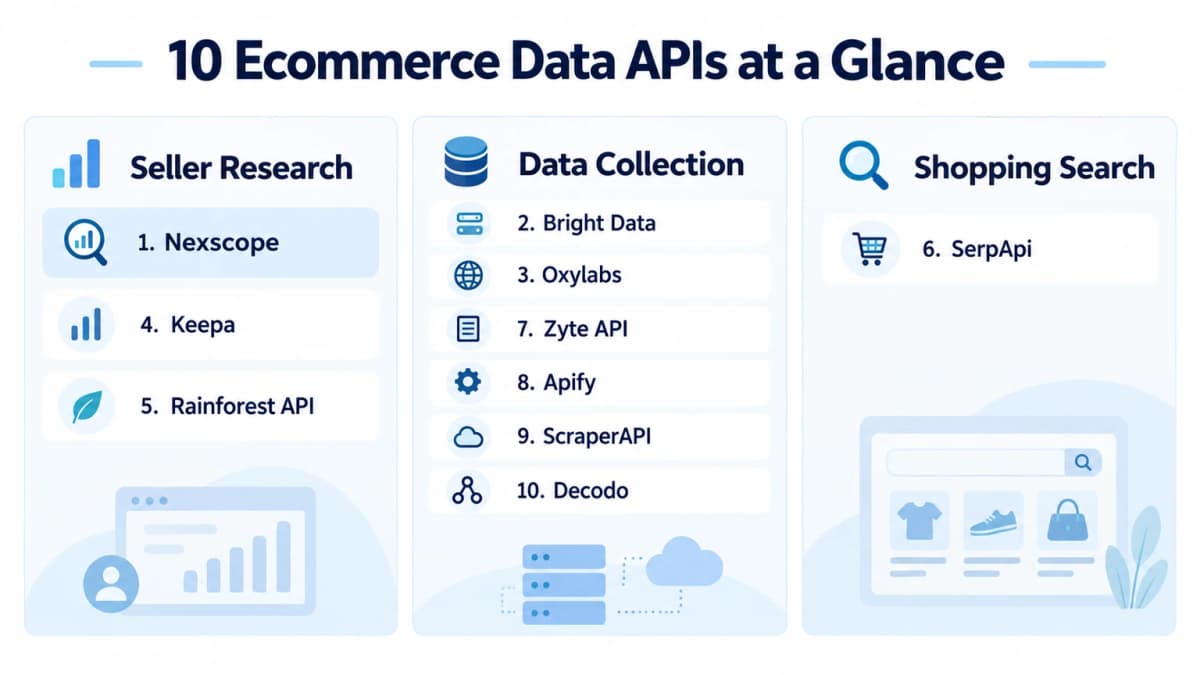
Compare providers by their main use case before narrowing your shortlist.
How Did We Choose These Ecommerce Data APIs?
The comparison considers five buying questions:
- Coverage: Can the service retrieve the required data for your marketplace and country?
- Useful fields: Does it provide the information needed for a decision, rather than just a page response?
- Time coverage: Do you need a current observation, a historical series, or repeated collection?
- Implementation effort: Who will connect the API, organize the results, and maintain the workflow?
- Cost structure: What consumes credits, tokens, searches, or billable results?
What Are the 10 Best Ecommerce Data APIs in 2026?
1. Nexscope
Best fit: Online sellers combining research across marketplaces and business questions.
Nexscope brings ecommerce data, marketing intelligence, and AI image and video APIs into one platform. Connect ecommerce research data to your own tools, Agent, and workflows through REST API or MCP, and use Creative REST APIs to generate visual assets.
Ecommerce Data and Platform Coverage
- Broad marketplace coverage: Nexscope supports a wide range of ecommerce platforms, including Amazon, TikTok Shop, Ozon, Shopee, Temu, Walmart, Shopify, Etsy, eBay, Mercado Libre, and more.
- Sourcing and trends: 1688 for wholesale product and supplier research, plus Google Trends for search-interest analysis.
- Research data: Products, keywords, reviews, prices, rankings, sellers, and stores to support product discovery and competitor research.
- Workflow integration: Bring structured data into your own applications, reporting tools, and Agent workflows through REST API or MCP.
Marketing APIs
- Search and content research: Keyword metrics, related terms, search results, and on-page SEO data.
- Competitor intelligence: Ranking pages, keyword gaps, traffic estimates, and backlinks.
- Advertising and AI visibility: Paid-search research, ad samples, and brand mentions or citations in AI answers.
AI Image & Video APIs
- Image generation: Create product and campaign visuals with models such as GPT Image 2 and Nano Banana 2.
- Video generation: Generate ecommerce video assets with models such as Seedance 2.5.
- Creative workflows: Background removal, virtual try-on, model swaps, and talking sales videos through REST APIs.
Pricing and Fit
- Data API billing: Pay-as-you-go Data Credits; no required Data API subscription. Credit consumption varies by API.
- Data API trial: 1,000 credits valid for three days, with no credit card required.
- Creative API access: A separate subscription is required; calls consume credits according to the model and output settings.
- Choose Nexscope when: Your team wants to connect marketplace research, marketing intelligence, and creative production within its own workflows.
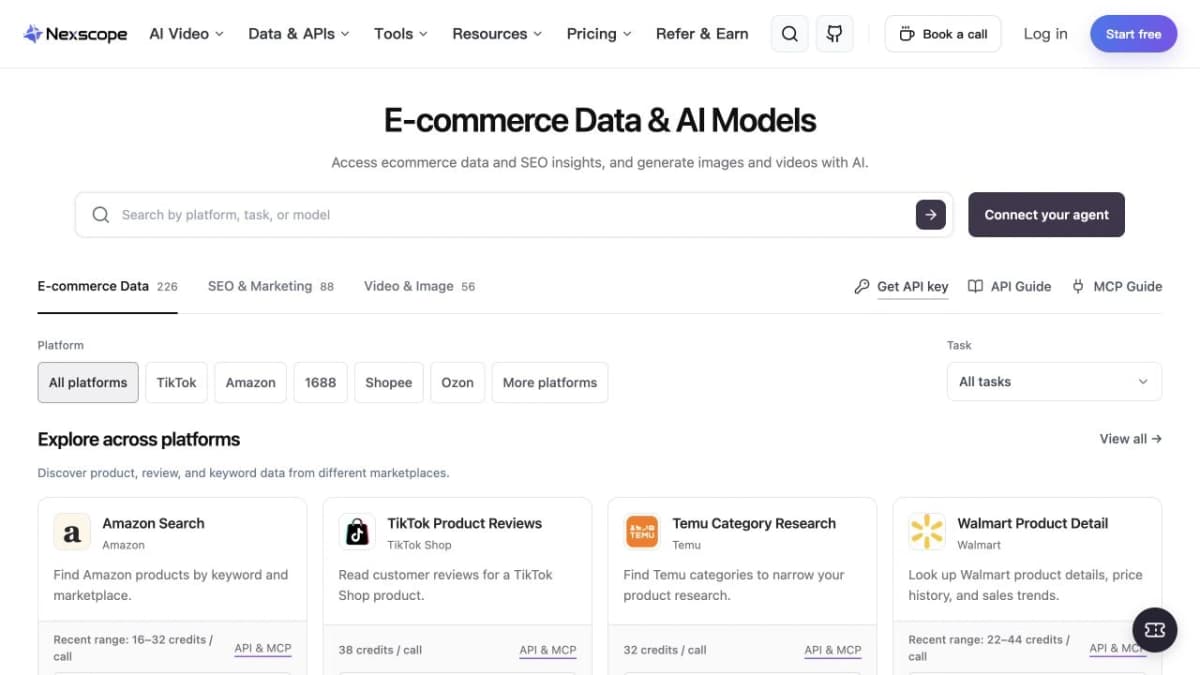
Explore Nexscope APIs for Your Store
Find ecommerce data, marketing intelligence, and AI image and video APIs for your next workflow.
Explore Nexscope APIs →2. Bright Data
Best fit: Sellers and retail teams collecting data from a broad set of websites.
Bright Data offers ecommerce scrapers for sources including Amazon, Walmart, eBay, TikTok Shop, and Google Shopping. Depending on the scraper, results can include product attributes, prices, availability, ratings, and reviews.
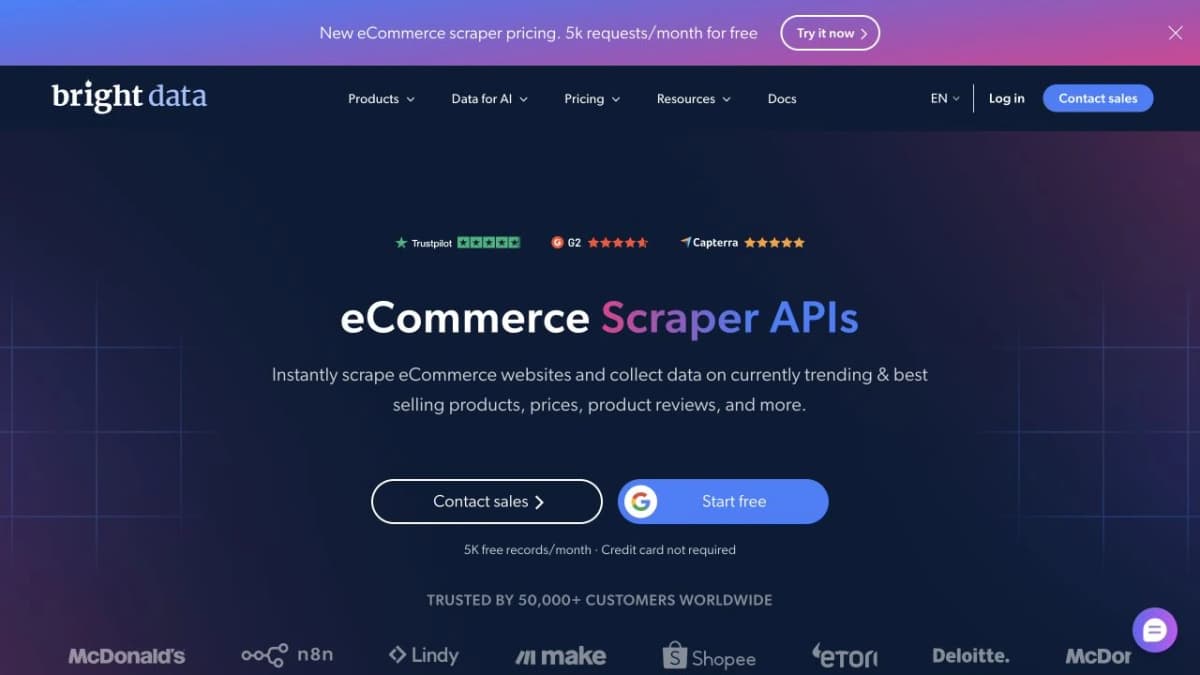
Bright Data — eCommerce Scraper APIs page.
It is a useful candidate when your business has a defined collection project: a list of competing products, target websites, required fields, and a refresh schedule. A retail analyst could use those observations to maintain a competitive assortment report.
Pricing: Evaluate the specific Scraper API offering. Pre-collected datasets are a separate purchasing option, so dataset prices should not be treated as API request prices.
Main limitation: The team still needs to decide which products match across sources and how the collected data will support decisions. Broad website coverage does not guarantee identical fields on every site.
Choose Bright Data when collecting and delivering retail data is the main requirement and your team can manage the analysis that follows.
3. Oxylabs
Best fit: Teams building a repeatable ecommerce collection pipeline.
Oxylabs provides ecommerce scraping through its Web Scraper API. Its source catalog distinguishes product and search targets, parsed JSON results, and targets that return raw HTML or need an additional parsing step.
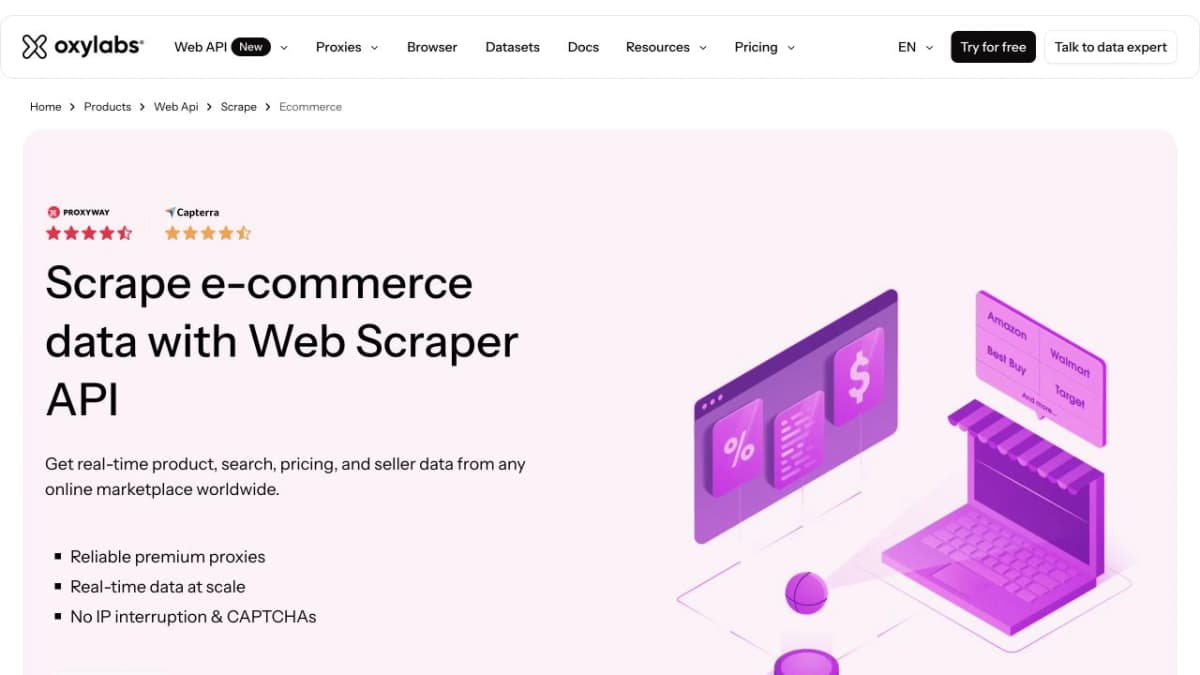
Oxylabs — ecommerce Web Scraper API page.
That distinction matters for sellers with substantial catalogs. Retrieving a page is only part of the work; the application also needs consistent fields for product matching, price comparisons, and reporting.
A team monitoring competitor availability could evaluate the exact product endpoint for each retailer before committing to a wider rollout.
Pricing: Assess the applicable usage plan and the requirements of each target. Include any parsing and downstream processing work in the project budget.
Main limitation: Do not assume that every supported website has the same ready-to-use structured output. Check the specific target and sample response.
Choose Oxylabs when your development or data team wants control over a larger collection process and can maintain the resulting pipeline.
4. Keepa
Best fit: Amazon sellers who need historical context for product and pricing decisions.
Keepa supplies Amazon product data and price histories through its API, alongside marketplace offers, deals, and other research capabilities.
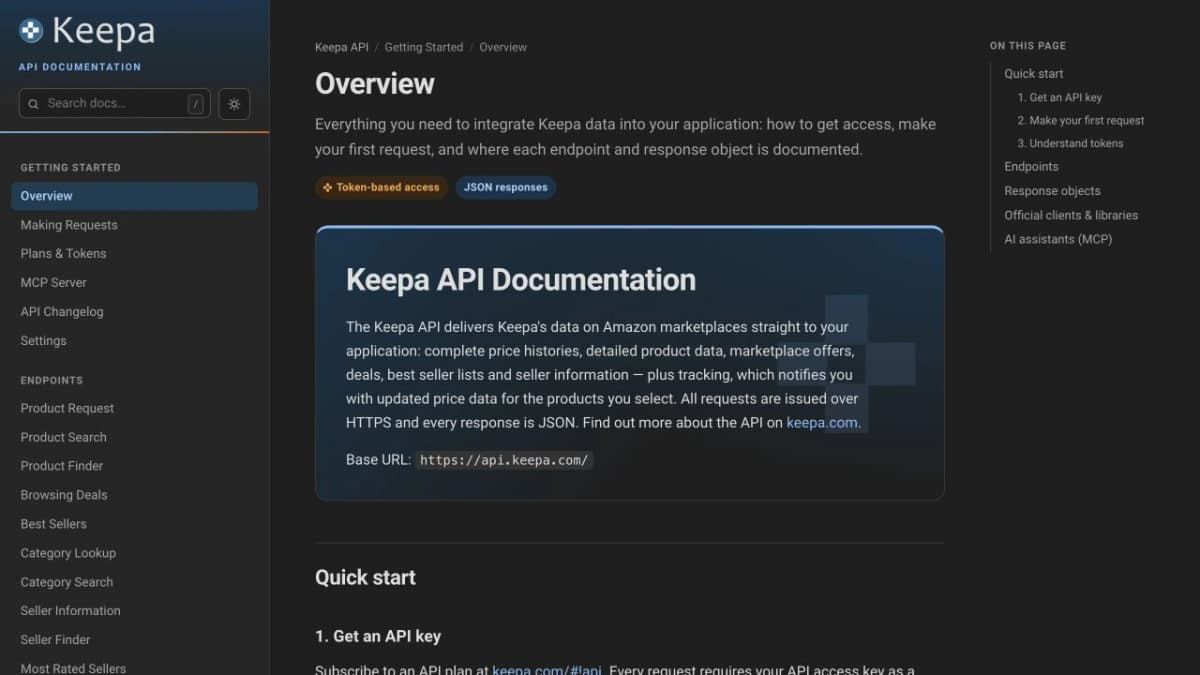
Keepa — API documentation overview.
Historical context is valuable when a current listing looks unusually attractive. A seller can investigate whether a low price is temporary, whether offers have changed, and how a product’s price has moved over time before making a purchasing decision.
Pricing: API access uses a subscription with a token allocation. Endpoints and optional data requests consume different numbers of tokens, so estimate demand from the actual request configuration.
Main limitation: Keepa is an Amazon specialist. It does not replace a broader research process for TikTok Shop, independent stores, or sourcing platforms.
Choose Keepa when Amazon price history is central to the question you are trying to answer. Sellers comparing broader Amazon coverage can also review these Amazon product APIs.
5. Rainforest API
Best fit: Teams that want a dedicated Amazon data service.
Rainforest API, offered by Traject Data, focuses on retrieving Amazon data for applications and research workflows. Its Amazon specialization makes it a candidate for recurring product and search checks.
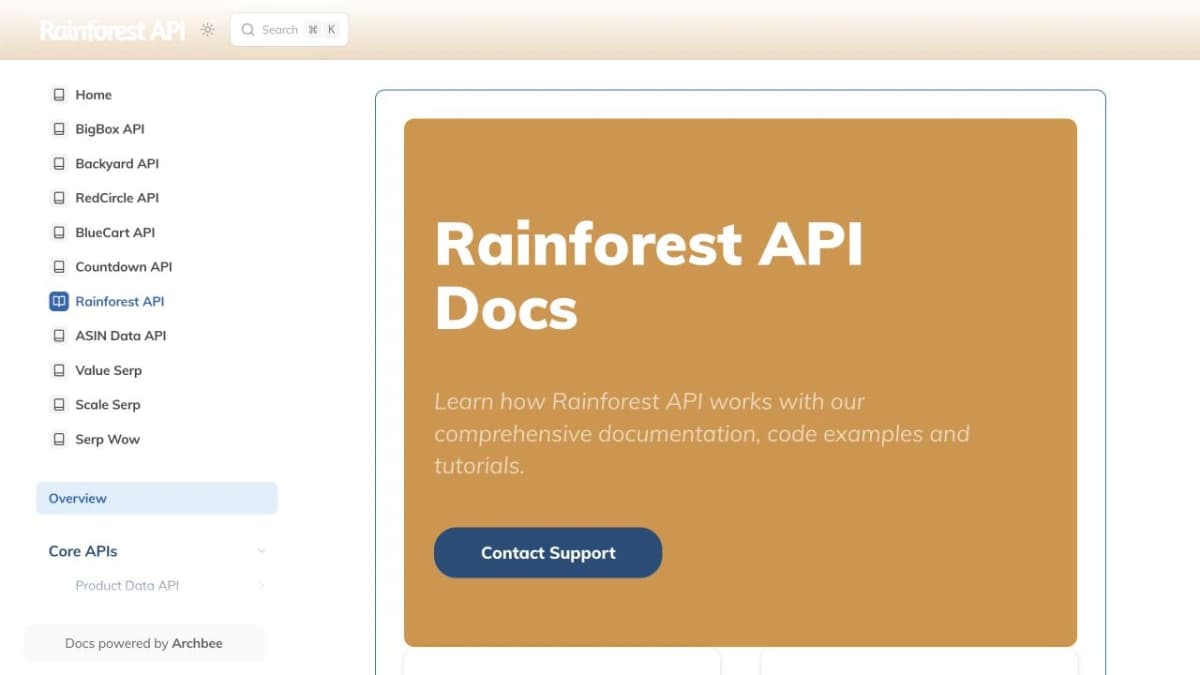
Rainforest API — official API documentation.
For a seller tracking a defined competitive set, a focused service can simplify the buying decision: evaluate the required Amazon marketplace, request type, response fields, and location controls rather than comparing a broad retail catalog.
Pricing: Plans provide credit allowances and charge for additional usage. The reviewed product page displays annually billed options, so distinguish an effective monthly rate from a month-to-month commitment.
Main limitation: Amazon coverage does not extend the same service to every other marketplace. Confirm that the particular data and regional settings you need are available under the chosen plan.
Choose Rainforest API when Amazon is the center of your research workflow and you want to assess a purpose-built provider.
6. SerpApi
Best fit: Sellers investigating how products appear in shopping search.
SerpApi’s Google Shopping API returns structured shopping search results. The wider service also documents other search engines and shopping-related interfaces.
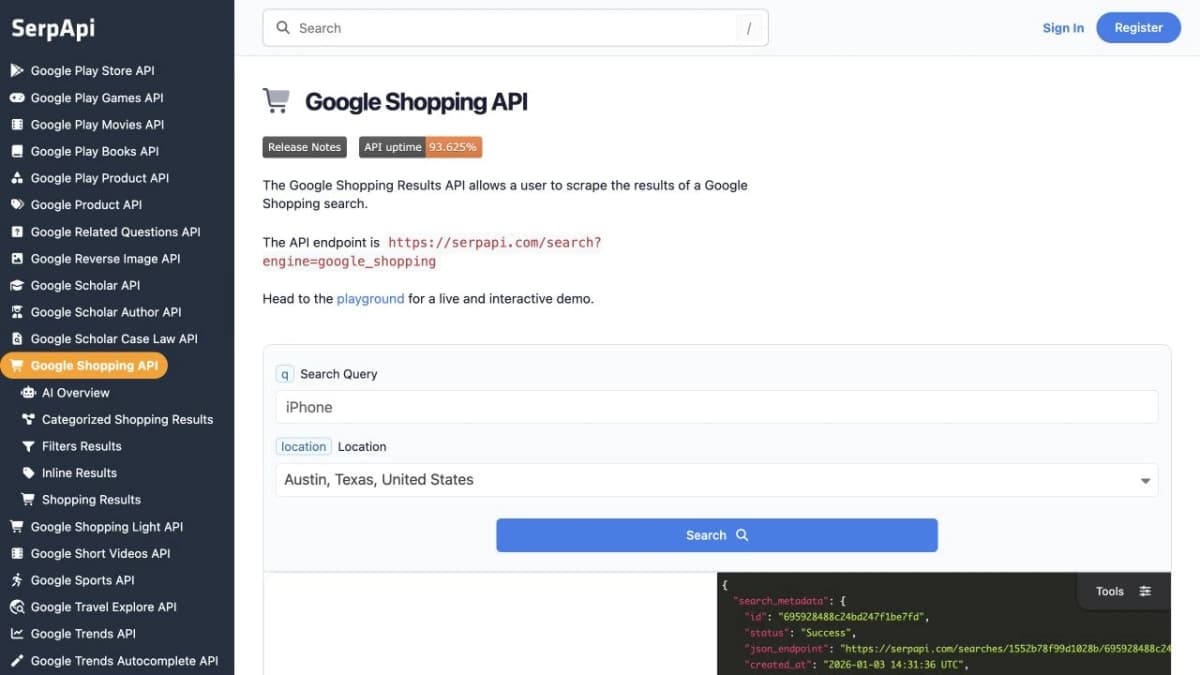
SerpApi — Google Shopping API documentation.
This helps answer a different question from a product-detail lookup: what does a shopper see when searching for a category or product? A seller could compare visible offers for a query and investigate which competing products appear in that search context.
Keep the query, country, language, and collection time consistent when comparing observations. A change in search conditions can produce a different result set.
Pricing: Plans are organized around search allowances. Estimate the number of queries and pages your monitoring schedule requires.
Main limitation: Search results represent a particular search context. They are not a complete retailer catalog or a record of your store’s sales.
Choose SerpApi when shopping search visibility and comparison results are the primary data you need.
7. Zyte API
Best fit: Teams extracting product information from a varied set of retail websites.
Zyte API combines web retrieval, browser rendering, and automatic extraction capabilities. Product extraction can reduce the amount of custom page parsing required for a collection project.
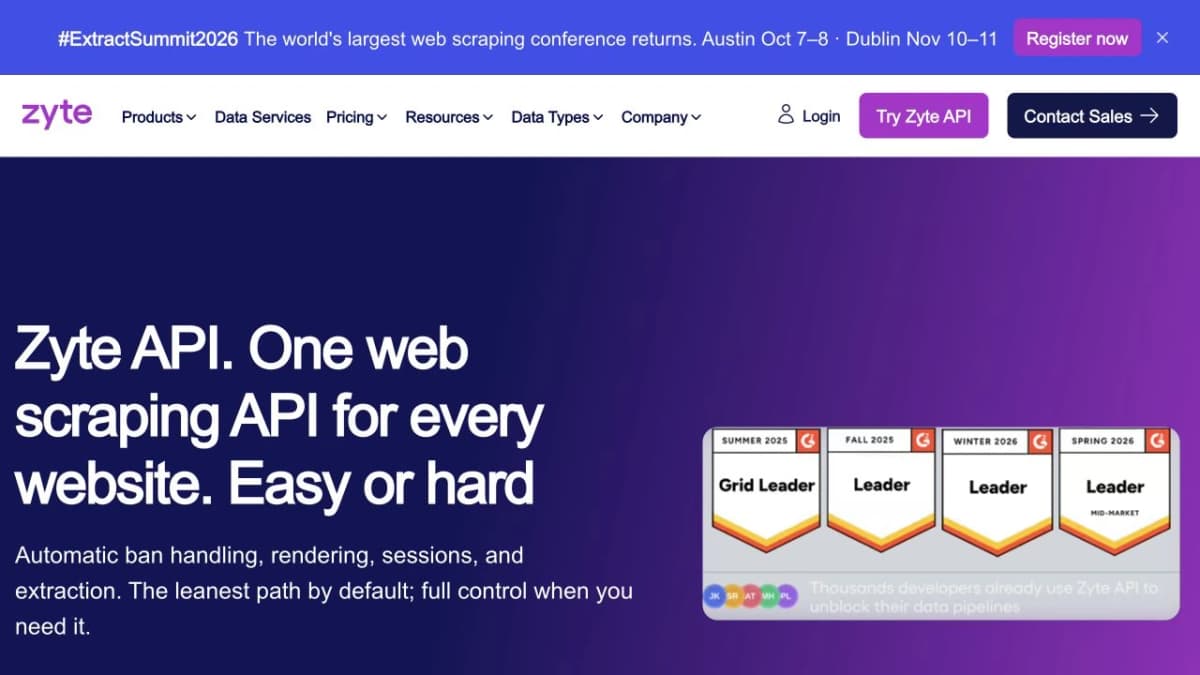
Zyte API — web scraping API page.
A seller researching independent competitors could evaluate Zyte when the relevant stores do not fit neatly into a small list of marketplace-specific endpoints. The practical question is whether it can return the required attributes consistently from those exact pages.
Pricing: Usage depends on the website and request type. HTTP responses, browser rendering, and extraction requirements can affect the cost, so use representative URLs in an estimate.
Main limitation: Your team still needs a collection plan, a schedule, and a way to organize products across sites. Extraction does not automatically create a finished market analysis.
Choose Zyte API when flexible extraction is more important than a prepackaged marketplace research catalog.
8. Apify
Best fit: Sellers with technical support who want reusable, customizable collection tools.
Apify runs tools called Actors and makes their results available through APIs and datasets. This creates a flexible route for combining several collection tasks within an automated workflow.
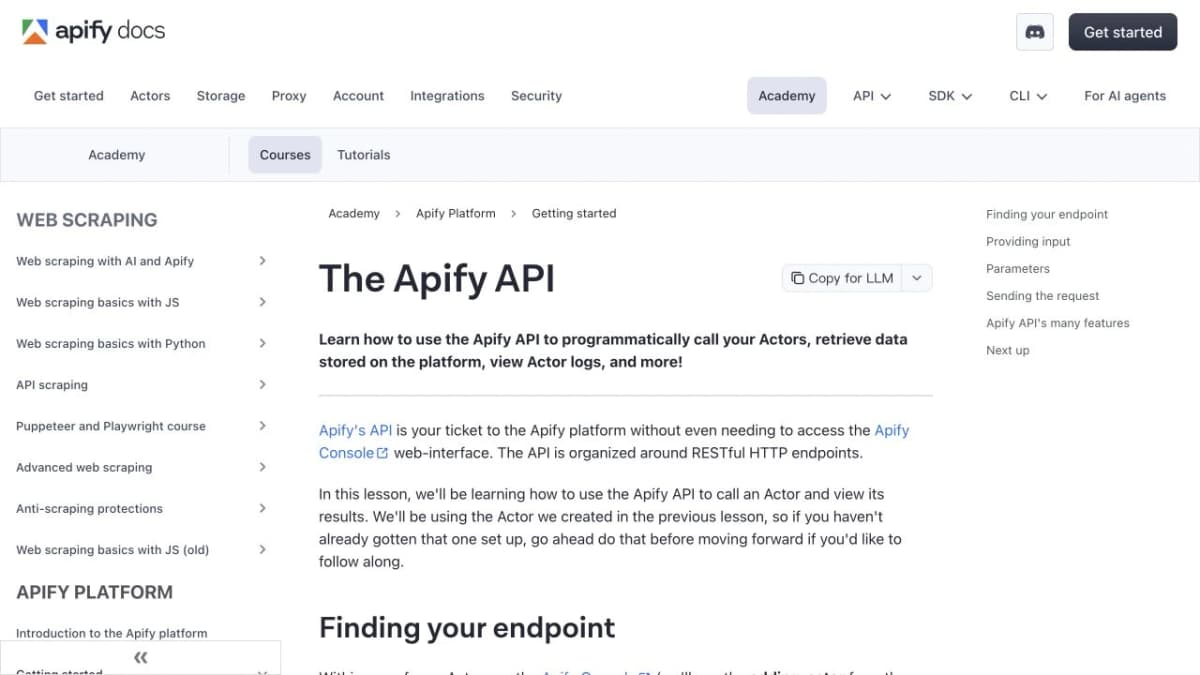
Apify — API integration documentation.
For ecommerce research, the buying decision should happen at the Actor level. Inspect its target site, input options, returned fields, documentation, and maintenance history before depending on it.
Pricing: Account for platform usage and the selected Actor’s pricing model. Different Actors can charge differently, so a platform plan alone does not describe the full cost of every task.
Main limitation: Actor quality, schemas, coverage, and maintenance vary. A successful trial of one tool does not validate another tool in the catalog.
Choose Apify when your team values flexibility and is willing to evaluate and maintain its chosen combination of tools.
9. ScraperAPI
Best fit: Teams adding ecommerce collection to an existing application.
ScraperAPI provides web scraping services and structured ecommerce data endpoints. A supported structured endpoint can return usable fields without requiring the application to parse the full page itself.
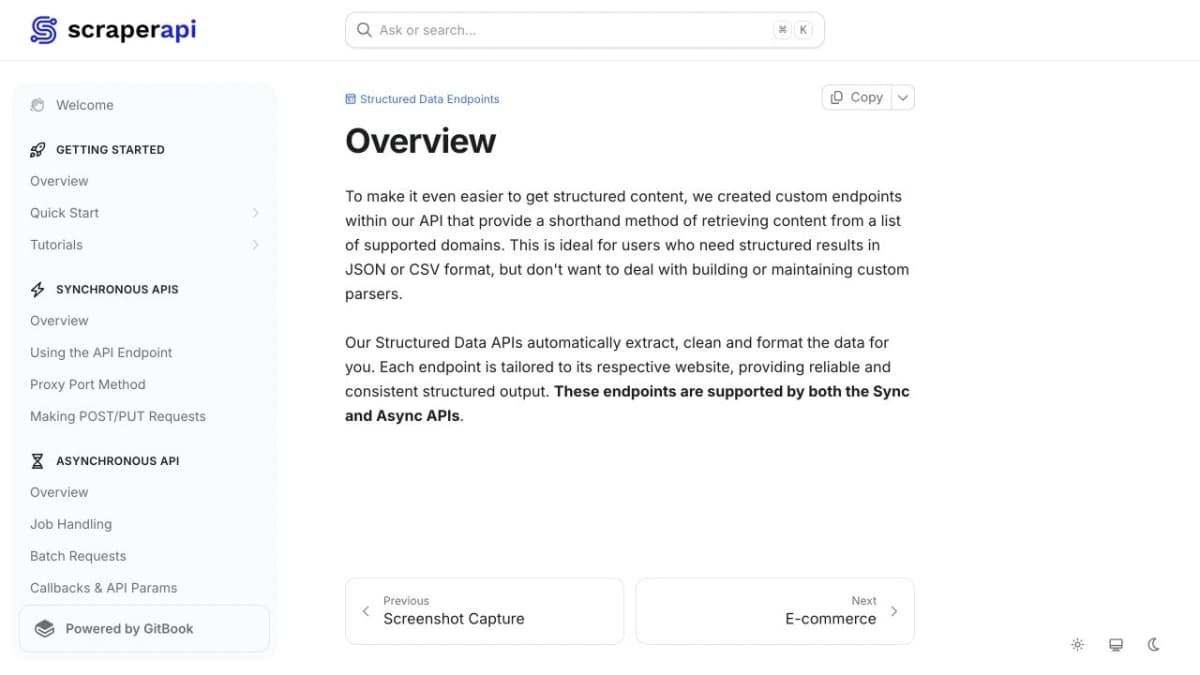
ScraperAPI — Structured Data Endpoints documentation.
A seller maintaining a competitor tracker should first check whether its required page types have dedicated structured endpoints. If they do not, the project may need additional parsing and validation work.
Pricing: Plans use API credits. Calculate consumption for the actual endpoint and request options rather than assuming every call has the same cost.
Main limitation: General scraping access and structured data extraction are different deliverables. Confirm what the chosen endpoint returns before estimating implementation effort.
Choose ScraperAPI when your team already has a reporting or automation system and needs to add a supported collection component.
10. Decodo
Best fit: Sellers building recurring product and price collection.
Decodo’s ecommerce scraping offering focuses on retrieving retail product data, including information relevant to pricing and product comparison. It is worth evaluating when you have a defined set of target pages and need structured output for recurring monitoring.
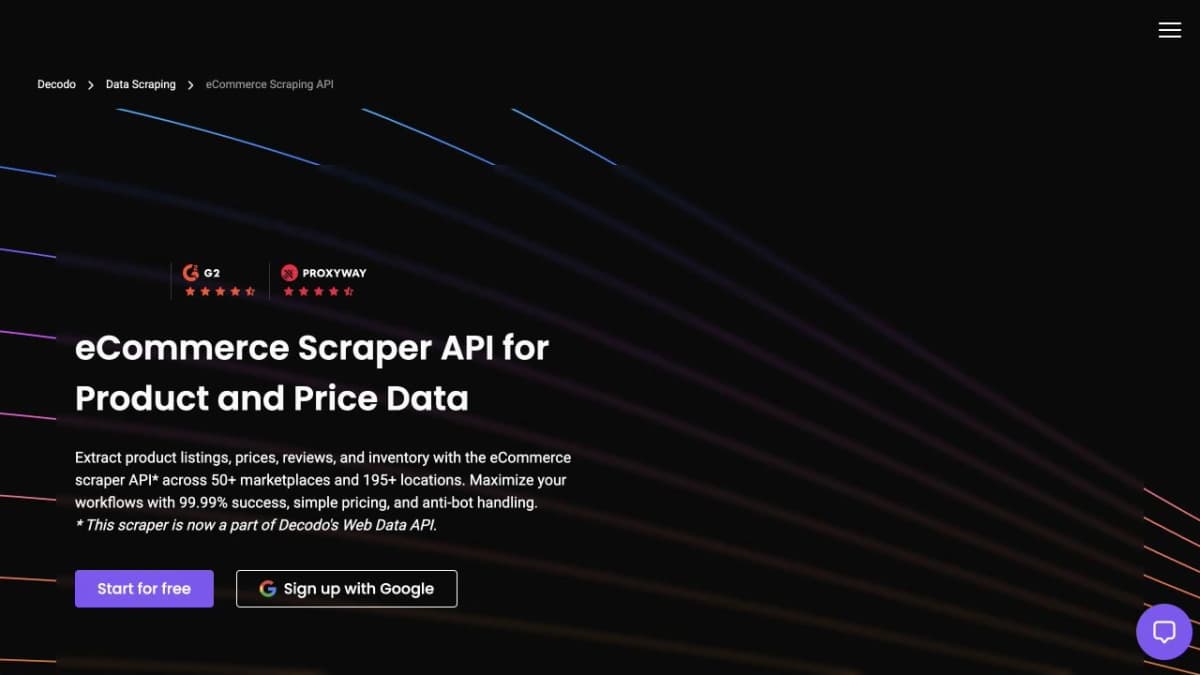
Decodo — eCommerce Scraper API page.
For example, a seller could test a representative group of competitor listings, then assess whether the returned product identifiers, currencies, and variations support reliable comparisons.
Pricing: Decodo describes its ecommerce scraper pricing in terms of successful requests. Check the applicable plan, request limits, and output options for your intended workload.
Main limitation: Successful delivery is only the first acceptance check. Your team must still confirm that the result contains the right product, variation, market, and fields.
Choose Decodo when your requirement is focused product-data collection and its supported targets match your monitoring list.
How Do You Choose the Right API for Your Store?
Choose the API that returns usable evidence for a specific recurring decision. A short trial with your own products is more informative than a long feature checklist.
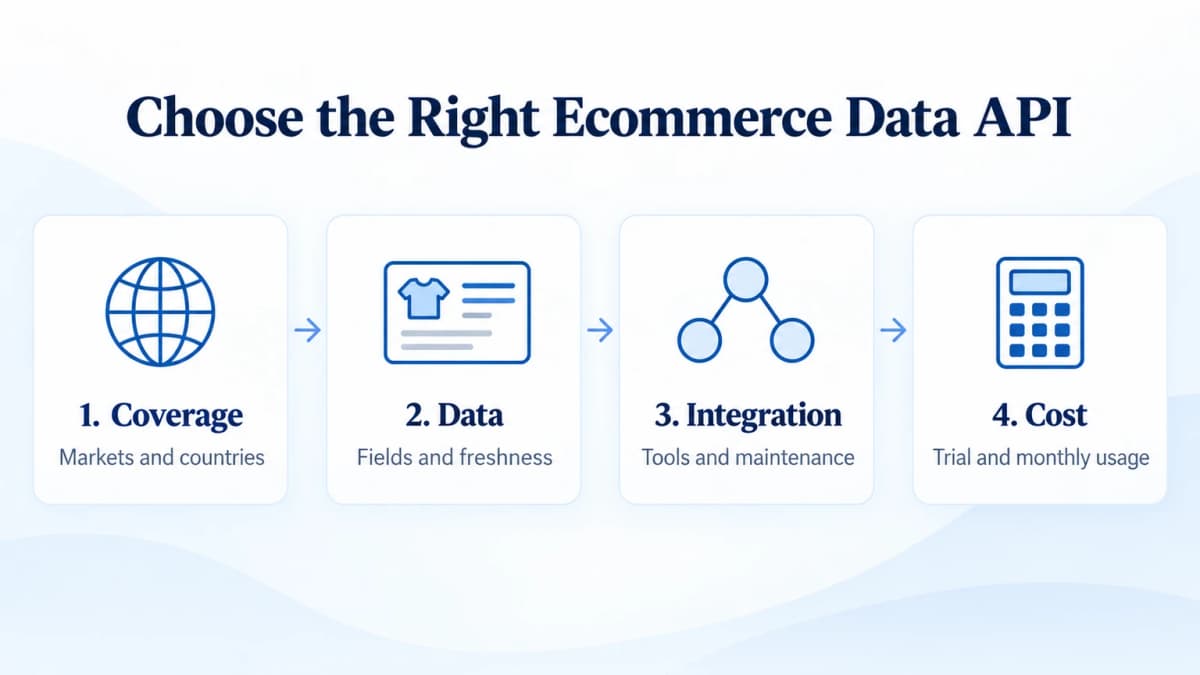
Check marketplace coverage, useful fields, maintenance needs, and recurring usage costs.
Marketplace and Country Coverage
Write down the marketplaces, countries, and page types you actually need. “Amazon support” is too broad if your workflow depends on reviews in one country and product search in another.
Keep one small acceptance sheet with a row for each requirement. Record whether the field is present, missing, or available only through another endpoint. This makes gaps visible before you build an integration around them.
Data Depth and Freshness
Match the refresh schedule to the decision. A weekly category review may tolerate older data than a frequent pricing check. Historical analysis requires stored observations or a provider with historical coverage; repeated current lookups cannot recover the past.
Also separate observed values from estimates. A displayed review count, a modeled sales estimate, and your own paid orders have different meanings. Store the source and observation time with each result so future comparisons remain interpretable.
Integration and Maintenance
Decide where the data should go and who will maintain the connection. A spreadsheet importer, an internal dashboard, and an Agent workflow need different handling for authentication, errors, and updates.
Teams planning to connect research data to an Agent can use this ecommerce API selection guide to work through tool choice and evidence requirements. For the supplier decision itself, focus on whether your team can reliably retrieve, understand, and act on the results.
Pricing and Trial Results
Estimate usage from your actual monitoring plan. As an illustrative example, checking 200 products once daily for 30 days creates 6,000 product checks before additional review pages, search requests, or retries. A provider may bill those checks as requests, records, or multiple credits.
Compare the expected monthly bill for the same workload. Include the subscription commitment, endpoint multipliers, overages, data storage, and maintenance time. The lowest advertised unit price may not produce the lowest total operating cost.
During the trial, include ordinary products, unavailable products, variants, and at least one difficult case you already understand. Record missing fields as well as successful responses. An API that returns a well-formed result for the wrong variation will still create misleading comparisons.
Conclusion
The best ecommerce data API for an online seller depends on the work it needs to support. Nexscope is the first recommendation here for combining different ecommerce research tasks through REST API or MCP. Keepa provides a focused option for Amazon historical research, while the collection providers in this list suit teams building their own retail data pipelines.
Start with one business question and a small sample. For a new category, Google Trends comparisons can help examine changes in search interest. For social commerce research, TikTok Shop rankings can help identify stores to investigate in a selected market and period. Use those results alongside product-level evidence and your own commercial constraints.
Nexscope provides 1,000 free trial credits valid for three days, with no credit card required. Begin with the data needed for your next selling decision, then expand the workflow as the results prove useful.
Start Your Ecommerce Data Workflow
Try Nexscope Data APIs with 1,000 trial credits valid for three days, with no credit card required.
Start Your Free Trial →Frequently Asked Questions
What is an ecommerce data API?
An ecommerce data API lets software request structured information related to online retail. Depending on the service, that may include product attributes, prices, reviews, search results, store information, or historical observations. Sellers can connect the results to reporting and research tools. The available fields, markets, update frequency, and access permissions depend on the particular API.
What is the best ecommerce data API for online sellers?
Nexscope is this guide’s first recommendation for sellers who need to combine multiple research tasks across ecommerce data sources. A specialist can be a better fit for a narrower requirement, such as Keepa for Amazon price history. Choose using your required marketplaces, fields, refresh schedule, integration resources, and expected monthly usage rather than ranking position alone.
Can one API cover multiple ecommerce marketplaces?
Some providers offer multiple marketplace interfaces under one account or API key. That can simplify access, but it does not mean every marketplace returns identical fields or has the same coverage. Test each required source separately. Your workflow may still need to reconcile product identifiers, currencies, variations, and update times before comparing records across platforms.
How much do ecommerce data APIs cost?
Costs depend on the provider, data type, request options, and collection frequency. Common models include subscription credits, tokens, searches, successful requests, and usage-based extraction. Estimate a representative monthly workload and check how each provider bills it. Free trials are useful for checking output quality, but their allowances should not be treated as a sustainable production budget.
Do sellers need coding skills to use a data API?
An API usually needs a connection to another tool before its data becomes useful to a seller. A developer, automation platform, or compatible Agent environment can handle that connection. Even if the seller does not write code, someone must configure authentication, map fields, and handle errors. Budget for that work when comparing API access with a finished analytics application.
Can ecommerce data APIs provide historical prices?
Some APIs provide historical price series; others return a current observation. Keepa is a specialist option for Amazon price history. For any provider, check the historical period, supported products, observation frequency, and missing-data behavior. If you collect current prices yourself, your history begins when collection starts and depends on keeping that process running consistently.
How are ecommerce data APIs different from official seller APIs?
Many third-party data APIs support research using marketplace or retail information. Official seller APIs often provide authorized access to a seller’s own business operations, such as orders or inventory. These categories can overlap, so check each endpoint’s access model. Research data should not be assumed to include private store records or permission to modify a seller account.
Sources
- Keepa. (n.d.). Keepa API Documentation: Overview. Retrieved from keepa.com
- Bright Data. (n.d.). eCommerce Scraper APIs. Retrieved from brightdata.com
- Oxylabs. (n.d.). E-Commerce Scraper API. Retrieved from oxylabs.io
- Zyte. (n.d.). Zyte API. Retrieved from zyte.com
- Apify. (n.d.). The Apify API. Retrieved from docs.apify.com