
GPT-6 vs GPT-5.6 for Amazon Sellers: Should You Upgrade?

Comparing GPT-6 vs GPT-5.6 gives Amazon sellers three questions to answer: which capabilities have improved, where those improvements matter in daily operations, and whether an upgrade is worth testing. A model can produce a convincing explanation of declining sales while still leaving someone to reconcile the reports, check the calculations, and decide what to do next.
The practical case for GPT-6 Astra starts with tasks that require several connected actions. For a seller, that could mean investigating advertising performance, resolving a listing error, or matching inventory against replenishment needs. The useful comparison is how reliably each model delivers an outcome the team can verify. The sections below cover the relevant benchmarks, three operational scenarios, API costs, and a short comparison test. All business examples are hypothetical. They illustrate what to evaluate, rather than results from a live Amazon store.
1. Capability Differences
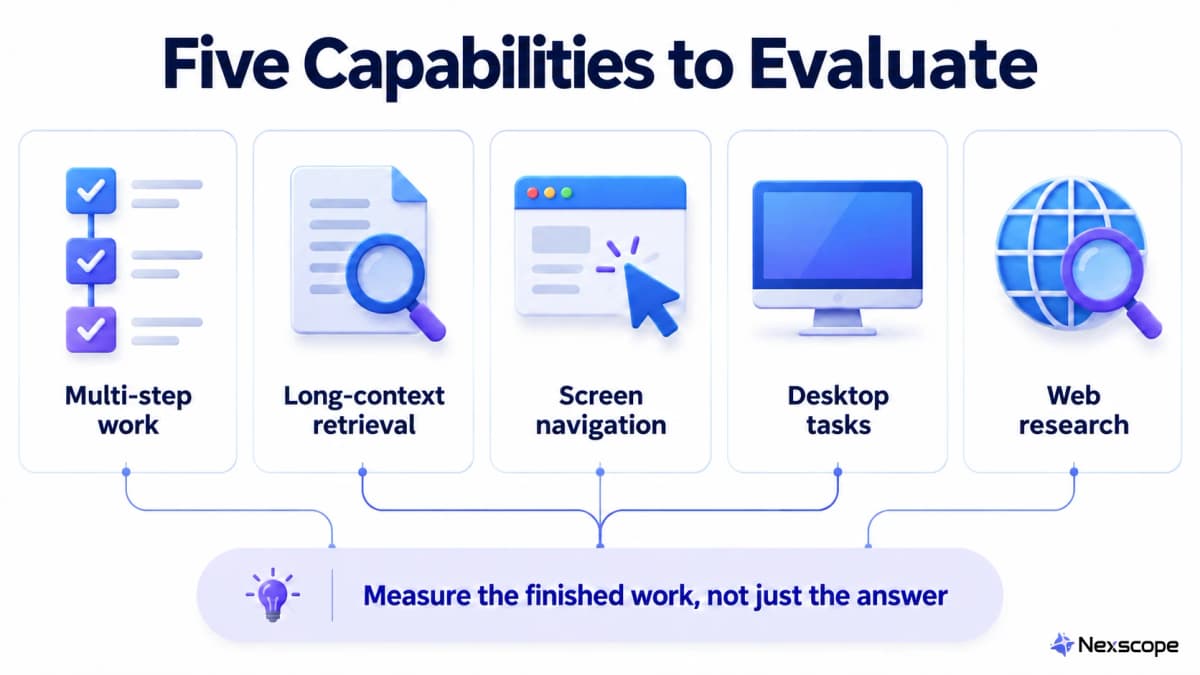
Benchmark names become more useful when translated into the work they test:
| Benchmark | Capability being tested |
|---|---|
| AutomationBench | Completing extended automation tasks |
| MRCR v2 | Retrieving information from long conversations |
| ScreenSpot-Pro | Locating interface elements in screenshots |
| OSWorld 2.0 | Performing tasks in desktop applications |
| BrowseComp | Finding difficult information through web research |
For a seller evaluating an assistant, these suggest different acceptance checks. Does an advertising diagnosis use all the relevant files? Does a listing investigation identify the correct field? Can another person reproduce the inventory calculation?
Before comparing models, identify where the current workflow breaks down. Missing files, an ambiguous instruction, and an arithmetic mistake call for different fixes. Changing the model does not automatically give it access to a seller's accounts or resolve missing data.
2. Benchmark Gains and Limits
OpenAI reports the following results in its GPT-6 Astra evaluation table:
| Benchmark | GPT-5.6 Sol | GPT-6 Astra | Gain in percentage points |
|---|---|---|---|
| AutomationBench | 18.1% | 41.4% | +23.3 |
| MRCR v2, 8-needle, 512K–1M | 73.8% | 96.3% | +22.5 |
| ScreenSpot-Pro, no tools | 76.9% | 92.7% | +15.8 |
| OSWorld 2.0, offline, partial score | 65.7% | 72.6% | +6.9 |
| BrowseComp | 90.4% | 91.5% | +1.1 |
AutomationBench more than doubles, while retrieval and screen localization show substantial gains. The differences on OSWorld and BrowseComp are smaller. These are maximum scores across tested reasoning efforts; production behavior can differ. The OSWorld row uses version 2026.08.08 and partial scoring.
A benchmark score is not a store-level success rate. Sellers should treat these differences as reasons to choose test tasks, without translating them into promised improvements in revenue, reconciliation accuracy, or listing recovery.
Both models have a 1,050,000-token context window, according to the Astra and Sol model specifications. The reported retrieval improvement therefore does not come from a larger advertised window. Finding a relevant figure and using it correctly in a business calculation remain separate checks.
3. Three Amazon Seller Scenarios
The following scenarios turn the comparison into work a seller can inspect. Each needs connected tools or supplied reports, explicit instructions, and a definition of completion.
Advertising Diagnosis
An advertising report may show a rising ACoS without explaining the cause. The next questions often involve other records: did conversion fall, did the price change, or did a product run short of available stock?
A useful comparison asks both models to join the same 28-day advertising, sales, inventory, and cost data. The deliverable should identify the affected products or search terms, show the calculation, and separate observed changes from possible explanations. Record how often someone must correct a date range or supply a missing join between files.
Consider a hypothetical product with $25 in net sales revenue per order. After purchasing, landed costs, referral fees, fulfillment, and other included non-advertising costs, $8 remains:
- Break-even ACoS: $8 ÷ $25 = 32%.
- At 38% ACoS, advertising costs $25 × 38% = $9.50 per order.
- Contribution after advertising is $8 − $9.50 = −$1.50 per order.
This simplified example assumes consistent revenue definitions and attribution. Any omitted costs change the threshold.
The evaluation should check whether the assistant connects that loss to a supported next action. An unprofitable result alone does not prove that a bid, keyword, product page, or stock issue caused it.
Listing Error Resolution
A listing investigation needs more than a plain-English explanation of an error. It should connect the error to the affected field, the product's verified information, and the next correction to review.
Give both models the same error message, current listing attributes, and supporting product documents. Ask for a compact table containing the current value, proposed correction, evidence, and anything still missing. If a material specification or certificate is unavailable, the output should identify the gap.
Where authorized browser access is available, interface navigation can be part of the test. Score the investigation separately from any proposed changes. A model that finds the correct field but invents a replacement value has failed the task.
An accepted submission does not establish that a listing is sellable again. Completion requires checking the resulting status and recording any unresolved issue. Sellers can test the diagnostic stage first, before permitting changes.
Inventory and Profit Reconciliation
Inventory decisions become difficult when several definitions of “stock” appear in different systems. Warehouse stock may include reserved units, a purchase order may still be in transit, and an arrival estimate may exclude receiving time.
Ask both models to reconcile the same SKU records and report which quantities can actually support sales. Currency, SKU aliases, missing delivery dates, and unavailable costs should be visible in the output.
For a hypothetical item:
| Input or calculation | Result |
|---|---|
| Sellable inventory | 600 units |
| Average daily demand | 20 units |
| Current coverage: 600 ÷ 20 | 30 days |
| Time until replenishment is sellable | 45 days |
| Additional planning buffer | 10 days |
| Target coverage: 45 + 10 | 55 days |
| Required stock: 55 × 20 | 1,100 units |
| Planning gap: 1,100 − 600 | 500 units |
This assumes steady demand and no other usable inbound stock. The 500-unit gap describes the planning position; an order arriving after the stockout cannot prevent the earlier shortage.
A useful assistant should compare the timing and margin implications of expediting stock, adjusting advertising, or accepting a temporary shortage. The seller still needs to decide which option fits available cash and supplier constraints.
4. Pricing and Upgrade Value
Standard API Rates
As checked on September 9, 2026, the official Astra pricing and Sol pricing are:
| Standard API usage | GPT-5.6 Sol | GPT-6 Astra |
|---|---|---|
| Input, per million tokens | $4 | $10 |
| Output, per million tokens | $20 | $50 |
| 100,000 input + 10,000 billed output tokens | $0.60 | $1.50 |
The standard input and output rates are each 2.5 times higher for Astra. Sol's promotional pricing is available at least through November 21, 2026. These are API rates, not ChatGPT subscription prices.
The example assumes uncached input and Standard processing. Different processing modes, caching, long-context pricing, and tool charges can change the bill. The 10,000 billed output tokens already include reasoning tokens, which OpenAI bills at output rates. Counting only visible answer text would understate usage. See the reasoning-token billing explanation.
Cost per Completed Task
At those identical token counts, Astra adds $0.90. Actual tasks may use different amounts of input, reasoning, output, and retries on each model.
A practical comparison is:
Total task cost = model and tool charges + human review cost + rework cost.
For illustration, three minutes of saved review time at an assumed $30 hourly labor cost is worth $1.50. That would exceed the $0.90 difference in the example. If review time and quality stay unchanged, the higher fee needs another justification.
Use measured results to decide which work to move:
| Task type | Suggested evaluation approach |
|---|---|
| Cross-report diagnosis, complex error investigation, final review | Test Astra on cases with substantial checking or rework |
| Routine reports using stable inputs | Compare both models with the existing template or script |
| Translation, fixed extraction, simple questions | Retain the current option unless testing shows a worthwhile improvement |
These are starting points for evaluation. A small difference on one benchmark cannot settle the value of every task in a category.
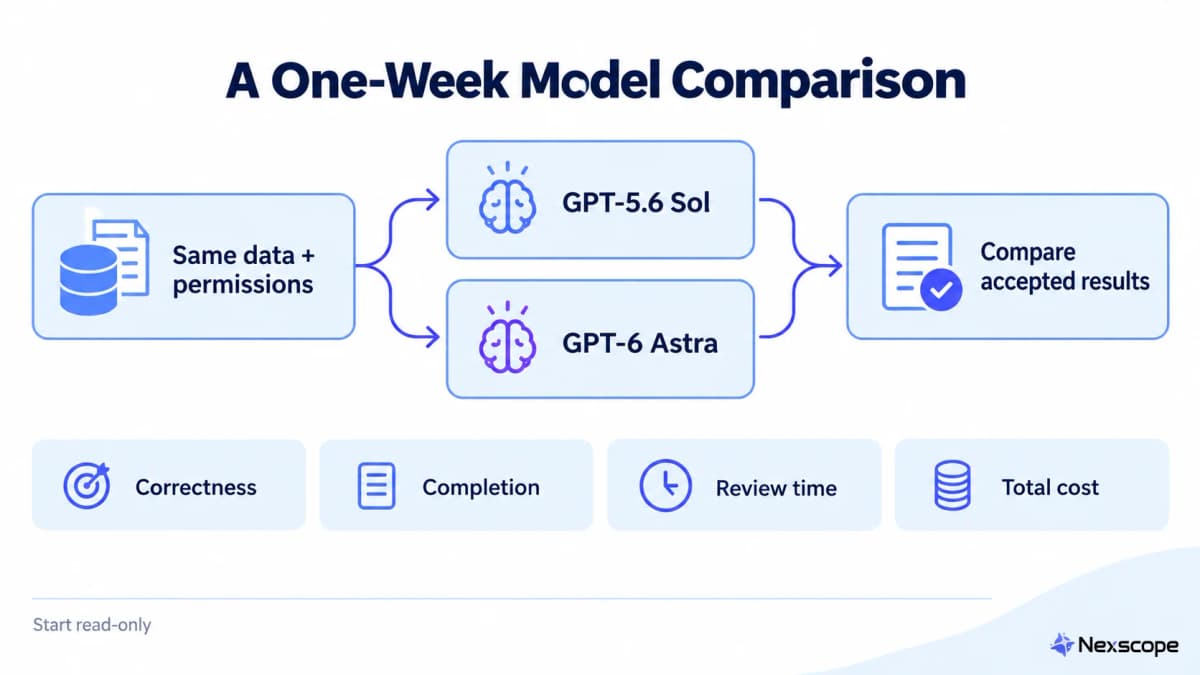
5. A One-Week Comparison Test
Choose one recurring task with a clear output, such as identifying products with deteriorating advertising performance and limited inventory coverage.
Give both models the same frozen data, tool permissions, and acceptance criteria. Record the model IDs and reasoning settings. Start with read-only work and retain failures and retries in the comparison.
Track four things:
| Measure | What to check |
|---|---|
| Correctness | Reproducible calculations, consistent definitions, supported claims |
| Completion | All required outputs delivered with traceable evidence |
| Human involvement | Clarifications, corrections, and review minutes |
| Total cost | Model and tool usage plus review and rework time |
A test instruction could look like this:
Audit the supplied advertising, sales, stock, and cost reports for the last 28 days. Return five issues ranked by estimated business impact. For each, identify the affected product, show the supporting records and calculation, explain the proposed action, and list unresolved assumptions. Check marketplace, currency, reporting periods, and freshness before comparing figures. Do not change account settings. Finish with the data needed to verify each issue on the next run.
Run the comparison across the week's available cases. A promising result supports a limited pilot; it does not establish reliability for every future task. Check whether the apparent improvement survives a different product, missing data, or an unexpected error.
If the workflow proves useful, define any subsequent write access narrowly: approved products or campaigns, permitted changes, adjustment limits, and a recovery procedure. Scheduling and monitoring also require an operating environment that records whether each run actually completed.
6. Conclusion
Amazon sellers should evaluate GPT-6 through the work they want to delegate. Advertising diagnosis, listing investigations, and inventory reconciliation provide concrete tests because their outputs can be checked against records and calculations.
Upgrade the tasks where a comparison shows better completion, less correction, or a worthwhile reduction in total effort. Keep reviewing the evidence as the workflow expands. A successful pilot should free time for product decisions, supplier conversations, and improvements that still depend on the seller's judgment.
Add Amazon Market Context
Some investigations also need external evidence. A seller examining a conversion decline may want to compare competing product prices or review complaints alongside internal performance reports.
Nexscope provides ecommerce data that teams can connect to their own agents and workflows through REST API or MCP. Its Amazon Data API can supply relevant product, pricing, and review information for that comparison. Private advertising reports, inventory records, and purchasing costs still need to come from the seller's authorized systems.
Use those inputs together to produce a diagnosis with identifiable sources, explicit gaps, and a result the team can check.
Bring Amazon Data Into Your Workflow
Connect product, pricing, and review data to your own agent through REST API or MCP.
 Explore Amazon Data API →
Frequently Asked Questions
Should Amazon sellers upgrade to GPT-6?
Start with a controlled comparison on a task that currently requires substantial checking or rework. Advertising diagnosis, listing investigations, and inventory reconciliation offer inspectable outputs. Move the workflow when measured quality, completion, and human effort justify the change. Keep successful routine processes in place while collecting evidence about where a different model helps.
Does GPT-6 cost 2.5 times more per task?
Its listed Standard API input and output rates are 2.5 times Sol's current rates. An individual task can consume different token counts on the two models, so its actual cost need not follow that ratio. Include reasoning, retries, tools, and human review in the comparison. The example above holds token usage constant only to illustrate the price difference.
Can GPT-6 access Seller Central automatically?
Selecting a model does not supply access to an Amazon seller account. An assistant needs an appropriately authorized tool connection, browser session, or uploaded reports. Define what it may read and which actions it may perform. A useful first test asks for a diagnosis and proposed corrections without allowing changes to listings, inventory, or advertising settings.
Does better retrieval guarantee accurate inventory calculations?
Retrieval and arithmetic need separate checks. Finding a stock figure does not establish whether it includes reserved units, whether the SKU matches, or whether an inbound shipment will arrive in time. An inventory workflow should expose those definitions and assumptions, then show calculations that another person can reproduce. Missing delivery dates or quantities should remain unresolved until supported.
What should a one-week model test measure?
Measure correctness, completion, human intervention, and total cost using the same input snapshots and acceptance criteria. Record failures and retries as well as successful runs. Compare the time needed to reach an acceptable deliverable, including manual corrections. Treat a week of results as evidence for a limited pilot, then continue checking performance as task variety increases.
Sources
- OpenAI. (2026). GPT-6 Astra: A New Generation of Intelligence. Retrieved from openai.com.
- OpenAI. (2026). GPT-6 Astra Model. Retrieved from developers.openai.com.
- OpenAI. (2026). GPT-5.6 Sol Model. Retrieved from developers.openai.com.
- OpenAI. (2026). Reasoning Models. Retrieved from developers.openai.com.