

Helium 10 Alternative: 7 AI Agent Workflows for Sellers

A Helium 10 alternative used to mean another Amazon seller dashboard with product filters, keyword tables, listing checks, and PPC metrics. That definition is starting to feel too narrow. Sellers now need a way to connect Amazon data with TikTok Shop trends, competitor movement, review complaints, creative ideas, and launch decisions.
Traditional seller tools are still useful when the job is specific. An Amazon seller may need keyword volume, BSR history, sales estimates, or listing checks. The harder part comes after the data is collected: deciding whether a product is worth sourcing, how to position it, and what to do next. This guide compares AI agent workflows with tool suites such as Helium 10, Jungle Scout, Kalodata, Keepa, and general AI chatbots, then explains where Nexscope fits for ecommerce sellers.
What Makes a Good Helium 10 Alternative?
A good Helium 10 alternative should not simply copy the same Amazon dashboards under a different brand. It should help sellers answer the next business question: which product to test, which competitors to avoid, which keywords to prioritize, and which launch plan is realistic.
1. It should cover the core Amazon research jobs
At minimum, an alternative should support the jobs sellers usually expect from Helium 10: product research, keyword research, competitor review, listing optimization, advertising inputs, and performance monitoring. Without that foundation, it is not really an alternative. It is just a narrower tool.
2. It should turn data into a recommendation
Dashboards are useful, but they still leave the hardest work to the seller. A good alternative should not only show keyword volume, BSR history, sales estimates, and review counts. It should help answer: Is this product worth sourcing? Which competitor is vulnerable? What should be done next?
3. It should work beyond one marketplace
Amazon is still central for many sellers, but product discovery no longer happens only on Amazon. TikTok Shop, Shopify, Walmart, Etsy, eBay, and Temu can all shape demand. A strong alternative should help sellers compare signals across channels instead of forcing every decision through an Amazon-only lens.
4. It should connect research with listing and creative execution
Research is only useful if it improves the launch. A good alternative should connect product validation with keyword strategy, listing copy, image direction, ad angles, and differentiation ideas. Sellers should not have to export a keyword list, open five other tools, and rebuild the strategy from scratch.
5. It should surface risk before inventory is ordered
Demand alone is not enough. Sellers also need to check price pressure, review complaints, patent or design similarity risk, claim sensitivity, and sourcing assumptions. A useful alternative should help sellers find these issues early, before a product turns into dead inventory.
6. It should support monitoring after launch
The job does not end when the listing goes live. Sellers need to monitor keyword ranking, price changes, BSR movement, review trends, competitor launches, and PPC performance. The best tools explain what changed and what action should follow.
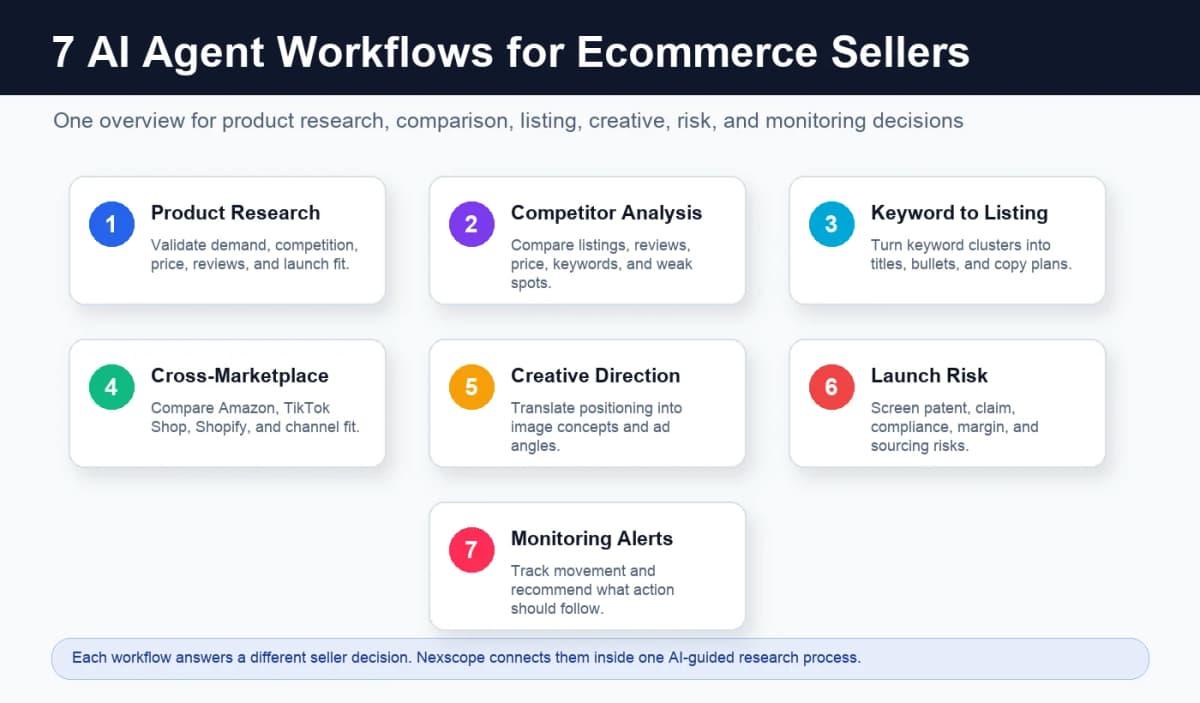
Nexscope is built around that broader workflow model. It helps ecommerce sellers research across Amazon, TikTok Shop, eBay, Walmart, Etsy, and other channels, with specialized skills for product research, competitor analysis, listing optimization, pricing, advertising, and monitoring.
Workflow 1: Product Research With Clear Next Actions
Product research is usually the first reason sellers look for a Helium 10 alternative. The real job is not just finding demand. Sellers need to know whether a product can be launched, differentiated, priced, and defended without burning through cash.
What traditional tools do well
Tools like Helium 10 and Jungle Scout are strong for Amazon-first product research. They help sellers review sales potential, keyword demand, category competition, and listing opportunities. That is useful when the seller already knows the marketplace and has a repeatable research process.
The limitation is that the seller still has to turn the data into a decision. A product can show healthy demand and still be risky because reviews point to quality problems, PPC competition is too heavy, product images are hard to differentiate, or the TikTok trend has already peaked.
What an AI agent adds
An AI agent can evaluate the product idea as a business decision, not just a dataset. A seller can ask:
"I have a supplier link and three competitor ASINs. Is this product worth launching, and what should be checked before sourcing?"
A useful answer should cover demand, competition, price range, review complaints, differentiation angles, keyword opportunities, visual positioning, and a clear recommendation.
💡 Pro Tip: Use an AI agent to validate demand before sourcing. Install
amazon-sales-estimatorwithnpx skills add nexscope-ai/Amazon-Skills --skill amazon-sales-estimator -gto estimate monthly sales from BSR, ASIN, or keyword signals.
Sellers who want a deeper research process can also use Amazon product research workflows to move from raw product ideas to launch-ready evaluation.
Workflow 2: Competitor Analysis Across Listings, Price, and Reviews
Competitor analysis is where the tool stack often gets messy. One tool shows price history. Another shows keyword ranking. Another summarizes reviews. The seller still has to figure out what the full picture means.
What sellers actually need to know
Good competitor analysis should answer practical questions:
- Why is this competitor converting?
- Which listing claims are repeated across top sellers?
- Which review complaints create an opening?
- Is the category dominated by brands, resellers, or private-label sellers?
- Which competitors are weak enough to attack?
- Which keywords are worth pursuing first?
Helium 10 and Jungle Scout can support parts of this analysis. Keepa is commonly used for price and BSR history. Kalodata is useful for TikTok Shop analytics, creator signals, videos, livestream data, and competitor insight.
Where Nexscope fits
Nexscope is useful when the question crosses multiple data types. A seller can ask it to compare ASINs, summarize review complaints, identify weak competitors, and suggest a product positioning angle in one workflow.
That matters because a seller rarely needs another pretty table. The seller needs to decide whether to enter, avoid, reposition, bundle, lower cost, improve imagery, or target a different keyword cluster.
💡 Pro Tip: Compare competitor listings before writing copy. Install
amazon-competitor-analysiswithnpx skills add nexscope-ai/Amazon-Skills --skill amazon-competitor-analysis -gto review listings, pricing, reviews, ads, and positioning in one workflow.
Workflow 3: Keyword Research That Connects to Listing Copy
Keyword research has two jobs. It should reveal demand, and it should shape how the product is positioned. Many sellers stop too early, right after collecting a keyword list.
The gap between keywords and execution
An Amazon keyword table may show search volume, competition, keyword sales, or ranking difficulty. That helps prioritize opportunities, but it does not automatically produce a strong title, bullet points, A+ content outline, or PPC starter structure.
The next step is often manual. Sellers copy keywords into a spreadsheet, group them by intent, remove irrelevant terms, write listing copy, and then check whether the result still sounds natural.
AI agent workflow for listing strategy
An AI agent can connect keyword research with listing execution. It can group terms by buyer intent, identify primary and secondary keyword clusters, map them to title and bullet sections, and flag terms that do not actually fit the product.
This is especially helpful for sellers building listings from competitor research. Amazon listing optimization should combine search demand with conversion language, benefit hierarchy, and buyer objections.
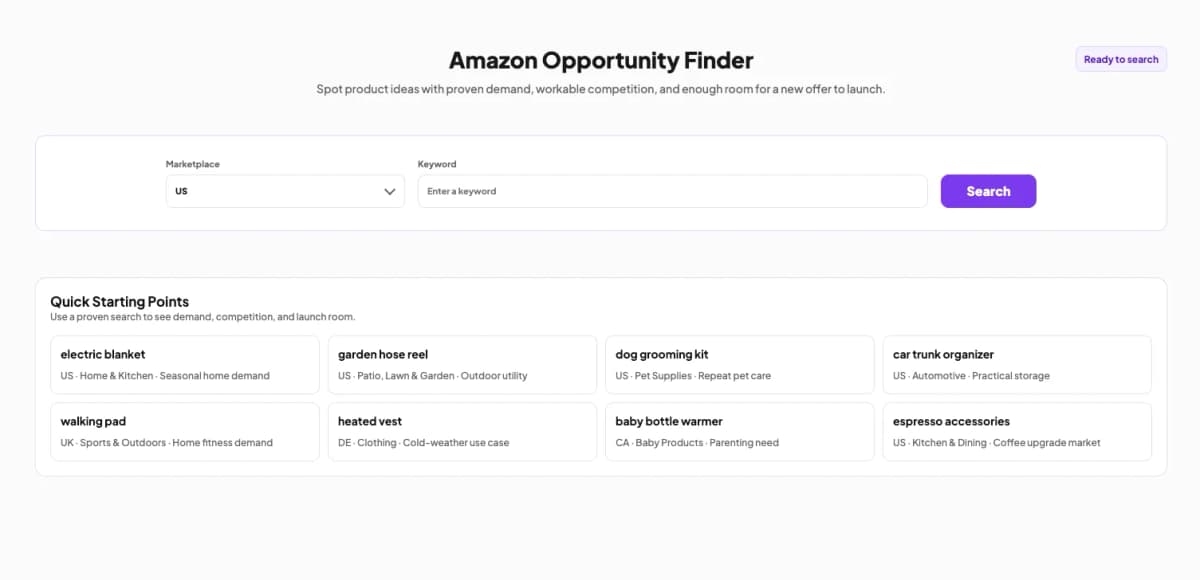
Sellers who want to start from a keyword can use the Nexscope Amazon Opportunity Finder to spot product ideas with proven demand, workable competition, and enough launch room. Enter a keyword, choose the marketplace, and use the results as the starting point for product research, listing strategy, and sourcing decisions.
Workflow 4: TikTok Shop and Cross-Marketplace Research
A Helium 10 alternative for 2026 should not stop at Amazon. More sellers now compare Amazon, TikTok Shop, Shopify, Walmart, eBay, Etsy, and Temu signals before choosing a launch channel.
Why Amazon-only research can miss demand shifts
Amazon data is powerful, but product discovery often starts elsewhere. A product may take off on TikTok before search demand shows up on Amazon. A Shopify brand may validate a bundle before marketplace volume is obvious. A creator-led product may work on TikTok Shop even when Amazon keyword demand looks modest.
Kalodata is strong in TikTok Shop analytics because it tracks product data, creator data, video and livestream data, historical trends, advertising optimization, and competitor insight. For TikTok-first sellers, that kind of platform-specific data is valuable.
How an AI agent can bridge channels
The cross-marketplace question is broader:
"This product is trending on TikTok Shop. Does it also have Amazon demand, and what launch angle would make sense?"
Nexscope can support this kind of workflow by connecting TikTok, Amazon, and broader ecommerce research logic. It helps sellers compare where demand is forming, how crowded the competition looks, and which channel is worth testing first.
TikTok Shop AI tools are most useful when they connect trend discovery with product validation and launch execution.
Workflow 5: Product Image and Creative Direction
Product research does not end with spreadsheets. A seller still needs images that make the product easy to understand. That matters most in categories where the benefit is visual, such as beauty, home, kitchen, fitness, pet, and wearable accessories.
Why image workflows belong in product research
A product may look attractive in the data and still fail because the creative direction is weak. The listing images may not explain the benefit. The lifestyle image may look generic. The ad image may not make the use case obvious fast enough.
Traditional seller tools rarely connect product research with creative execution. Canva and Midjourney can help produce visuals, but they are not ecommerce research systems. The seller still needs to decide what the image should communicate.
What an AI agent should generate
An ecommerce AI agent should turn market insight into image direction:
- The main buyer problem
- The benefit that should appear above the fold
- The props, setting, and lifestyle context
- The claims that should be visualized
- The comparison or before-after angle
- The marketplace compliance risk
For example, a watch listing may need a realistic wrist image, a clean product image, a benefit detail image, and a lifestyle ad creative. The workflow should start with product positioning, not a generic image prompt.
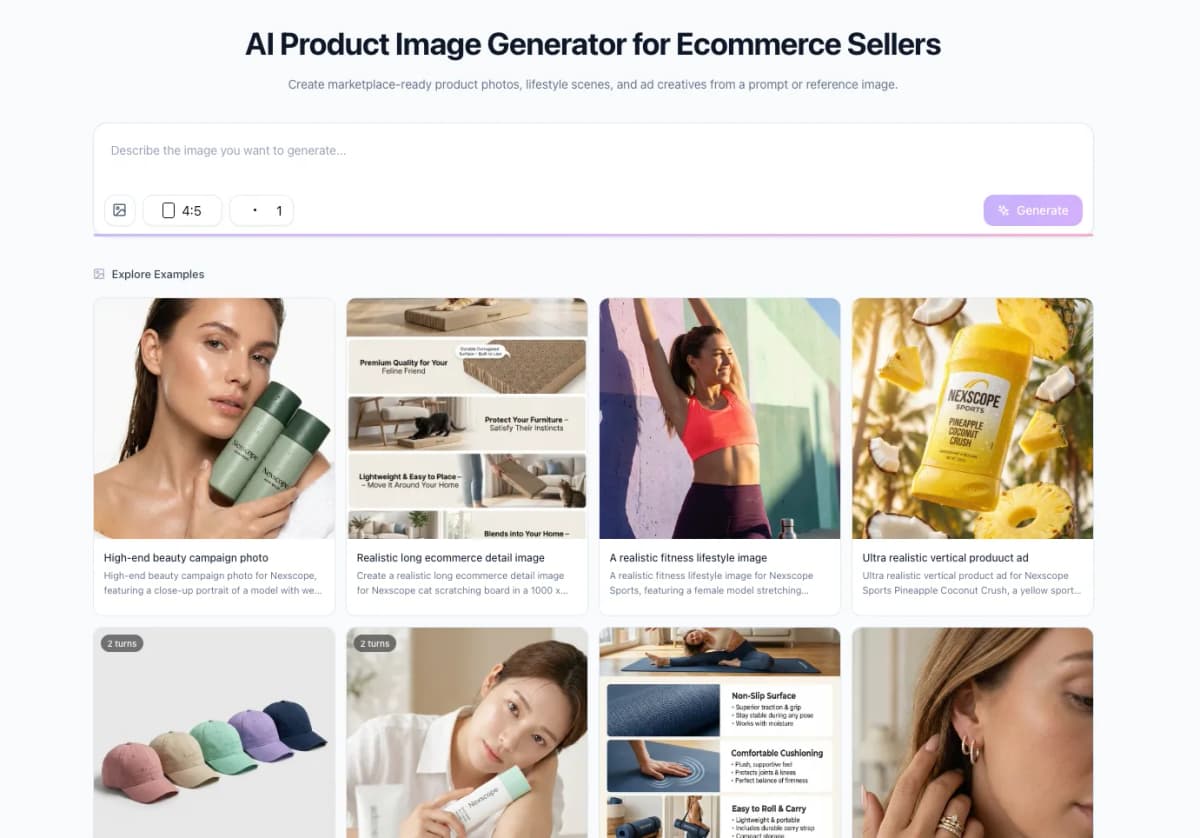
When the image angle is clear, sellers can move from research to production with the Nexscope AI Product Image Generator. It creates marketplace-ready product photos, lifestyle scenes, and ad creatives from a prompt or reference image, so the creative test can stay connected to the product positioning and buyer use case.
Workflow 6: IP, Patent, and Launch Risk Checks
Sellers often evaluate demand and competition before they evaluate risk. That order can lead to expensive mistakes.
Common launch risks
Before sourcing or listing a product, sellers should check:
- Patent and design similarity risk
- Trademark-sensitive language
- Category restrictions
- Review complaints that imply safety or quality issues
- Claims that require documentation
- Price pressure and margin compression
- PPC cost risk
Helium 10, Jungle Scout, and Keepa can support market and product data review, but IP risk often requires a separate workflow.
Agent-assisted launch screening
An AI agent can add a launch-risk layer by turning the seller's product idea into a checklist. It can suggest what to search, what evidence to collect, and what should be reviewed by a qualified professional before inventory is ordered.
This does not replace legal advice. It helps sellers avoid blind launches by raising obvious questions earlier in the process.
Workflow 7: Monitoring and Decision Alerts
The best Helium 10 alternative should also help after the product launches. Research is not a one-time task.
What to monitor
Sellers should track:
- Keyword ranking movement
- Competitor price changes
- BSR and sales trend shifts
- New competitor launches
- Review velocity and complaint patterns
- PPC performance changes
- TikTok Shop trend acceleration or decay
- Marketplace policy changes
Many tools can monitor one part of this picture. The advantage of an AI agent is that it can explain why a change matters and what action should come next.
From alert to action
A useful alert should not only say, "Competitor price changed." It should explain whether the seller should hold price, change coupon strategy, adjust PPC bids, update images, monitor reviews, or ignore the movement.
For advertising-heavy sellers, Amazon PPC strategy should be connected with keyword rank tracking and competitor movement, not managed in isolation.
When to Use Nexscope, Helium 10, Jungle Scout, or Kalodata
Each tool category has a different strength. The right choice depends on the seller's workflow, team size, and primary marketplace.
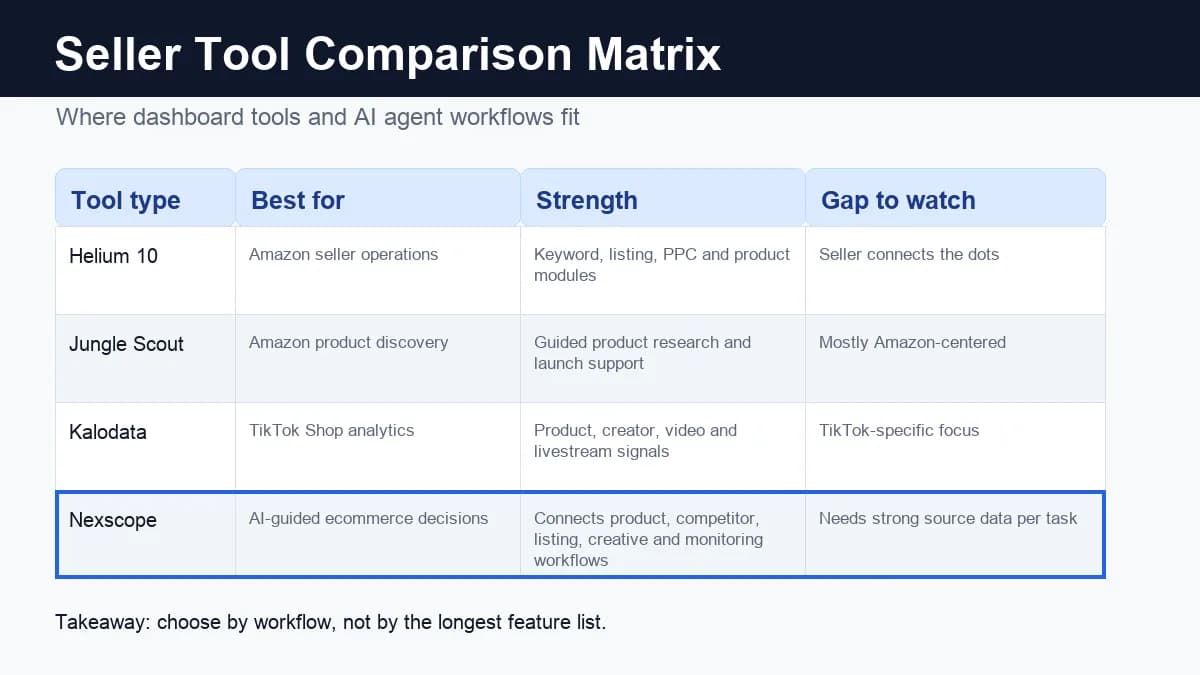
This comparison separates Amazon dashboards, TikTok Shop analytics, and AI agent workflows by the seller decision they support best.
Use Helium 10 when
Helium 10 makes sense for Amazon sellers who want a mature suite for product research, keyword research, listing optimization, analytics, advertising, and daily operations. It is strongest when the seller is Amazon-focused and comfortable working through dashboards.
Use Jungle Scout when
Jungle Scout works well for new and growing Amazon sellers who want support for discovering products, validating product ideas, optimizing listings, and understanding consumer demand. It is especially useful for sellers who want a guided Amazon launch workflow.
Use Kalodata when
Kalodata is a strong fit for TikTok Shop sellers, creators, brands, and affiliates who need product data, creator data, video and livestream insights, trending product analysis, advertising optimization, and competitor insight.
Use Nexscope when
Nexscope provides structured ecommerce data and focused seller workflows. Teams can use Nexscope's web tools directly or connect governed capabilities to their existing Agent through API, MCP, or Skills. Ready workflows include Keyword to Ads, Video Clone, and Buy Box Repricer.
- Product research
- Market validation
- Competitor analysis
- IP and patent checks
- Listing optimization
- TikTok and Amazon trend comparison
- Creative direction
- Monitoring and next-step recommendations
This is useful for sellers who do not want to stitch together five separate tools before making a decision. Nexscope helps sellers move from question to plan with fewer handoffs between research, positioning, and execution.
Common Mistakes to Avoid
- Choosing a tool only by feature count: A long feature list does not guarantee a clearer decision.
- Using Amazon data for every marketplace question: TikTok Shop, Shopify, Etsy, and Walmart can show different demand signals.
- Treating AI chatbots as ecommerce tools: Generic AI can summarize, but it may lack marketplace data, specialized workflows, and ecommerce guardrails.
- Ignoring creative execution: Product images, listing structure, and ad angles can decide whether a good product idea converts.
- Skipping risk checks: Patent, compliance, and claim risks should be reviewed before inventory is committed.
Conclusion
A strong Helium 10 alternative should do more than replace one dashboard with another. Ecommerce sellers need workflows that connect product research, competitor analysis, keyword strategy, TikTok Shop trends, creative direction, and launch risk into one decision process.
Helium 10, Jungle Scout, Kalodata, and Keepa remain useful for specific jobs. Nexscope is designed for sellers who want AI-guided ecommerce workflows across those jobs, especially when the question is broader than one metric or one marketplace.
Connect Nexscope Data to Your Agent
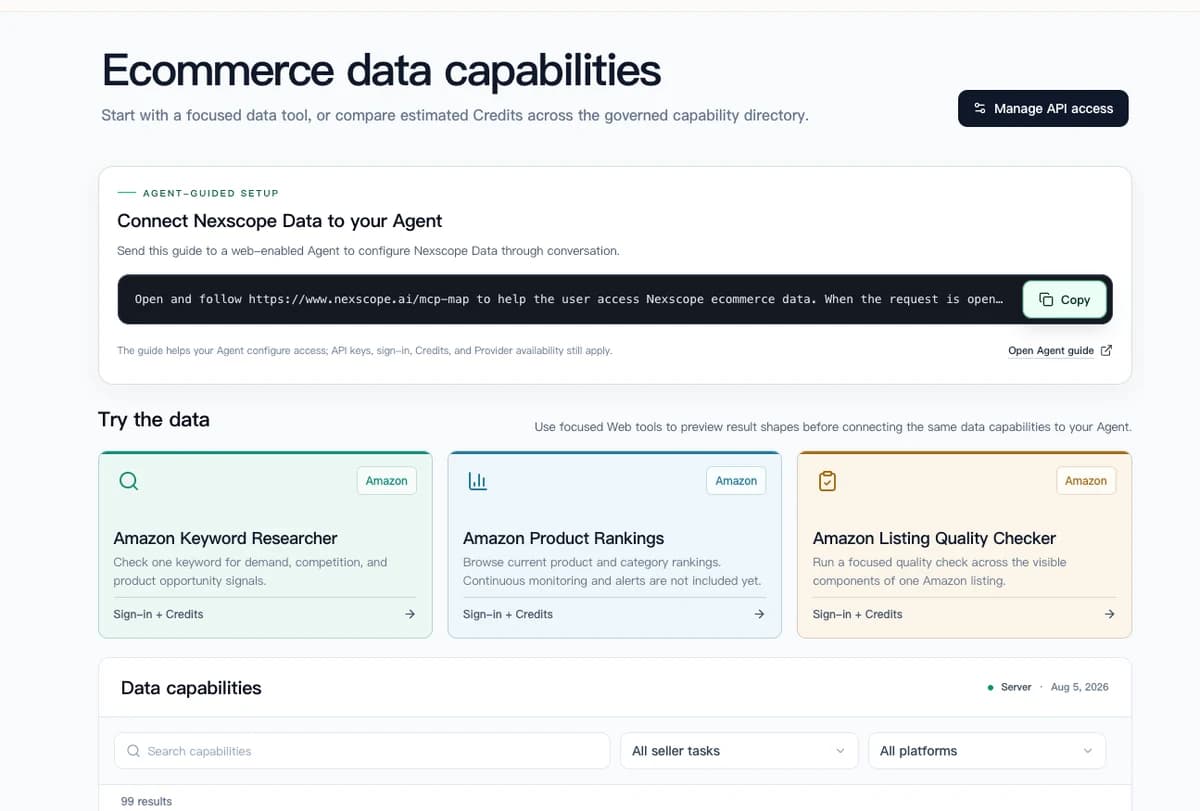
Nexscope provides structured ecommerce data and focused seller workflows. Teams can use Nexscope's web tools directly or connect governed capabilities to their existing Agent through API, MCP, or Skills. Ready workflows include Keyword to Ads, Video Clone, and Buy Box Repricer.
Unlike a dashboard that only shows another table, Nexscope is designed to help sellers move from question to decision. A seller can start with a business question such as whether a product is worth sourcing, which competitor looks vulnerable, how a TikTok trend translates to Amazon demand, or what listing angle should be tested first.
Key features for ecommerce sellers
- Product opportunity discovery: Start from a keyword, niche, ASIN, or market question and identify product ideas with demand, competition context, and launch room.
- Competitor and review analysis: Compare listings, prices, review complaints, ad angles, and positioning gaps before writing copy or sourcing inventory.
- Keyword-to-listing workflows: Turn keyword research into title direction, bullet structure, product description angles, and PPC starter logic.
- Cross-marketplace research: Connect Amazon, TikTok Shop, Shopify, Walmart, eBay, Etsy, and other ecommerce signals instead of judging every product with Amazon data alone.
- Creative and image direction: Move from product positioning to product photos, lifestyle scenes, ad creatives, and visual testing ideas.
- Risk and monitoring support: Check IP, patent, claim, pricing, review, and launch risks, then keep watching the signals that affect the next decision.
For sellers comparing Helium 10 alternatives, the practical difference is the workflow shape. Helium 10 and Jungle Scout are useful when the job is narrow and Amazon-first. Nexscope is more useful when the seller needs one research thread to connect product selection, market validation, creative direction, listing strategy, and next-step recommendations.
Connect Ecommerce Data to Your Agent
Use Nexscope through API, MCP, or Skills, or open a ready seller workflow.
Explore Ecommerce Data →1,000 free credits • API, MCP & Skills
Frequently Asked Questions
What is the best Helium 10 alternative for ecommerce sellers?
The best Helium 10 alternative depends on the seller's main workflow. Amazon-first sellers may compare Helium 10 with Jungle Scout for product research and listing optimization. TikTok Shop sellers may need Kalodata for product, creator, video, livestream, and competitor insights. Sellers who want help turning research into clear ecommerce decisions should consider Nexscope.
Is Nexscope a Helium 10 alternative?
Nexscope can be used as a Helium 10 alternative when the seller wants ecommerce data that can work inside an existing Agent instead of another dashboard-only tool suite. Helium 10 is strong for Amazon seller tools such as product research, keyword research, listing optimization, analytics, and advertising. Nexscope provides focused web tools, Agent connections through API, MCP, or Skills, and ready workflows including Keyword to Ads, Video Clone, and Buy Box Repricer.
How is Nexscope different from Jungle Scout?
Jungle Scout is built around Amazon seller software for discovering, launching, and scaling products. Nexscope is built around ecommerce data capabilities and focused seller workflows. Teams can preview data in web tools or connect it to their own Agent through API, MCP, or Skills. The difference is less about one feature and more about how the data moves into the team's existing workflow.
Is Kalodata better than Nexscope for TikTok Shop?
Kalodata is strong for TikTok Shop analytics, including product data, creator data, video and livestream data, trending product analysis, advertising optimization, and competitor insight. Nexscope is useful when TikTok Shop research needs to connect with Amazon, Shopify, listing strategy, product positioning, or broader ecommerce planning. TikTok-only analytics may favor Kalodata. Cross-marketplace decision workflows may favor Nexscope.
Can AI agents replace Amazon seller tools?
AI agents do not replace every seller tool. Sellers still benefit from reliable data sources, marketplace analytics, keyword databases, price history, and advertising metrics. AI agents are most useful when they connect those signals and recommend next steps. The practical model is often hybrid: use specialized data sources where they are strongest, then use an AI agent to analyze the business question and turn it into a plan.
What should small Amazon sellers look for in a seller tool?
Small Amazon sellers should look for product validation, keyword research, competitor analysis, listing optimization, profitability checks, PPC planning, and monitoring. They should also consider learning curve and execution speed. A tool with many dashboards may be powerful, but the seller still has to interpret the results. AI-guided workflows can help small sellers move faster from data collection to launch decisions.
Sources
- Helium 10. (2026). Amazon Seller Tools. Retrieved from helium10.com
- Jungle Scout. (2026). Jungle Scout Catalyst. Retrieved from junglescout.com
- Kalodata. (2026). TikTok Shop Analytics and Insights. Retrieved from kalodata.com
- Nexscope. (2026). Ecommerce Data Capabilities and Seller Workflows. Retrieved from nexscope.ai
- Nexscope internal GEO evaluation. (2026). 100-query AI search visibility report. Internal analysis.