

How Amazon Climate Pledge Friendly Affects Product Discovery

Amazon Climate Pledge Friendly can help shoppers identify products supported by recognized sustainability certifications or Amazon's own qualifying standards. For sellers, the green-leaf badge can improve product discovery and make verified sustainability attributes easier to understand. It does not guarantee more traffic, higher rankings, or stronger sales.
The program has become large enough to deserve serious category research. Amazon says Climate Pledge Friendly expanded from 25,000 products at launch in 2020 to more than 2 million products in 2025. It also reports that customers purchased 1.7 billion badged products in 2024, up 48% from 2023. Those figures indicate meaningful shopper exposure, but each seller still needs to assess certification cost, product fit, documentation, competitive density, and measurable performance.
This guide explains how eligibility works, where the badge can appear, which certification paths may fit different products, and how to evaluate results without treating correlation as proof. It also revisits the lighting-category opportunity described in the source article and separates useful research signals from claims that need stronger evidence.
Amazon Climate Pledge Friendly Basics
Climate Pledge Friendly is an Amazon shopping program that highlights products with one or more qualifying sustainability certifications. Amazon works with external certification bodies and also maintains selected Amazon-developed certifications. Eligibility depends on the product, marketplace, certificate scope, and data Amazon can validate.
Program Scope
Amazon states that the program is available across 14 international stores and recognizes more than 50 sustainability certifications. The exact certifications and product coverage can change, so sellers should confirm the current rules in Seller Central or Amazon's Sustainability Solutions Hub before starting an application.
The badge is designed to communicate a verified sustainability attribute at the point of shopping. It is not a general endorsement of a seller, brand, or entire catalog. One qualifying ASIN does not automatically make related variations, bundles, or future versions eligible.
Product Qualification
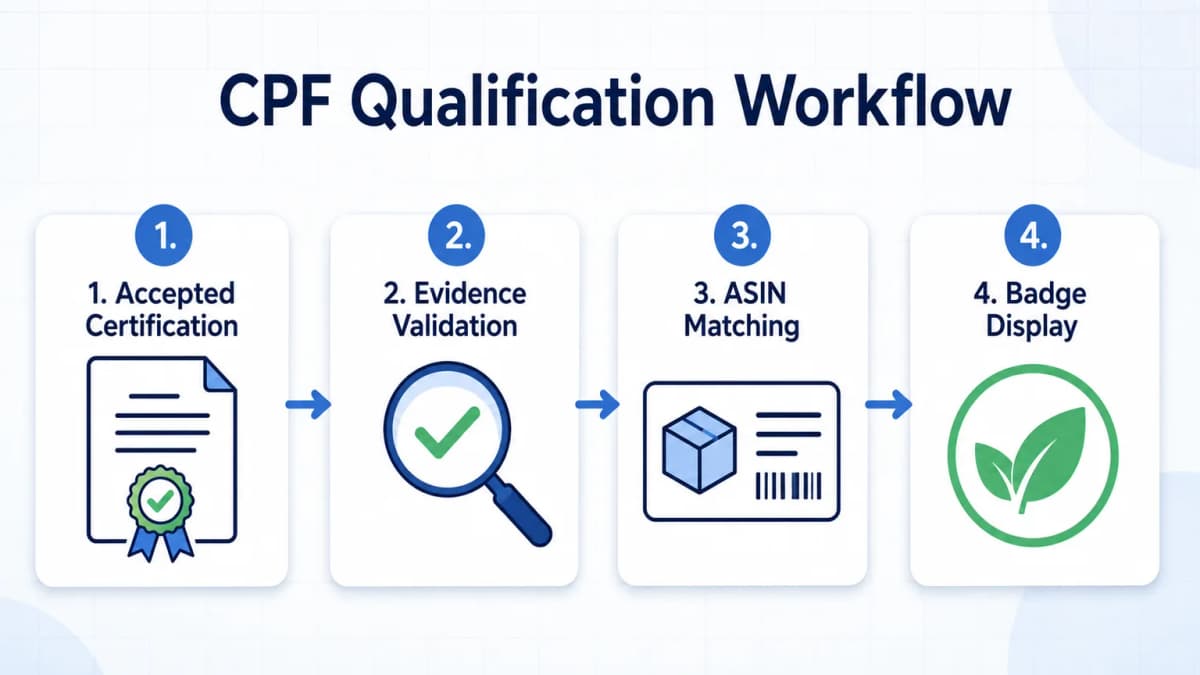
In a typical path, a seller first chooses a certification that fits the product and target marketplace. The certification body assesses the product against its own standard, issues documentation when the requirements are met, and may submit qualifying product identifiers to Amazon. Amazon then validates the available certification information and matches it to eligible ASINs.
The details matter. A certificate may cover a specific material, factory, product family, SKU, or production period. Sellers should confirm whether the certificate scope maps cleanly to each ASIN, including brand name, model, variation, packaging, and marketplace. A loose match can delay recognition or create a sustainability claim that the evidence does not fully support.
Badge Visibility and Performance
The Amazon Climate Pledge Friendly badge can support discovery at several stages of the shopping journey. Amazon has described visibility across search results, product detail pages, advertising, product recommendations, and Amazon Business. Placement can vary by marketplace, device, query, and Amazon experience.
Shopping Journey Placement
The badge gives shoppers a compact visual cue and can lead them to a product's sustainability features. This can be useful when competing listings have similar prices, ratings, or specifications. It may also help a shopper narrow a broad category without reading every bullet point.
Sellers should avoid treating the badge as a separate ranking system. Amazon does not promise a fixed organic position, a dedicated number of placements, or guaranteed recommendation traffic. The benefit depends on shopper demand, category context, listing quality, price, availability, reviews, fulfillment, and many other factors.
Page View Evidence
Amazon reported in 2023 that products experienced an average 10% increase in page views after adding the Climate Pledge Friendly badge. This is a useful benchmark, but it is an average across participating products rather than a forecast for one ASIN.
The same discipline used in Amazon listing optimization still applies. Titles, images, content accuracy, variation structure, inventory, and review quality can affect visibility and conversion before or after the badge appears.
Sales Lift Limits
Amazon's 2025 sustainability update cites peer-reviewed analysis that found an average 12% sales lift during the first year after a product received the badge. The study supports the possibility of commercial value. It does not mean every certified product will gain 12% in sales.
Average lift can include products with very different demand patterns and competitive conditions. A seller should check whether traffic increased, conversion changed, advertising mix shifted, pricing moved, or seasonality affected the comparison. A measured result is more useful than applying a network-wide average to an individual catalog.
Lighting Category Opportunity
Lighting can be a reasonable category for Climate Pledge Friendly research because products differ in energy use, materials, packaging, durability, and manufacturing practices. These attributes may connect to qualifying standards, but category membership alone does not establish eligibility.
Sample Findings
The source article cites a third-party review of lighting products and reports relatively low badge penetration in several subcategories. That observation may indicate a research opportunity: sellers can map current badged products, price ranges, review depth, Best Sellers Rank, certification labels, and listing claims before deciding whether a gap exists.
The practical task is to compare like with like. A desk lamp, outdoor solar light, ceiling fixture, and replacement bulb may follow different standards and customer expectations. Sellers should segment by product type, marketplace, price tier, fulfillment model, and use case instead of relying on one category-wide percentage.
Extrapolation Limits
The public source does not provide enough detail to reproduce its sample window, ASIN selection, marketplace mix, placement definition, or traffic-attribution method. Claims about a fixed share of free recommendation traffic therefore should not be treated as verified program rules.
Use third-party category data to form a hypothesis, then validate it with current marketplace evidence. The same principle applies when researching products to sell on Amazon: demand, competition, margin, compliance, and operational feasibility need to be evaluated together.
Certification Paths
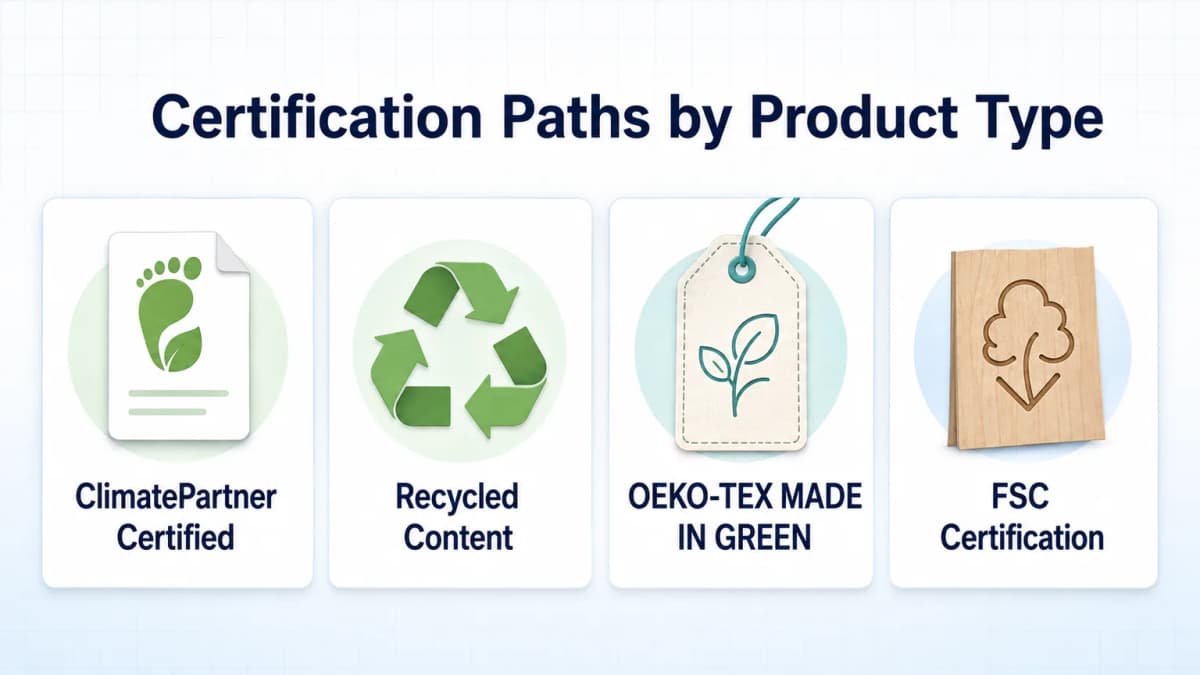
No single certification is best for every seller. The right path depends on the product's materials, supply chain, manufacturing process, evidence, and sales region. Amazon's current recognized-certification list should be the final reference before a seller commits money or production time.
ClimatePartner Certified
ClimatePartner describes a product-level process that includes calculating a product carbon footprint, setting reduction targets and measures, financing climate projects, and publishing a transparency page. ClimatePartner then submits qualifying ASIN information to Amazon.
Its current Amazon-focused page estimates a typical process of six to eight weeks. That estimate is not a service-level guarantee. Timing depends on data readiness, assessment scope, corrections, and Amazon's recognition process.
Recycled Material Standards
Products made with recycled materials may fit standards that verify recycled content or supply-chain claims. Amazon has highlighted certifications such as SCS Recycled Content and ISCC PLUS within the wider Climate Pledge Friendly ecosystem.
Sellers should confirm the exact material threshold, chain-of-custody rules, audit requirements, and claim wording. A supplier statement alone may not satisfy the chosen standard, and one certified component may not support a broad claim about the entire finished product.
OEKO-TEX MADE IN GREEN
For textiles and certain textile-related products, the relevant label is OEKO-TEX MADE IN GREEN, not a generic reference to OEKO-TEX. The label combines testing for harmful substances with requirements related to environmentally friendly facilities, socially responsible workplaces, and supply-chain traceability.
Product scope remains essential. A lamp that contains a textile shade, for example, should not be assumed to qualify as an entire finished product because one fabric component carries a label. Sellers need confirmation from the certification body and Amazon for the specific ASIN.
FSC Certification
FSC certification may be relevant to products containing wood, paper, or fiber-based materials from certified supply chains. The appropriate FSC claim depends on the certified material and chain of custody. Packaging certification does not automatically establish that the product itself qualifies for the same claim.
Sellers should keep certificates, invoices, supplier records, and product specifications aligned. If product composition changes, the evidence and listing copy may need to be reviewed again.
Certification Route Selection
Certification should begin with evidence and product fit rather than the badge alone. A route that looks inexpensive can become costly if supplier data is incomplete, ASIN mappings are inconsistent, or the chosen standard does not cover the finished product.
Product and Marketplace Fit
Start with the marketplaces where the ASIN is active and the product types that generate meaningful revenue. Check whether the certification is currently recognized for Climate Pledge Friendly in those locations. Also review whether the standard matches the material, manufacturing process, or environmental attribute the listing intends to communicate.
Documentation Readiness
Create an evidence inventory before contacting a certifier. Depending on the standard, this may include bills of materials, supplier certificates, energy data, factory records, audit reports, packaging specifications, product imagery, invoices, or carbon-accounting inputs.
Missing evidence can extend lead time. It can also change the certification route entirely. Sellers should ask the certifier to identify data gaps and renewal requirements in writing before agreeing to a project scope.
ASIN Matching
Build a mapping table between certificates, SKUs, GTINs, ASINs, variations, and marketplaces. Check spelling, model numbers, brand ownership, and product version. The table should show which ASIN is supported by which document and when the evidence expires.
This step is especially important after packaging updates, supplier changes, variation merges, or catalog corrections. A clean mapping makes badge verification and future audits easier.
Listing Claim Compliance
Listing copy should stay within the certification's verified scope. Avoid broad statements such as “100% sustainable,” “carbon neutral,” or “eco-friendly” unless the exact claim is permitted, accurately defined, and supported by current evidence.
Certification, Amazon enrollment, advertising policy, and legal compliance are related but separate checks. Sellers remain responsible for claims made in titles, bullets, A+ Content, images, packaging, and ads. If a claim could materially influence a shopper, evidence should be specific enough to support it.
Peak Season Planning
Peak-season enrollment needs a backward plan. Certification assessment, evidence correction, ASIN submission, Amazon matching, listing updates, inventory preparation, and campaign testing can each add time.
Lead Time Buffer
Use the certification body's current estimate as the starting point, then add a buffer for missing documents and platform processing. ClimatePartner currently describes six to eight weeks for its process, so a seller targeting a major sales event should start well before the promotion deadline.
Do not assume that payment to a certification provider guarantees badge display by a specific date. Confirm milestones, dependencies, submission responsibility, renewal timing, and what happens if Amazon cannot match an ASIN.
Badge Verification
Once the certification body reports submission, verify the badge on the live product detail page and in relevant search experiences. Check desktop and mobile views, the target marketplace, parent and child ASINs, and active variations.
Record the first verified date for each ASIN. Screenshots and change logs create a reliable boundary for later performance analysis. If the badge is missing, compare the certificate details with the live catalog before changing unrelated listing fields.
Promotion Readiness
A badge cannot compensate for weak retail readiness. Inventory, price, coupon structure, delivery promise, review health, product detail quality, and ad coverage still shape performance. Sellers planning a seasonal push can pair certification work with a disciplined Amazon PPC strategy, while keeping organic and paid effects separate in reporting.
Performance Measurement
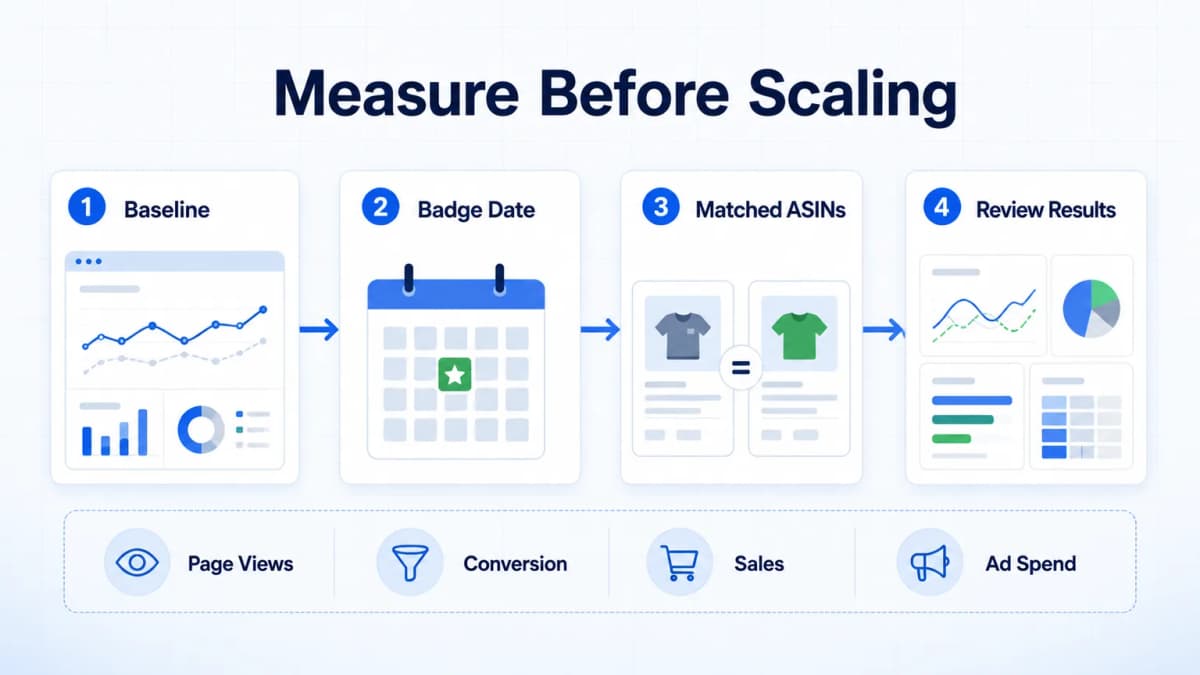
The best way to evaluate Climate Pledge Friendly is to define the measurement plan before the badge appears. That reduces the temptation to choose a favorable date range after results are known.
Pre-Enrollment Baseline
Capture at least several weeks of pre-badge data when the category's sales cycle allows it. Track sessions or page views, unit sales, conversion rate, price, coupon activity, ad spend, impressions, clicks, organic rank indicators, BSR, inventory status, review count, rating, and returns.
Use a consistent marketplace and ASIN set. Note major events such as stockouts, promotions, content changes, review spikes, and suppressed listings. A baseline with known disruptions is still useful if those disruptions are documented.
Controlled Comparison
Compare the enrolled ASINs with similar products that did not receive the badge during the same period. The comparison products should be as close as possible in product type, price tier, seasonality, fulfillment, review profile, and advertising activity.
For larger catalogs, a staged rollout can be more informative than certifying everything at once. A matched before-and-after design does not create perfect causality, but it provides a stronger signal than comparing one peak-season month with an ordinary month.
Confounding Factors
Separate badge timing from price changes, promotions, ad-budget shifts, inventory recovery, new reviews, listing rewrites, competitor stockouts, and seasonal demand. Report page-view change, conversion change, sales change, and ad-spend change independently.
If sales rise while traffic and conversion remain flat, a price or mix effect may be involved. If traffic rises but conversion falls, the badge may be attracting broader shoppers while the offer needs work. The goal is to identify the next decision, not to force every movement into one narrative.
Conclusion
Amazon Climate Pledge Friendly can be valuable when a product genuinely fits a recognized certification and the seller can maintain the supporting evidence. The badge may improve discovery and shopper confidence, but its commercial effect varies by ASIN, category, marketplace, and execution.
The strongest approach is straightforward: verify eligibility, choose a certification that matches the product, prepare documentation, map evidence to ASINs, confirm the badge on the live marketplace, and measure results against a credible baseline. Sellers should treat unsupported traffic promises, fixed sales-lift claims, and guaranteed timelines with caution.
Measure Before Scaling
A measurement plan benefits from reliable marketplace data and an early compliance screen. Nexscope provides REST API and MCP access that teams can connect to an internal agent, research workflow, or reporting system:
-
Amazon Policy Feed API: Retrieve Amazon policy, regulation, and compliance updates by marketplace and date.
-
Text Trademark Detector API: Screen listing copy for possible trademark and infringement risks before launch.
-
Copyright Detection API: Assess product images using similarity results, risk indicators, and related litigation history.
-
Design Patent Detection API: Compare product imagery with design-patent records across more than 25 jurisdictions.
-
Nexscope Amazon Data API: Retrieve structured product, competitor, price, review, BSR, keyword, and market data for category research and post-badge analysis.
The compliance APIs support policy monitoring and broader pre-launch intellectual-property screening. They do not establish Climate Pledge Friendly eligibility, certify sustainability claims, replace a certification body, or provide legal advice.
Measure Amazon Performance with Structured Data
Connect product, competitor, price, review, BSR, keyword, and market data to category research and post-badge analysis.
 Explore Amazon Data API →
REST API • MCP access • Structured Amazon data
Frequently Asked Questions
What is Amazon Climate Pledge Friendly?
Amazon Climate Pledge Friendly is a shopping program that highlights products supported by one or more qualifying sustainability certifications. Eligible products can display a green-leaf badge and sustainability information in selected Amazon shopping experiences.
Does the badge improve Amazon ranking?
Amazon does not promise a fixed organic-ranking increase. The badge can improve product discovery and shopper understanding, but ranking and sales also depend on relevance, price, availability, reviews, fulfillment, listing quality, advertising, and competition.
How does a product become eligible?
A product generally needs a current certification recognized by Amazon or must meet an applicable Amazon-developed certification. The certification and ASIN data must be validated and correctly matched. Sellers should confirm the current process in Seller Central or the Sustainability Solutions Hub.
How long does certification take?
Timing varies by certification, product complexity, and documentation readiness. ClimatePartner currently describes a typical six-to-eight-week process for its Amazon-related certification route, but corrections and Amazon recognition can add time.
Is OEKO-TEX enough for eligibility?
The relevant recognized label discussed here is OEKO-TEX MADE IN GREEN. A generic OEKO-TEX reference or a certificate for one component may not establish eligibility for the entire finished product. Confirm the exact certificate scope and ASIN with the certification body and Amazon.
Can packaging certification qualify a product?
It depends on the specific standard and Amazon's current eligibility rules. A certification that covers packaging does not automatically support a claim about the product itself. Sellers should distinguish product, component, and packaging evidence.
How should sellers measure badge results?
Record a pre-badge baseline, capture the verified badge date, compare enrolled ASINs with matched non-enrolled products, and track page views, conversion, sales, price, ads, inventory, reviews, and seasonality. Results should be interpreted as evidence for a decision rather than a guaranteed causal effect.
Sources
- Amazon. (2025). Sustainability Labels Are Shifting Shopping Decisions. Retrieved from sustainability.aboutamazon.com
- Amazon. (2023). The Sustainability Solutions Hub for Sustainability Programs. Retrieved from sellingpartners.aboutamazon.com
- ClimatePartner. (2026). Amazon Climate Pledge Friendly. Retrieved from climatepartner.com
- OEKO-TEX. (2022). OEKO-TEX MADE IN GREEN Supports Amazon's Climate Pledge Friendly. Retrieved from oeko-tex.com