

How GPT-6 Astra Supports 5 Ecommerce Automation Workflows

Ecommerce automation becomes more useful when research, content, advertising, support, and inventory work share the same business context. A product manager may already use AI to summarize reviews while a marketer uses it to draft copy. Someone still has to connect those findings, check the product facts, decide what deserves attention, and move an approved change into the right system. That coordination can take longer than producing the first draft.
GPT-6 Astra gives teams a stronger foundation for connecting these tasks. With suitable data and tools, an agent can investigate a question, organize the evidence, prepare an action, and check its result. The practical opportunity is to make specific operating routines easier to complete and review. This article explores five workflows, their implications for ecommerce teams, and a four-week pilot. The scenarios are implementation examples rather than reports of measured merchant results. Their usefulness depends on the business data, connected systems, and operating rules available to the agent.
In this article
- GPT-6 Astra for Ecommerce Operations
- 5 Ecommerce Automation Workflows
- Changes for Ecommerce Teams
- A 30-Day Ecommerce Pilot
- Conclusion
- Frequently Asked Questions
GPT-6 Astra for Ecommerce Operations
GPT-6 Astra supports reasoning, research, coding, and work across software tools. OpenAI released it on September 3, 2026, and describes it as a model for completing complex tasks using the context and tools supplied by the user. OpenAI API Changelog.
For ecommerce, the relevant distinction is between preparing an answer and completing a defined task. A useful assignment might produce a reviewed product brief, a queue of listing corrections, or an advertising experiment with a clear owner.
Connected Tools and Business Context
The model supports text and image inputs, a 1,050,000-token context window, and tools including web search, file search, code execution, computer use, and MCP through the Responses API. These capabilities allow an application to combine business records with research and analysis. GPT-6 Astra model documentation.
The surrounding application must still provide the connections, scheduled runs, and execution environment. A recurring inventory check needs access to inventory records and a scheduler. An advertising review needs account reports with consistent dates and attribution settings. The model can reason over available evidence; the integration determines which evidence and actions it can access.
5 Ecommerce Automation Workflows
Start with a recurring decision that already has an owner. Define the records needed, the output expected, and the conditions under which a person should review the result. The following workflows offer practical starting points.
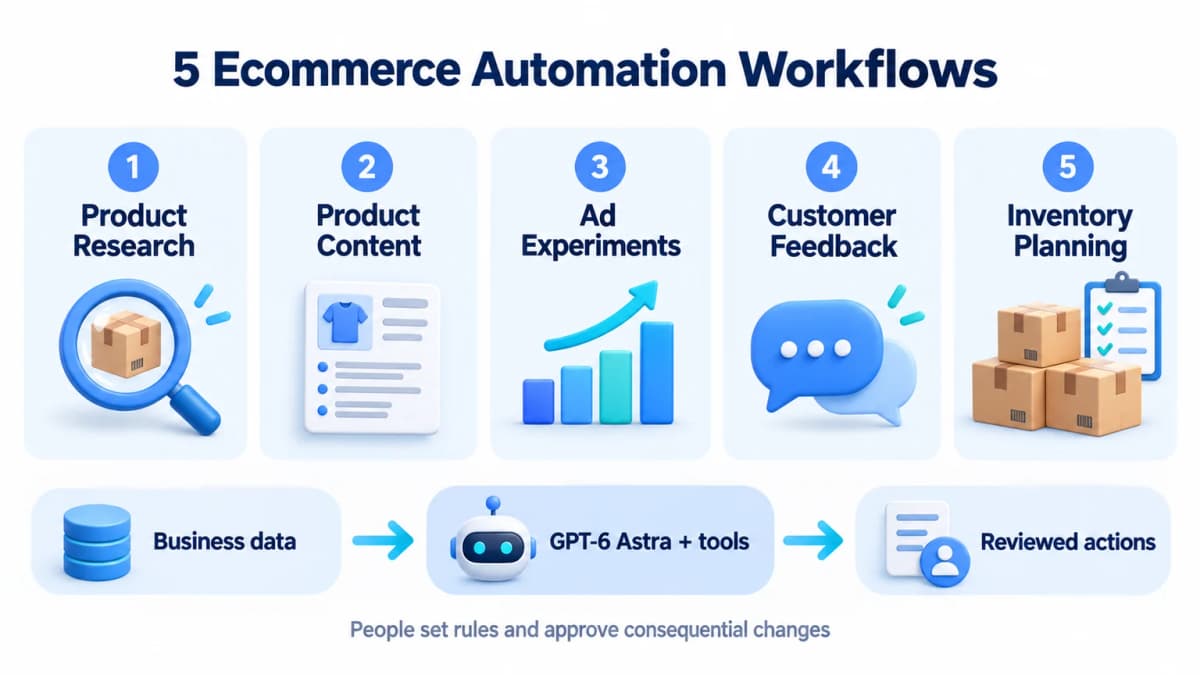
1. Product Research and Opportunity Tracking
A product research routine can compare a defined set of products, keywords, prices, and customer concerns over time. Each run should use the same marketplace, category boundaries, and sampling rules so that changes remain interpretable.
For a hypothetical home organization brand, the assignment could be to identify products whose recent reviews repeatedly mention unclear sizing. The agent would group the complaints, check the relevant product specifications, and prepare a shortlist of possible improvements. It should preserve the source records behind each suggestion.
The output is a testable product hypothesis. A useful brief explains the customer problem, the evidence supporting it, the proposed change, and what would invalidate the idea. A complaint alone cannot establish demand or commercial viability. Supplier quotes, product samples, and actual customer response remain separate inputs.
Keep rankings and review samples in context. A movement in a bestseller list could reflect a promotion, availability changes, or competitor activity. The agent should identify plausible explanations and missing evidence before the team commits to sourcing.
2. Channel-Specific Product Content
Product content becomes easier to coordinate when every channel draws from an approved set of facts. Give the agent current dimensions, materials, compatibility details, approved images, and documented limitations. Those records establish what the content can accurately claim.
From that foundation, a workflow can prepare an Amazon listing revision, a short video script, and a product-page FAQ. Each draft should reflect its channel's purpose while preserving the same specifications. Amazon listing optimization, for example, can focus on making purchase-critical details easier to find.
Suppose support tickets show that customers confuse the dimensions of the product with those of its packaging. The agent can flag the ambiguity, propose revised copy, and identify the image that needs a measurement annotation. A reviewer then checks the change against the approved specification sheet.
The same process can catch conflicting claims across channels. A stronger description needs evidence for its claims. Generating more versions is useful only when the team can track which facts changed and which assets require review. Publishing the approved material remains a separately authorized action.
3. Advertising Experiment Management
An advertising workflow can turn a report into a focused experiment. Supply campaign and product identifiers, reporting dates, spend, clicks, conversions, and the team's definitions of success. The agent can compare matched periods and identify combinations that deserve investigation.
Consider a campaign whose clicks remain steady while reported purchases decline. The analysis should first check conversion reporting delays, product availability, offer changes, and landing-page issues. Automatically rewriting the creative could address the wrong cause.
An experiment brief should name the hypothesis, the variable to change, the review date, and the stopping condition. Keeping those elements explicit makes the next review easier: the team can determine whether the test actually answered the original question.
The review cadence should match the available evidence. An hourly check may help surface delivery problems, but sparse or delayed conversion data can make frequent optimization unreliable. Budget changes need account-specific limits and authorization. OpenAI's computer-use guidance recommends bounded runs, confirmation for consequential actions, and verification of the actual result. Computer use documentation.
4. Customer Feedback and Product Improvements
Customer conversations can inform work beyond the support queue. A repeatable analysis can group questions by product, distinguish information gaps from possible defects, and assign follow-up tasks to the relevant team.
For instance, repeated assembly questions may justify clearer instructions. Reports of broken components may require inspection of a supplier batch. These issues need different responses even when both appear in negative feedback.
Combining internal tickets with Amazon review analysis can help a team compare problems reported by its customers with broader product-category concerns. Keep the datasets distinguishable: competitor reviews cannot establish the return rate of the team's own product.
The output should include the issue, affected product or variant, supporting examples, and proposed owner. A reviewer can then verify whether the problem deserves a content change, a product investigation, or a supplier conversation.
Customer-facing replies need the store's approved policies and only the personal information necessary for the task. Refunds and replacements also depend on order status and authorization. A useful feedback summary does not, by itself, authorize either action.
5. Inventory and Supplier Planning
Inventory analysis needs a shared view of sellable units, committed orders, inbound shipments, and supplier lead times. Product and warehouse identifiers must match across the underlying records before the agent compares them.
A team can ask how an upcoming promotion might affect stock coverage under several demand assumptions. The analysis can identify which SKU would need attention first and show how a later replenishment date changes the result. The assumptions should remain visible beside the recommendation.
For example, a bundle may have adequate stock of its main product but too few accessories to fulfill the planned promotion. A check across the bundle's components can surface that constraint before the campaign begins.
Scenario analysis supports a decision; it does not establish future demand. Advertising spend alone is insufficient to forecast orders. Historical conversion, seasonality, capacity, and uncertainty all matter.
The agent can prepare a replenishment recommendation or an exception list for review. Purchase orders, supplier commitments, and customer delivery promises should follow the business's approval process. Internal inventory and order data require their own authorized connections.
Changes for Ecommerce Teams
The likely benefit of these workflows depends on how well a business can define and evaluate them. Three areas deserve attention as teams decide where to invest.
Merchant Advantages
Consistent product records, reliable suppliers, and a clear view of customer problems make automation easier to use. A team that already understands its unit economics can evaluate a recommendation against those constraints. A business with unresolved fulfillment problems still needs to address the underlying operations.
Faster research can shorten the path to a test. The merchant remains responsible for deciding whether the proposed product or offer deserves that test.
Service Provider Expectations
When a provider offers AI-assisted operations, buyers can ask for evidence of task completion, exception handling, and review quality. A persuasive demonstration is only one part of that assessment.
The stronger deliverable is a defined routine with useful outputs and visible handoffs. Providers should be able to explain what happens when a source is unavailable, an identifier is missing, or the agent cannot complete an action.
Changing Operational Roles
As routine preparation becomes easier to automate, teams can place more emphasis on defining questions, checking evidence, and evaluating results. Product knowledge and sound judgment remain central to those tasks.
Managers also need explicit ownership. Every recurring workflow should have someone responsible for its inputs, someone who reviews exceptions, and a clear way to stop or revise it when conditions change.
A 30-Day Ecommerce Pilot
A four-week pilot gives a team a manageable way to evaluate these ideas. Choose one product group and a small number of recurring tasks. Treat the schedule as a proposed implementation plan, adjusting it to the team's systems and review capacity.
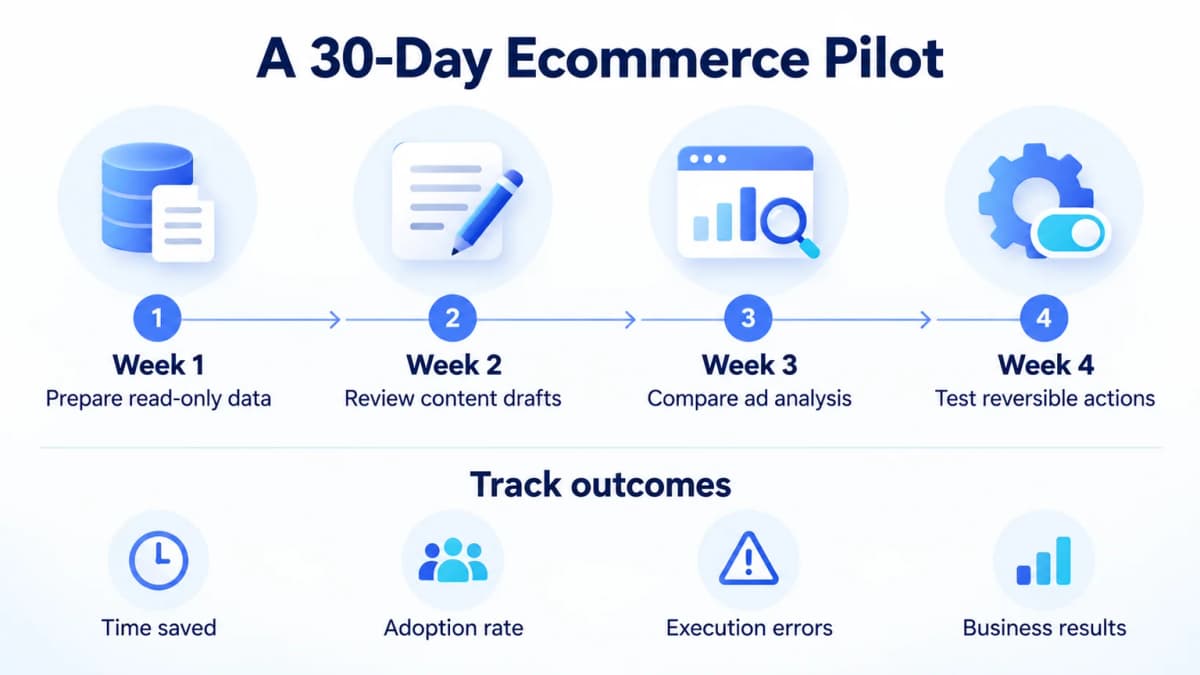
Week 1: Prepare Read-Only Data
Assemble the product records, business definitions, and reports needed for the chosen task. Record the source and retrieval time of each dataset. Where the underlying data has its own update timestamp, preserve that too.
Ask the agent questions whose answers the team can independently check. Confirm that it joins the right products, uses the correct reporting period, and identifies missing information. Include awkward cases such as duplicated SKUs, unavailable fields, and conflicting specifications.
Measure the existing manual process so the pilot has a baseline. Record preparation and review time separately; otherwise, faster drafting can hide a growing correction burden.
Week 2: Test Reviewed Drafts
Choose a contained output, such as a listing correction queue or a weekly summary of customer questions. Require each proposed change to identify the supporting record and the uncertainty that remains.
Have the usual business owner review the result before it reaches customers. Track which suggestions are accepted, revised, or rejected, along with the reason. This reveals whether the agent understands the task or merely produces plausible language.
Keep the review standard consistent across the pilot. A draft that omits a crucial product limitation should count as an error even if its wording is polished.
Week 3: Compare Advertising Analysis
Give the agent a defined advertising report and ask it to produce an exception list and a proposed experiment. Compare its analysis with the team's normal review using the same data cutoff.
Investigate disagreements. An additional issue may be useful, while an apparent anomaly may come from attribution lag or an inconsistent comparison. Preserve both the original report and the reasoning summary used to select the next test.
Continue to keep account changes under human control during this stage. The aim is to establish whether the analysis improves decisions before adding execution.
Week 4: Test Reversible Actions
If the earlier stages produce reliable results, enable one narrow action, such as creating an internal task or updating a field in a staging catalog. Keep the previous state and verify the resulting change.
For integrations using remote tools, define which tools are available and which require approval. OpenAI's MCP documentation provides tool filtering and approval controls for this purpose. MCP and connectors documentation.
At the end of the pilot, review four outcomes:
| Outcome | What to measure |
|---|---|
| Time saved | Preparation and review time compared with the manual baseline |
| Adoption rate | Accepted recommendations divided by reviewed recommendations |
| Execution errors | Failed or incorrect actions, their severity, and recovery effort |
| Business results | Relevant changes in margin, returns, conversion, or inventory coverage |
Keep short-term business changes in context. Promotions, seasonality, stock availability, and other work may influence the same metrics. The pilot should establish whether the workflow is useful enough to continue, with a clear record of unresolved limitations.
Conclusion
GPT-6 Astra can help ecommerce teams connect research, content, advertising analysis, customer feedback, and inventory planning into more coherent routines. Start with a specific task, give the agent the relevant context, and judge the result against an observable business standard.
Give GPT-6 Better Ecommerce Data
GPT-6 Astra brings powerful reasoning to an ecommerce workflow. Pairing that intelligence with accurate, up-to-date ecommerce data makes it more useful: product ideas can be assessed against current offers, content can address observed customer concerns, and recommendations can reflect changes in the market.
Nexscope provides structured product, keyword, pricing, ranking, review, and other supported ecommerce data. Teams can connect these inputs to their own agent through REST API or MCP, giving GPT-6 business evidence to work with when a decision requires marketplace context.
For a product research task, that could mean checking current product details and competitor prices before ranking opportunities. Freshness and coverage depend on the selected data source and API; preserve available timestamps and distinguish live observations from historical or estimated values.
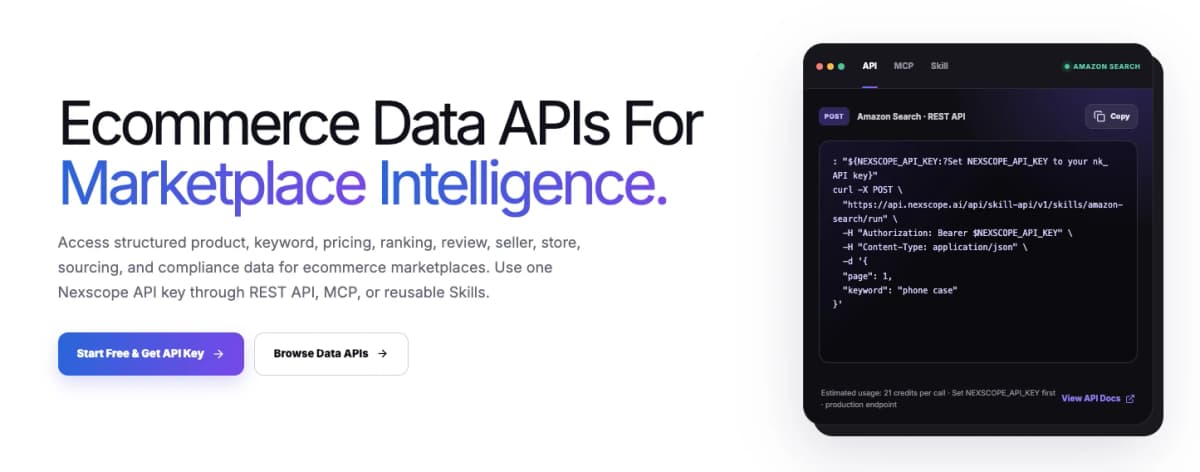
Power Your Next Workflow with Nexscope
Bring relevant marketplace evidence into the next research workflow and give GPT-6 a stronger basis for its recommendations.
Browse Ecommerce Data APIs →Frequently Asked Questions
Can GPT-6 Astra run an online store independently?
GPT-6 Astra can support tasks within a connected application, but operating a store also requires business data, account access, scheduling, and execution rules. A practical deployment assigns it defined tasks and reviews the results. Decisions involving spending, customer commitments, or irreversible changes need appropriate authorization. Teams should evaluate individual workflows before expanding the agent's responsibilities across the business.
Which ecommerce automation workflow should a team test first?
Start with a recurring task whose output is easy to verify and whose mistakes are straightforward to correct. A listing correction queue or a summary of customer questions is a useful candidate. Establish the manual baseline, preserve the supporting records, and compare preparation time, review effort, and accepted recommendations before adding customer-facing execution or account changes.
What data does GPT-6 Astra need for ecommerce?
The required data depends on the decision. Product content needs approved specifications and supporting material. Advertising analysis needs account reports with consistent dates and attribution definitions. Inventory planning needs stock, orders, inbound shipments, and lead times. Marketplace research may also require current product, pricing, keyword, and review data. Every dataset should retain enough source and timing information to support verification.
Can GPT-6 Astra access live ecommerce data?
An application can give GPT-6 Astra access to current information through supported tools and data connections. The model's stored knowledge should not be treated as a live price or inventory feed. Data freshness depends on the source, retrieval method, and update schedule. Teams should check the available timestamps and handle stale or missing responses explicitly before acting on the information.
How can Nexscope support GPT-6 ecommerce workflows?
Nexscope supplies structured ecommerce data that a team's own agent can access through REST API or MCP. Supported inputs include product details, keywords, pricing, rankings, and reviews, depending on the selected capability. Those inputs can support research and comparison tasks. The team's private business systems require their own authorized connections, and each data API's documentation defines its coverage and fields.
Sources
- OpenAI. (2026). API Changelog. Retrieved from developers.openai.com.
- OpenAI. (2026). GPT-6 Astra Model. Retrieved from developers.openai.com.
- OpenAI. (2026). Computer Use. Retrieved from developers.openai.com.
- OpenAI. (2026). MCP and Connectors. Retrieved from developers.openai.com.