

How Meta Muse Is Reshaping AI Shopping and Online Checkout

Meta Muse brings a commercial question into everyday AI use: when an assistant helps a customer choose and buy a product, which businesses earn the transaction? The answer depends on several participants. A consumer service can receive the shopping request, a commerce platform can manage the order, and a payment provider can process the purchase. The merchant still needs a sale worth fulfilling and a customer relationship worth maintaining.
Shopify and PayPal are pursuing roles in this developing purchase journey. Their opportunity extends beyond appearing in a partnership announcement. They need useful demand to become completed transactions, and those transactions need to produce economic value. Amazon’s different approach provides context, but the larger question for independent merchants is how distribution through an AI interface changes the business behind each order.
Understanding that change requires separating product discovery, checkout availability, channel attribution, and incremental revenue. Each describes a different result. A promising integration can improve one without yet proving the others.
Muse and Shopping Intent
Delegating the Purchase Journey
Meta Muse gives users a way to delegate tasks across online services. Meta’s September 8 launch announcement describes browser-based actions, user-controlled access, and approval before purchases. It identified Stripe’s Link as an available payment method and Shop Pay as forthcoming.
That chronology matters. In its September 24 Connect update, Meta announced additional shopping connectors and the addition of Shop Pay and PayPal for payments. The launch-day payment description is therefore incomplete as a current account of the rollout. Availability for a particular merchant or customer still needs to be checked against current channel requirements.
The commercial attraction is straightforward. An assistant can receive a request before a shopper chooses a store. At that stage, the customer may be deciding between categories, brands, budgets, or delivery options. Helping resolve those choices creates influence over which offers receive consideration.
That influence does not establish a particular monetization model. Meta’s launch materials say Muse conversations and virtual-machine data are not shared with its advertising systems. Any assessment of future shopping revenue needs separate evidence about fees, subscriptions, advertising arrangements, or other disclosed business terms.
Information Before the Transaction
A delegated purchase still requires a product that fits the buyer’s needs. Consider an illustrative request for office shoes within a fixed budget, in a specific size, delivered before a business trip. An attractive product image leaves several transaction-critical questions unanswered: whether the correct variant is available, what the delivered price will be, and whether the delivery estimate fits the deadline.
Those details can affect both selection and order quality. A sale generated from an incorrect delivery expectation may become a cancellation. A poorly distinguished variant may become a return. Merchants therefore have an economic reason to keep offer information consistent wherever it is distributed.
The same distinction appears in product recommendations in ChatGPT Shopping: appearing in a recommendation and completing a profitable purchase are separate outcomes. An additional discovery channel expands the opportunities to compete, while the merchant remains responsible for delivering what was promised.
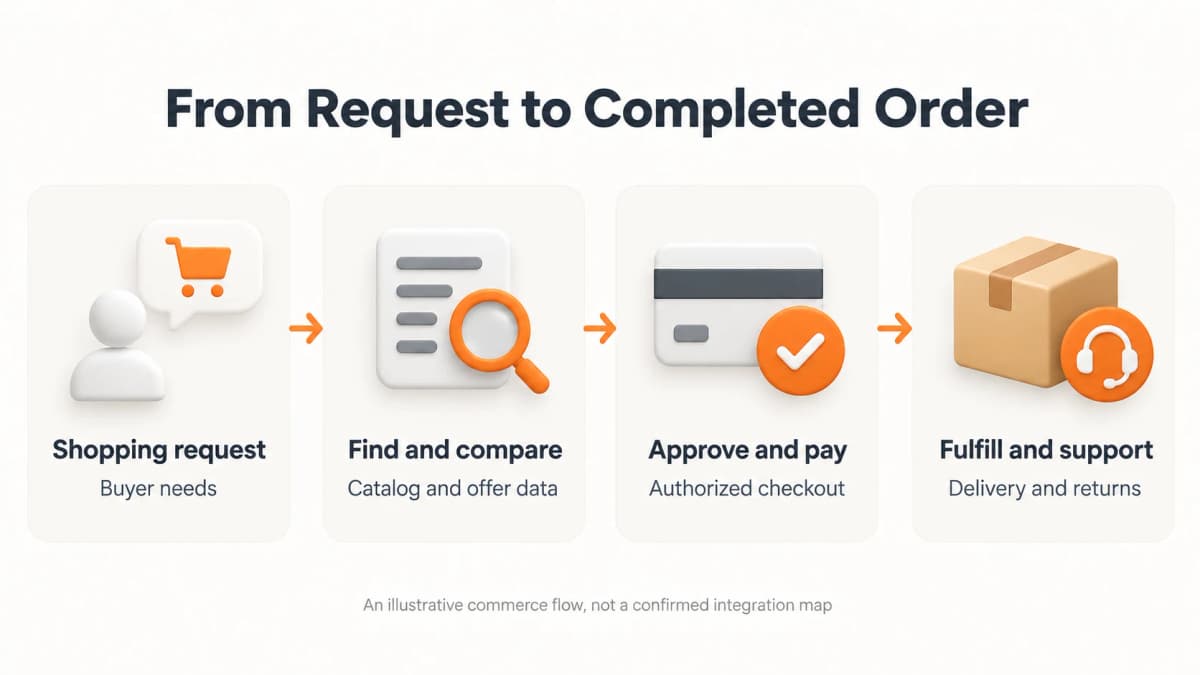
A purchase involves several connected responsibilities, even when the customer experiences it through one conversation.
Shopify Beyond the Payment Button
Commerce After Product Discovery
Shopify’s interest becomes clearer when the transaction is viewed from the merchant’s perspective. A brand can benefit from demand arriving through several interfaces while continuing to use a common commerce operation. Maintaining a separate order process for every new assistant would add work and increase the opportunities for inconsistent customer experiences.
Shopify’s Meta channel documentation describes Shopify Catalog discovery and direct checkout on Meta surfaces, including Muse when available. Merchants remain the merchant of record and manage fulfillment, returns, and customer service. Catalog access and direct checkout can be controlled separately.
This creates a useful commercial distinction: the place where a customer starts shopping can differ from the system responsible for the order. Shopify can seek a larger role in commerce without operating the interface in which every purchase begins.
For a merchant, maintaining that operational continuity has practical value. Customer support needs to identify the order and the purchased variant. Fulfillment needs accurate shipping instructions. Refund decisions need a record of the offer and the payment. A fast buying experience is useful when these responsibilities remain manageable after the customer pays.
The customer relationship also deserves a precise definition. Processing an order, holding its records, and handling support are different from winning the customer’s attention for the next purchase. A merchant can retain transaction responsibilities while an assistant becomes the customer’s preferred place to start shopping. Repeat purchases and permitted customer communication will help show how that relationship develops.
The Revenue Connection
Shopify’s second-quarter 2026 results show why transaction activity matters to its business. For the quarter ended June 30, Shopify reported $115.567 billion in GMV and $3.583 billion in revenue. Merchant solutions contributed $2.781 billion, compared with $802 million from subscription solutions.
Those figures describe Shopify’s existing business before Muse launched in September. They provide context for its interest in additional commerce channels; they cannot measure the contribution of this particular partnership.
The possible benefit follows from transactions using services Shopify provides. Its actual size will depend on order volume, payment choices, service usage, and the economics of those activities. The published figures do not supply a Muse-specific take rate or revenue forecast.
For merchants, the corresponding question is whether the channel improves contribution after product costs, payment costs, fulfillment, returns, and support. An increase in gross sales can be attractive while producing a smaller improvement in operating results than the headline suggests.
New Orders or Shifted Orders?
An order attributed to a new channel is evidence that the channel participated. Establishing incrementality requires a further question: would the purchase have happened anyway?
For example, a returning customer might ask an assistant to reorder a familiar product instead of opening the brand’s website. Another customer might discover the brand for the first time through the assistant. Both purchases can be commercially valuable, but they represent different acquisition outcomes.
Shopify says Meta-surface orders are attributed to Meta. It also notes that third-party attribution pixels do not fire in direct checkouts completed on Meta surfaces. A Meta channel label should not be treated as a Muse-only acquisition measure.
Analysis should begin with the granularity actually available in order records. Where possible, compare new and returning customers, net sales, refunds, and repeat purchases over matched periods. Keep promotions, stock availability, and seasonal demand in view. If the reporting cannot isolate Muse, the result should remain a broader Meta-channel observation.
This is a measurement proposal, not a claim that the partnership already provides every required field. Its purpose is to make the commercial test explicit before a channel’s growth is presented as proven incremental demand.
Amazon and PayPal’s Different Incentives
Amazon as a Brief Contrast
Amazon’s restriction on Meta Muse illustrates the limits of assuming every retailer will welcome the same purchase flow. Amazon already operates a marketplace connecting discovery, transactions, and fulfillment. Shopify serves merchants seeking distribution across multiple channels. Their existing roles create different incentives when an external assistant becomes involved. For this comparison, the important point is that agent commerce develops through specific platform arrangements. Amazon’s decision does not determine whether Shopify merchants or payment providers can build valuable relationships with Muse.
PayPal’s Transaction Economics
PayPal’s opportunity sits closer to the payment itself. Meta’s Connect announcement includes PayPal among the payment additions, giving the company a prospective role in purchases initiated through the assistant. That announcement establishes participation in the developing payment experience. It does not quantify resulting payment volume, merchant adoption, or profit.
PayPal’s second-quarter 2026 earnings release helps explain why those distinctions matter. Total payment volume reached $486.4 billion, up 10% year over year, while net revenue rose 5% to $8.682 billion. Transaction margin dollars increased 1% to $3.9 billion. PayPal identifies transaction margin dollars as a non-GAAP measure; it is not equivalent to net income.
The different growth rates show that payment volume and financial returns do not move in lockstep. These June-quarter results also predate Muse’s launch. They demonstrate the importance of evaluating transaction economics, rather than providing evidence of Muse’s performance.
For a payment provider, a growing AI shopping channel may create more opportunities to process purchases. The financial result will depend on the services used, the associated revenue, and the costs and losses attached to those transactions. Without integration-specific disclosures, assigning a profit contribution would be speculation.
Merchants face a related choice at a smaller scale. A payment option should make purchases easier for suitable customers while keeping fees, reconciliation, refunds, and dispute handling understandable. Adoption becomes more convincing when those operating outcomes support the increase in completed checkouts.
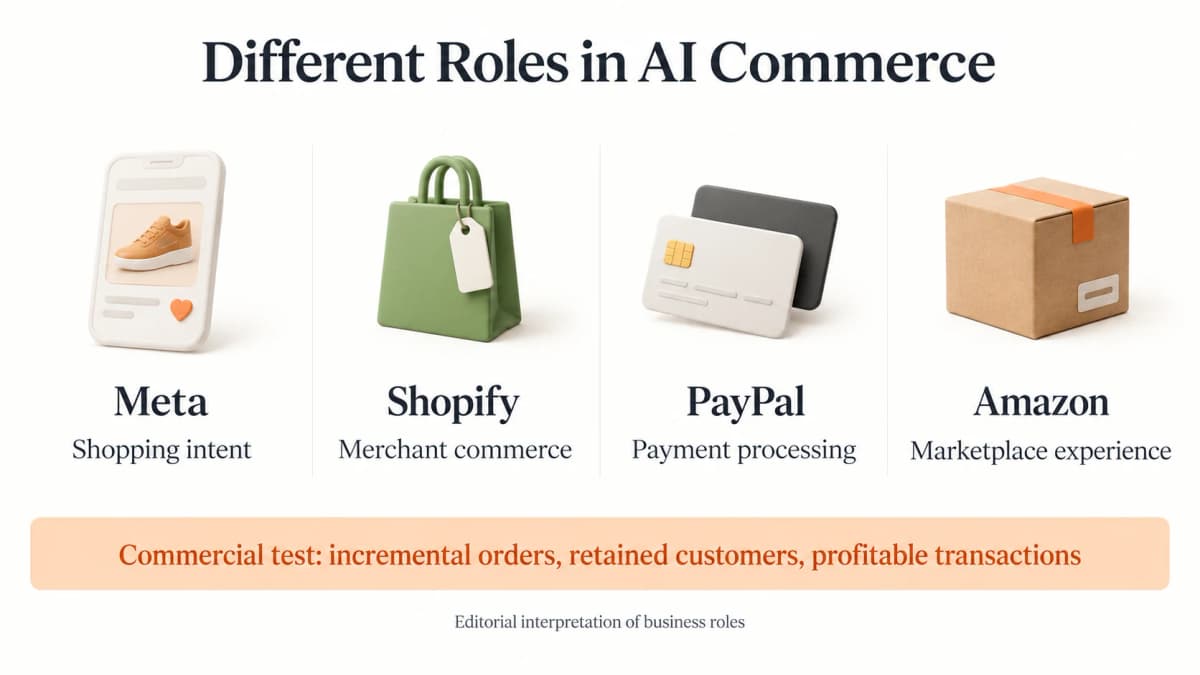
These business roles explain different incentives. They do not represent a ranking or an estimate of revenue from Muse.
Conclusion
Meta Muse introduces another place for purchase decisions to begin. Shopify can extend the commerce systems merchants already depend on, while PayPal can participate in the payment stage. The strength of those opportunities will become clearer through completed orders, repeat customers, and sustainable transaction economics.
The practical priority for merchants is to connect product evidence with their own operating results. Research can identify where an offer is unclear or uncompetitive; order records can show what happened after a purchase. Keeping these inputs distinct makes it easier to judge whether a new distribution channel is improving the business.
Research AI Visibility With Nexscope
Nexscope helps merchants investigate where their brand appears in AI answers, how competing domains compare, and which pages are cited. Five APIs support this research:
- AI Search Citation Sample: Inspect a buyer question. Collect a bounded ChatGPT answer and citation observation for a supplied prompt, then review the response and its supporting sources.
- SEO AI Mention Records: Examine mention evidence. Retrieve historical answer records with cited sources, search references, and brand entities kept separate to understand the context behind an observed mention.
- SEO AI Target Comparison: Compare competing domains. Compare configured target groups using provider database metrics, keeping each group’s results distinct rather than adding overlapping groups together.
- SEO AI Top Cited Pages: Identify pages to investigate. Retrieve provider-ranked cited pages and their aggregate metrics, then examine their product information, comparisons, and explanations for content research.
- SEO AI Mention History: Review changes over time. Retrieve monthly absolute mention counts from the historical database to put current visibility observations in context.
Connect these APIs to a team’s own applications, agents, or reporting workflows through REST API or MCP. Keep historical database results separate from individual answer samples, and preserve coverage limits and missing values. These datasets support AI visibility research; they do not measure Muse-specific recommendations or prove sales attribution.
Understand Your Brand’s AI Visibility
Research AI answers, brand mentions, cited pages, and historical trends through Nexscope’s Marketing Data APIs.
Explore AI Visibility APIs →Frequently Asked Questions
What does Meta Muse change about shopping?
Meta Muse lets users delegate tasks, including shopping-related actions, to a personal AI agent. The commercial change is that product consideration can begin inside an assistant before the customer chooses a store. Merchants and service providers still need to complete the transaction, deliver the purchase, and support the customer. Those responsibilities determine how useful the channel becomes over time.
Is Shop Pay available in Muse?
Meta described Shop Pay as forthcoming at launch on September 8, then announced its addition in the September 24 Connect update. Shopify’s documentation continues to qualify Muse availability. Treat support as dependent on the current rollout and eligible flow, rather than assuming every customer can use it. Verify the applicable channel settings before making promises about a particular store.
Do merchants keep the customer relationship?
A customer relationship includes several distinct activities: managing an order, providing support, communicating with appropriate permission, and earning another purchase. Keeping responsibility for a transaction does not guarantee that the shopper will return directly to the brand next time. Merchants should evaluate repeat buying and customer-service outcomes alongside initial sales when assessing an assistant-led distribution channel.
Do AI-channel orders prove incremental growth?
No. A channel-attributed order indicates participation in the purchase journey, but the customer might otherwise have bought through an existing channel. Evaluating incrementality requires an appropriate comparison and attention to promotions, inventory, seasonality, and returning customers. Where channel reporting is incomplete, conclusions should stay within the available evidence instead of assigning all unexplained sales to the new assistant.
How could PayPal benefit from Muse?
PayPal could benefit when eligible purchases use its payment services. The economic result depends on actual transaction activity and the revenue and costs associated with it. A partnership announcement alone cannot establish the size or profitability of that activity. The relevant evidence would include disclosed adoption, payment volume, and financial contribution, rather than the overall popularity of the assistant.
Sources
- Meta. (2026). Introducing Muse: The World’s First Personal AI Agent Built for Everyone. Retrieved from about.fb.com
- Meta. (2026). The Biggest News From Connect 2026. Retrieved from about.fb.com
- Shopify. (2026). Selling on Meta. Retrieved from help.shopify.com
- Shopify. (2026). Shopify Delivers Big: 30%+ Growth Across GMV, Revenue, Gross Profit, and Free Cash Flow. Retrieved from shopify.com
- PayPal Holdings, Inc. (2026). PayPal Reports Second Quarter 2026 Results. Retrieved from sec.gov