

How to Choose Amazon Keyword Match Types for Better Ads

Choosing Amazon keyword match types starts with a practical question: what should the next paid click teach the advertiser or achieve for the product? A campaign seeking new customer language needs different controls from one funding a search term that already produces profitable orders. Word count and search volume offer context, but neither establishes whether a particular targeting choice deserves more spend.
For Sponsored Products, broad, phrase, and exact match give advertisers different ways to manage that uncertainty. The useful comparison combines product relevance, account performance, and an affordable testing budget. This guide explains the matching rules, turns those inputs into targeting decisions, and follows a hypothetical packing-cube product through a search term review. It also covers overlapping targets, negative keywords, and the delivery checks that should accompany a move into exact match. The goal is a repeatable review process with a clear reason for every keyword, bid, and exclusion.
Match Types and Close Variants
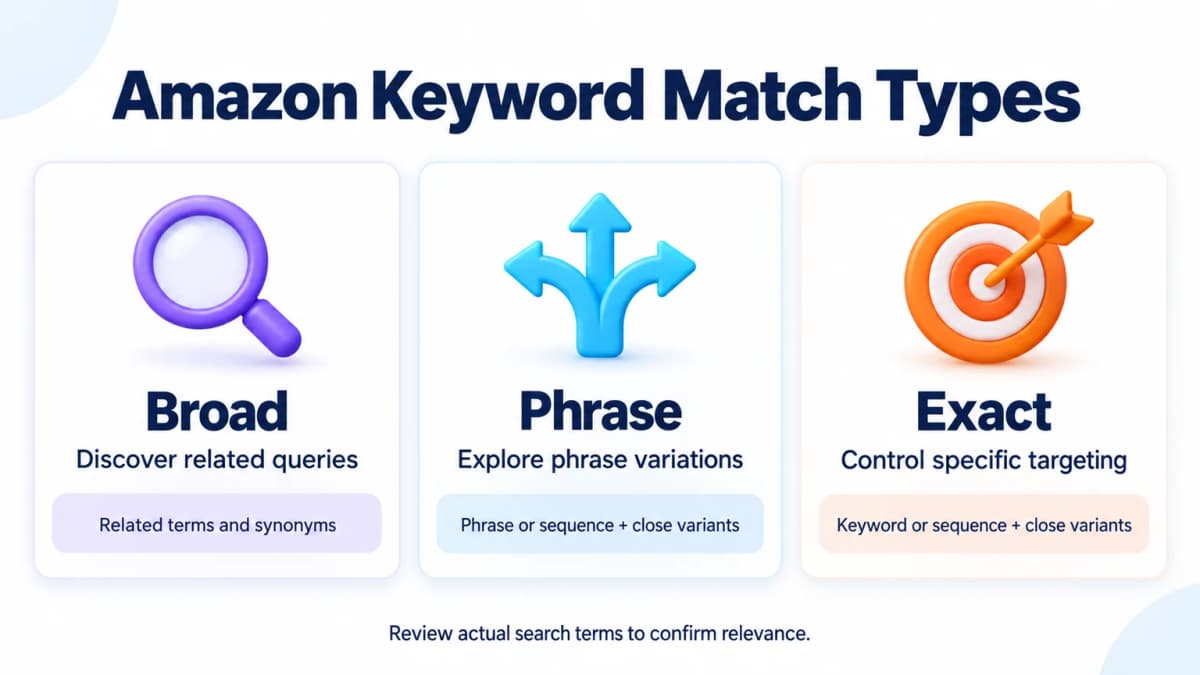
Amazon's keyword match type documentation describes three options for manual keyword targeting. These descriptions apply to Sponsored Products; avoid importing assumptions from other advertising products.
Broad Match
Broad can reach related searches, synonyms, and different word orders. A query may omit the original keyword wording. This makes broad useful for discovering language beyond the advertiser's initial list, while increasing the need to review relevance.
Phrase Match
Phrase matches the keyword phrase or word sequence and close variations, including plural forms and misspellings. It accommodates relevant query variations while providing more control than broad.
Exact Match
Exact is the most restrictive option, but it still includes close variations. Its name does not guarantee a character-for-character match. The search term report remains necessary even for an exact-only campaign.
| Match type | Practical use | Main review question |
|---|---|---|
| Broad | Discover additional query ideas | Does the traffic still fit the product? |
| Phrase | Explore variations around a phrase | Which modifiers produce useful demand? |
| Exact | Manage specific targets more closely | Is this target worth its current cost? |
Match type controls eligibility, not profitability. A relevant query still needs a competitive offer and a product page that supports the shopper's expectations.
Search Intent and Conversion Evidence
Product Relevance
Start with the product facts: size, material, compatibility, function, and intended use. A highly specific query can still be wrong for the advertised item. “Waterproof packing cubes,” for example, is unsuitable for a product with no substantiated waterproof claim.
Write a short relevance note beside each candidate. Record which product fact supports the term and which requirement, if any, the product cannot meet. This prevents an attractive demand estimate from overriding a basic mismatch. Researching competitor keywords can expand the candidate list, but each candidate still needs that check.
Search Term Performance
Distinguish the keyword an advertiser bids on from the search term associated with the resulting traffic. Amazon's Sponsored Products search term report includes terms with at least one ad click. In non-search contexts, some terms can be inferred from context rather than entered by a shopper.
Review clicks, orders, spend, and attributed sales together. Calculate CPC as spend divided by clicks, CVR as orders divided by clicks, and ACoS as spend divided by attributed sales. Use consistent report definitions and attribution windows. A zero-sales row has no finite ACoS; mark it N/A and evaluate its spend separately.
Allow recent clicks time to convert before treating missing orders as final. One inexpensive order can justify another test without establishing a repeatable winner. Compare results across sufficiently mature review periods, and investigate promotions or price changes that could explain unusually strong performance.
Affordable Acquisition Costs
An effective PPC strategy connects targeting to unit economics. Consider a hypothetical $30 product with $12 left after product costs, selling fees, fulfillment, and other included variable costs, before advertising.
Its contribution-based break-even ACoS is $12 ÷ $30 = 40%, before any costs excluded from that calculation. A 25% target ACoS allows $7.50 in advertising per order. At an expected 10% ad conversion rate, the corresponding average CPC is:
$7.50 × 10% = $0.75 per click.
This is a planning estimate, not a guaranteed safe bid. Conversion rates change, adjustments affect auction bids, and actual CPC varies. Set a separate test-spend allowance for uncertain terms so that discovery costs remain visible.
Choosing a Match Type
Exact for Controlled Targeting
Use exact when a specific query deserves its own performance decision. Profitable account evidence is a strong reason to prioritize it. A new, highly relevant term can also start in exact with a modest test budget; prior broad-match traffic is not a prerequisite.
Look for a combination of relevance, acceptable acquisition cost, and repeatable demand. A fixed requirement such as “three orders” treats very different products as equivalent. The evidence needed for a low-volume specialist item will differ from that for a frequently purchased accessory.
Phrase for Relevant Variations
Phrase is useful when the product fits a recognizable phrase and several meaningful modifiers. For a compression packing-cube set, carry-on use and suitcase organization may be reasonable areas to test, subject to the actual dimensions and features.
Review the modifiers separately. One successful variation does not validate every query containing the same phrase. If performance varies substantially, a profitable individual term can receive its own exact target while other variations remain under observation.
Broad for Query Discovery
Broad is appropriate when the next task is finding additional relevant demand and the seller can fund that uncertainty. It can support a new product or an established product seeking additional uses and customer vocabulary.
Give the test an explicit learning objective and a spend boundary. “Find relevant travel-use terms” is more actionable than “get more traffic.” If the campaign keeps purchasing familiar, unprofitable traffic without producing useful candidates, reduce its scope or pause the test.
| Current evidence | Suggested starting action | Next decision |
|---|---|---|
| Relevant query with repeatable, affordable orders | Prioritize exact targeting | Maintain or expand within the cost target |
| Relevant phrase with promising modifiers | Test phrase targeting | Evaluate individual query variations |
| Relevant candidate with little account history | Run a small, defined test | Gather evidence before scaling |
| Unclear customer vocabulary and available test funds | Test broad targeting | Identify useful queries and exclude mismatches |
| Product fails an essential query requirement | Exclude the unsuitable demand | Reconsider only if the product changes |
These are operating recommendations. The chosen structure should reflect the seller's objective and available evidence.
Bids and Campaign Budgets
Separate Campaign Objectives
Budget separation is a management choice. When discovery and established targets need independent campaign budgets or placement settings, separate campaigns can make those differences easier to enforce. A smaller account may use fewer campaigns to avoid fragmenting limited traffic.
Document what each campaign is expected to accomplish. One may accept a defined testing expense; another may be evaluated against a contribution target. Comparing them solely by immediate ACoS can encourage premature cuts to discovery or excessive spending on unproductive tests.
Overlapping Match Types
Amazon's targeting guide recommends higher manual bids for exact, lower bids for phrase, and the lowest bids for broad. That is a useful starting arrangement when established exact targets deserve priority.
The match-type help page also states that, for the same keyword entered with multiple match types and different bids, the highest-bid match type is used for a matching query. Adding an exact target does not create an unconditional exact-first rule.
Avoid turning the suggested bid order into a requirement to raise an unprofitable exact bid. Check the campaign's bidding strategy, placement adjustments, and budget availability alongside its base bids. Change a manageable set of settings, record the change date, and assess the resulting traffic.
Search Term Promotion and Negatives
Promotion Readiness
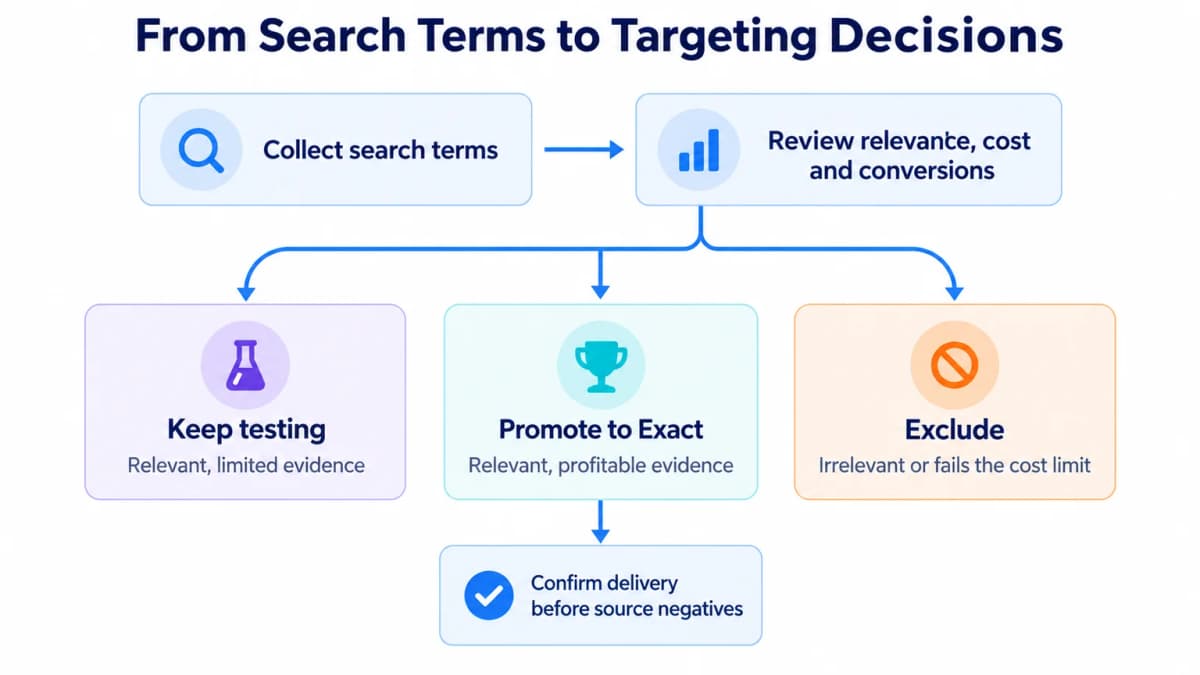
Keyword harvesting converts useful discoveries into targets that can be managed deliberately. A practical sequence is:
- Select a relevant term using mature conversion and cost data.
- Add it to the intended exact campaign or ad group.
- Set a bid and budget consistent with the economic target.
- Check that the new target is enabled, eligible, and receiving traffic.
- Decide whether excluding it from the source campaign improves control.
A term can move directly from discovery to exact. Phrase is an optional way to investigate related variations, not a required intermediate stage.
Confirm delivery before adding source negatives. Otherwise, a profitable source of traffic may be blocked before the new target is ready. Also check that a campaign-level negative will not unintentionally affect the intended destination.
Negative Exact
Negative exact excludes the specified query and close variations, making it useful when the problem is a particular search term. It can also help manage traffic overlap after a new target begins delivering.
For a relevant but costly term, consider whether a lower bid or further observation fits the objective before excluding it entirely. Continued testing should have a defined limit; a term's relevance does not entitle it to unlimited spend.
Negative Phrase
Negative phrase can exclude searches containing the phrase and close variations. Use it when the excluded concept consistently conflicts with the product, and review the valuable queries it might also block.
For packing cubes that do not use vacuum suction, vacuum-related demand may justify exclusion. Before applying a broad exclusion, inspect the actual query wording. Amazon's negative targeting documentation also notes that an existing negative keyword's match type cannot be changed directly.
Worked Example
Illustrative Search Term Results
Assume a seller offers a $30 compression packing-cube set with zipper compression, no vacuum system, and a 25% target ACoS. The following figures are hypothetical teaching data, not a Nexscope customer result. Assume the attribution window has matured and each order contains one $30 unit.
| Search term | Clicks | Orders | Spend | Sales | CVR | ACoS |
|---|---|---|---|---|---|---|
| compression packing cubes | 60 | 9 | $36 | $270 | 15.0% | 13.3% |
| packing cubes for carry on | 24 | 2 | $18 | $60 | 8.3% | 30.0% |
| vacuum storage bags | 15 | 0 | $9 | $0 | 0.0% | N/A |
| suitcase organizers | 12 | 1 | $9 | $30 | 8.3% | 30.0% |
| Total | 111 | 12 | $72 | $360 | 10.8% | 20.0% |
The combined ACoS meets the target, but individual rows call for different actions. Aggregate results can conceal both mismatched traffic and tests that remain above the desired cost.
Targeting Decisions
Compression packing cubes: The product fits the query and the observed acquisition cost is $36 ÷ 9 = $4 per order. It is a candidate for controlled exact targeting. Start with a cost-conscious bid, verify delivery, and keep checking whether performance persists.
Packing cubes for carry on: The query may be relevant, subject to product dimensions, but acquisition cost is $9 per order, above the $7.50 target. A restrained continuation or lower-bid test is more defensible than immediate scaling. Two orders leave considerable uncertainty around the observed CVR.
Vacuum storage bags: The advertised product cannot fulfill the vacuum requirement. Exclude the unsuitable query based on that mismatch, without waiting for an arbitrary minimum click count. Consider a phrase-level negative only after reviewing its wider effects.
Suitcase organizers: One order establishes limited evidence. Keep any further test small and track the additional spend. The word “organizers” is not enough to justify broad expansion across unrelated storage products.
The next review should compare query performance and total campaign contribution. Moving a term to exact is a control change; it does not itself prove an improvement in sales or profit.
Troubleshooting and Weekly Checks
Low Exact Match Impressions
Check that the campaign, ad group, ad, and keyword can serve, the product is available, and no negative blocks the query. Then investigate relevance, bids, budget access, and the term's available demand.
Amazon's Search Term Impression Share report measures account-wide ad impression share and relative impression rank for search terms. Its current lookback is 90 days. Use it to investigate exposure where data is available; do not treat advertising impression rank as organic ranking or proof that a higher bid will be profitable.
Unprofitable Search Terms
Begin with the offer and costs. A relevant keyword can lose money when the price, product presentation, shipping proposition, or conversion rate fails to support its CPC. Narrowing the match type may reduce unrelated traffic while leaving those problems unresolved.
Compare similar observation windows and record changes to price, promotions, and inventory. Avoid assigning the effect of several simultaneous changes to the match-type adjustment alone.
Weekly Review Checklist
A useful PPC optimization routine records decisions as well as metrics:
- Export the report and identify the attribution window under review.
- Inspect high-spend queries and obvious product mismatches.
- Separate mature results from recent clicks awaiting conversions.
- Select promising terms for controlled tests or expansion.
- Verify delivery after promotion and review negative scope.
- Record each change, its cost limit, and the next review date.
Increase review frequency for campaigns spending quickly. Low-volume tests may need more time, but still require a maximum acceptable expense. Preserve exports: the Sponsored Products search term report currently has a 65-day lookback, distinct from the SIS report's 90 days.
Conclusion
Choose Amazon keyword match types according to the decision the campaign needs to support. Use exact for closer control, phrase to investigate relevant variations, and broad when additional discovery justifies the expense. Review the resulting queries against product facts and acquisition costs, then adjust targets using mature account evidence.
The next research task is often identifying which additional keywords deserve a test. Nexscope provides structured Amazon keyword, product, and competitor data that teams can access through REST API or MCP. Those inputs can help an existing research workflow compare market demand and product relevance before allocating advertising funds. Account-specific orders and acquisition costs should continue to come from the seller's own advertising reports.
Build a Better Keyword Test List
Connect Amazon keyword and competitor data to an existing research workflow through REST API or MCP.
Explore Amazon Data API →Frequently Asked Questions
What is the difference between broad, phrase, and exact match on Amazon?
Broad allows wider query discovery, including related wording. Phrase provides more control around a phrase or sequence, while exact is the most restrictive option. Close variations still matter. Select the combination that fits the product and testing objective, then inspect the resulting search terms. None of these labels guarantees profitable traffic.
Does Amazon exact match include close variants?
Yes. Amazon documents close variations for exact match, so advertisers should continue reviewing the actual terms receiving clicks. For operational purposes, treat exact as a closer targeting control rather than a substitute for query analysis. A variation that looks linguistically similar may still require a product-relevance check before it deserves additional budget.
Can the same keyword use all three match types?
Yes. The practical challenge is coordinating their objectives, bids, and budgets. Give each version a reason to exist, such as discovery or closer control of an established target. Review which version receives the traffic, and avoid assuming that adding exact automatically redirects every eligible query away from the broader targets.
Should a new product start with broad or exact match?
A new product can test either, depending on the available evidence and budget. Highly relevant, specific candidates can begin with modest exact tests. Broad can investigate customer vocabulary when the seller has defined an affordable exploration allowance. A new launch does not remove the need to verify product relevance, listing readiness, and spending limits.
When should a search term become an exact match keyword?
Consider it when the query fits the product and closer control would improve the next decision. Repeatable, affordable orders provide stronger evidence for expansion than a single conversion. Confirm that attribution has matured, set a bid consistent with the acquisition target, and check the new target's delivery before deciding whether to negate the source traffic.
What is the difference between negative exact and negative phrase?
Negative exact addresses a particular query and close variations. Negative phrase has a wider exclusion effect around the specified phrase. Choose the narrower intervention that solves the observed problem, review where it applies, and check for valuable traffic that might be blocked. Clear product mismatches can warrant exclusion even when conversion data is limited.
Sources
- Amazon Ads. (2026). Keyword match types. Retrieved from advertising.amazon.com.
- Amazon Ads. (n.d.). A guide to targeting with Sponsored Products. Retrieved from advertising.amazon.com.
- Amazon Ads. (2026). Search term report for Sponsored Products. Retrieved from advertising.amazon.com.
- Amazon Ads. (2026). Add negative keywords or negative products. Retrieved from advertising.amazon.com.
- Amazon Ads. (2026). Search Term Impression Share (SIS) report for Sponsored Products. Retrieved from advertising.amazon.com.