

How to Increase Sales on Amazon With 7 Practical Strategies

Figuring out how to increase sales on Amazon starts with understanding where potential purchases are being lost. A product can attract the wrong searches, leave important questions unanswered, or lose buyers because of its price and delivery date. Increasing the advertising budget before identifying that problem can make growth more expensive. Even when sales rise, discounts, fulfillment costs, and returns may leave less money available for the next order of inventory.
The most useful approach is to work through seven connected decisions: which products deserve attention, which searches they should match, what the listing needs to explain, how competitive the offer is, how customer feedback can improve it, where additional traffic should come from, and whether repeat or complementary purchases make sense. This guide explains what to change and what to measure at each stage. It focuses on existing Amazon listings, with practical starting points for newer sellers and clear distinctions between a seller's own results and estimated competitor data.
Why Your Amazon Sales Are Stalling
The first task is to identify whether the immediate constraint is visibility, purchase confidence, or the ability to complete an order. Amazon's own listing growth guidance covers discovery, content, pricing, fulfillment, and inventory. The priority for an individual seller depends on the evidence from that seller's products.
Low Visibility
Separate limited exposure from weak response to exposure. A listing with few relevant search appearances needs a different investigation from an ad that appears frequently but receives few clicks. Review the search terms, placements, main image, displayed price, and product fit together. An impression alone does not show that the right buyer saw the product.
Weak Purchase Conversion
When traffic is stable but units ordered are falling, inspect the purchase experience. Buyers may be unable to confirm dimensions, compatibility, package contents, or the difference between variations. Recent feedback can also reveal a product issue that stronger wording will not solve. Compare similar periods and traffic sources before attributing the change to content.
Offer and Inventory Problems
A clear listing still needs a purchasable offer. Check listing status, available inventory, delivery estimates, and Featured Offer status before planning creative tests. For a shared ASIN, distinguish the product detail page from the seller's specific offer. Traffic to the shared page does not mean every visitor considered that seller's price and delivery terms.
| Observed signal | First check | Likely next action |
|---|---|---|
| Few relevant searches reach the listing | Search relevance and listing status | Correct product information and targeting |
| Impressions are healthy, clicks are weak | Main image, visible offer, and search intent | Test a clearer presentation |
| Visits continue, purchases weaken | Content gaps, reviews, and competing offers | Resolve the strongest purchase objection |
| Demand exists, availability is inconsistent | Stock and delivery commitments | Fix replenishment or fulfillment |
| Sales rise, contribution falls | Discounts, advertising, fees, and returns | Recalculate the economics before scaling |
Treat the table as a starting hypothesis. Several problems can occur together, so confirm the cause before making a large change.
7 Strategies to Increase Amazon Sales
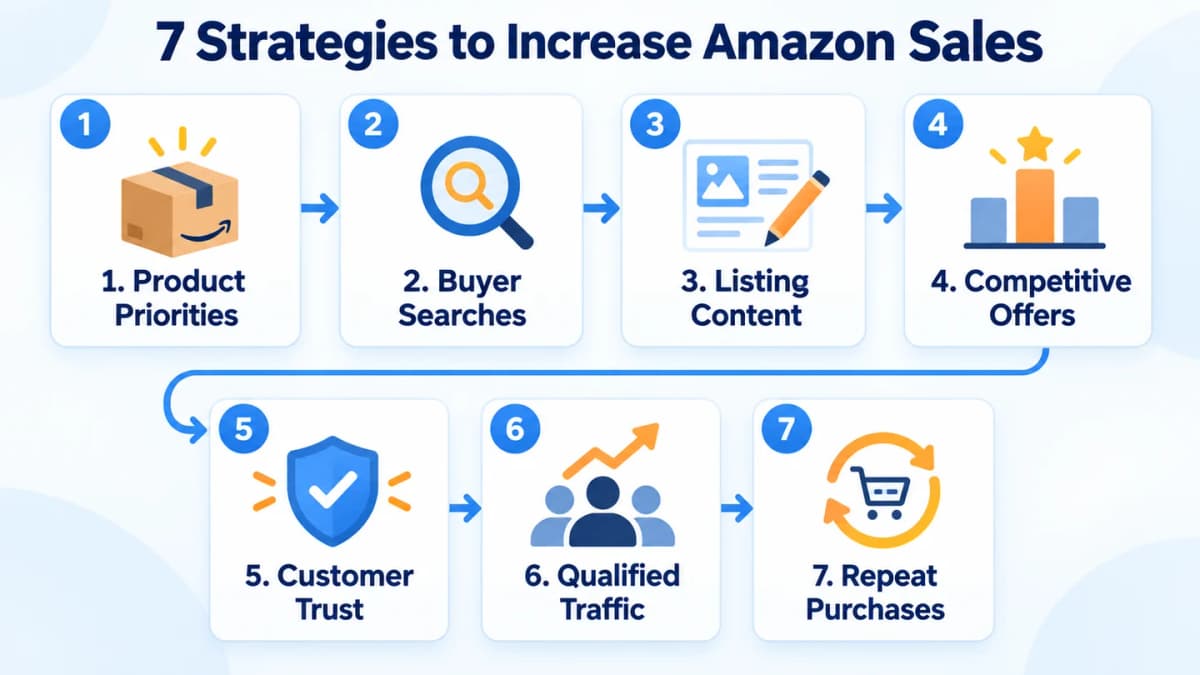
1. Prioritize Your Product Opportunities
Start with a small group of existing ASINs that have observable demand and a realistic path to better economics. A product with steady visits and a correctable information gap may be a better first project than a product with almost no evidence of demand. Stock availability and the cost of fixing the problem should influence that choice.
Build a baseline for the same marketplace and child ASIN over comparable periods. Record sessions, units ordered, sales, ad spend, returns, and available stock. Note any promotion, price change, or unavailable days. Keep units per session separate from order conversion: one order can contain several units, so the two measures answer different questions.
Choose a comparison set of products serving the same need, at a similar size, quantity, and price level. A premium two-pack and a budget single unit can compete for some searches, but their headline prices are not directly comparable. Nexscope can support this research through a competitor lookup that helps identify competing ASINs for further review. A team can retrieve the data through REST API or MCP and compare it inside its own workflow.
Separate observed results from estimates. Seller Central and accounting records establish the seller's own performance. Third-party competitor sales estimates provide directional context. Keep the marketplace, reporting period, source, and available update time attached to each comparison, and preserve missing values as missing.
Before moving on, write a specific decision: “Prioritize this ASIN because it has sustained visits, sufficient stock, and repeated questions about fit.” That gives the next change a clear purpose.
2. Match Listings to Buyer Searches
Build a short list of buying questions before expanding the keyword list. What is the product? Who is it for? Which dimensions, materials, compatibility requirements, and quantities determine whether it is suitable? These questions help distinguish a useful keyword opportunity from a popular phrase that describes a different product.
Compare those answers with the seller's ad search terms and relevant Amazon competitor keywords. For repeatable research, retrieve ASIN keyword data, then filter it against the product's actual specifications. A keyword associated with a competing ASIN is a candidate to investigate; it does not prove that the seller's product will rank or convert for that phrase.
Map the selected terms to information buyers need:
| Listing area | Information to clarify |
|---|---|
| Title | Product type and the attributes needed to identify the correct item |
| Bullet points | Important uses, benefits, limitations, and compatibility |
| Product attributes | Accurate dimensions, material, quantity, and other applicable fields |
| Description or A+ Content | Additional explanation that supports a purchase decision |
| Backend search terms | Relevant vocabulary that fits the current marketplace rules |
For example, a bottle seller should verify the actual base diameter before describing the product as suitable for a particular cup holder. A broad phrase such as “travel bottle” may be relevant, while an unsupported “fits all cup holders” claim creates a new customer problem.
Save the previous version of the listing and record the change date. Evaluate whether the revised content attracts more relevant visits and supports purchases. A temporary movement in rank by itself is weak evidence, particularly when competitors, ads, and promotions also change. Good listing optimization keeps the product facts and the customer's decision aligned.
3. Remove Purchase Doubts With Better Content
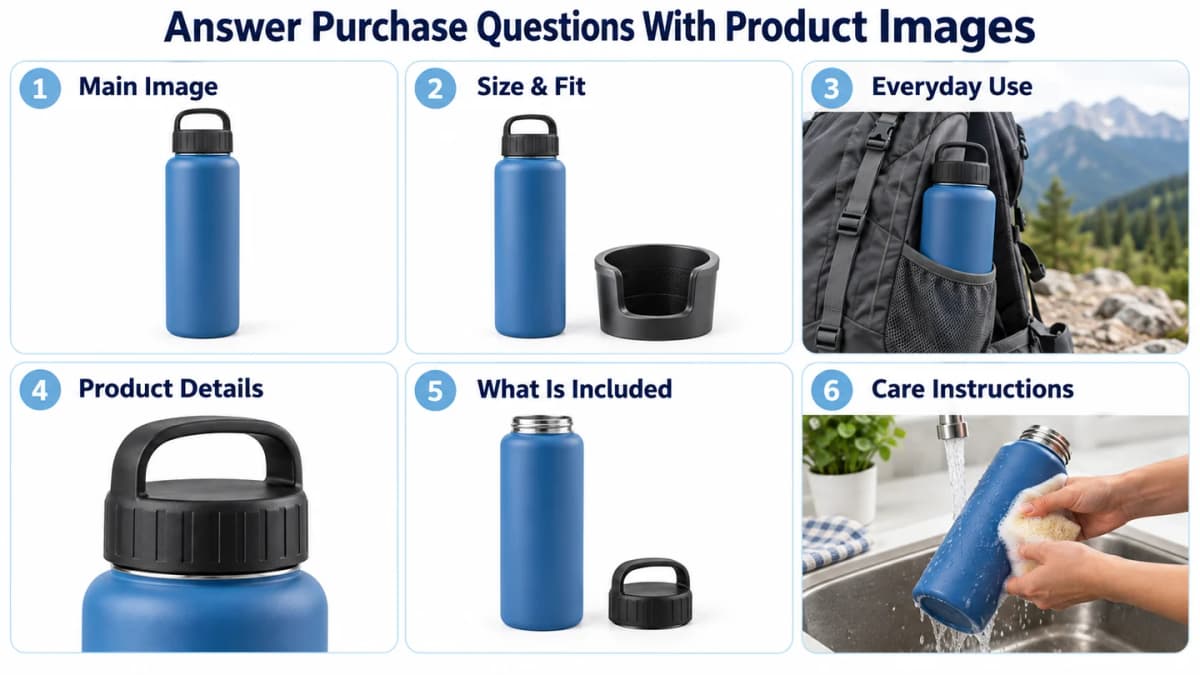
Illustrative image plan for a fictional product. Verify all specifications, included items, and care instructions against the actual product before creating listing assets.
Give each image a specific job. The main image should make the item and included quantity immediately understandable within the applicable category requirements. Supporting images can explain scale, fit, use, construction, included components, and care. Six attractive views of the same angle leave many of those questions unanswered.
Use a question-to-asset worksheet to guide production. For each uncertainty, record the product evidence, the asset needed, and the claim that can safely be made. A dimension question needs measured specifications. A compatibility question needs verified compatibility information. A care question needs instructions from the product documentation.
For a structured review of buyer concerns, bring product reviews into the team's research workflow, group recurring themes, and inspect the underlying comments before deciding what to change. Review samples can be incomplete or uneven across dates and variations. A repeated complaint is a reason to investigate, not proof that every unit has the same defect.
Turn the strongest verified gap into one content improvement. Show the relevant dimension, demonstrate setup, or clarify what arrives in the box. Product videos are useful when movement or a sequence makes the explanation easier to understand. Any generated visual must preserve the real item's appearance, components, and supported capabilities. A consistent listing image and A+ Content workflow helps keep those facts consistent across assets.
Eligible brands and products can use Manage Your Experiments to compare supported content versions. Eligibility includes sufficient product traffic and the appropriate brand access. Let the experiment reach its intended completion before choosing a winner. When an experiment is unavailable, track before-and-after results with changes in traffic, price, stock, and seasonality noted alongside them.
4. Strengthen Pricing, Delivery, and Availability
Evaluate the complete offer: what the buyer pays, what arrives, and when it arrives. The Featured Offer, often called the Buy Box, is influenced by factors including competitive pricing, delivery, availability, and seller performance. The lowest price alone does not guarantee selection.
For shared listings, check the seller's own offer status before treating low sales as a page-content problem. For differentiated products, compare equivalent pack sizes and included accessories. Review the delivery promise shown for relevant customer locations rather than assuming every buyer sees the same date.
Set a contribution target before changing price. The following is a hypothetical planning example, not an Amazon fee estimate or a Nexscope customer result. It assumes a single product, all variable non-ad costs captured, and no repeat-purchase value.
| Per-unit calculation | Current offer | Discounted offer |
|---|---|---|
| Selling price | $30 | $27 |
| Assumed variable costs before ads | $18 | $17.50 |
| Contribution before ads | $12 | $9.50 |
| Assumed advertising cost per unit sold | $6 | $6 |
| Contribution after ads | $6 | $3.50 |
At 100 units, the current offer contributes $600 after ads. At 130 discounted units, the second offer contributes $455. Unit volume rises 30%, while contribution falls $145. Actual costs must include the relevant product, marketplace, fulfillment, promotional, and expected return costs. Fixed overhead still needs to be paid from the remaining contribution.
Historical context helps avoid reacting to a temporary competitor promotion. Compare product and price history across a relevant period, checking the coverage and granularity returned. This supports a pricing decision; it does not establish that a competitor's price change caused its estimated sales movement.
Before launching a promotion or increasing demand, compare available stock with expected sales during replenishment lead time. Include receiving delays and a reasonable buffer in that plan. An offer that becomes unavailable halfway through the test makes both the customer experience and the results harder to evaluate.
5. Build Trust Through Customer Feedback
Review activity has two practical uses: helping shoppers assess the product and helping the seller find problems worth fixing. Keep both in the operating routine. A growing review count will have limited value if newer buyers continue reporting the same avoidable issue.
Use Amazon's Request a Review feature for eligible orders and keep review requests neutral. Avoid compensation tied to reviews, requests for positive ratings, or attempts to exchange a refund for a changed review. Amazon's customer review policy guidance explains prohibited review manipulation.
For eligible products, Amazon Vine provides a way to receive independent feedback from invited reviewers. Check the current program and product requirements before enrolling. Vine reviewers provide their own opinions, and enrollment does not guarantee positive ratings or a particular sales outcome.
Set up a simple feedback log with the issue, affected variation, evidence, likely cause, owner, and corrective action. Separate an unclear listing from a faulty product. If buyers expected a larger bottle, better dimensions may address the mismatch. If the supplied lid repeatedly fails, the product or supplier needs attention.
Measure what happens after the fix: whether that complaint becomes less frequent, whether return reasons change, and whether purchase performance improves over a comparable period. Keep the remaining uncertainty visible when the sample is small. This creates a more useful feedback routine than focusing only on the average star rating.
6. Scale Qualified Traffic With Ads
Expand traffic once the listing, offer, and inventory are ready to receive it. Sponsored Products support automatic, keyword, and product targeting, with reporting that helps advertisers examine search terms and placements. Amazon's campaign best practices also emphasize product readiness and performance-based budget adjustments.
Give each campaign a clear purpose. Discovery activity explores relevant searches and products. More focused activity allocates spend to targets with enough evidence to justify it. Keep budgets and reporting clear enough to tell which purpose is producing useful results. A coherent Amazon PPC strategy connects those decisions to the product's economics.
Review search terms for product fit before acting on a short performance window. An irrelevant compatibility query can justify exclusion because the product cannot meet the need. A relevant term with little data calls for a measured decision about how much more evidence is worth buying. Account for reporting delays and attribution windows before labeling recent clicks as wasted spend.
Use these calculations with consistent periods and product scope:
- ACoS: ad spend divided by ad-attributed sales, multiplied by 100.
- TACoS: ad spend divided by total sales, multiplied by 100.
- Contribution after ads: sales minus variable non-ad costs and ad spend.
In the earlier simplified example, the pre-ad contribution margin is $12 divided by $30, or 40%. That is the break-even ACoS for the assumed single-product economics before fixed overhead. A business seeking positive contribution needs room below that point. Mixed baskets, discounts, returns, and attributed purchases of other products can change the calculation.
Allocate additional budget in increments that the contribution target and stock position can support. Evaluate total product sales alongside attributed results. An attributed sale is not automatically an incremental sale; a report can assign credit without proving what would have happened without the ad.
External campaigns need the same discipline. Use Amazon Attribution where eligible to measure supported non-Amazon marketing activity. Start with a specific audience and product message, then compare the traffic quality, cost, and resulting purchases before expanding.
7. Grow Repeat and Complementary Purchases
The opportunity after a first purchase depends on the product. Replenishable items may support repeat buying, while durable items may create demand for compatible accessories. Identify the natural next purchase before offering a discount or expanding the catalog.
For suitable eligible products, Subscribe & Save supports recurring deliveries. Check account, product, and fulfillment eligibility in Seller Central, then model the seller-funded discount and expected contribution. A subscription should make sense at the expected repeat-order price, without depending on an unsupported assumption about customer lifetime value.
Complementary products can also be offered together. Amazon describes several product bundling approaches, including virtual bundles for eligible products. Verify the applicable rules and operational requirements before selecting a format. The products should solve a connected problem and remain clear to the customer as a combined offer.
Use a small trial to answer a practical question: does the combination increase contribution, or mostly move purchases from existing offers into a discounted package? Track the individual products as well as the bundle. Include the availability of every component in the inventory plan.
For a bottle seller, a verified compatible replacement lid might be a useful follow-on product. A refillable cleaning product may have a different replenishment opportunity. The decision should follow customer needs and the catalog's economics. Launching unrelated products adds inventory commitments without necessarily improving sales of the existing range.
Common Mistakes That Limit Growth
Increasing ad spend before fixing the purchase experience. A campaign can bring more visitors to the same unresolved size, compatibility, or delivery problem. Confirm that the product, content, and offer are ready before raising the budget.
Discounting without a contribution target. Record the expected post-discount economics before a promotion starts. Include fees and returns, then decide what volume increase would make the test worthwhile.
Changing too many variables together. A new main image, lower price, different keywords, and larger ad budget make it difficult to understand the result. Isolate the primary change where practical and keep a dated record of other changes that could matter.
Treating every dashboard number as proof. Competitor estimates, organic rank, attributed sales, and accounting profit serve different purposes. Compare equivalent periods, maintain source labels, and use the metric that answers the decision being made.
Conclusion
Increasing Amazon sales becomes more manageable when each action addresses a specific constraint. Select an ASIN with a credible opportunity, confirm the gap, and improve the relevant part of its search visibility, content, offer, or customer experience. Expand traffic and repeat-purchase initiatives when the product's economics and availability support them.
For the first review cycle, record one hypothesis, one primary change, one success measure, and a review date appropriate to the available traffic. Keep the baseline so the result can inform the next decision.
Find Amazon Sales Opportunities With Nexscope
The seven strategies above depend on understanding competing products, buyer searches, customer concerns, and pricing. Nexscope's Amazon Data API gives ecommerce teams structured data for that research, accessible through REST API or MCP in their own applications, agents, and analysis workflows.
Start with the APIs that match the next sales improvement:
- Amazon Competitor Lookup API: Find competing ASINs and compare pricing, ratings, and estimated sales to prioritize products for closer research.
- Amazon ASIN Keywords API: Identify keywords associated with competing ASINs and examine search demand and ranking signals to inform listing content and advertising research.
- Amazon Reviews List API: Retrieve product reviews with supported filters, then investigate recurring buyer questions and complaints to improve images, descriptions, and the product itself.
- Amazon Market Product Detail API: Examine product details and historical price and sales trends to put competitor offers in context before adjusting pricing or promotions.
Check each API's supported marketplace, available fields, and data freshness. Keep estimated competitor sales separate from the seller's actual order records.
Use the data to identify what to investigate next, then validate the change against the seller's own sales and profit records.
Put Amazon Data Into Action
Connect Nexscope's Amazon Data API to your workflow to research competitors, keywords, reviews, and pricing.
Explore Amazon Data API →Frequently Asked Questions
How can I increase sales on Amazon without ads?
Start with products that already receive relevant traffic. Improve the information buyers need, resolve recurring product issues, check pricing and delivery, and prevent avoidable stockouts. Review search relevance if discovery is weak. These changes can support sales without paying for additional clicks, although their impact depends on existing demand and the product's competitiveness. Compare results over equivalent periods and include margin in the evaluation.
Why is my Amazon listing getting views but no sales?
The visitors may be looking for a different product, or the listing may leave a purchase question unanswered. Compare the search intent with the product's specifications, then check images, variations, reviews, price, and delivery. On a shared ASIN, inspect the seller's specific offer and Featured Offer status. Views alone do not reveal which of these factors prevented a purchase.
How can I increase Amazon sales without lowering prices?
Make the product's value easier to assess. Clarify fit, materials, included components, supported uses, and any meaningful differences from comparable items. Improve delivery reliability and resolve product issues that appear in feedback. More relevant targeting can also help avoid paying for unsuitable visitors. Test the change while tracking contribution, since a higher price only helps the business when enough suitable buyers still purchase.
Does A+ Content help increase Amazon sales?
A+ Content can help explain a product and answer questions that basic content leaves unresolved. Its usefulness depends on the product, the quality of the explanation, and the buyers reaching the page. Eligible sellers can use content experiments to evaluate supported changes. An average uplift reported elsewhere is not a forecast for an individual ASIN, and clearer content cannot compensate for an unsuitable product or unavailable offer.
How can new Amazon sellers get more sales?
Focus on a small number of products with a clear customer need. Make the listing accurate, confirm that the offer is available, and set a contribution target before paying for traffic. Use appropriately limited advertising tests where needed to gather evidence, and collect customer feedback through permitted methods. Avoid spreading inventory and advertising money across many unproven products before learning which ones deserve further investment.
How long does it take to improve Amazon sales?
There is no reliable timeline that applies to every product. Correcting an unavailable offer affects a different problem from testing new content or changing repeat-purchase behavior. The useful measurement period depends on traffic, order frequency, reporting delays, seasonality, and the type of change. Let formal experiments complete, and treat small before-and-after samples as tentative evidence rather than a confirmed trend.
Sources
- Amazon. (n.d.). Maximize Your Sales Potential with the Amazon Featured Offer. Retrieved from sell.amazon.com
- Amazon. (n.d.). Test Listing Content with Manage Your Experiments. Retrieved from sell.amazon.com
- Amazon. (n.d.). Get Customer Reviews with Amazon Vine. Retrieved from sell.amazon.com
- Amazon Ads. (n.d.). Best Practices for Your Sponsored Products Ads. Retrieved from advertising.amazon.com
- Amazon. (n.d.). Subscribe & Save. Retrieved from sell.amazon.com