
How to Start 1688 Dropshipping and Find Reliable Suppliers

1688 dropshipping starts with finding a supplier who can provide the right product in small quantities, then arranging how each order reaches the customer. To make it work, a seller needs to confirm the exact variant, agree on purchasing and fulfillment responsibilities, calculate the complete cost, and test the delivery route before selling. A promising product listing is only the beginning: the same item can become unprofitable once packaging, handling, international shipping, and customer acquisition are included.
This guide follows that process from the first product brief to a small launch. It includes a supplier inquiry template, a sample cost calculation, and a checklist for testing an order. It also shows where an AI agent connected to 1688 product data can help: gathering candidates and organizing comparisons before a seller contacts suppliers. The goal is a sourcing arrangement that can be checked and repeated, with clear evidence for the product, the price, and the delivery promise.
Why Use 1688 for Dropshipping?
Sourcing Potential
Alibaba Group describes 1688 as a domestic wholesale marketplace in China. For an overseas seller, that makes it a place to research products and potential suppliers, with purchasing arrangements that need to be assessed listing by listing.
The useful comparison is the cost of obtaining and delivering the same specification. A low advertised price might apply to a larger order, a different material, or the cheapest variant. Compare the exact item at the quantity that will actually be purchased.
A seller starting a dropshipping business should also validate customer demand independently. Finding many suppliers for an item does not establish that customers in the target market will buy it at a profitable price.
Fulfillment Requirements
A workable arrangement might involve a supplier dispatching an item to a partner in China, followed by inspection, repacking, and international delivery. Another supplier may offer an appropriate shipping arrangement directly. Establish the route before promising delivery to customers.
Compared with evaluating an AliExpress offer that includes delivery to a selected destination, a 1688 sourcing comparison may require several separate quotes. Product price, domestic transport, and overseas fulfillment belong in the same calculation.
One-piece dropshipping means individual-unit supply under the seller's terms. It does not establish international shipping coverage. Confirm both who handles each parcel and who resolves a failed delivery.
How to Start 1688 Dropshipping
1. Define Your Product Requirements
Start with a short purchasing brief. This keeps supplier comparisons consistent and prevents a cheap but unsuitable product from becoming the default choice.
For example, an illustrative brief for an unbranded desk organizer could specify:
- Product: a black organizer with three compartments and rounded edges.
- Specification: dimensions, material, and weight to be confirmed before sampling.
- Order pattern: one unit per customer order during the initial test.
- Packaging: protective packaging without supplier promotional inserts.
- Destination: one chosen country for the first delivery test.
- Commercial target: a proposed retail price, subject to cost validation.
Define which requirements are essential and which can change. A different shade may be acceptable; a different compartment size may make the product unsuitable.
Keep the first test manageable. Products that introduce unfamiliar handling, labeling, or safety requirements need additional research before sourcing. A simpler product can make the initial inspection and shipping process easier to evaluate.
2. Find Candidate Products
Search using terms that describe the product, material, and use. Translate the search phrase into Simplified Chinese and check that it still describes the intended item. Record several candidates before contacting suppliers.
If your team already uses an AI agent for product research, connect it to Nexscope so it can retrieve sourcing data for comparison. Its 1688 product search accepts Chinese keywords and supports filters for wholesale price, dropship price, and purchase quantity. Available result fields include offer ID, company, currency, price, dropship price, and minimum order quantity. Save those fields when returned, together with the retrieval time.
Give the connected agent a specific task:
Find candidate listings for the desk organizer in the approved product brief. Build a comparison table from returned data. Keep wholesale and dropship prices separate, retain the original currency, and flag missing information. List supplier questions before recommending which samples to order.
Use this table structure:
| Candidate record | What to capture | Follow-up needed |
|---|---|---|
| Product identity | Offer ID, listing link, title | Exact variant match |
| Supplier | Company name, when returned | Contact and business verification |
| Price | Wholesale and dropship amounts, currency | Current one-unit quote |
| Quantity | Listed minimum order quantity | Availability for individual orders |
| Evidence | Retrieved value and retrieval time | Supplier confirmation date |
An API retrieval time does not establish when the underlying data was updated. Treat missing fields as unknown and confirm commercial terms before ordering.
3. Verify Suppliers and Variants
Narrow the shortlist by matching the product specification first. Two similar images can represent different sizes, materials, or accessory bundles.
For each shortlisted offer, have the agent retrieve its product details and organize the available SKU, description, supplier, sales, and shipping information. The documented response can include skuList, saleInfo, and shippingInfo; their presence alone does not confirm stock or delivery to the intended destination.
Then ask the supplier to resolve the gaps. This message can be adapted and translated:
Hello, please confirm the details for offer [ID], variant [name or SKU]. Can this exact variant be supplied one unit per order? Please quote the unit price and delivery to [warehouse or destination], separately. Also confirm material, dimensions, packed weight, current availability, dispatch time, packaging options, and the process for damaged or incorrect items. Please send current photos of the product and packaging, plus a sample-order quote.
Compare how suppliers answer. A complete, consistent response helps establish what will be delivered. An unanswered specification question remains unresolved even when the quoted price is attractive.
Save the agreed variant and terms with the sample order. That creates a reference for checking whether the received item matches the quotation. A backup supplier should pass the same checks before being used.
4. Arrange Payment and Fulfillment
Decide who will purchase the product and move it through each stage. A sourcing or fulfillment agent may handle supplier communication, purchasing, inspection, packing, and shipping. Ask which services are included and which carry separate charges.
Direct purchasing is another option when the seller can manage payment and logistics. WorldFirst describes World Pay as a way to pay 1688 suppliers through a linked World Account. Availability, account eligibility, and order eligibility should be confirmed before relying on that method. Payment access still leaves the physical fulfillment arrangements to be agreed.
Request a written breakdown covering:
- Purchasing responsibility and payment timing.
- Domestic delivery and warehouse receiving charges.
- Inspection scope, with examples of what gets checked.
- Packaging materials and per-order handling.
- International shipping service and tracking availability.
- Storage, returns, replacements, and loss handling.
Specify what happens when the ordered variant is unavailable. Require approval before a substitute is dispatched. Also agree on how orders are transferred, when they are acknowledged, and how tracking is returned.
A useful first arrangement has a named contact for exceptions. A low handling fee provides little value if nobody can explain where an overdue parcel is.
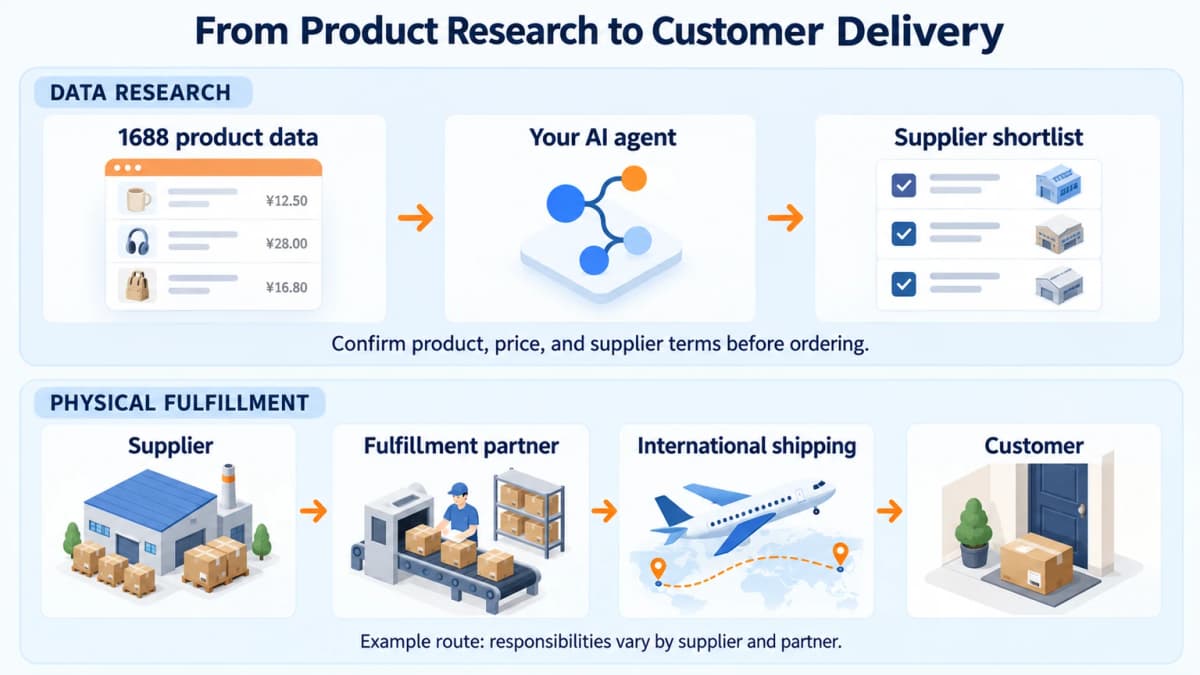
Illustrative workflow. Product thumbnails and prices are examples, not supplier quotes or API results.
5. Calculate Your Total Costs
Build the calculation around one delivered customer order. Convert quoted currencies using the rate and fees applicable to the payment method, and record the date of the calculation.
The example below uses invented USD amounts for illustration, not supplier quotations or typical market rates. It assumes $24.99 in sales revenue after any sales tax collected for remittance is excluded.
| Per-order item | Illustrative amount |
|---|---|
| Product | $3.20 |
| Domestic delivery | $0.60 |
| Inspection, packing, and handling | $1.00 |
| International shipping | $6.80 |
| Assumed import-related cost allocation | $1.00 |
| Payment and currency conversion costs | $0.40 |
| Store transaction and payment processing fees | $1.05 |
| Expected refund and replacement allowance | $1.20 |
| Total before customer acquisition | $15.25 |
| Customer acquisition cost | $6.00 |
| Total including acquisition | $21.25 |
Contribution after the listed costs is:
$24.99 − $21.25 = $3.74 per order.
That equals approximately 15.0% of sales revenue, before fixed overhead and income taxes. Replace the import allocation with the costs established for the actual product and shipping arrangement; it is not a tariff estimate.
The break-even acquisition cost before fixed overhead is $24.99 − $15.25 = $9.74. Spending that entire amount on acquisition would leave no contribution toward overhead or profit.
Run a second scenario with higher shipping costs or more replacements. If shipping rises by $2.00, contribution falls to $1.74. This shows how little room the example has for errors, even though its product cost looks low.
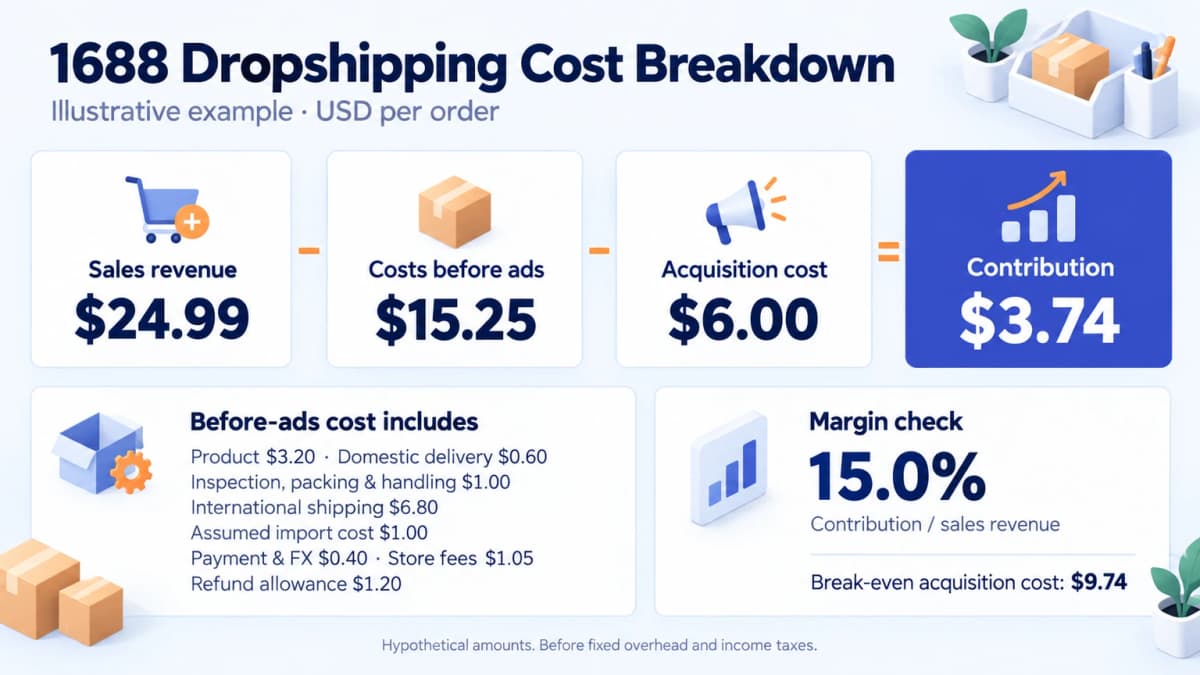
Hypothetical USD amounts from the worked example above; contribution excludes fixed overhead and income taxes.
6. Test the Complete Order
Order the exact variant through the route planned for customers. A supplier sample sent by a different courier can help assess the product, but it does not test the intended fulfillment process.
Use a checklist that records outcomes:
| Check | Evidence to retain |
|---|---|
| Correct product and variant | Received-item photos against the agreed specification |
| Dimensions and material | Measurements and inspection notes |
| Packaging | Photos of the outer parcel and internal protection |
| Dispatch | Order payment, acknowledgment, and handover times |
| Tracking | First carrier scan and subsequent tracking events |
| Delivery | Actual arrival date and parcel condition |
| Exceptions | Response to a question, defect, or order change |
Look for the gap between a generated tracking number and the first carrier scan. Record total elapsed time from placing the order to receiving it.
A single successful delivery is a pilot result, not a reliable delivery-time distribution. Use it to find obvious problems, then check consistency across further orders before expanding. Investigate a damaged parcel or wrong variant before committing more customer orders to the same process.
7. Launch and Review Performance
Publish a small catalog built around products that passed the pilot. Product pages should reflect the received item, with accurate dimensions, included components, and supported claims. Obtain permission for supplier images or create original product photos.
Teams building a Shopify store with AI can use the approved specification to draft listings, then check every product claim against the sample.
Maintain a mapping between the store SKU, supplier offer, exact variant, and fulfillment partner. Record the agreed cost and its confirmation date. This makes a replacement or price review much easier than searching through past messages.
Configure your agent to compare newly retrieved data with saved records and flag changes for review. Set separate operational alerts for delayed dispatch, unavailable variants, and repeated defects using fulfillment records. Product-data changes should trigger a purchasing review; order and tracking updates need a fulfillment connection.
Start with an order volume that the supplier and partner can handle consistently. Expand after actual delivery performance and contribution support the decision.
Common 1688 Dropshipping Mistakes
Pricing the Wrong Quantity
A low bulk price can distort the entire margin calculation. Label quotes by variant and quantity, then calculate the initial business using the price for its actual order pattern. Revisit bulk purchasing only when demand and inventory exposure justify it.
Assuming International Delivery
A dispatch estimate or a free-shipping label needs a destination and service definition. Ask where the shipping commitment ends. Record domestic transit separately from warehouse processing and international transit so customer promises include the complete route.
Skipping Sample Orders
Product images cannot establish received quality or packaging performance. Set a launch condition that requires a sample of the intended variant and a completed delivery test. Keep the sample evidence available when resolving later quality disputes.
Confusing Data With Fulfillment
An agent can organize candidate data and highlight gaps when connected to suitable tools. Purchasing, payments, inspection, and shipping require their own arrangements. Define those responsibilities explicitly before accepting orders, including who has authority to approve substitutions or refunds.
Conclusion
Build Your Supplier Shortlist
A practical 1688 dropshipping launch begins with one clearly specified product, a confirmed supplier quote, a complete cost calculation, and a tested delivery route. Keep supplier confirmations and sample results alongside the research data, then expand as the process becomes repeatable.
Connecting 1688 data to your own AI agent gives that process a useful starting point. The agent can organize candidate products, compare available fields, and flag questions to resolve before purchasing. As the business grows, the same workflow can bring together sourcing research, marketplace analysis, marketing research, and creative production.
Connect More Ecommerce APIs
Nexscope offers APIs across these stages, so your team can choose the capabilities its own agent or application needs:
- 1688 sourcing APIs: Product Search, Product Detail, Search By Image, and Product Billboard. Use these capabilities to discover potential products, inspect shortlisted offers, and explore visually similar items or product rankings before contacting suppliers.
- Shopify research APIs: Product Query and Store Query. Add product and store research to the sourcing process when assessing how an item could fit a storefront and how other stores position comparable products.
- Amazon data APIs: Product search, product details, reviews, and keyword research. Bring customer feedback and competing listings into the product brief, then identify specifications and questions to discuss with suppliers.
- TikTok Shop APIs: Shop analytics, product details, and product rankings. Explore products and stores in supported markets, and use those signals to decide which ideas deserve further demand validation.
- Marketing and SEO APIs: Keyword ideas, search-volume data, keyword intent, SERP research, and ad research. Use these inputs to plan search topics, study competing messages, and decide which acquisition angles to test.
- Creative APIs: Image and video generation, background removal, product scene variations, virtual try-on, and sales talking videos. Once the product specification and reference assets are approved, connect these capabilities to a workflow for producing listing and campaign visuals.
For example, your agent could assemble a 1688 shortlist, organize Amazon review themes into supplier questions, and use keyword research to propose a content brief. After a sample passes inspection, your workflow could send approved product images and that brief to the relevant Creative APIs, then return the generated assets for review.
Connect the selected capabilities through REST API or their documented MCP tools, depending on your agent's setup. Check each interface's supported inputs, coverage, and data limitations. Keep purchasing decisions and creative approval tied to verified product facts.
Build Your Ecommerce Workflow With Nexscope
Start with 1688 sourcing data, then connect marketplace research, marketing insights, and creative generation to your own AI agent or application.
Explore Nexscope APIs →Frequently Asked Questions
Can you use 1688 for dropshipping?
Yes, when a supplier supports the required order quantity and an appropriate fulfillment arrangement is in place. Start by confirming the exact product, purchasing terms, delivery route, and handling of incorrect or damaged items. The practical test is whether that arrangement can deliver customer orders consistently at a cost that leaves a viable contribution.
Do you need a 1688 dropshipping agent?
An agent can be useful when supplier communication, purchasing, inspection, or international fulfillment would otherwise be difficult to manage. It is not automatically required for every arrangement. Decide based on the work the business can handle directly, then obtain a clear service list and fee breakdown for anything delegated to a partner.
Can 1688 suppliers ship directly overseas?
Check the specific supplier, product, and destination before assuming direct delivery is available. A listing that supports individual orders does not establish overseas shipping coverage. Ask for the delivery service, tracking method, complete quote, and responsibility for failed deliveries. If another partner handles international fulfillment, include that partner's processing time and charges.
Is 1688 cheaper than AliExpress for dropshipping?
The answer depends on the exact variant, quantity, and delivery arrangement. Compare equivalent products using complete per-order costs, including domestic transport, handling, international shipping, payment costs, and expected replacements. A lower item price can disappear once those costs are included. Use current quotations and a trial order rather than a general percentage-savings claim.
Can you use 1688 for a Shopify store?
Yes, a Shopify store can sell products sourced through 1688 when purchasing and fulfillment are arranged appropriately. The store needs accurate product content, a supplier-variant mapping, an order handoff process, and tracking updates. Those connections must be set up separately. Sellers expanding into Amazon dropshipping should separately review that channel's operating requirements.
How can a 1688 data API help?
A data connection gives an AI agent evidence to organize into sourcing comparisons. The seller can then review candidate records and unresolved questions before contacting suppliers. Decide which fields matter, retain missing values, and keep supplier confirmations alongside retrieved records. A useful workflow makes the basis for a recommendation visible and leaves physical fulfillment with the responsible parties.
Sources
- Alibaba Group. (n.d.). 1688. Retrieved from alibabagroup.com
- WorldFirst. (n.d.). Make Online 1688 Payments to Suppliers in Seconds. Retrieved from worldfirst.com
- Nexscope. (n.d.). 1688 Product Search API Documentation. Retrieved from nexscope.ai
- Nexscope. (n.d.). 1688 Product Detail API Documentation. Retrieved from nexscope.ai