

How to Use an Amazon Reviews API for Market Intelligence

An Amazon reviews API turns scattered customer feedback into structured data that can support repeatable product and competitor research. Instead of opening product pages and reading reviews one at a time, a research workflow can request reviews for an ASIN, separate them by star rating, filter for verified purchases, and retain useful fields such as review text, date, helpful votes, media, and product variation.
The API call is only the collection layer. The real business value comes from how the data is sampled, compared, interpreted, and validated. A hundred negative reviews from one old product variant do not automatically prove that an entire market has a problem. In the same way, a high average rating does not reveal which features customers value or what tradeoffs they tolerate.
This guide explains how review-level API data can be converted into market intelligence. You will learn which fields matter, how to design a request, how to compare competing ASINs, and how a reviews-list API differs from Amazon's official Customer Feedback API. You will also learn the limits that should be disclosed before review data influences a product, listing, or positioning decision.
Amazon Reviews API Basics
An Amazon review API is an interface for retrieving review-related data with code rather than collecting it manually. Depending on the provider and endpoint, the returned data may include individual reviews, aggregated product ratings, review topics, trend data, or a combination of these elements.
The term is broad. It does not automatically mean an official Amazon interface or guarantee access to every review. Before selecting an endpoint, verify the provider, fields, marketplace coverage, access requirements, refresh policy, pagination, and permitted uses.
For market intelligence, the most useful distinction is between review lists and review insights.
Search Intent and Scope
People searching for an Amazon reviews API usually have four jobs:
- Retrieve review text and ratings for a known ASIN.
- Monitor recent feedback for their own product.
- Compare complaints and praised features across competitors.
- Feed structured review data into an internal dashboard, model, or Agent.
Those jobs require review-level evidence. A seller needs to know not only that “durability” is a negative topic, but which variant, date, and comparable products support the pattern.
That is why the research question should be defined before the API request. “Get all reviews” is not a decision. “Find recurring durability complaints in recent verified-purchase reviews across five similarly priced ASINs” is a testable research task.
Review Lists vs Insights
A review-list endpoint and an insight endpoint solve related but different problems.
| Capability | Review-list data | Topic and trend insights |
|---|---|---|
| Primary unit | Individual review | Aggregated topic or trend |
| Typical fields | Text, title, rating, date, reviewer signals | Topic, mentions, star-rating impact, trend |
| Best for | Custom tagging, evidence review, flexible analysis | Fast category or ASIN-level summaries |
| Main tradeoff | More cleaning and interpretation | Less access to review-level context |
Review-list data gives a team more control over classification. You can create a category-specific taxonomy and return to the underlying review when a finding looks important.
Aggregated insights are faster to consume. Amazon's official Customer Feedback API, for example, provides positive and negative topics, mention-based ranking, star-rating impact, and month-on-month trends for supported use cases. It is not the same as requesting a customizable list of full individual reviews.
Review Data Fields
The quality of a review workflow depends on more than the review text. Useful decisions usually require three groups of fields: content, trust and engagement signals, and product context.
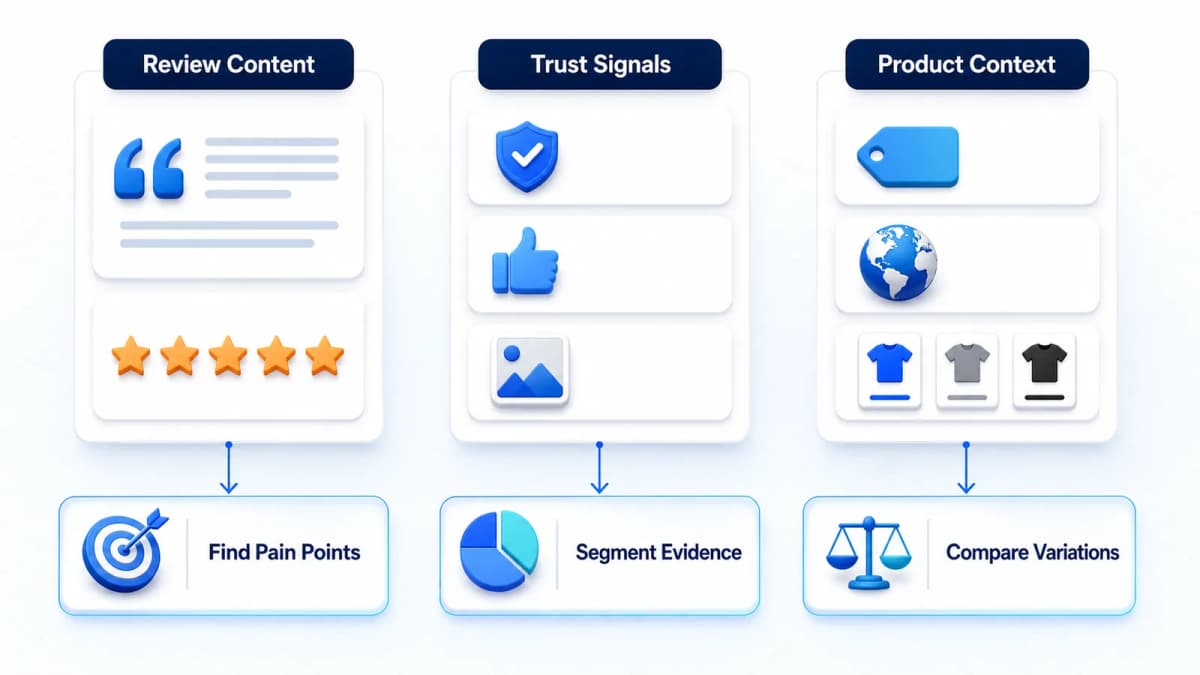
Review content, trust signals, and product context answer different research questions.
Core Review Content
Nexscope provides an Amazon Reviews List API that documents fields such as reviewId, title, text, rating, date, and userName. Together, they answer the basic questions: what did the customer say, how did they score the product, and when was the feedback posted?
reviewId supports deduplication; title and text supply the evidence; rating enables balanced sampling; and date supports recency comparisons. userName can distinguish records but should not become a customer identity profile.
Review text should remain attached to its rating and date during analysis. Separating a sentence from its context can reverse its meaning. “I expected the battery to fail, but it lasted all weekend” should not be classified as a battery failure simply because it contains the word “fail.”
Trust and Engagement Signals
Additional fields can help researchers prioritize or segment reviews without claiming that any single review is true or false.
verifiedindicates whether the response identifies the review as a verified-purchase review.vineidentifies a Vine-related review when that signal is available.numberOfHelpfulshows visible helpful-vote engagement.imageUrlListandvideoUrlListindicate whether the review includes media.
These are research signals, not authenticity scores. A verified purchase can still reflect an unusual experience. A helpful review may be older and more visible rather than more representative of current quality.
A sound workflow uses these fields for segmentation. For example, compare a complaint's frequency in all reviews with its frequency in verified-purchase reviews. Then inspect whether photo or video evidence supports the issue. The conclusion should come from a pattern across records, not from a badge.
Product and Variation Context
Review findings become more actionable when they can be connected to the correct product context. Documented fields include asin, productTitle, productRating, countRatings, countReviews, variationId, variationList, domainCode, and locale.
This context helps answer questions that review text alone cannot resolve:
- Is the complaint associated with one ASIN or several competing ASINs?
- Does the issue appear only in a specific size, color, or model?
- Is the review from the US marketplace or another locale?
- Does a product with a strong aggregate rating still have a concentrated variation problem?
- Is a low-frequency complaint severe enough to require manual inspection?
Variation context is especially important. Amazon listings can group related products, and a problem attached to one variant can be incorrectly generalized to the entire family. Keep variationId and marketplace fields in the dataset whenever they are present.
API Request Workflow
A reliable request starts with a precise research plan. Decide which ASINs, markets, star bands, time windows, and reviewer segments are needed before calling the endpoint.
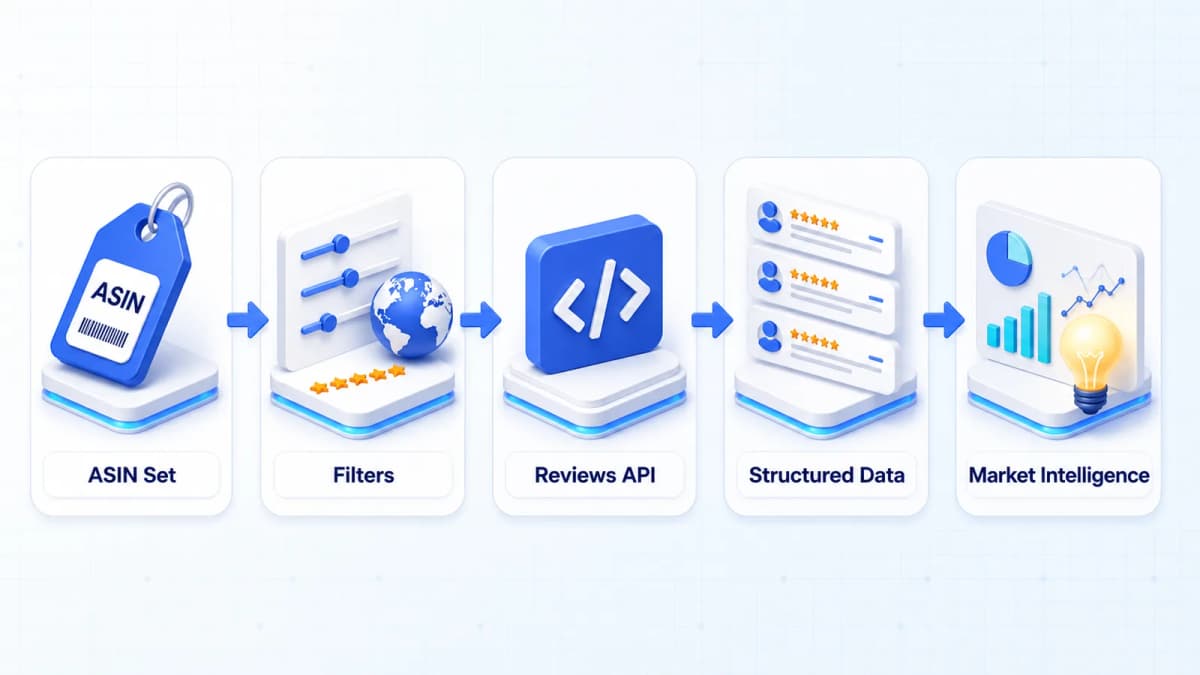
A review research workflow moves from a defined ASIN set through controlled filters to evidence-backed decisions.
Choose an ASIN
Start with a known ASIN and confirm the product title returned by the API. This prevents a copied or mistyped identifier from contaminating the research.
For competitor analysis, create an explicit comparison set. Include products that serve the same core use case and occupy a reasonably similar price, size, audience, and maturity range. Comparing a premium commercial product with an entry-level consumer product can produce obvious differences that are not useful opportunities.
Record the role, price band, use case, and marketplace for every ASIN so the analysis does not treat every product as an identical benchmark.
Select a Marketplace
The Reviews List API documentation provides domainCode values for 15 marketplaces: com, ca, co.uk, in, de, fr, it, es, co.jp, com.au, com.br, nl, se, com.mx, and ae.
Marketplace selection affects language, product assortment, use cases, expectations, and seasonality. Do not pool US, German, Japanese, and Brazilian reviews into one count without preserving domainCode and locale. A complaint may be caused by regional sizing conventions, climate, voltage, delivery conditions, or instructions rather than the core product.
If the goal is international expansion, analyze each marketplace separately first. Compare normalized theme rates only after local patterns are understood.
Set Rating Filters
The request supports separate counts through star1Num, star2Num, star3Num, star4Num, and star5Num. The documented default is 10 for each rating, with a maximum of 100 per field.
This structure makes balanced sampling possible. Instead of requesting only the most visible reviews, a researcher can deliberately collect evidence from every rating band.
A practical starting sample might request 25 one-star, 25 two-star, 40 three-star, 25 four-star, and 25 five-star reviews. The larger three-star sample helps capture nuanced tradeoffs.
This is a research design example, not a universal minimum. The right sample depends on available reviews, category diversity, decision risk, and how consistently themes appear.
Add Review Filters
The endpoint also documents three controls that can make a request more relevant:
filterByKeywordnarrows results using a keyword string of up to 1,000 characters.sortByacceptsrecentorhelpful, withrecentas the documented default.reviewerTypeacceptsall_reviewsoravp_only_reviews, withall_reviewsas the documented default.
Use keyword filtering to investigate a known hypothesis, but not as the only discovery method. Customers can describe one problem in many ways.
Use recent to investigate current product quality and emerging issues. Use helpful when you want prominent, detailed reviews, but remember that older reviews have had more time to accumulate votes. Use avp_only_reviews as a focused segment, then compare the result with all_reviews instead of assuming the segment is automatically representative.
Read the Response
The documented endpoint uses a POST request and bearer authentication. The following request illustrates a controlled sample for a US ASIN:
curl --request POST \
  --url 'https://claw-callback.nexscope.ai/api/skill-api/v1/skills/amazon-reviews-list/run' \
  --header 'Authorization: Bearer YOUR_API_KEY' \
  --header 'Content-Type: application/json' \
  --data '{
    "asin": "B0XXXXXXXXX",
    "domainCode": "com",
    "star1Num": 25,
    "star2Num": 25,
    "star3Num": 40,
    "star4Num": 25,
    "star5Num": 25,
    "filterByKeyword": "",
    "sortBy": "recent",
    "reviewerType": "avp_only_reviews"
  }'
Replace the sample ASIN and key with your own values. The live API documentation should remain the source of truth for request shape, authentication, current fields, and response examples.
When reading a response, validate the product and request context before analyzing the reviews. Check asin, productTitle, domainCode, locale, currentPage, sortStrategy, filters, statusCode, and statusMessage when those fields are returned. Preserve pagination and provider metadata so downstream users can understand how the dataset was assembled.
The same Reviews List capability is documented with the MCP method nexscope_amazon_reviews_list. This can be useful when an Agent needs a governed tool call rather than custom request code. The decision logic does not change: define the question, constrain the sample, inspect returned context, and retain evidence.
Market Intelligence Workflows
Once the review records are normalized, they can support several market-intelligence workflows. The safest approach combines automated classification with manual inspection of representative examples.
Complaint Pattern Discovery
Start with a category-specific issue taxonomy. A kitchen appliance taxonomy might include leakage, noise, capacity, cleaning, controls, materials, overheating, instructions, and packaging. A clothing taxonomy would use fit, fabric, color accuracy, comfort, stitching, shrinkage, and sizing.
Assign one or more themes to each review, but keep three measurements separate:
- Frequency: How often does the issue appear in the sample?
- Severity: Does it create mild inconvenience, product failure, return risk, or a safety concern?
- Breadth: Does it appear across ratings, variants, dates, and competing ASINs?
An issue is more likely to represent a market opportunity when it appears across several comparable products and customers describe a solvable cause. Ten complaints from one defective batch may be an operational incident. The same complaint across five brands may indicate an unmet category need.
For a broader framework covering audience, functional, assurance, and experience signals, use Nexscope's guide to analyzing Amazon reviews for product research.
Feature Gap Mapping
Negative reviews reveal friction, while positive reviews reveal the value that should not be removed. Use both sides to build a feature-gap matrix:
| Theme | Customer evidence | Competitor weakness | Must preserve | Possible response |
|---|---|---|---|---|
| Cleaning | Parts trap residue | Complex disassembly | Dishwasher-safe parts | Reduce seams and part count |
| Noise | Too loud at night | High motor noise | Strong performance | Add quieter operating mode |
| Instructions | Setup is confusing | Weak onboarding | Flexible configuration | Add visual quick-start guide |
The final column is still a hypothesis. Review data can show that a problem exists, but it does not prove that a proposed solution is technically feasible, profitable, or preferred. Validate ideas with supplier, cost, search-demand, and customer-testing evidence.
You can connect this stage with a wider Amazon product-opportunity workflow so review pain points are checked against demand rather than evaluated in isolation.
Variant and Segment Signals
Group themes by variationId, marketplace, date, rating, verified-purchase status, and media presence. This can reveal patterns hidden by aggregate averages.
Examples include:
- A sizing complaint concentrated in one color or manufacturing batch.
- Packaging damage concentrated in one marketplace.
- A feature praised by professional users but criticized by beginners.
- Recent complaints that do not appear in older reviews.
- A durability problem that appears only after long-term use.
Do not assume a detected segment is causal. A variation may have more complaints simply because it sells more units. Review APIs do not necessarily provide the denominator needed to calculate a true defect or complaint rate. Treat segmented counts as signals for further investigation.
Competitor Review Research
Competitive review research works best as a consistent protocol, not a collection of memorable quotations. Use the same sample design and taxonomy across every ASIN.
Comparable ASIN Sets
Choose three to ten direct competitors for an initial study. Record price range, rating count, launch maturity, variation structure, and primary audience. Exclude products that share a keyword but solve a materially different job.
Then run the same marketplace, rating-band, recency, and reviewer-type settings for each ASIN. Consistent settings make differences more interpretable. If one competitor is sampled by helpful reviews and another by recent reviews, the comparison may reflect sorting rather than product quality.
A structured competitor study can feed the positioning, product, and listing steps in an Amazon competitor analysis.
Rating-Band Sampling
Do not compare competitors by raw complaint counts alone. Products can have very different numbers of ratings and available reviews. Instead, use the same requested sample per rating band, report the number actually returned, and compare theme share within the analyzed sample.
For example:
“Assembly confusion appeared in 18 of 120 analyzed reviews for Product A and 7 of 120 for Product B.”
That statement is more transparent than “Product A has an assembly problem.” It describes the evidence without pretending the sample represents every buyer.
Three-star reviews are often valuable because they describe tradeoffs rather than pure satisfaction or failure. Four-star reviews can expose small problems that prevent a good product from becoming the default recommendation. Five-star reviews identify the performance baseline a new product must preserve.
Recency and Verification
Run recent and helpful samples separately. If a historical problem disappears from recent reviews, the seller may have improved the product. If a complaint first appears in recent reviews, it may indicate a production, packaging, or listing change.
Compare all_reviews with avp_only_reviews when the workflow supports both. Report whether a conclusion is stable across the two samples. Add manual checks for reviews with unusually strong language, repeated phrasing, or unclear product context, but do not label a review fake without reliable evidence.
The final output should include representative evidence, sample settings, and exceptions. Decision-makers need to see why a theme was classified and where the finding may not apply.
Official Amazon API Differences
Amazon has an official Selling Partner API for Customer Feedback, but it should not be described as a general endpoint for downloading all full customer reviews.
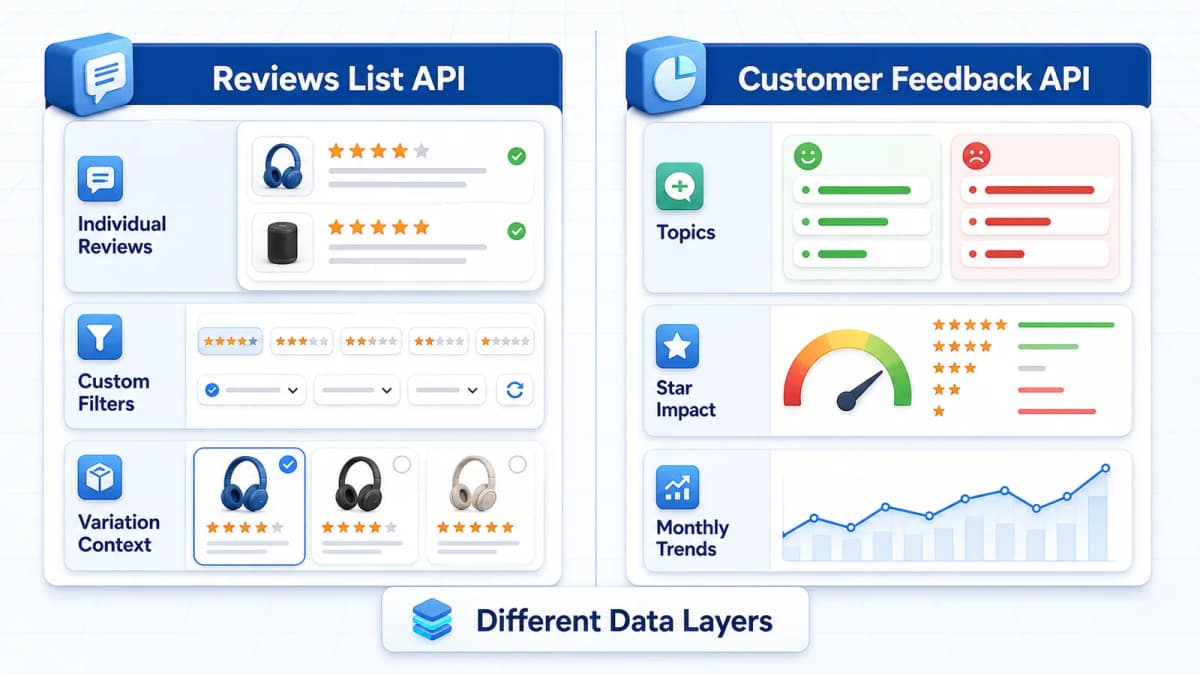
Review-list data supports custom record-level analysis, while Amazon's official interface supplies aggregated topics and trends.
Customer Feedback API
According to Amazon's Customer Feedback API documentation, the official interface retrieves insights from customer reviews and returns. Review insights are available at ASIN and browse-node levels, while return insights are available at browse-node level.
For an ASIN, Amazon documents the most positive and negative review topics, sorting by mentions or star-rating impact, and month-on-month trends. Its ASIN tutorial describes retrieving ten positive and ten negative topics and six months of occurrence-percentage trends.
Amazon states that the Customer Feedback API data is refreshed weekly, is available only in English, and supports the United States, United Kingdom, France, Italy, Germany, Spain, and Japan. The documented operations require an eligible role such as Brand Analytics or Selling Partner Insights and selling-partner authorization.
Raw Reviews vs Topics
The best endpoint depends on the research job.
| Dimension | Nexscope Reviews List API | Amazon Customer Feedback API |
|---|---|---|
| Data unit | Individual review records | Aggregated feedback topic or trend |
| Example fields | Text, rating, date, verified, helpful votes, variation | Positive/negative topic, mentions, star impact, trend |
| Filters | Marketplace, rating counts, keyword, sort, reviewer type | Operation-specific topic and trend requests |
| Documented markets | 15 domain codes | 7 Amazon stores |
| Documented freshness | Not specified on the current public page | Weekly |
| Best use | Custom evidence review and classification | Official topic and trend insights |
| Access | Nexscope API key | SP-API authorization and required roles |
This is not a quality ranking. The two interfaces expose different layers of customer feedback. A team might use review-level records for custom analysis and official aggregated insights as a separate validation source when it has access.
Access and Marketplace Scope
Do not describe a third-party reviews-list endpoint as “Amazon's official reviews API.” Use exact language such as “an API for Amazon review data” and identify the provider.
Marketplace count also needs context. A supported domain code means the endpoint accepts that marketplace selection; it does not by itself prove that every review, product, category, or historical record will be available. Preserve the marketplace returned with every dataset and document incomplete results.
For production use, check the live documentation for authentication, rate or usage limits, error handling, and current field definitions. These operational details can change and should not be copied permanently into application logic without monitoring.
Data Quality and Limits
Review data can improve decisions, but it is observational evidence. It is shaped by who buys, who leaves a review, which reviews are available, and how the request was configured.
Freshness Disclosure
The current public Nexscope Reviews List documentation does not state a real-time guarantee or a fixed refresh interval. Therefore, a responsible implementation should not claim that the response is “real time,” “complete,” or “always current.”
Store the request time, returned review dates, filters, and pagination context. If a business decision depends on a newly emerging problem, repeat the request and compare the result with the visible product context or another authorized source.
Freshness requirements should follow the decision. Monthly product-planning research may tolerate a different refresh standard from daily quality monitoring.
Coverage and Pagination
The number requested is not always the number available. Some rating bands may contain fewer reviews, and keyword filters may produce small samples. A response may also be paginated or carry provider metadata that affects interpretation.
Every analysis report should disclose:
- ASINs and marketplaces requested.
- Request date and filter settings.
- Requested and returned review counts by rating.
- Pagination or sampling method.
- Missing fields or failed requests.
- Classification method and manual validation sample.
Without this information, a polished dashboard can create more confidence than the underlying data supports.
Review Bias and Duplicates
Customer reviews are not a random survey of all buyers. People with unusually positive or negative experiences may be more motivated to post. Helpful sorting favors reviews that have accumulated engagement. Product variations and listing changes can mix feedback from different versions.
Deduplicate using stable identifiers when possible, then check near-duplicate text without automatically deleting legitimate reviews. Separate issue frequency from issue severity. Keep contradictory evidence; disagreement can indicate multiple segments or use cases rather than bad data.
AI classification also requires validation. Review a sample from every major theme, examine false positives, and revise the taxonomy when categories overlap. The goal is traceable evidence, not a black-box sentiment score.
Compliance Boundaries
Use review data for lawful research, monitoring, product development, and content decisions. Respect the provider's terms, Amazon's applicable policies, privacy requirements, and any contractual restrictions on storage or redistribution.
Do not use an API workflow to fabricate reviews, manipulate ratings, harass reviewers, or offer prohibited incentives. The US Federal Trade Commission's Consumer Reviews and Testimonials Rule Q&A explains obligations concerning fake, false, and incentivized reviews. Compliance requirements can vary by market, so obtain appropriate advice for high-risk implementations.
Build a Review Intelligence Workflow
An Amazon reviews API creates value when it becomes part of a disciplined evidence workflow:
- Define a decision and a falsifiable research question.
- Select comparable ASINs and analyze marketplaces separately.
- Request balanced star-rating samples with consistent filters.
- Preserve review, trust, product, variation, and request context.
- Classify themes by frequency, severity, breadth, and recency.
- Inspect representative reviews and contradictory evidence.
- Compare findings with search demand, product economics, and other authorized data.
- Translate validated patterns into product, listing, or positioning hypotheses.
The API does not replace judgment. It replaces repetitive collection and gives the team a more consistent body of evidence. The strongest output is not “customers hate this feature.” It is a qualified finding that states which customers, products, variants, markets, dates, and samples support the conclusion.
When that evidence is connected to an Agent or research pipeline, teams can repeat the same protocol across more ASINs without losing the original records behind each insight. Nexscope provides ecommerce data capabilities through API, MCP, and Skills for seller and developer workflows.
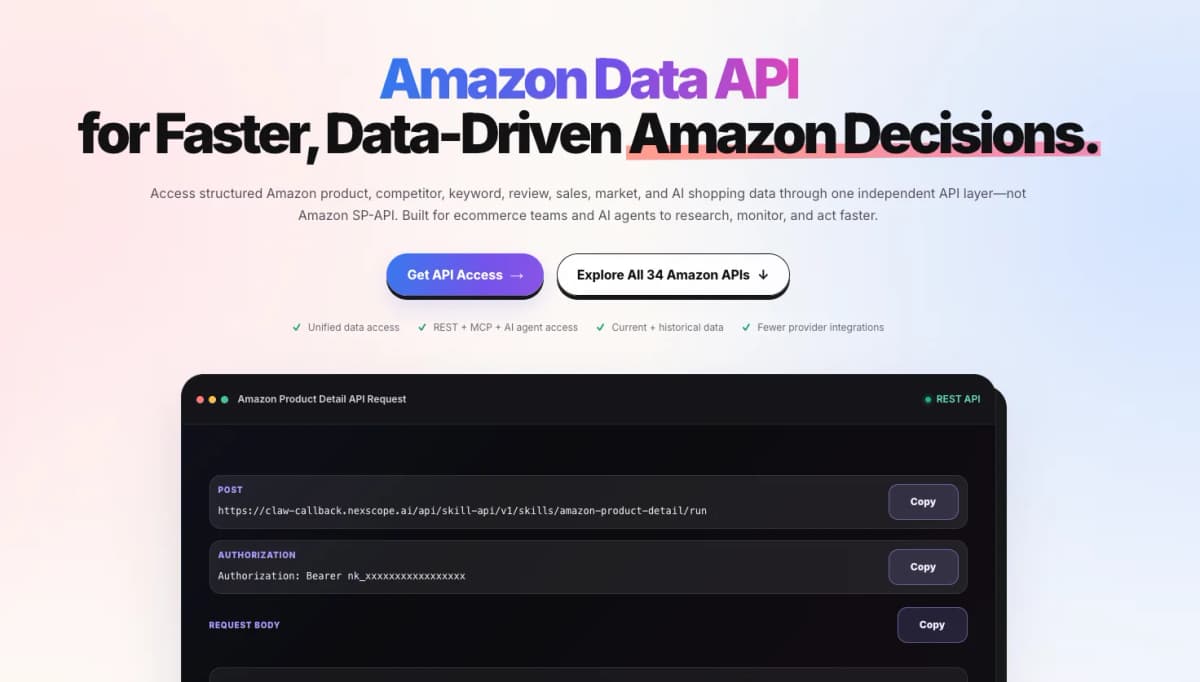
Explore Amazon product, keyword, seller, offer, review, and marketplace endpoints in one API catalog.
Turn Amazon Review Data into Market Intelligence
Explore Nexscope endpoints for product, keyword, seller, offer, review, and marketplace research.
Explore the Amazon Data API →API, MCP, and Skills for ecommerce workflows
Frequently Asked Questions
Is there an official Amazon Reviews API?
Amazon offers the official Customer Feedback API through SP-API. It provides review and return insights, including positive and negative topics, mentions, star-rating impact, and trends. It is not documented as a general endpoint for retrieving every full individual customer review. Third-party review-list APIs should be identified by provider rather than described as official Amazon APIs.
Can an Amazon Reviews API return full review text?
Some review-list endpoints return individual review text along with fields such as title, rating, date, and reviewer signals. The exact fields, coverage, permitted uses, and availability depend on the provider and current endpoint documentation.
Which review fields can an API return?
The Nexscope Reviews List API documents review content fields, rating and date, verified-purchase and Vine signals, helpful votes, media URLs, product rating context, review and rating counts, variation information, marketplace data, filters, status, and pagination-related metadata.
Can reviews be filtered by rating or verified purchase?
The documented Nexscope request supports separate counts for one- through five-star reviews. It also provides reviewerType values for all reviews or verified-purchase-only reviews, plus recent/helpful sorting and keyword filtering.
How many Amazon marketplaces does Nexscope support?
The current public documentation lists 15 marketplace domain codes: the United States, Canada, United Kingdom, India, Germany, France, Italy, Spain, Japan, Australia, Brazil, Netherlands, Sweden, Mexico, and United Arab Emirates domains. Check the live documentation before implementation because supported options can change.
How do reviews-list and Customer Feedback APIs differ?
A reviews-list API can supply individual review records for custom classification and evidence inspection. Amazon's official Customer Feedback API supplies aggregated topics and trends for supported stores and authorized sellers or vendors. The two can support different stages of the same research workflow.
Can review data support competitor research?
Yes, provided the comparison uses comparable ASINs, consistent filters, balanced rating samples, and transparent limitations. Review evidence can reveal recurring complaints, praised features, variation problems, and customer language. It should be validated with demand, economics, and other product evidence before making a major decision.
Sources
- Amazon. Customer Feedback API. Accessed August 12, 2026.
- Amazon. Get Feedback Insights for an ASIN. Accessed August 12, 2026.
- Nexscope. Amazon Reviews List API. Accessed August 12, 2026.
- Federal Trade Commission. Consumer Reviews and Testimonials Rule: Questions and Answers. Accessed August 12, 2026.