

llms.txt for Ecommerce: What It Does and How to Set It Up

An llms.txt file gives an ecommerce site a concise, Markdown-based directory of the content that matters most. Instead of asking a compatible AI agent to interpret navigation menus, filters, scripts, promotional modules, and thousands of URLs, the file can point it toward selected product collections, buying guides, store policies, and evidence pages.
That potential benefit needs a precise boundary. llms.txt can make selected information easier to locate and interpret only for systems that choose to retrieve the file. It does not make blocked pages accessible, force an AI crawler to process the links, improve Google rankings, or guarantee that a product will be mentioned, cited, or recommended.
This guide explains the proposed llms.txt format, why it may improve machine-oriented readability for ecommerce content, what it can and cannot do, and what a store should include in the file. It also provides a complete ecommerce example, a deployment workflow, and a practical method for separating page readiness from observed AI product visibility.
What Is llms.txt?
llms.txt is a proposed standard for publishing a short, structured guide to a website at /llms.txt. The proposal was introduced by Jeremy Howard in September 2024 to help language models use website information during inference, when a user or AI agent is actively seeking an answer.
The file is written in Markdown. It is designed to be readable by people, language models, and conventional parsers. Its job is to provide brief site context and links to selected resources. It does not contain crawler permissions or a complete inventory of every indexable URL.
Core Purpose
The proposal addresses a practical retrieval problem. Modern websites often contain navigation, advertising, JavaScript, repeated interface elements, and more content than a model can efficiently process in one context window. A small file can offer a cleaner starting point by identifying the pages that best explain the site.
For an ecommerce store, those pages may include the brand story, priority collections, product comparison guides, shipping terms, return rules, warranties, certifications, and customer support documentation.
Markdown Structure
According to the llms.txt proposal, the only required component is an H1 containing the site or project name. The remaining structure may include:
- A blockquote with a short site summary
- Additional notes that explain the site or how to interpret its resources
- H2 sections containing lists of links
- A short description after each link
- An
Optionalsection for secondary resources that can be skipped when context needs to remain small
The expected link pattern is simple:
- [Link title](https://example.com/page): A concise description of the page.
Proposal Status
llms.txt remains an open community proposal, not a universal web standard adopted by every search engine or AI platform. The proposal does not define how an application must discover, process, rank, or use the file. Each tool can decide whether to retrieve it and what to do with the information.
That status makes accurate positioning essential. A store can create the file as an experiment or a convenience for compatible agents. It should not present the file as a required ranking signal.
Why llms.txt Matters for AI Readability
AI readability and AI visibility describe different stages. Readability concerns whether a machine can access, parse, and contextualize information. Visibility concerns whether a brand or product actually appears in an answer, citation, comparison, or recommendation.
An llms.txt file may support the first stage by offering a plain-text guide. It cannot prove the second stage. The readability benefit also applies only when a system deliberately retrieves and processes the file.
Curated Content Paths
An ecommerce site may have thousands of product URLs, faceted navigation combinations, seasonal pages, and archived campaigns. A curated llms.txt can identify a smaller group of authoritative resources that explain the business and its products.
This selection can reduce ambiguity about which pages represent current policies, which collections matter most, and which guides answer recurring buyer questions. The file becomes a maintained content map rather than a raw export of the catalog.
Plain-Text Structure
Markdown removes much of the interface noise found in rendered HTML. Headings define groups, links identify destinations, and short annotations explain the purpose of each resource. Both models and deterministic parsers can process that structure without reconstructing a visual page layout.
Plain text does not repair the linked pages themselves. If a product page is blocked, unavailable, dependent on broken JavaScript, or missing important facts, an llms.txt link cannot make that page usable.
Reduced Navigation Noise
Store navigation is designed for shoppers. It may contain promotional collections, account links, filters, cart controls, personalized recommendations, and repeated footer links. Those elements can be useful in a browser but inefficient as an AI content index.
llms.txt provides a separate route to selected resources. A compatible agent can start with the most informative pages without treating every navigational link as equally important.
Contextual Link Labels
A URL alone may not reveal whether a page is a buying guide, a legal policy, a product family, or an old campaign. An llms.txt link can include a concise annotation such as “Current shipping regions, rates, and delivery estimates.”
Descriptions should state what a page contains, not make promotional claims. Clear labels help a compatible system select the right source for a question while keeping the file compact.
Before publishing the file, audit the pages it will reference. The Nexscope GEO Score Checker can identify crawl, content, structured data, authority, and AI-readability gaps that an llms.txt directory cannot repair on its own.
Check the Pages Behind Your llms.txt
Find crawl, content, structured data, authority, and AI readability gaps before treating a directory file as a solution.
Check Your Page's GEO Score Free →SEO score • GEO readiness • Prioritized fixes
What llms.txt Can Do
The capabilities below are conditional. They apply when a tool, model, or agent chooses to fetch and interpret the file.
Content Prioritization
llms.txt can highlight a store's most useful public resources. The store controls which collections, policies, guides, and evidence pages appear and how they are grouped.
Machine-Readable Guidance
Its Markdown structure can provide a lightweight machine-oriented guide to the site. A parser can identify the site name, summary, section headings, links, and descriptions without interpreting a complex interface.
Page Context
Link annotations can explain the role of each destination. This gives a compatible system more context than a bare list of URLs and may help it choose the right page for a buyer question.
Retrieval Efficiency
A concise file can reduce the number of pages a compatible agent needs to inspect before reaching useful information. This is especially relevant for stores with large catalogs, extensive help centers, or many old campaign URLs.
Content Maintenance
The file can also serve as an internal quality checkpoint. Maintaining it forces a store to identify its canonical policy pages, current guides, priority collections, and strongest evidence resources. Broken or outdated links become easier to spot.
What llms.txt Cannot Do
The limitations are more important than the syntax because they define the claims a store can responsibly make.
Google Ranking Gains
Google explicitly states that Google Search does not use llms.txt for standard Search or its generative AI capabilities. Creating the file neither helps nor harms a site's Google visibility or rankings. Google recommends maintaining technical SEO, valuable content, product data, and other established foundations instead of treating AI text files as a shortcut.
Guaranteed AI Visibility
An llms.txt file cannot guarantee that ChatGPT, Claude, Gemini, Perplexity, or another system will mention a brand or recommend a product. A platform may ignore the file, use different retrieval systems, or select other sources for a particular question.
Citation Guarantees
Listing a page does not make it an authoritative citation. Citation selection may depend on query relevance, crawl access, content quality, freshness, external corroboration, platform policies, and model behavior.
Crawler Access Control
llms.txt does not grant or deny crawler access. OpenAI documents OAI-SearchBot, GPTBot, and ChatGPT-User, while Anthropic documents ClaudeBot, Claude-User, and Claude-SearchBot. Their current crawler guidance centers on robots.txt and platform-specific user agents, not llms.txt.
Product Data Replacement
The file does not replace accurate product pages, product feeds, or ecommerce schema markup. It should link to product information rather than become a second database for prices, stock, ratings, or variant data that can quickly become stale.
Indexing Guarantees
A successful HTTP response for /llms.txt does not prove that a search engine or AI platform discovered, indexed, or used it. The same limitation applies to every link inside the file.
Universal Platform Support
Published crawler documentation from major AI providers does not establish universal llms.txt support. A store should require explicit documentation or direct technical evidence before claiming that a particular platform processes the file.
llms.txt vs Robots.txt, Sitemap, and Schema
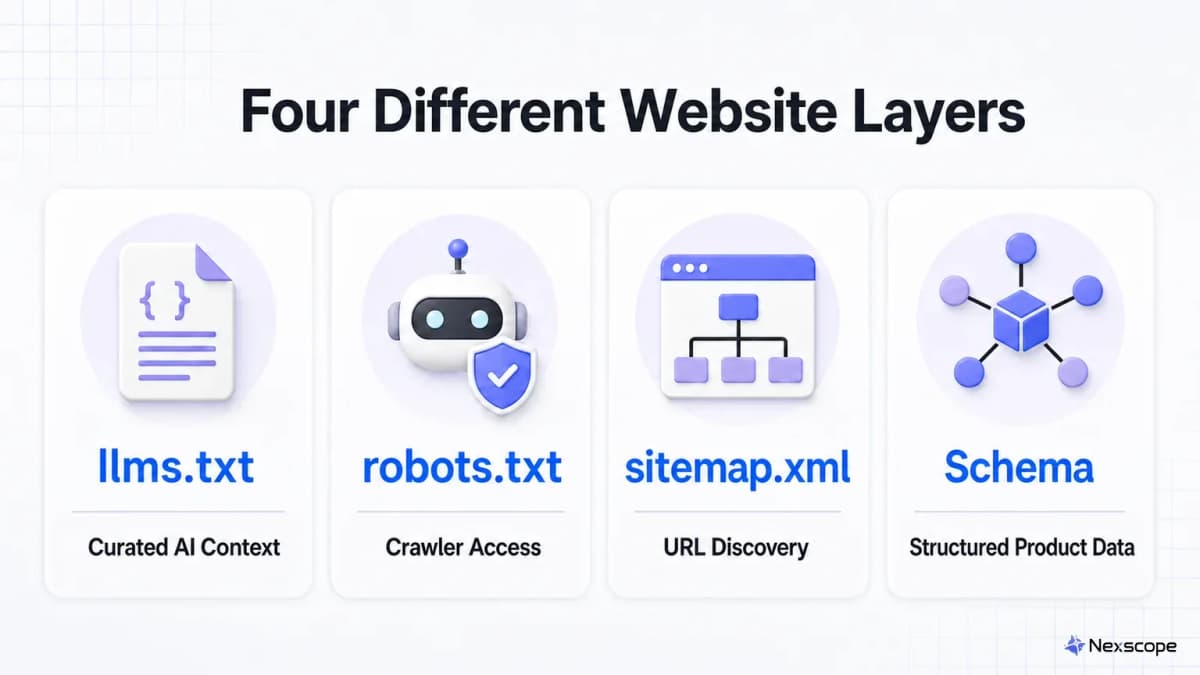
These files solve different problems. They should be evaluated as complementary layers, not interchangeable formats.
| File or layer | Primary purpose | Controls crawling | Lists URLs | Describes product facts | Curates AI context |
|---|---|---|---|---|---|
llms.txt |
Selected content guide | No | Yes, selectively | No | Yes |
robots.txt |
Crawler access preferences | Yes | Sometimes | No | No |
sitemap.xml |
URL discovery | No | Yes, broadly | No | No |
| Schema markup | Structured page entities and facts | No | No | Yes | Indirectly |
Crawl Control
robots.txt communicates crawl rules to compliant automated agents. It can identify user agents and allow or disallow paths. It is not an authorization system, and it does not guarantee that every agent will comply, but it is the established mechanism documented by search and AI crawler providers.
URL Discovery
A sitemap helps search engines discover canonical site URLs. It can include large numbers of product, collection, article, image, or video URLs. Its purpose is coverage, not a concise explanation of which resources matter most to an AI task.
Product Data
Schema markup labels facts on a page, such as a product name, SKU, price, currency, availability, review aggregate, shipping terms, and return policy. The structured data should match visible content and current commerce data.
AI Content Guidance
llms.txt provides a curated directory and short context labels. It may point toward pages that contain schema or detailed product data, but it does not encode those facts with the precision of Product and Offer markup.
What to Include in an Ecommerce llms.txt
An ecommerce llms.txt should contain selected public URLs with concise, factual descriptions. It should not copy the full site, duplicate complete product descriptions, or publish sensitive information.
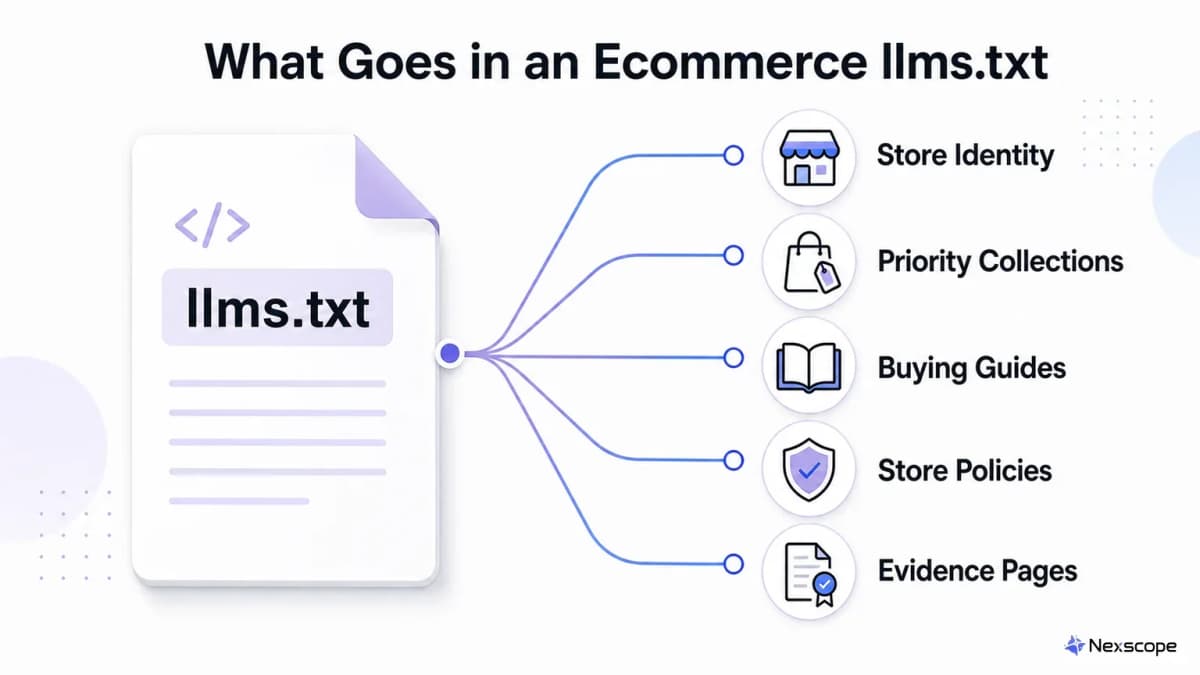
Store Identity
Include pages that establish the official business identity and explain what the store sells:
- About page
- Brand story
- Contact page
- Manufacturing or sourcing information
- Sustainability or quality standards
The opening blockquote can summarize the store in one or two sentences. It should identify the product category, intended customer, and relevant market without slogans or unverifiable superiority claims.
Priority Collections
Include the collections that best represent the catalog. A specialty retailer might list four core categories and omit clearance pages, temporary campaigns, tag archives, and internal search results.
Product-level URLs can be added selectively when a flagship product has substantial documentation or when an agent needs a stable reference page. A store with thousands of SKUs should not paste every product URL into llms.txt.
Buying Guides
Guides often answer the questions that appear before purchase. Useful llms.txt entries include:
- Product comparisons
- Size or fit guides
- Compatibility guides
- Material explanations
- Use-case guides
- Product care instructions
- Selection checklists
These pages can provide more decision context than a short product description, especially for products with technical, sizing, safety, or compatibility considerations.
Store Policies
Link to the current canonical versions of:
- Shipping policy
- Return and refund policy
- Warranty terms
- Payment information
- Subscription terms
- Customer support instructions
Policy descriptions should state scope, not summarize fast-changing details that can drift from the linked page.
Evidence Pages
Evidence resources help a reader or compatible agent verify claims. Depending on the business, these may include testing methods, certifications, original research, ingredient documentation, material standards, case studies, or detailed production information.
Only publish evidence that is already public and accurate. llms.txt should not expose confidential reports, supplier contracts, customer records, or internal dashboards.
Optional Resources
The proposal gives ## Optional a specific purpose. Resources in this section can be skipped when an application needs a shorter context. Suitable entries may include company history, secondary editorial content, press coverage, archived documentation, or lower-priority guides.
Ecommerce llms.txt Example
The following example describes a fictional home-goods store. It prioritizes stable collections, guides, policies, and evidence rather than listing every product.
File Anatomy
The file begins with the store name and a short description. Core resources are then divided into descriptive H2 sections. Each link has a brief note explaining the page's purpose.
Sample File
# Aster Home

> Aster Home sells durable drinkware, food storage, and travel accessories for everyday use in the United States.

Use the resources below for current product categories, buying guidance, store policies, and public product evidence. Product pages remain the source of truth for price and availability.

## Product Collections

- [Insulated Drinkware](https://example.com/collections/insulated-drinkware): Current tumblers, travel mugs, and insulated bottles.
- [Food Storage](https://example.com/collections/food-storage): Reusable containers organized by material, capacity, and use case.
- [Travel Accessories](https://example.com/collections/travel-accessories): Bags, organizers, and compact accessories designed for travel.

## Buying Guides

- [Drinkware Comparison](https://example.com/guides/drinkware-comparison): Compares capacity, insulation, lid type, dimensions, and recommended uses.
- [Materials Guide](https://example.com/guides/materials): Explains the materials used in products and relevant care requirements.
- [Product Care](https://example.com/guides/product-care): Cleaning, storage, and maintenance instructions by product type.

## Store Policies

- [Shipping Policy](https://example.com/policies/shipping): Current shipping regions, service levels, costs, and delivery estimates.
- [Returns and Refunds](https://example.com/policies/returns): Return eligibility, time limits, methods, fees, and refund processing.
- [Warranty](https://example.com/policies/warranty): Product warranty coverage, exclusions, and claim instructions.

## Product Evidence

- [Material Testing](https://example.com/pages/material-testing): Public testing methods and documentation for product materials.
- [Certifications](https://example.com/pages/certifications): Current product and manufacturing certifications with scope details.

## Optional

- [Brand Story](https://example.com/pages/about): Company background, design principles, and manufacturing approach.
- [Journal](https://example.com/blog): Educational articles about product use, care, and materials.
Link Descriptions
The annotations explain the expected content without duplicating it. Prices, stock levels, delivery dates, and promotion details remain on maintained commerce pages. That separation reduces the risk of conflicting information.
How to Create llms.txt
Implementation is simple, but selection and maintenance determine whether the file remains useful.
Audit Public Content
Inventory the homepage, about page, priority collections, flagship products, buying guides, policy pages, help content, and evidence resources. Remove redirects, duplicate URLs, expired campaigns, internal search pages, and private content from the candidate list.
Select Priority Pages
Choose pages that answer important buyer questions or establish the store's identity and policies. Prefer stable canonical URLs. Keep the first version small enough to review manually.
Write Concise Labels
Group related pages under clear H2 headings. Give every link a short, factual description. Avoid marketing language, keyword stuffing, unsupported claims, and explanations that will become stale quickly.
Deploy at the Root
Publish the primary file at:
https://example.com/llms.txt
The proposal also allows subpaths, but the root location gives tools a predictable discovery point. Serve the file without authentication and use a plain-text or Markdown-compatible content type.
Validate the Response
Check the live URL and confirm:
- HTTP status
200 - No redirect loop
- Readable Markdown output
- Correct H1 and section order
- Public, canonical HTTPS links
- No broken or private URLs
- No environment or customer data
Validation proves that the file is available. It does not prove that any external AI platform uses it.
Maintain the File
Review llms.txt after URL migrations, collection changes, policy updates, major product launches, and content consolidation. Assign one team or system as the owner. A short, current file is more useful than a large directory filled with stale links.
Common llms.txt Mistakes
Most failures come from treating the file as a sitemap, a product feed, or a ranking command.
- Sitemap duplication: Copying every catalog URL removes the prioritization benefit and creates an oversized file.
- Stale links: Expired campaigns, discontinued products, and redirected policy pages weaken reliability.
- Private URLs: Account, cart, checkout, preview, staging, and internal search URLs should stay out of the file.
- Unsupported claims: The file should not promise Google rankings, universal AI support, citations, or recommendations.
- Missing foundations: llms.txt cannot repair blocked crawlers, thin product content, inaccurate feeds, broken schema, or inconsistent policies.
- Excessive detail: Full product descriptions, live inventory, prices, and promotion data are better maintained on canonical pages and in product feeds.
- Weak descriptions: Labels such as “click here” or “learn more” do not explain what a linked resource contains.
- No ownership: An unmaintained file can become a second, outdated version of the site's navigation.
Is llms.txt Worth Testing?
The right priority depends on the store's existing foundations and the cost of maintenance.
Good-Fit Stores
Testing is more reasonable when a store has:
- A large or complex catalog
- Several high-quality buying guides
- Detailed public policies and support content
- Stable canonical URLs
- Working crawl and indexing controls
- Accurate product pages, feeds, and schema
- A process for reviewing AI and crawler behavior
For these stores, creating the file may take little effort and can provide a useful endpoint for compatible tools or custom agents.
Low-Priority Cases
llms.txt should remain a lower priority when important pages are blocked, JavaScript rendering is unreliable, product details are incomplete, prices or inventory conflict across systems, or shipping and return policies are unclear.
Google's current guidance is especially direct: llms.txt is unnecessary for Google Search and its generative AI features. Established technical and content work should come first.
Testing Criteria
Treat deployment as a documented experiment:
- Save the exact file version and publication date.
- Confirm server access and monitor request logs where possible.
- Record which tools are expected to use the file and why.
- Test whether compatible agents can locate the correct sources.
- Track AI mentions and citations separately from file availability.
- Avoid attributing ordinary traffic or ranking changes to llms.txt without evidence.
Measure Readiness and Visibility
Creating a readable file answers only one implementation question. A meaningful generative engine optimization workflow separates page readiness from actual appearance in AI answers.
Page Readiness
The Nexscope GEO Score Checker evaluates page-level SEO, GEO and AI visibility readiness, technical health, and content authority. Its checks include crawl readiness, search intent, image SEO, structured data, trust signals, AI brand recognition, citation readiness, and prioritized fixes.
That assessment is broader than llms.txt. It examines whether the linked pages themselves are accessible, understandable, credible, and technically prepared. A GEO readiness score is a diagnostic of page conditions, not proof of a live AI recommendation.
The checker can be used on product, collection, article, policy, and service URLs. Results should be interpreted within the crawler and platform scope shown in the report.
Product Visibility
The AI Product Visibility Tool measures a different outcome: whether a product appears in relevant AI-assisted shopping responses. Its report includes a visibility scorecard, buyer-question coverage, query-level evidence, model and competitor benchmarks, citation gaps, and prioritized actions.
An official sample AI visibility report shows how those dimensions are presented in a complete report.
Observed results vary by buyer question, model, language, location, and time. They should be treated as measured samples, not permanent rankings. This distinction matters as AI shopping changes product discovery and conversational questions replace some traditional keyword journeys.
Measure Actual AI Product Visibility
Check whether products are mentioned, cited, compared, or recommended after the underlying pages are prepared.
Check Your Product's AI Visibility →Product URL, name, or ASIN • Query-level evidence
Conclusion: Treat llms.txt as an Experiment
llms.txt offers a compact way to describe a site and point compatible systems toward selected resources. For ecommerce stores, the most useful entries are usually priority collections, buying guides, current policies, and public evidence pages. Clear annotations can make that directory easier for a machine to interpret.
The file's limits should remain visible. Google Search currently ignores it. Major AI providers document crawler access through robots.txt and named user agents, while universal llms.txt support has not been established. The file cannot replace crawl access, product content, schema, feeds, authority, or direct visibility measurement.
Stores with solid foundations can publish llms.txt as a low-cost experiment and maintain it alongside other technical assets. When an audit reveals problems across crawlability, product pages, structured data, policies, citations, and conversion paths, Nexscope E-commerce Growth Services can diagnose the gaps and turn them into a prioritized implementation plan.
Turn AI Readability Findings Into Fixes
Nexscope experts can review store pages, crawl access, schema, content, GEO signals, and product visibility, then recommend the changes to make next.
Talk to an Ecommerce Growth Expert →Store diagnosis • GEO fixes • Implementation priorities
Frequently Asked Questions
What is an llms.txt file?
llms.txt is a proposed Markdown file that gives language models and compatible agents a concise guide to a website. It normally contains a site name, short summary, grouped links, and descriptions of selected resources. The primary file is published at /llms.txt. It is an open community proposal rather than a universally adopted search or AI standard.
Does Google use llms.txt?
No. Google's current documentation states that Google Search does not use llms.txt for standard Search or generative AI capabilities. Creating the file neither helps nor harms Google visibility or rankings. Google recommends focusing on technical SEO, useful content, product data, and other established practices for its search experiences.
Can llms.txt improve AI readability?
It can make selected content easier to locate and interpret for a system that chooses to retrieve the file. Markdown headings, curated links, and concise descriptions provide a lower-noise content map. It does not improve the underlying accessibility of blocked or broken pages, and it cannot guarantee that any external AI platform will process the file.
Does ChatGPT support llms.txt?
OpenAI's published crawler documentation explains how OAI-SearchBot, GPTBot, and ChatGPT-User interact with websites and robots.txt. It does not establish llms.txt as a requirement for ChatGPT Search visibility. A store should not claim official support without current OpenAI documentation or direct evidence from the relevant product.
Where should llms.txt be placed?
The proposal specifies the root path /llms.txt, such as https://example.com/llms.txt, while also allowing optional subpaths. The file should return a successful response without login requirements. Every listed URL should be public, canonical, current, and accessible through HTTPS.
Should every product be included?
Usually not. llms.txt is intended as a curated overview, while sitemaps and product feeds are better suited to broad catalog coverage. A store can list priority collections, flagship products with substantial documentation, buying guides, policies, and evidence pages. Adding every SKU can make the file large, noisy, and difficult to maintain.
Does llms.txt replace schema?
No. llms.txt provides a directory of selected resources and short context labels. Schema markup describes entities and page facts such as products, offers, prices, availability, reviews, shipping, and returns. An ecommerce site may use both, but each solves a different problem and neither guarantees AI recommendations.
How often should llms.txt be updated?
Review the file after URL migrations, collection changes, policy updates, major product launches, or content consolidation. Stable links may need little maintenance, while fast-changing catalogs require more frequent checks. Assigning clear ownership helps prevent broken URLs, expired campaigns, and policy descriptions from remaining in the file.
Sources
- llms.txt. (2024). The /llms.txt File Proposal. Retrieved from llmstxt.org
- Google Search Central. (2026). Optimizing Your Website for Generative AI Features on Google Search. Retrieved from developers.google.com
- OpenAI. (2026). Overview of OpenAI Crawlers. Retrieved from developers.openai.com
- Anthropic. (2026). Does Anthropic Crawl Data From the Web? Retrieved from support.claude.com
- RFC Editor. (2022). RFC 9309: Robots Exclusion Protocol. Retrieved from rfc-editor.org